 Small batches, high standards. Our rapid prototyping service makes validation faster and easier —
  EN
EN

The Structural–Precision Divide: Why Fabrication and Machining Are Complementary, Not Competitive
Fabrication builds robust, scalable primary structures
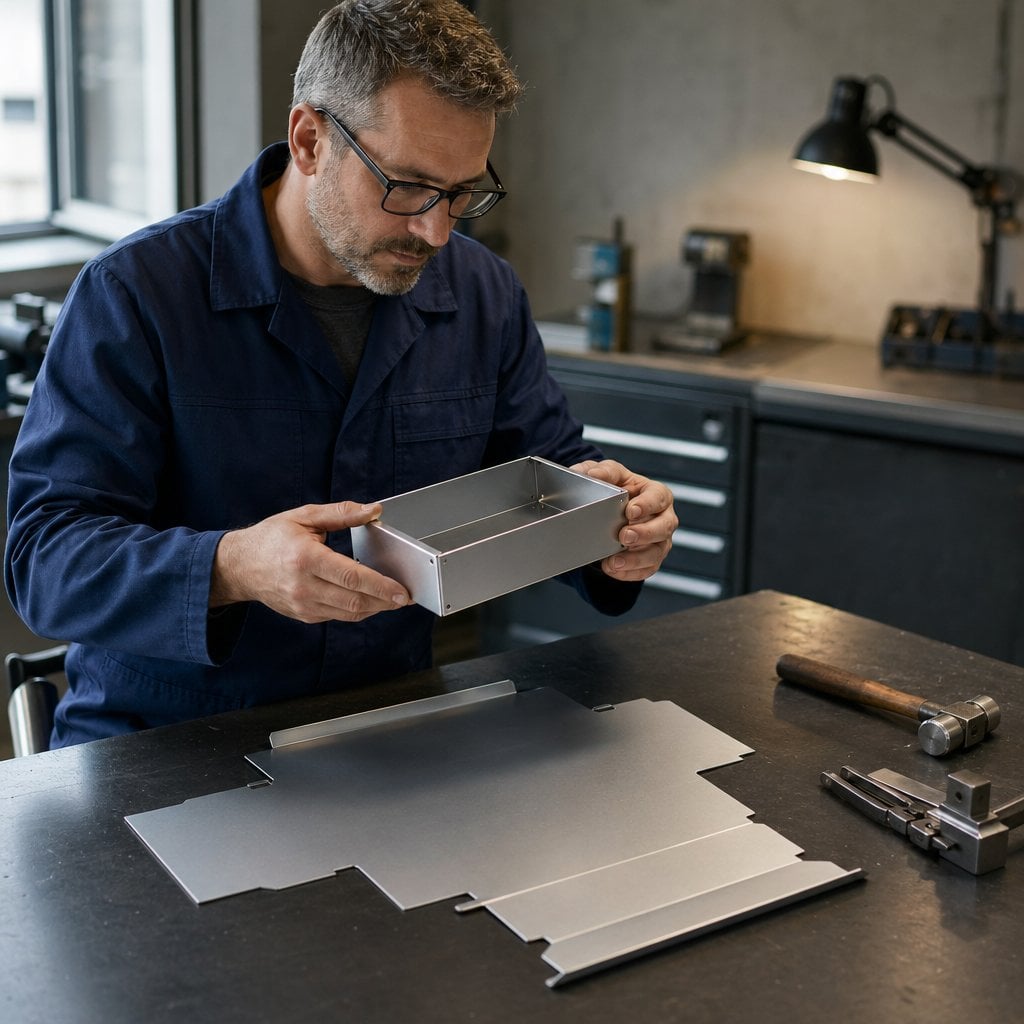
Sheet metal fabrication constructs durable frameworks by cutting, bending, and welding standardized materials. Processes like CNC punching and laser cutting shape large panels quickly, while press brakes form angles and channels with repeatable accuracy. Welding joins these components into rigid assemblies capable of handling high structural loads. Fabrication excels at producing enclosures, chassis, and frames in volumes that machining cannot economically match—scaling output is straightforward through additional tooling or extended shifts, without major process redesign. Because it works from flat stock, fabrication minimizes material waste compared to subtractive methods. The resulting structures are often oversized relative to final functional interfaces, deliberately leaving excess material for later refinement. This creates a stable foundation for precision work—establishing the natural handoff point between processes. Fabrication delivers the foundational mass and macro-geometry, but not the sub-thousandth-inch accuracy required for critical mating features.

Machining achieves tight tolerances and functional surface integrity
Machining removes material through controlled cutting to achieve specifications beyond fabrication’s reach—often ±0.0005 inches or better. Milling, turning, and drilling produce surfaces with predictable roughness (Ra) essential for sealing, bearing, or sliding contact. A machined bore aligns precisely with its mating shaft, eliminating play that would compromise performance; threaded holes accept fasteners without galling due to accurate pitch diameters and clean finishes. Crucially, machining corrects distortion introduced during welding—restoring flatness, parallelism, and positional accuracy. For example, a welded frame may receive CNC-machined mounting faces so attached equipment sits true within arc-second tolerances. By assigning fabrication to bulk forming and machining to precision finishing, manufacturers avoid overburdening either process. Their interplay becomes a deliberate, cost-effective strategy—not a competitive trade-off.
Hybrid Fabrication–Machining Workflows for Mission-Critical Assemblies
Aerospace case study: Welded frame + CNC-machined interfaces ensure load path continuity and fit accuracy
In aerospace structures, a welded frame provides exceptional strength and rigidity—but raw fabricated surfaces rarely meet the sub-thousandth-inch tolerances needed for mating components. When a primary load-bearing frame is welded, residual stresses and thermal distortion can shift mounting points, threatening load path continuity. Integrating CNC machining directly after welding allows engineers to restore critical interface geometries on the same part. For instance, a titanium engine-mount truss is first welded as a one-piece skeleton; then, the pads receiving landing-gear actuators are face-milled and drilled on a five-axis machining center. This sequential workflow ensures machined surfaces are exactly parallel and hole patterns positioned within ±0.001 inch—preserving straight-line load transfer from airframe to gear. The result is a monolithic assembly that avoids the weight and potential failure modes of bolted joints, while post-fabrication machining guarantees precise alignment under dynamic loads. One leading manufacturer reported this integrated approach eliminated 85% of the shimming and rework previously required to correct misaligned interfaces—slashing assembly time and improving first-pass yield.
Industry validation: 68% of Tier‑1 defense contractors report ≥32% rework reduction with integrated workflows (2023 AMT Survey)
The 2023 Association for Manufacturing Technology (AMT) survey of Tier-1 defense contractors found that 68% achieved at least a 32% reduction in rework after adopting integrated fabrication–machining workflows. This improvement stems from eliminating transportation delays and setup changes between separate shops. When a single work cell handles welding, stress relieving, and finish machining, distortions are corrected in real time—and inspection data feeds directly into the machining program. Teams catch deviations early, often within the same fixture, rather than discovering misalignment only at final assembly. The survey also showed integrated workflows cut average lead time by 22% and reduced scrap rates by 15%, confirming that combining fabrication and machining is a measurable driver of quality and efficiency—not just operational convenience.
A Feature-Based Decision Framework for Deploying Fabrication and Machining Together
Tier 1: Primary structure → fabrication (bending, welding, rolling)
Fabrication forms the structural backbone of any assembly by shaping large-scale components through bending, welding, and rolling. These processes create robust geometries that carry primary loads and define the product’s overall envelope. Welded frames and rolled cylinders provide the material continuity essential for strength and durability—but they inherently operate within wider tolerance bands. The guiding principle is reserving fabrication for features where dimensional variation of ±0.5 mm or greater remains functionally acceptable. This tier establishes macro-geometry and leaves generous stock at critical interfaces, enabling downstream precision without forcing costly, unnecessary accuracy early in the process.
Tier 2: Functional interfaces → machining (milling, turning, drilling)
Machining delivers the precision surfaces essential for mating, sealing, and motion control. Using milling, turning, and drilling, this tier achieves tolerances as tight as ±0.025 mm and surface finishes critical for fatigue resistance and fluid containment. It is applied exclusively where fabrication’s inherent variability would compromise function—bearing seats, flange faces, threaded holes, and alignment dowels. Rigid fixturing references the part’s primary structure accurately, ensuring GD&T compliance. By confining machining to functional interfaces, manufacturers maximize throughput and tool life—refining only what matters, not every square inch.
Tier 3: Assembly sequencing logic — why process order impacts GD&T compliance and inspection efficiency
Process sequence directly governs geometric accuracy and inspection efficiency. Machining critical interfaces before joining sub-assemblies risks thermal distortion from subsequent welding—pulling surfaces out of tolerance. A disciplined order—fabricate primary structures, stress-relieve as needed, machine functional interfaces, then perform final assembly—preserves dimensional integrity. This logic simplifies Coordinate Measuring Machine (CMM) workflows by isolating precision features for inspection after the part stabilizes.
| Process Sequence | GD&T Outcome | Inspection Impact |
|---|---|---|
| Machine before weld | Low compliance due to thermal distortion | Recurring, full-part re-inspections |
| Weld, stress-relieve, then machine | High compliance, stable reference datums | Streamlined, targeted feature checks |
Adopting a build-to-datums approach—not machining prematurely—reduces cumulative error and rework loops. Inspection plans align with manufacturing sequence, focusing on critical machined surfaces only after all forming operations are complete.
Cost and Time Benefits of Integrated Fabrication–Machining Processes
Combining fabrication and machining in a single, sequenced workflow eliminates the costly delays of multi-vendor coordination—transport between facilities, redundant inspections, and communication gaps inflate lead times and invite errors. Housing bending, welding, milling, and drilling under one operational roof compresses production cycles by up to 40% and significantly reduces rework. As confirmed by the 2023 AMT survey, 68% of Tier-1 defense contractors reported a ≥32% cut in rework after adopting integrated processes. Financially, near-net shaping cuts material waste, logistics costs fall, and faster time-to-market improves margins. Real-time feedback between fabrication technicians and CNC programmers also enables mid-process design refinements—avoiding scrap. This cohesive approach transforms the traditional build-to-print model into a lean, agile system that consistently meets tight tolerances—on budget and on schedule.
FAQ
What is the difference between fabrication and machining?
Fabrication involves forming robust structures using processes like cutting, bending, and welding, while machining achieves high precision and tight tolerances through controlled cutting.
Why are fabrication and machining considered complementary processes?
Fabrication provides the structural backbone, while machining refines functional surfaces for critical precision. Together, they balance scalability and accuracy without overburdening either process.
How do integrated workflows improve efficiency?
Integrated workflows eliminate time-consuming transportation between facilities, reduce rework by addressing issues in real-time, and streamline inspection processes by aligning sequences and data sharing within a single team.
What are some examples of hybrid fabrication-machining workflows?
In aerospace, welded frames are machined to restore alignment post-fabrication. For example, titanium engine-mount trusses are welded and then machined to precise tolerances for load path continuity.
How does process sequencing affect overall outcomes?
A disciplined sequence—fabrication first, then machining—ensures dimensional integrity, avoids distortions, and streamlines inspections, reducing errors and rework loops.
Table of Contents
- The Structural–Precision Divide: Why Fabrication and Machining Are Complementary, Not Competitive
- Hybrid Fabrication–Machining Workflows for Mission-Critical Assemblies
- A Feature-Based Decision Framework for Deploying Fabrication and Machining Together
- Cost and Time Benefits of Integrated Fabrication–Machining Processes
- FAQ