 Small batches, high standards. Our rapid prototyping service makes validation faster and easier —
  EN
EN


Automotive Metal Prototyping: A Guide to Faster Innovation
Automotive Metal Prototyping: A Guide to Faster Innovation

TL;DR
Rapid prototyping for automotive metal components leverages advanced technologies like CNC machining and Direct Metal Laser Sintering (DMLS) to quickly produce functional parts from materials such as aluminum and steel. This process is crucial for accelerating vehicle development by enabling swift design iteration, rigorous functional testing, and a significantly reduced time-to-market for new automotive innovations.
Understanding Metal Rapid Prototyping in the Automotive Sector
Metal rapid prototyping is a transformative approach that uses advanced manufacturing technologies to fabricate metal parts and components directly from 3D CAD data. Unlike traditional methods that often require weeks or months for tooling, rapid prototyping can produce a functional metal part in a matter of hours or days. These prototypes closely resemble the final product in material properties, functionality, and form, allowing for realistic evaluation and testing. The core principle is to build parts additively (layer by layer) or subtractively (carving from a solid block) in an automated fashion, streamlining the path from digital design to physical object.
In the highly competitive automotive industry, speed and precision are paramount. Rapid prototyping has become indispensable for modernizing vehicle design and compressing development timelines. Historically, creating metal prototype parts was a slow, labor-intensive process, ill-suited for the one-off designs needed for validation. Today, manufacturers can test new ideas for engine components, chassis parts, and structural elements with significantly lower financial and technical risk. According to an article by Xcentric Mold, this capability allows companies to verify new designs, conduct market research with physical models, and ensure component accuracy before committing to expensive mass production tooling.
The strategic importance of this technology lies in its ability to facilitate an iterative design process. Engineers can create a part, test its fit and function, identify flaws, and then quickly produce a revised version. This cycle, which might have taken months, can now be completed in a fraction of the time. This acceleration directly translates to a shorter time-to-market, allowing automotive brands to innovate faster and respond more effectively to consumer demands for safer, more efficient, and feature-rich vehicles.
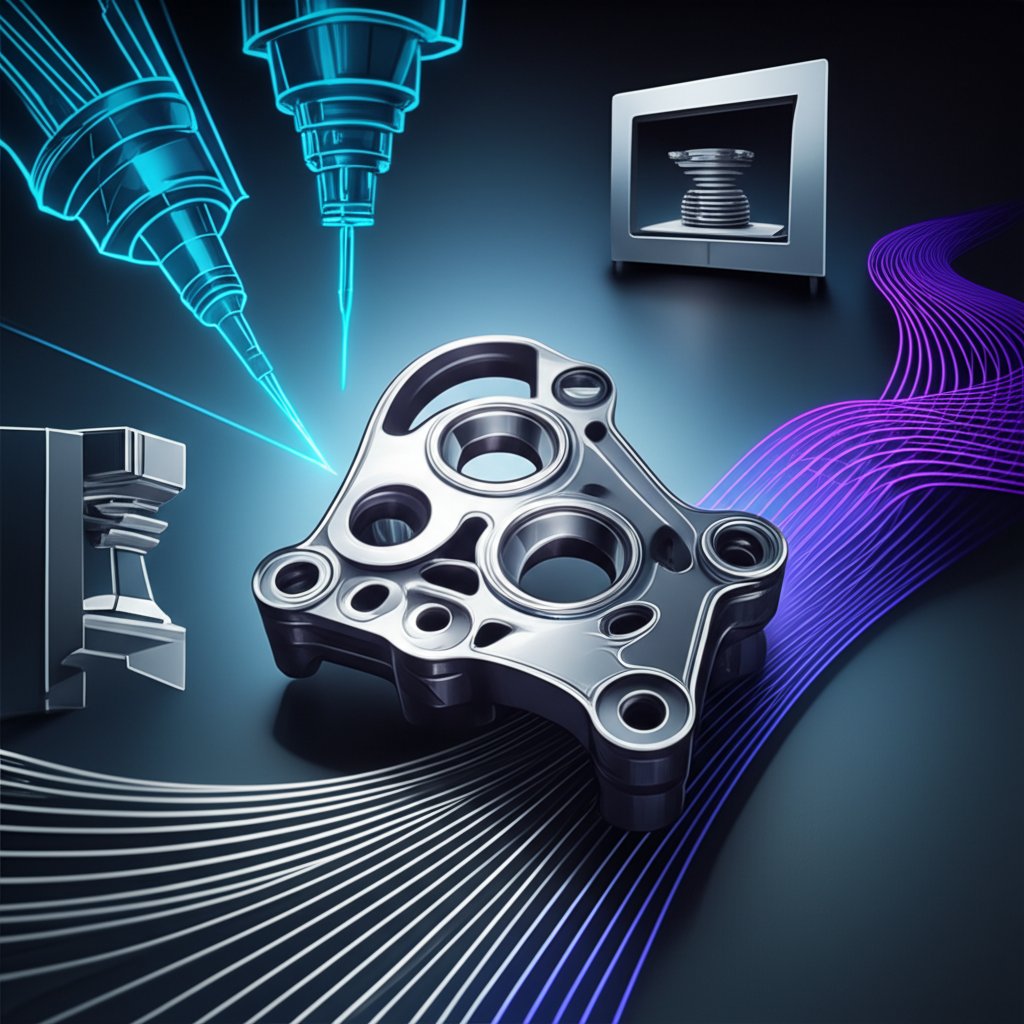
Key Technologies and Materials Driving Innovation
The effectiveness of rapid prototyping for automotive metal components hinges on a suite of sophisticated technologies and a selection of high-performance materials. Each technology offers distinct advantages in terms of speed, cost, precision, and material compatibility, allowing engineers to select the optimal process for their specific application.
Subtractive Manufacturing: CNC Machining
Computer Numerical Control (CNC) machining is a cornerstone of metal prototyping. It is a subtractive process that uses computer-controlled machinery to cut and shape a solid block of metal into a final part. As highlighted by Global Technology Ventures, CNC machining is ideal for producing parts with exacting tolerances and excellent surface finishes, which are critical for automotive applications. It is highly versatile and can be used with a wide range of metals, making it a go-to choice for functional prototypes that require the full strength and properties of the final production material.
Additive Manufacturing: Metal 3D Printing
Metal 3D printing, also known as additive manufacturing, builds parts layer by layer from metal powder. Technologies like Direct Metal Laser Sintering (DMLS) and Selective Laser Melting (SLM) use a powerful laser to fuse the powder into a solid object. This method excels at creating parts with complex internal geometries or intricate features that would be impossible to machine. While the initial cost can be higher, 3D printing offers unparalleled design freedom and is perfect for consolidating multiple components into a single, optimized part, reducing weight and assembly complexity.
Sheet Metal Fabrication
For components like brackets, enclosures, and body panels, sheet metal fabrication is a vital rapid prototyping technique. This process involves cutting, bending, and stamping metal sheets into the desired shape. Modern techniques often use laser cutting for high precision and speed, followed by forming operations. This approach is highly effective for creating durable, lightweight parts and testing the form and fit of structural components before investing in permanent stamping dies.
Common Materials Used
The choice of material is as critical as the technology. Automotive prototyping relies on metals that offer specific properties to mimic final production parts. Common choices include:
- Aluminum Alloys: Valued for their excellent strength-to-weight ratio, corrosion resistance, and thermal conductivity. As ARRK notes, aluminum is a dominant choice in the automotive sector for creating lightweight yet robust parts that improve fuel efficiency and safety.
- Steel and Stainless Steel: Chosen for their high strength, durability, and wear resistance. Stainless steel is often used for prototypes that must withstand harsh environments or require a high-quality finish.
- Titanium: Used for high-performance applications where extreme strength and heat resistance are required, such as in engine components or exhaust systems.
For projects demanding precision-engineered aluminum components, a specialized partner can be invaluable. For instance, Shaoyi Metal Technology provides a comprehensive service that includes rapid prototyping to accelerate validation, followed by full-scale production under a strict IATF 16949 certified quality system. Their focus on strong, lightweight, and customized parts makes them a relevant resource for automotive projects.
The 5-Step Rapid Prototyping Process from CAD to Component
The journey from a digital idea to a physical metal part follows a structured and highly automated workflow. While the specific technology may vary, the fundamental process remains consistent and is designed for maximum efficiency and accuracy. Understanding these steps helps demystify how complex automotive components are brought to life so quickly.
- CAD Modeling: The process begins with a detailed 3D model created using Computer-Aided Design (CAD) software. This digital blueprint contains all the geometric information, dimensions, and specifications necessary to manufacture the part. Engineers meticulously design the component to meet its functional and assembly requirements.
- CAD Conversion: The completed 3D CAD model is then converted into a file format that the prototyping machine can understand, most commonly the STL (Stereolithography) format. This format approximates the surfaces of the model using a mesh of triangles, creating a universal language for additive manufacturing, though subtractive processes generally require formats with more precise data, such as STEP.
- Slicing: For additive manufacturing processes like 3D printing, the STL file is fed into a slicer software. This program digitally cuts the model into hundreds or thousands of thin horizontal layers. It also generates the toolpaths the machine will follow to build each layer, including any necessary support structures to prevent the part from deforming during fabrication.
- Fabrication: This is the stage where the physical part is created. A CNC machine will follow its programmed toolpaths to cut material away from a block, while a 3D printer will build the part layer by layer by fusing metal powder. This step is almost entirely automated, running for hours or days without human intervention to produce the precise component.
- Post-Processing: Once the part is fabricated, it often requires some form of post-processing to be ready for use. This can include removing support structures, heat treatment to improve strength, surface finishing (like polishing or anodizing) for better aesthetics or performance, and final inspection to ensure it meets all specifications.
Critical Applications and Benefits in the Automotive Industry
Rapid prototyping for metal components has unlocked significant advantages for automotive manufacturers, fundamentally changing how vehicles are designed, tested, and brought to market. The ability to quickly create functional parts provides tangible benefits that impact the entire product development lifecycle.
The primary benefits of adopting this technology are clear and impactful. As detailed by First Mold, the process accelerates development cycles, enhances collaboration between design and engineering teams, and reduces costs by catching design flaws early. Key advantages include:
- Accelerated Development: Drastically reduces the time between concept and validation, allowing new vehicles and components to reach the market much faster.
- Cost Savings: Avoids the immense cost of creating production-level tooling for a design that has not been fully validated, minimizing the financial risk of errors.
- Improved Design Iteration: Enables engineers to test multiple design variations quickly, leading to more optimized, efficient, and innovative final products.
- Functional Testing: Produces parts from production-intent materials, allowing for rigorous real-world testing of mechanical performance, durability, and heat resistance.
In practice, these benefits translate into a wide range of applications across the vehicle. Metal prototypes are essential for validating engine components, where performance under high stress and temperature is critical. They are used to test structural parts of the chassis and frame, ensuring they meet safety and durability standards. Furthermore, rapid prototyping is used to create custom jigs, fixtures, and tools that improve the efficiency and accuracy of the assembly line itself. This versatility makes it an essential tool for pushing the boundaries of automotive engineering.
Ultimately, by enabling faster innovation and more thorough testing, rapid prototyping directly contributes to the development of safer, more reliable, and higher-performing vehicles. It empowers manufacturers to explore novel solutions to complex engineering challenges, from lightweighting for electric vehicles to developing more efficient internal combustion engine parts.

The Future of Automotive Component Development
The integration of rapid prototyping has firmly established a new standard for efficiency and innovation in the automotive industry. It is no longer just a tool for creating models but a strategic asset that drives competitive advantage. By bridging the gap between digital design and physical reality, these technologies empower engineers to build, test, and refine with unprecedented speed. The ability to hold a functional metal part just days after completing a design allows for more confident decision-making and a more robust final product.
As manufacturing technologies continue to advance, the role of rapid prototyping will only expand. We can expect to see faster production speeds, a wider array of available materials, and even greater precision. This evolution will further shorten development timelines and enable the creation of even more complex and optimized components. For an industry defined by constant innovation, the ability to rapidly transform ideas into tangible, testable parts is the key to engineering the vehicles of tomorrow.
Frequently Asked Questions
1. What is the application of rapid prototyping in the automotive industry?
In the automotive industry, rapid prototyping is used to create physical models of parts and components quickly from CAD data. Key applications include design verification, functional testing of engine and chassis parts, validating the fit of components before mass production, and creating custom tools and jigs for assembly lines. This process is essential for reducing development time, cutting costs, and improving the overall quality and innovation of vehicle designs.
2. What are the 5 steps of rapid prototyping?
The five common steps of rapid prototyping are: 1. CAD Modeling, where a 3D digital model is created; 2. CAD Conversion, where the model is converted to a machine-readable format like STL; 3. STL Model Slicing, where the model is digitally cut into layers for fabrication; 4. Model Fabrication, where the machine (e.g., a 3D printer or CNC mill) builds the physical part; and 5. Post-Processing, which includes cleaning, finishing, and inspecting the final component.
3. What are the three R's of rapid prototyping?
The three principles, or 'R's', of rapid prototyping are to develop a Rough model, do it Rapidly, and ensure it is for the Right problem. This framework emphasizes speed and iteration over initial perfection, focusing on quickly creating a tangible model that can be used to test a specific aspect of a design and gather feedback for improvement.