 Small batches, high standards. Our rapid prototyping service makes validation faster and easier —
  EN
EN

The Core Principles of Fixture Design for Repeatability
Applying the 3-2-1 Locating Principle to Eliminate Degrees of Freedom
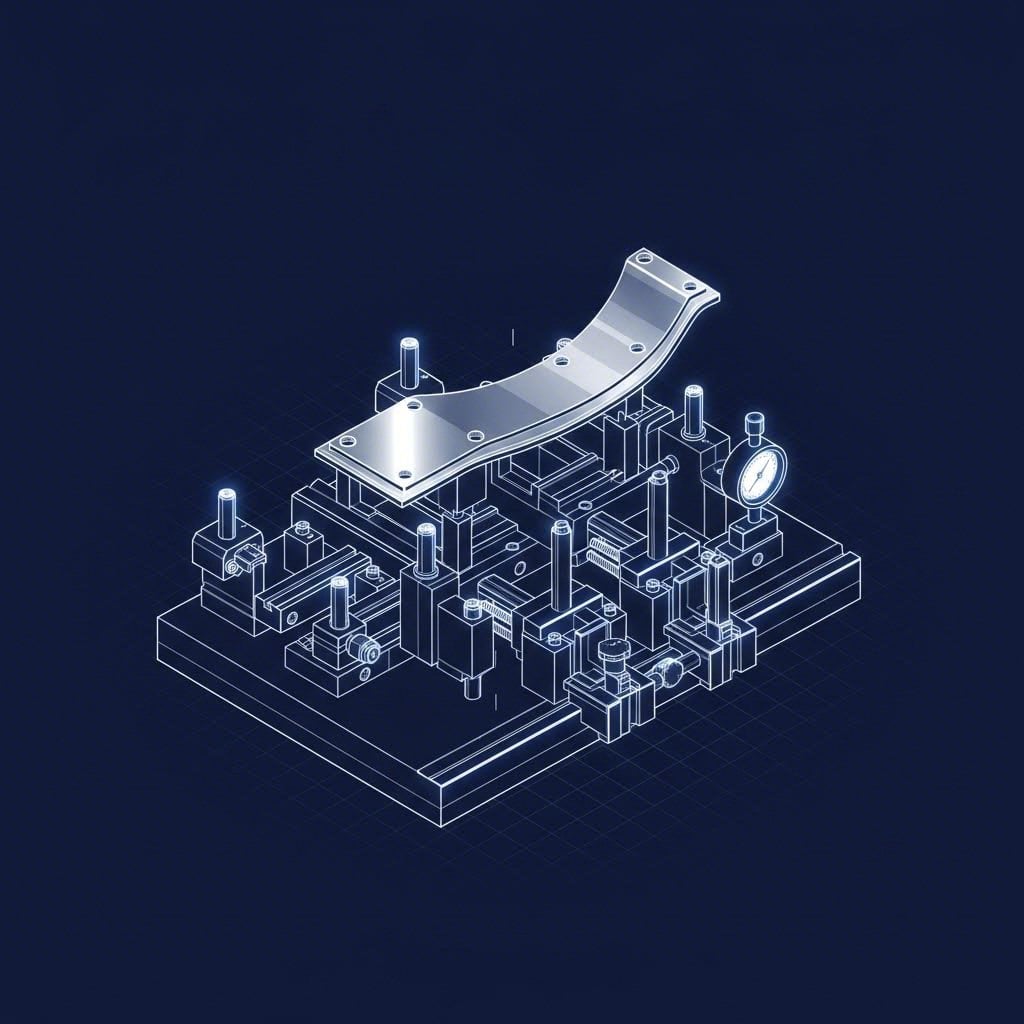
The 3-2-1 locating principle is foundational to repeatable fixture design: it constrains all six degrees of freedom—three translational and three rotational—by using three contact points on a primary datum plane, two on a secondary plane, and one on a tertiary plane. This configuration ensures stable, unambiguous part positioning without over-constraint, which could induce stress or distortion. Critically, it decouples location from clamping force—keeping datum integrity intact regardless of clamp load. When properly implemented, the 3-2-1 layout delivers consistent part-to-tool relationships across operators and shifts, forming the essential baseline for process capability. A 2022 manufacturing efficiency study found fixtures built to this standard reduced dimensional variability by 35% over 5,000 cycles compared to ad-hoc setups.
Clamping Strategy and Consistency: Preventing Part Shift Across Cycles
Even precise location fails without controlled, repeatable clamping. Effective clamping applies balanced, sequenced force directly over support points—minimizing micro-shift, lift-off, or deformation under machining loads. Misaligned or inconsistent clamp placement introduces localized stress that compromises repeatability, especially during high-force operations. Standardizing torque values and tightening sequence eliminates operator-dependent variation; a 2023 survey of high-volume machining facilities showed this simple discipline lowered scrap rates by 20% and improved Cp/Cpk by 0.2. Quick-change modular clamps further enhance consistency while preserving datum references across configurations. Equally important is designing for chip and coolant clearance—debris trapped between clamp and workpiece acts as a wedge, causing subtle repositioning over time. Treating clamping as a controlled process variable—not an afterthought—is key to eliminating cycle-to-cycle drift.
Material Selection and Thermal Management for Long-Term Dimensional Stability
Fixture materials govern long-term stability through their thermal expansion, wear resistance, and rigidity. Steel alloys offer high stiffness and durability but expand significantly with temperature changes; aluminum dissipates heat faster but exhibits greater thermal growth per degree Celsius. In environments with ambient or process-induced temperature swings exceeding 30°C, switching from standard steel to low-expansion alloys like Invar can reduce thermal elongation by up to 90%, according to a 2020 materials engineering benchmark. Surface hardening and wear-resistant coatings also mitigate micro-wear at locator and clamp interfaces—preventing gradual datum shift over thousands of cycles. Thoughtful material selection and thermal management ensure the fixture itself remains dimensionally stable, preserving the precision built into the 3-2-1 layout and clamping strategy throughout its service life.
How Fixture Design Directly Impacts Precision and Process Capability
Reducing Cp/Cpk Drift Over 10,000+ Cycles Through Robust Fixture Design
Process capability indices degrade predictably when fixture components wear or deform over time. A turning fixture may sustain a Cpk of 1.67 for the first 5,000 cycles—but just 0.02 mm of locator wear can drop that value below 1.33 by cycle 10,000. That decline translates directly into non-conformance: Manufacturing Metrics (2022) estimates such drift can cost a single production line up to $150,000 annually in scrap and rework. Proactive design mitigates this risk—hardened steel contact surfaces, hardened dowel pins, and wear-resistant bushings are not cost premiums; they’re investments in sustained capability. These features preserve locator geometry and clamp alignment, ensuring the fixture continues to deliver the same positional fidelity cycle after cycle.
When Over-Engineering Undermines ROI: Balancing Rigidity, Cost, and Maintainability
Maximizing rigidity at the expense of practicality often backfires. Over-engineered fixtures—monolithic, excessively heavy, or over-specified—slow changeovers, inflate costs, and complicate maintenance. They may require specialized lifting equipment, extend setup times, and make component replacement impractical. The result is not better precision, but lower throughput and higher total cost of ownership. Finite Element Analysis (FEA) offers a smarter path: strategically reinforcing low-stress zones with lightweight ribs achieves required stiffness without unnecessary mass. This optimized approach supports both precision and agility—ensuring the fixture enhances, rather than hinders, production flow. The table below highlights the trade-offs:
| Factor | Over-Engineered Fixture (Excessive Rigidity) | Balanced Fixture (Optimized Design) |
|---|---|---|
| Initial Cost | Very High | Moderate |
| Changeover Speed | Slow; requires heavy equipment | Fast; manual or quick-change capable |
| Component Serviceability | Difficult; entire assembly often replaced | Easy; individual worn elements replaced |
| Process Efficiency | Low; acts as a production bottleneck | High; enables smooth workflow |
Optimizing Fixture Design for Production Efficiency and Scalability
Modular, Quick-Change Fixtures That Cut Setup Time by 40–60%
In high-mix, low-volume environments, setup speed defines competitiveness. Modular fixtures replace fixed, single-purpose tooling with standardized, interchangeable components—baseplates, locators, clamps, and interface plates—that assemble rapidly using zero-point clamping systems and common datum features. This eliminates repeated manual alignment and bolting for each new job. A 2023 manufacturing agility survey confirmed these systems consistently reduce changeover time by 40–60%, unlocking machine capacity and enabling one workstation to serve multiple part families without extended idle periods. Interchangeable component libraries amplify efficiency: operators swap only the pads or clamps needed for a new geometry while retaining the calibrated baseplate on the machine table—preserving proven datum offsets and avoiding the drift common in rebuild-from-scratch setups. Scalability follows naturally: additional pallets or stations integrate seamlessly into the same modular framework, requiring no line-wide re-engineering. Because the 3-2-1 principle and repeatable clamping forces are engineered into the module interfaces themselves, speed never compromises precision. Well-executed modularity transforms fixture changeover from a logistical burden into a strategic advantage—enabling manufacturers to scale output while holding tight tolerances across thousands of cycles.
FAQ
Q: What is the 3-2-1 locating principle in fixture design?
A: The 3-2-1 locating principle constrains all six degrees of freedom (three translational and three rotational) using three contact points on a primary datum plane, two points on a secondary plane, and one on a tertiary plane. This ensures stable and repeatable part positioning without inducing stress or distortion.
Q: How does clamping strategy affect repeatability in fixture design?
A: Effective clamping minimizes micro-shift and deformation by applying balanced, sequenced force directly over support points. Consistency in clamping through standardized torque values and tightening sequence eliminates operator-dependent variation, ensuring repeatability across machining cycles.
Q: Why is material selection important in fixture design?
A: Material selection impacts long-term stability by governing thermal expansion, wear resistance, and rigidity. For example, low-expansion alloys like Invar can reduce thermal elongation under significant temperature swings, while wear-resistant coatings prevent gradual datum shift.
Q: What are the trade-offs of over-engineering a fixture?
A: Over-engineering a fixture can increase costs, slow changeovers, and complicate maintenance. Optimized designs balance rigidity, cost, and maintainability, ensuring fixtures boost production efficiency without becoming bottlenecks.
Q: How do modular fixtures improve production efficiency?
A: Modular fixtures standardize interchangeable components, enabling quick setup changes for different jobs. They reduce changeover time by 40–60%, maintain datum offsets, and support scalability without compromising precision.