 Small batches, high standards. Our rapid prototyping service makes validation faster and easier —
  EN
EN

Core Sheet Metal Forming Processes and How They Work
Bending, Punching, and Stamping Explained
Bending, punching, and stamping are foundational sheet metal forming techniques used to create precise, repeatable components. Bending deforms metal along a straight axis—typically using a press brake—to produce angles or curves without thinning the material. Punching creates holes or cutouts by driving a punch through the sheet into a matching die, enabling high-speed production of enclosures, brackets, and panels. Stamping is a broader category that includes drawing, embossing, and coining, where the entire sheet is shaped between two dies under controlled pressure. All three processes depend on accurate tool alignment, appropriate material selection, and proper lubrication to prevent defects such as tearing, wrinkling, or springback—ensuring tight tolerances and consistency in high-volume manufacturing.
Advanced Techniques: Roll Forming and Hydroforming
For complex geometries and extended parts, advanced methods like roll forming and hydroforming offer compelling alternatives to conventional stamping. Roll forming continuously bends a metal strip through successive pairs of rotating rollers to produce long, uniform profiles—such as structural rails or architectural trim—with minimal scrap and excellent dimensional stability. It’s widely used for automotive frame members and building cladding. Hydroforming uses high-pressure fluid (typically water or oil) to expand a sheet or tube blank into a die cavity, yielding intricate, near-net-shape parts with superior strength-to-weight ratios and smooth surface finishes. This technique is especially valuable in aerospace and premium automotive applications—for fuel tanks, suspension components, and chassis subframes—where weight reduction and structural integrity are critical. Both processes reduce secondary operations and support lightweight, integrated designs that would be impractical or cost-prohibitive with traditional methods.
Material Selection and Design Considerations for Sheet Metal Forming
Common Alloys (Steel, Aluminum, Stainless Steel) and Their Formability
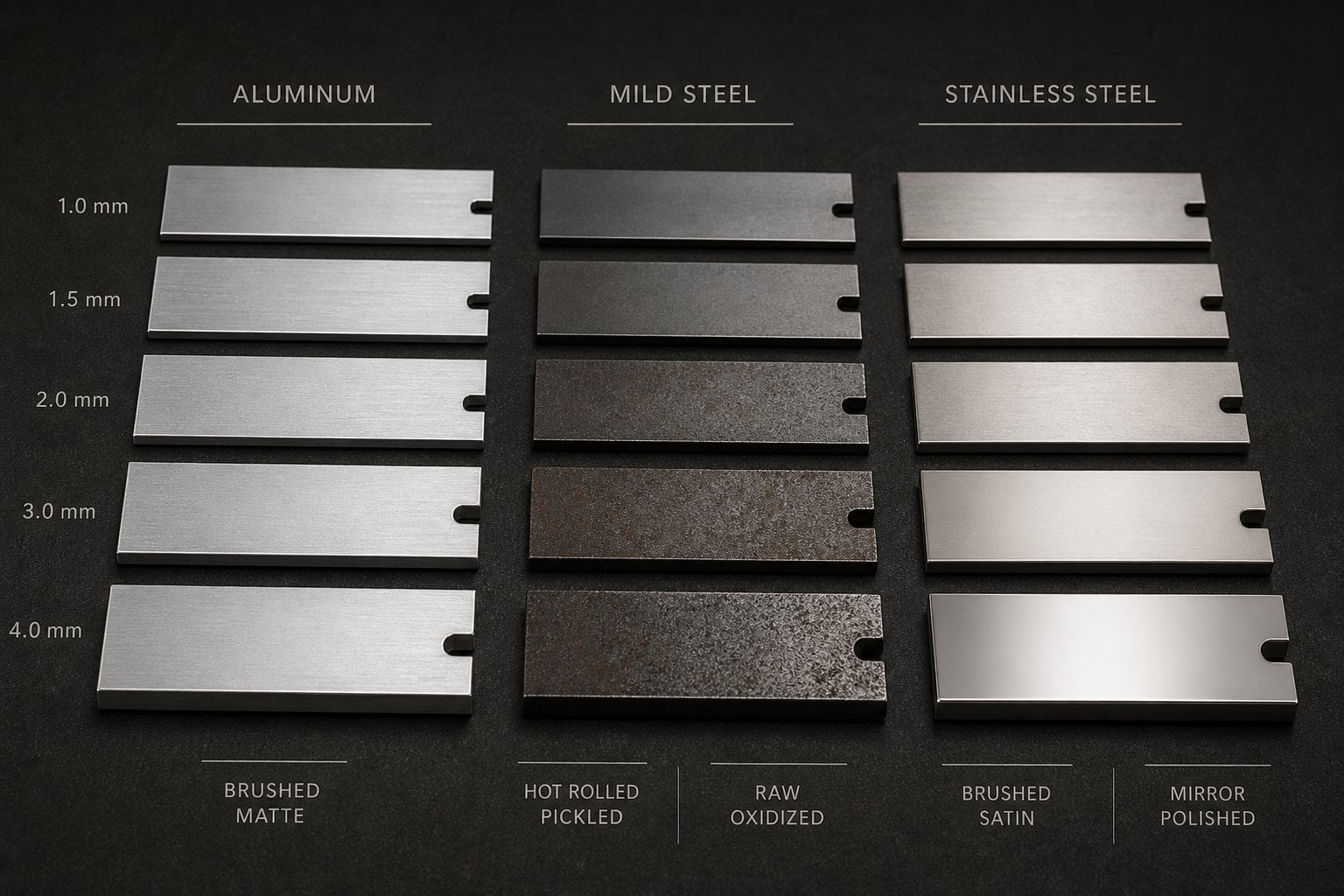
Material choice directly governs formability, part performance, and production efficiency. Carbon steel (e.g., 1010 or 1020 grades) delivers high ductility—elongation typically exceeds 30%—and remains the most cost-effective option for deep drawing and complex bending. Aluminum alloys like 3003 and 5052 provide excellent corrosion resistance and low density, making them ideal for aerospace and thermal management applications; however, their lower yield strength requires careful control of forming pressures and tool clearances. Stainless steels (304, 316) combine high strength with outstanding corrosion resistance but exhibit greater springback, necessitating compensated tooling and tighter process controls. Elongation remains the strongest predictor of formability across all three families:
| Material | Elongation % | Key Properties | Primary Use Cases |
|---|---|---|---|
| Carbon Steel | 30–45% | High ductility, cost-effective | Automotive frames, enclosures |
| Aluminum Alloys | 12–37% | Lightweight, corrosion resistant | Aerospace panels, heat sinks |
| Stainless Steel | 35–60% | Corrosion resistance, high strength | Medical equipment, marine hardware |
Key Design Rules: Bend Radii, Hole Placement, and Tolerance Management
Effective sheet metal design balances manufacturability with functional requirements. Minimum bend radii should exceed material thickness—generally 1× thickness for aluminum and 1.5× for stainless steel—to avoid cracking or excessive thinning. Holes must be placed at least twice the hole diameter from edges or bends to prevent distortion during forming. For precision-critical applications—such as electronics enclosures or medical device housings—Geometric Dimensioning and Tolerancing (GD&T) ensures consistent interpretation of specifications, with typical tolerances held to ±0.005 inches. Integrating finite element analysis (FEA) early in design validates formability and predicts springback behavior, reducing physical trial runs by up to 65% and accelerating time-to-production.
Quality Control and Common Defects in Sheet Metal Forming
Identifying Cracking, Springback, and Surface Imperfections
Three defects dominate quality concerns in sheet metal forming: cracking, springback, and surface imperfections. Cracking arises from localized tensile stress exceeding material ductility—especially in high-strength steels or when bend radii fall below minimum thresholds. Springback—the elastic recovery after forming—leads to angular or dimensional deviations that compromise assembly fit. Surface flaws—including burrs above 0.1 mm, scratches, or die marks—often stem from worn tooling, improper clearance, or inadequate lubrication. Crucially, variability between incoming coil lots can amplify all three issues, underscoring the need for rigorous incoming material inspection before production begins.
Preventive Measures and In-Process Inspection Strategies
Robust defect prevention starts upstream: qualifying incoming material via bend testing and tensile analysis identifies potential formability risks before tooling engagement. Maintaining optimal punch-to-die clearance—typically 5–10% per side depending on material and thickness—minimizes burr formation and tool wear. In-process inspection using calibrated go/no-go gauges, optical comparators, and structured-light scanning detects springback trends and surface anomalies in real time. When paired with statistical process control (SPC), these checks enable predictive adjustments—such as compensating press tonnage or adjusting hold-down force—keeping output within aerospace-grade tolerances (e.g., AS9100) and automotive standards (e.g., IATF 16949). This integrated approach reduces scrap rates by up to 40% while ensuring first-pass yield across diverse production volumes.
Industry Applications and Real-World Advantages of Sheet Metal Forming
Automotive, Aerospace, and Electronics Use Cases
Sheet metal forming underpins mission-critical components across high-performance industries. Automakers rely on it for body-in-white structures, crash-absorbing crumple zones, and battery enclosures—balancing strength, weight, and crashworthiness. In aerospace, it produces fuselage skins, wing ribs, and engine nacelles that meet stringent fatigue and thermal expansion requirements—often using titanium or specialty aluminum alloys processed with hydroforming or precision stamping. The electronics industry depends on it for EMI-shielded enclosures, custom heatsinks, and mounting brackets requiring fine features, tight flatness, and electrical continuity. Across sectors, the process delivers unmatched repeatability, scalability, and integration of functional features—from embossed stiffeners to tapped holes—without compromising structural integrity.
Cost Efficiency, Scalability, and Rapid Prototyping Benefits
Beyond technical capability, sheet metal forming excels in economic flexibility. Unlike casting or forging, it supports both low-volume prototyping and mass production with minimal retooling—enabling design iterations without prohibitive lead times or capital investment. Modern CNC press brakes and servo-driven stamping lines allow functional prototypes to be fabricated in days rather than weeks, accelerating design validation and customer feedback loops. Per-unit costs decline significantly with volume due to efficient material utilization and automation-friendly workflows. Combined with high recyclability—over 90% of sheet metal scrap is recovered and reused—the process aligns with sustainability goals while delivering strong ROI across startups, contract manufacturers, and Tier 1 suppliers.
Frequently Asked Questions
What is the difference between stamping and punching in sheet metal forming?
Stamping involves shaping the entire sheet between two dies, while punching specifically creates holes or cutouts in a sheet using a punch and die.
Which materials are best suited for roll forming?
Materials with good ductility and uniform thickness like steel and aluminum are well-suited for roll forming due to their ability to maintain dimensional stability during continuous bending.
Why is springback a concern in sheet metal forming?
Springback can lead to angular or dimensional deviations after forming, potentially compromising assembly fit and requiring precise tooling compensation.
How can surface imperfections in sheet metal forming be avoided?
Surface imperfections can be minimized by using properly maintained tooling, ensuring accurate punch-to-die clearance, and applying adequate lubrication.
What industries benefit the most from hydroforming?
Hydroforming is particularly valuable in aerospace and premium automotive applications where lightweight yet strong parts with intricate details are required.