 Small batches, high standards. Our rapid prototyping service makes validation faster and easier —
  EN
EN


Rapid CNC Machine Secrets: Cut Lead Times Without Cutting Corners
What Rapid CNC Machining Actually Means
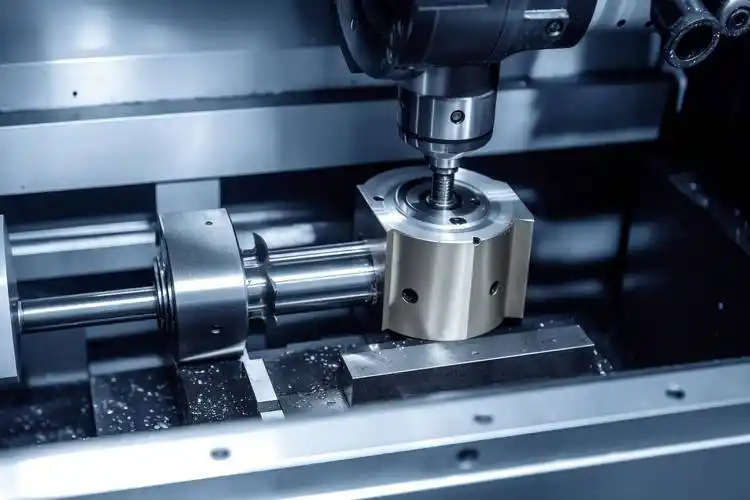
When your design deadline is next week and traditional machine shops are quoting three-week lead times, what do you do? This is exactly where rapid CNC machining changes the game. Unlike conventional manufacturing workflows that follow predictable but slow schedules, a rapid CNC machine operates within accelerated production frameworks designed to compress timelines dramatically.
Rapid CNC machining is the process of producing precision-machined parts with significantly shortened timelines—typically within hours to a few business days—rather than the weeks required by traditional CNC manufacturing workflows.
What Makes CNC Machining Rapid
The distinction between rapid machining and standard CNC processes isn't about cutting corners on quality. It's about eliminating inefficiencies throughout the entire manufacturing chain. Traditional machine shops often spend days on quoting alone, followed by scheduling delays as jobs wait for machine availability. Rapid CNC providers restructure these workflows entirely.
Think of it this way: a conventional shop might take 10 days to deliver parts, with much of that time consumed by administrative processes rather than actual machining. Rapid CNC operations leverage AI-assisted quoting, instant design-for-manufacturability feedback, and streamlined logistics to deliver the same parts in as little as 2-4 days.
Defining Speed in Precision Manufacturing
Speed without precision is worthless in manufacturing. What makes rapid CNC truly valuable is maintaining accuracy, repeatability, and quality standards while accelerating production. This balance requires efficient precision machining & custom solutions that don't sacrifice tolerances for turnaround time.
The technology behind this speed includes:
- Advanced CAM software that reduces programming time
- Easily programmed or automated CNC machines
- AI-powered quoting and logistics systems
- Highly skilled machinists who understand rapid workflows
The Turnaround Time Threshold
So what exactly qualifies as "rapid"? Here's what the industry benchmarks actually look like:
- 24-hour express: Ideal machining for urgent MRO parts, line-down emergencies, or critical medical device components
- 48-hour standard rapid: The sweet spot for cnc prototyping and quick-turn custom parts—many providers deliver 95% of orders within this window
- 3-5 business days: Considered rapid for complex geometries or specialty materials that require additional setup
- One week or less: The outer boundary of rapid CNC—anything beyond typically falls into traditional machining territory
Understanding these thresholds helps you set realistic expectations when sourcing parts. A project requiring tight design iterations benefits enormously from rapid cnc capabilities, giving you more cycles to refine your design before final production deadlines hit.
How Rapid Turnaround Is Actually Achieved
You now understand what makes CNC machining "rapid"—but how do manufacturers actually deliver parts in days instead of weeks? The answer lies in a combination of workflow optimizations, strategic technology investments, and process efficiencies that most shops simply don't implement. Let's pull back the curtain on what separates rapid CNC prototyping operations from traditional machine shops.
Workflow Optimizations Behind Fast Turnaround
Speed starts long before a spindle ever turns. Traditional CNC shops often lose days in pre-production phases—manual quote generation, back-and-forth design reviews, and scheduling bottlenecks that stack up quickly. Rapid CNC providers attack these inefficiencies systematically.
Consider the quoting process. When you submit a CAD file to obtain a cnc quote online, advanced platforms analyze geometry automatically using AI-driven algorithms. These systems instantly identify features, calculate machining time, flag potential manufacturability issues, and generate pricing—all within minutes. Compare this to traditional shops where a machinist manually reviews drawings, consults with estimators, and returns quotes days later.
Beyond quoting, workflow optimization includes:
- Parallel processing: Multiple operations happen simultaneously—while one part is machining, the next job's toolpath is being generated and raw material is being staged
- Digital job tracking: Real-time visibility into every production stage eliminates communication delays and keeps projects moving
- Standardized fixturing systems: Modular workholding solutions reduce setup time from hours to minutes between jobs
- Integrated quality checks: In-process inspection catches issues immediately rather than after completing an entire batch
The cumulative effect is dramatic. What takes a conventional shop 10 days often compresses to 2-3 days when these workflow efficiencies work together.
Technology Investments That Enable Speed
Rapid turnaround requires serious technology investment—both in hardware and software. Modern online cnc machining services leverage CAM automation that would have seemed like science fiction a decade ago.
Toolpath optimization represents perhaps the biggest time-saver. According to research published in Machines journal, proper toolpath strategy selection can reduce machining time by 12% or more—and that's before applying advanced G-code optimization. The study demonstrated that combining optimized toolpath strategies with G-code refinement reduced one project's completion time from over 20 minutes to just 13 minutes and 33 seconds.
Key technology investments include:
- Advanced CAM software integration: Platforms like Autodesk PowerMill and hyperMILL can reduce programming time by 60-80% through automated feature recognition and knowledge-based machining
- High-RPM spindles: Machines running at 15,000-40,000 RPM dramatically reduce cycle times for aluminum and other soft metals by allowing faster feed rates while maintaining surface finish
- Multi-axis simultaneous machining: 5-axis machines complete complex parts in single setups, eliminating multiple fixturing operations
- Automated material handling: Robotic part loading keeps machines running during breaks and shift changes
The spindle speed consideration deserves special attention. Higher RPM capabilities directly impact cycle times because they allow proportionally higher feed rates. A machine running at 20,000 RPM can theoretically move material twice as fast as one limited to 10,000 RPM—assuming the tooling and workpiece material support it. This is why cnc machining services mw+ often invest heavily in high-speed machining centers for aluminum and engineering plastics.
From Quote to Finished Part
Imagine you need a batch of cnc rapid prototyping parts for a product review next week. Here's how the accelerated workflow typically unfolds:
| Stage | Traditional Shop | Rapid CNC Provider |
|---|---|---|
| Quote Generation | 24-72 hours | Minutes to hours |
| Design Review | 1-2 days | Automated DFM feedback instantly |
| Scheduling | Waits in queue | Prioritized rapid slots |
| Programming | 4-8 hours manually | 1-2 hours with automation |
| Setup | 1-3 hours per operation | 30-60 minutes with modular fixturing |
| Machining | Similar actual cut time | Optimized toolpaths reduce cycles |
| Inspection | Post-production batch | In-process verification |
The actual cutting time—the period when tools engage material—often represents less than 20% of total project duration. This explains why online cnc machine services focus so heavily on optimizing everything around the machining itself. When you compress quoting from days to minutes, programming from hours to under an hour, and setup from hours to under an hour, those savings compound into dramatically shorter total lead times.
Understanding these behind-the-scenes optimizations helps you evaluate rapid CNC partners more effectively. A shop claiming fast turnaround but still requiring manual quotes and phone-tag scheduling probably isn't structured for true rapid delivery. The infrastructure for speed must be built into every stage of the process.
Machine Configurations for Different Rapid Applications
Now that you understand how rapid CNC providers compress timelines through workflow optimization, there's another critical factor that determines whether your parts can be delivered quickly: the machine configuration itself. Not every cnc machine part requires the same level of complexity—and choosing the right axis configuration can mean the difference between a 2-day turnaround and a 2-week project.
Sounds technical? It doesn't have to be. Think of machine axes like degrees of freedom—the more axes a machine has, the more directions it can approach your part from without stopping to reposition. Let's break down exactly what this means for your rapid prototyping projects.
Understanding Machine Axis Configurations
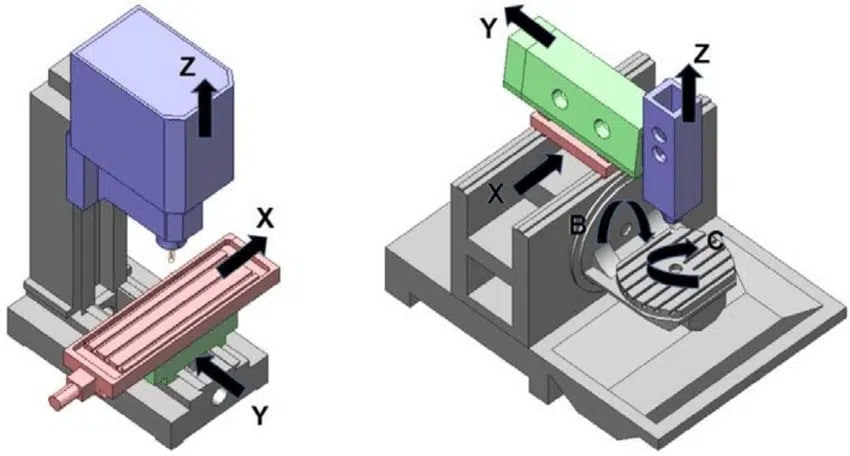
Every CNC machine operates along defined axes of motion. The simplest machines move cutting tools in three linear directions, while more advanced configurations add rotational capabilities that unlock complex geometries.
3-Axis Machines: The workpiece stays fixed while the spindle moves along X, Y, and Z linear directions. This is the most common and cost-effective configuration. According to CloudNC's machining experts, 3-axis machines excel at 2D and 2.5D geometries—think flat surfaces, drilled holes, and stepped features. The limitation? You can only machine one face per setup. Need features on all six sides? That's six separate setups, each adding time and potential tolerance stack-up.
4-Axis Machines: These add an A-axis rotation (around the X-axis), allowing the workpiece to rotate during or between operations. This single addition dramatically expands what's achievable in one setup. Four sides of a part become accessible without manual repositioning, which directly impacts rapid turnaround times.
The real power of 4-axis comes in two flavors:
- Indexed 4-axis: The part rotates to a new position, locks in place, then machining continues—ideal for features at fixed angles
- Continuous 4-axis: The axis rotates while cutting occurs simultaneously, enabling helical features and complex cam profiles
3+2 Axis Machines: Often confused with true 5-axis, 3+2 (or positional 5-axis) machines can orient the workpiece to any compound angle using two rotational axes—but those axes lock during cutting. This means you get access to virtually any surface angle, but without the simultaneous motion of full 5-axis machining. For many cnc milled parts, this configuration offers the best balance of capability and cost.
5-Axis Simultaneous: The most advanced common configuration. Both rotational axes move continuously while the three linear axes cut, allowing the tool to maintain optimal orientation throughout complex surface machining. According to MakerVerse, this capability is essential for intricate details and complex surfaces where continuous cutting of irregular shapes is required.
Matching Complexity to Capability
Here's where prototype cnc machining decisions get practical. You don't always need the most capable machine—and using one unnecessarily can actually slow your project down while increasing costs.
Consider a simple aluminum bracket with holes and slots on one face. A 3-axis machine handles this perfectly in a single setup. Sending it to a 5-axis cell might mean waiting for machine availability when a simpler machine could start cutting immediately.
Conversely, a turbine blade with compound-curved surfaces and features at multiple angles would be nearly impossible on a 3-axis machine. The dozens of setups required would extend lead times dramatically and introduce tolerance errors as the part is repositioned repeatedly.
| Axis Type | Geometric Capability | Typical Applications | Setup Complexity | Rapid Prototyping Suitability |
|---|---|---|---|---|
| 3-Axis | Flat surfaces, 2D/2.5D features, straight holes, pockets | Brackets, plates, simple housings, jigs | Low—one setup per face | Excellent for simple parts; fastest turnaround for appropriate geometries |
| 4-Axis | Cylindrical features, helixes, angled features around one rotation axis | Cam lobes, shafts, rotary components, multi-sided enclosures | Moderate—single setup accesses 4 faces | Very good; reduces setups significantly for cylindrical or rotational parts |
| 3+2 Axis | Compound angles, undercuts at fixed orientations, tilted features | Aerospace brackets, medical implants, complex housings | Moderate—orientation changes between cuts | Good for complex parts; balances capability with machine availability |
| 5-Axis Simultaneous | Freeform surfaces, continuous contours, turbine blades, impellers | Aerospace components, mold tooling, prosthetics, automotive dies | High—requires advanced programming | Essential for complex geometries; may have longer queue times |
For precision cnc machining services focused on rapid delivery, machine selection often comes down to this question: what's the simplest configuration that achieves the required geometry? Simpler machines typically have shorter queues and faster setup times. Complex machining services reserve 5-axis capacity for parts that genuinely require it.
When 5-Axis Becomes Necessary
So when should you specifically request cnc prototype machining on a 5-axis machine? There are clear indicators:
- Deep cavities with angled walls: When a standard tool can't reach without collision, 5-axis tilting provides access
- Compound angle features: Any surface that's angled relative to two axes simultaneously—3-axis and 4-axis machines simply cannot produce these without multiple setups
- Continuous sculptured surfaces: Aerodynamic profiles, organic shapes, and freeform contours require the tool to constantly adjust its orientation
- Tight tolerance multi-face features: When features on different faces must align within microns, single-setup 5-axis machining eliminates repositioning error
- Undercuts at odd angles: While some undercuts are achievable with specialty tools on simpler machines, complex undercut geometries often demand 5-axis access
There's also a practical consideration many engineers overlook: surface finish. According to CloudNC's analysis, 5-axis simultaneous machining allows the cutter to maintain optimal engagement angles throughout the cut, producing smoother surfaces that often require less post-processing—which directly supports faster overall delivery.
The bottom line for rapid prototyping? Match your part complexity to the appropriate machine configuration. Simple parts on simple machines get the fastest turnaround. Reserve 5-axis capacity for parts that genuinely demand it, and you'll avoid unnecessary queue delays while still achieving the precision your design requires.
Material Selection for Rapid CNC Projects
You've selected the right machine configuration for your geometry—but here's a factor that impacts turnaround time just as dramatically: your material choice. The difference between aluminum and stainless steel isn't just about mechanical properties. It's about machining speed, tool wear rates, and whether your rapid CNC provider has raw stock sitting on the shelf or needs to order it.
Let's explore how material selection directly affects your project timeline—and which choices give you the fastest path from CAD file to finished custom machined parts.
Metal Selection for Fast Turnaround
When speed matters, not all metals are created equal. Machinability—how easily a material can be cut while maintaining good surface finish and dimensional accuracy—varies enormously across common engineering metals.
According to JLCCNC's comparative analysis, machinability is often represented as an index relative to free-machining steel at 100. Here's how popular metals stack up:
- Aluminum 6061: Machinability index of approximately 270—nearly three times easier to cut than baseline steel. This translates directly to faster cycle times, longer tool life, and lower costs. Custom aluminum machining is the default choice for rapid prototyping when strength requirements permit.
- Brass: Excellent machinability around 300+. Chips break cleanly, surface finishes come easily, and tools last longer. Ideal for functional prototypes and aesthetic components in small batches.
- Stainless Steel 304/316: Machinability drops to roughly 45-50. Tool wear accelerates significantly, cutting speeds must slow down, and specialized coolant strategies become necessary. Expect 2-3x longer cycle times compared to aluminum.
- Titanium: Machinability around 22. This material demands slow feeds, rigid setups, and frequent tool changes. While essential for aerospace and medical applications, titanium parts rarely fit true "rapid" timelines without significant cost premiums.
For metal parts machining projects with aggressive deadlines, the practical hierarchy is clear: aluminum and brass enable genuinely rapid turnaround. Stainless steel cnc machining services can still achieve compressed timelines, but expect lead times 30-50% longer than equivalent aluminum work. Titanium sits in a separate category altogether—high performance, but high difficulty.
Here's a key insight from production reality: for small-batch production or prototyping, aluminum and brass reduce risk due to shorter machine times and easier setups. If your application doesn't specifically require stainless steel's corrosion resistance or titanium's strength-to-weight ratio, choosing an easier-to-machine material is the fastest path forward.
Engineering Plastics in Rapid CNC
Metals aren't the only game in town. Engineering plastics offer unique advantages for rapid prototyping—lighter weight, no corrosion concerns, and often faster machining than metals. But plastic selection requires understanding each material's quirks.
CNC plastic machining services commonly work with three categories:
- Delrin (POM/Acetal): The workhorse of plastic machining parts. Delrin machines beautifully at cutting speeds of 250-500 m/min with clean chip formation and minimal tool wear. According to TiRapid's material comparison, Delrin delivers excellent dimensional stability (±0.02 mm tolerance control), low friction, and costs around $5-15/kg. It's ideal for gears, sliders, bushings, and precision components where moderate strength suffices.
- PEEK (Polyetheretherketone): The high-performance option. PEEK handles continuous temperatures up to 260°C, resists virtually all chemicals, and offers biocompatibility for medical applications. The trade-off? Material costs of $90-400/kg, mandatory diamond or ceramic tooling, and cutting speeds limited to 100-200 m/min. PEEK projects require careful planning but deliver unmatched performance.
- Nylon (PA6/PA66): Good all-around properties with moderate cost. However, nylon's higher moisture absorption (around 2-3%) can cause dimensional changes in humid environments—something to consider for precision applications.
The choice between Delrin and PEEK often comes down to operating environment. Room-temperature applications with moderate loads? Delrin offers faster machining and dramatically lower material costs. High-temperature, chemically aggressive, or medical-grade requirements? PEEK justifies its premium through irreplaceable performance.
Material Availability and Lead Time Impact
Here's what many engineers overlook when requesting quotes: material availability can add days to your timeline before any chips even fly.
Common materials like aluminum 6061, brass, and Delrin typically sit in stock at most aluminum cnc service providers. Standard sheet and rod dimensions ship same-day from distributors. But specialty alloys, exotic grades, and less common plastics? You might wait a week just for material delivery.
Consider these availability factors:
- Standard stock: Aluminum 6061/7075, 304/316 stainless, brass 360, Delrin, and common nylons are widely stocked. Rapid turnaround is realistic.
- Limited stock: Titanium grades, specialty stainless alloys (17-4 PH, duplex), and PEEK often require ordering. Add 3-7 business days for material procurement.
- Custom or certified material: Medical-grade PEEK, aerospace-certified titanium with full traceability, or specialty composites may require 2-6 weeks lead time before machining even starts.
The lesson? When timeline is critical, design around commonly stocked materials whenever possible. If your application demands something exotic, communicate with your machining parts supplier early—they may have suitable stock on hand, or can suggest equivalent materials with better availability.
Smart material selection isn't just about mechanical properties. For rapid CNC projects, it's about choosing materials that machine quickly, are readily available, and match your actual performance requirements—without overspecifying into exotic territory that extends lead times unnecessarily.
Designing Parts for Faster CNC Production
You've selected your material and matched your geometry to the right machine configuration—but here's a secret many engineers learn the hard way: your CAD design itself can be the biggest bottleneck to rapid turnaround. Every wall thickness decision, every internal corner radius, and every tolerance callout directly impacts how quickly your cnc machining parts move from quote to delivery.
The good news? With a few design adjustments, you can dramatically reduce machining time and cost while maintaining the precision your application demands. Let's walk through the specific design features that speed production—and the common mistakes that silently add days to your timeline.
Design Features That Speed Production
Think of your part design as a conversation with the machining process. Some features are easy requests—the machine handles them quickly with standard tooling. Others are demanding favors that require specialty setups, slower feed rates, or multiple operations. Knowing the difference is what separates fast-track projects from extended lead times.
Wall Thickness Considerations: Thin walls are the classic trap. According to Super-Ingenuity's CNC design guidelines, minimum wall thickness should be at least 0.03 in (approximately 0.8 mm) for metals and 0.06 in (approximately 1.5 mm) for plastics. Go thinner than this, and you invite deflection during cutting, chatter marks on finished surfaces, and potential part failure during machining.
Why does this matter for speed? Thin walls force machinists to slow down dramatically. Light cuts, multiple finishing passes, and sometimes custom fixturing become necessary—all eating into your rapid timeline. Thicker walls allow aggressive cutting parameters and fewer passes.
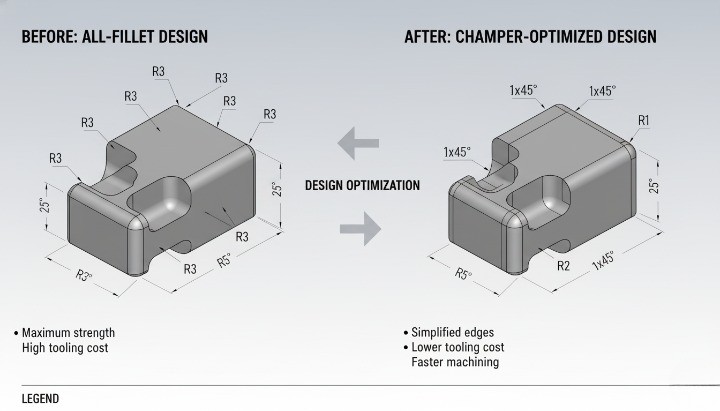
Internal Corner Radii: Here's a design detail that trips up even experienced engineers. Sharp internal corners are physically impossible to machine with rotating cutters. Every end mill leaves a radius equal to its own radius—a 6 mm tool leaves at least a 3 mm internal fillet.
When you specify internal corners smaller than standard tooling allows, the machinist must switch to tiny cutters running at much slower feed rates. The Super-Ingenuity guidelines make this relationship clear:
- 3 mm tool diameter: Minimum internal fillet of 1.5-2.0 mm
- 6 mm tool diameter: Minimum internal fillet of 3.0-3.5 mm
- 10 mm tool diameter: Minimum internal fillet of 5.0-6.0 mm
Relaxing internal corner requirements is one of the most effective ways to accelerate production. Larger radii allow larger, stiffer tools that cut faster and last longer—directly benefiting your precision cnc parts delivery timeline.
Hole Depth-to-Diameter Ratios: Deep holes present similar challenges. The deeper a drill or end mill plunges relative to its diameter, the more it deflects and chatters. For blind pockets and cavities, keep depth within 3× the tool diameter. Beyond this, extended-reach tools lose rigidity, surface finish degrades, and tolerances become harder to hold.
If your design genuinely requires deeper features, consider these alternatives:
- Open one side of the pocket so the cutter enters horizontally
- Use stepped pocket depths, keeping each level within the 3×D guideline
- Split the part into two components that machine separately and assemble afterward
Undercut Avoidance: Undercuts—features that require the tool to cut inward beneath a surface—often demand special tooling, additional setups, or 5-axis machining. For small batch cnc machining with rapid turnaround requirements, eliminating undercuts wherever possible keeps your project on simpler, faster machine configurations.
Tolerance Specification Strategies
Tolerances are where many projects unnecessarily extend their own lead times. Over-specifying tolerances across an entire drawing forces slower cutting speeds, additional inspection steps, and sometimes secondary finishing operations—all of which work against rapid delivery.
Here's the tolerance hierarchy that balances precision with speed, based on industry-standard CNC capabilities:
| Tolerance Tier | Typical Band | Best Use Cases | Impact on Turnaround |
|---|---|---|---|
| General | ±0.10 mm (±0.004 in) | Non-critical features, general geometry, cosmetic surfaces | Minimal—standard machining achieves this automatically |
| Precision Fit | ±0.05 mm (±0.002 in) | Sliding fits, aligned faces, mating feature locations | Moderate—requires careful process control |
| Critical/Reamed | ±0.01-0.02 mm | Dowel holes, bearing bores, CTQ features verified with gauges | Significant—slower machining, dedicated inspection |
The strategic approach? Apply tight tolerances only to features that genuinely require them for function—what quality engineers call CTQ (critical-to-quality) dimensions. Mark these clearly on your drawing and leave everything else at general tolerances.
Consider a practical example: you're designing an enclosure with a precision bearing pocket and six mounting holes. The bearing pocket needs ±0.02 mm to ensure proper interference fit. But the mounting holes? They accept M4 bolts with 0.5 mm clearance. Specifying those holes at ±0.02 mm forces the machinist to ream each one individually—adding time without adding value. Standard ±0.1 mm tolerances work perfectly and keep your custom cnc machining services delivery on track.
Here's what rapid CNC facilities can typically achieve:
- Standard capability: ±0.005 in (approximately ±0.13 mm) across most features without special process controls
- Precision capability: ±0.002 in (approximately ±0.05 mm) for critical dimensions with proper fixturing and tool selection
- Ultra-precision: ±0.0005 in (approximately ±0.01 mm) achievable but requires specialized equipment, additional time, and higher costs
Common Design Mistakes That Slow Turnaround
Even experienced engineers make these errors—and each one silently adds hours or days to project timelines. Here's your optimization checklist to avoid the most common pitfalls when designing precision cnc machined parts:
- Non-standard hole sizes: Specifying odd-diameter holes (like 4.7 mm instead of 5.0 mm) forces interpolation with small end mills or custom reaming. Align critical dimensions with standard drill and tap sizes whenever possible.
- Unnecessary thread depth: Effective thread length beyond 2-3× the nominal diameter adds machining time without meaningful strength gains. Design with the minimum required engagement.
- Tall, thin ribs: Features with height-to-thickness ratios exceeding 8:1 tend to vibrate during cutting, causing chatter marks and potential breakage. Add gussets, thicken the rib, or reduce height.
- Multi-face features requiring excessive setups: Each time a cnc machining part gets flipped and re-clamped, positional uncertainty increases and time accumulates. Design critical features accessible from the same direction whenever possible.
- Blind threaded holes without relief: Taps need room at the bottom. Include a short unthreaded run-out so the tap doesn't bottom out on the drill cone. Through threads are always faster than blind threads when functionally acceptable.
- Tight tolerances on non-functional surfaces: Every surface called out at ±0.02 mm gets machined and inspected at that level. Reserve tight tolerances for features that actually need them.
- Very small internal corner radii: Radii smaller than 1.5 mm force tiny tools with dramatically reduced feed rates. Use the largest radius your design allows.
The cumulative effect of good design practice is substantial. A well-optimized part might machine in 30 minutes and inspect in 5 minutes. The same geometry with unnecessary complexity could require 2 hours of machining and 30 minutes of inspection. Multiply that across a batch, and you've turned a 2-day project into a week-long affair.
When you're designing for rapid turnaround, think like a machinist: what's the simplest way to achieve the function you need? Standard hole sizes, generous corner radii, appropriate wall thicknesses, and strategically applied tolerances all contribute to faster delivery without compromising the precision your application demands.
Rapid CNC Compared to Other Prototyping Methods
You've optimized your design for fast CNC production—but here's a question worth asking: is CNC machining even the right process for your project? Rapid cnc machining excels in many scenarios, but it's not the only game in town. Understanding how it compares to 3D printing, rapid injection molding, and sheet metal fabrication helps you choose the fastest, most cost-effective path to finished parts.
Let's break down when each method shines—and when switching processes could actually accelerate your timeline.
Rapid CNC Versus 3D Printing
This comparison comes up constantly, and for good reason. Both processes deliver parts quickly, but they approach manufacturing from opposite directions. CNC machining rapid prototyping starts with a solid block and removes material. 3D printing builds layer by layer from nothing.
According to Ecoreprap's 2025 analysis, the fundamental difference shapes everything else:
- Precision: CNC typically achieves ±0.05 mm tolerances, while 3D printing ranges from ±0.05 mm (SLA) to ±0.2 mm (FDM). When functional fits matter, CNC wins.
- Material strength: CNC parts use production-grade metals and engineering plastics with full mechanical properties. 3D printed parts often have anisotropic properties—weaker in the layer direction.
- Surface finish: CNC delivers smooth surfaces ready for use. Most 3D printed parts show visible layer lines requiring post-processing.
- Geometric freedom: Here's where 3D printing excels. Internal channels, lattice structures, and organic shapes that would be impossible to machine are routine for additive processes.
The speed comparison isn't straightforward either. Small, complex 3D printed parts might finish in 1-12 hours. But a simple cnc prototype in aluminum could machine in 30 minutes with superior properties. According to industry surveys cited by Ecoreprap, 42% of industrial prototyping companies use CNC for functional testing, while 38% rely on 3D printing for design validation—suggesting each has distinct roles.
Cost structures also differ dramatically. CNC machines range from $5,000 to $150,000, requiring skilled operators at $40-70/hour. 3D printers span $500 to $20,000 with minimal operator expertise needed. But material costs flip the equation at scale—aluminum costs $10-100/kg while specialty 3D printing resins run $20-150/kg.
When Alternative Methods Make Sense
Beyond 3D printing, two other rapid manufacturing methods deserve consideration for your rapid prototype parts.
Rapid Injection Molding: When you need more than a handful of identical parts, injection molding becomes compelling. According to Protolabs' manufacturing selection guide, injection molding is ideal for high-volume production with complex geometries and detailed features. The catch? You need tooling first—even rapid tooling takes 1-3 weeks. But once that mold exists, parts flow at pennies apiece.
The decision point is quantity. For 1-50 parts, CNC is almost always faster. For 500+ identical parts, injection molding's per-part economics justify the tooling investment and upfront delay.
Sheet Metal Fabrication: For enclosures, brackets, and structural components, sheet metal often beats CNC on both speed and cost. Laser cutting, bending, and welding transform flat stock into 3D geometry quickly. The limitation? You're constrained to uniform wall thickness and bend-friendly geometries.
Many experienced engineers use a hybrid approach. Protolabs highlights how companies increasingly combine processes—CNC for functional bases requiring precision, 3D printing for complex interface components, and sheet metal for structural enclosures. This strategy optimizes each process for what it does best.
Choosing the Right Rapid Process
The decision framework comes down to four questions: What material properties do you need? How tight are your tolerances? How many parts? And what geometry are you producing?
| Method | Material Options | Typical Tolerances | Minimum Quantity | Best Use Case |
|---|---|---|---|---|
| Rapid CNC Machining | All metals, engineering plastics, composites | ±0.05 mm standard, ±0.01 mm achievable | 1 part | Functional prototypes requiring production-grade materials and precision |
| 3D Printing (FDM/SLA/SLS) | Thermoplastics, resins, metal powders | ±0.1-0.2 mm (FDM), ±0.05 mm (SLA) | 1 part | Complex geometries, design validation, lightweighting, rapid iterations |
| Rapid Injection Molding | Wide range of thermoplastics | ±0.05 mm achievable | 50-100+ parts | Higher volumes of identical plastic parts with production intent |
| Sheet Metal Fabrication | Steel, aluminum, stainless, copper | ±0.1-0.5 mm depending on process | 1 part | Enclosures, brackets, panels—any bent/welded geometry |
For rapid prototyping cnc machining specifically excels when:
- Your prototype must withstand mechanical testing or real-world loads
- Material properties must match final production intent
- Tolerances tighter than ±0.1 mm are required
- You need metal parts with full strength and no porosity
- Surface finish matters for sealing, sliding, or aesthetic purposes
Consider switching to 3D printing when:
- Internal channels or lattice structures are required
- You're iterating rapidly through design concepts (multiple versions per week)
- Geometric complexity would require extensive CNC setups
- Lower strength and wider tolerances are acceptable
The smartest approach? Don't commit to one process religiously. Prototype machining decisions should match project requirements, not process loyalty. Many successful development programs use rapid prototyping cnc for functional validation parts while simultaneously running 3D printed iterations for form and ergonomic studies. This parallel approach often delivers better products faster than either method alone.
Industry Applications for Rapid CNC Machining
Now that you understand how to choose between rapid CNC and other prototyping methods, let's explore where this technology delivers the most value. Different industries have vastly different requirements—and those requirements directly shape how rapid CNC projects get planned, executed, and validated. A prototype machine shop serving automotive clients operates under completely different constraints than one supporting medical device development.
Understanding these industry-specific demands helps you communicate more effectively with your cnc service provider and set realistic expectations for your project timeline.
Automotive Rapid Prototyping Requirements
The automotive industry runs on tight development cycles and unforgiving validation schedules. When a new vehicle program needs functional chassis components for crash testing or custom brackets for powertrain integration, there's no room for delays.
Rapid CNC machining serves automotive applications including:
- Chassis components: Suspension brackets, control arm prototypes, and structural reinforcements that must withstand real-world load testing
- Custom brackets and mounts: Engine mounts, sensor brackets, and wiring harness supports—often needed in multiple iterations as packaging evolves
- Functional testing parts: Intake manifolds, throttle bodies, and cooling system components machined from production-intent materials for dynamometer validation
- Jigs and fixtures: Assembly tooling for prototype builds and quality inspection gauges
What makes automotive different? Certification requirements. According to 3ERP's certification analysis, automotive suppliers increasingly require IATF 16949 certification—the industry-specific quality management standard that builds upon ISO 9001 with additional automotive requirements. This certification ensures consistent quality under accelerated timelines through rigorous process controls and documented procedures.
Material traceability also matters significantly. When machined parts go into crash test vehicles, engineers need documented proof of material specifications. Custom cnc parts for automotive testing typically require material certifications (mill certs) that trace the aluminum or steel back to its source.
Medical Device Development Applications
Medical applications demand the highest precision and most rigorous documentation—but development timelines are often just as aggressive as automotive. When a surgical instrument prototype needs clinical evaluation or an implant design requires mechanical testing, rapid CNC becomes essential.
Common medical cnc prototypes include:
- Surgical instrument prototypes: Forceps, retractors, and cutting guides machined in stainless steel or titanium for ergonomic evaluation and functional testing
- Implant testing samples: Spinal fusion cages, orthopedic plates, and dental components requiring biocompatible materials and tight tolerances
- Diagnostic equipment housings: Enclosures for ultrasound probes, patient monitoring devices, and laboratory instruments
- Surgical robotics components: End effectors, actuator housings, and articulating mechanisms for minimally invasive surgical systems
The certification landscape differs from automotive. ISO 13485 governs quality management for medical devices, with requirements focusing on risk management, regulatory compliance, and complete traceability. As Uptive Manufacturing notes, medical industries often require prototypes with extremely tight tolerances and intricate designs—and CNC machining's high accuracy makes it favored in situations where deviations from specifications can have devastating effects.
Material selection also takes on special significance. PEEK sees heavy use for implant prototypes due to its biocompatibility and radiolucency. Titanium grades like Ti-6Al-4V dominate load-bearing implant development. Every material choice must align with eventual regulatory submissions.
Cross-Industry Rapid CNC Use Cases
Beyond automotive and medical, rapid CNC machined parts serve critical roles across multiple sectors—each with unique considerations.
Aerospace Applications:
- Flight-critical prototypes requiring AS9100-certified machine shop services and full material traceability
- Fixture components for assembly and testing operations
- Structural brackets and mounting hardware machined from aerospace-grade aluminum alloys
- Engine component prototypes requiring nickel superalloys or titanium
Aerospace tolerance demands are notoriously tight. Components often require ±0.01 mm accuracy on critical features, with surface finish specifications measured in microinches. The certification burden is substantial—AS9100 emphasizes risk management, configuration control, and product traceability beyond standard quality management practices.
Robotics and Automation:
- End effectors and gripper components requiring precise mating surfaces for reliable operation
- Custom actuator housings accommodating motors, encoders, and power transmission elements
- Sensor mounting brackets with tight positional tolerances
- Structural frames and gantry components for custom automation systems
Robotics development moves fast—often faster than traditional product development cycles. A startup building automated systems might iterate through dozens of end effector designs in months. Rapid CNC enables this pace by delivering functional aluminum or stainless steel components within days rather than weeks.
Energy and Industrial Equipment:
- Valve bodies and pump housings for oil and gas applications
- Heat exchanger components and flow control devices
- Custom tooling for renewable energy manufacturing
The common thread across all these industries? Rapid CNC delivers functional prototypes in production-grade materials, allowing real-world validation before committing to production tooling. But each industry's certification requirements, material traceability needs, and tolerance expectations shape how projects get quoted, scheduled, and executed. When you approach a prototype machine shop with industry context, you enable better planning and more accurate timeline commitments.
This brings us to a critical question that many rapid CNC providers gloss over: how do you maintain quality when timelines compress? The answer lies in systematic quality assurance processes designed specifically for accelerated manufacturing.
Quality Assurance in Rapid Manufacturing
Here's the uncomfortable truth about accelerated timelines: speed without quality control is just faster failure. When a rapid CNC machine delivers precision cnc machining parts in one day instead of two weeks, what happens to the inspection processes that normally catch problems? Do shortcuts creep in? Does verification become an afterthought?
The answer separates legitimate rapid manufacturing operations from shops that simply rush. Certified facilities don't sacrifice quality for speed—they engineer quality systems that operate at accelerated pace without compromising rigor. Let's examine exactly how this works.
Quality Control Under Accelerated Timelines
Traditional manufacturing inspection follows a predictable pattern: machine the parts, then inspect the parts. This sequential approach works fine when you have days or weeks of buffer time. But when customers need cnc machining prototyping delivered tomorrow, waiting until the end to discover problems is catastrophic.
Rapid CNC operations flip this model through in-process monitoring. Rather than inspecting after completion, critical dimensions get verified during production—often with the part still fixtured on the machine. This approach catches drift before it becomes scrap.
According to CNCFirst's quality analysis, the traditional sampling approach creates dangerous blind spots: "In traditional inspection, an operator might produce 100 parts, and then the quality inspector randomly checks 10 of them. If 3 are out of tolerance, the problem has already occurred. The other 90 parts might also hide defects, leading to rework or scrap."
In-process verification changes this equation entirely. Key strategies include:
- First-piece verification: Before running a batch, the initial part gets measured against all critical dimensions. Problems with programming, fixturing, or tool selection surface immediately—not after 50 parts are already machined.
- Interval sampling: Rather than waiting until completion, operators check dimensions at regular intervals (every 5th or 10th piece). Trends become visible before tolerances are violated.
- On-machine probing: Modern CNC machines equipped with touch probes can verify features without removing parts from fixtures. This eliminates handling time while providing dimensional feedback in seconds.
- Real-time tool wear compensation: As cutting edges wear, dimensions shift predictably. Advanced controls adjust tool offsets automatically based on measured trends, maintaining precision throughout production runs.
The result? Quality verification happens in parallel with machining rather than sequentially. A precision machining service using these methods can deliver parts faster while actually improving quality compared to traditional post-production inspection.
Certification Standards in Rapid Manufacturing
Certifications aren't just plaques on the wall—they're documented proof that quality systems can handle demanding requirements. For rapid CNC operations, two certifications matter most: IATF 16949 for automotive and AS9100 for aerospace.
IATF 16949 for Automotive: This certification builds on ISO 9001 fundamentals but adds automotive-specific requirements that directly support rapid manufacturing. According to Intertek's certification overview, IATF 16949 organizations demonstrate "an elite level of dedication to quality excellence" through systematic process controls.
What makes IATF 16949 relevant for rapid turnaround? The standard requires:
- Risk-based thinking: Identifying potential failure modes before they occur—essential when compressed timelines leave no room for rework
- Contingency planning: Documented procedures for handling equipment failures or material issues without derailing delivery commitments
- Statistical Process Control (SPC): Mandatory implementation of data-driven monitoring that catches drift early
- Customer-specific requirements: Flexibility to adapt quality systems to individual customer needs without rebuilding from scratch
Shaoyi Metal Technology exemplifies how IATF 16949 certification enables high precision machining services at accelerated pace. Their facility delivers high-tolerance automotive components with lead times as fast as one working day—not by cutting corners, but by implementing the systematic process controls that certification demands. When contract machining services carry IATF 16949 certification, customers gain confidence that rapid timelines won't compromise part quality.
AS9100 for Aerospace: This certification adds aerospace-specific requirements including configuration management, product traceability, and enhanced risk management. The documentation burden is substantial, but certified facilities have systems in place that maintain rigor even under schedule pressure.
Inspection Protocols That Maintain Speed
The secret to maintaining quality under accelerated timelines isn't working faster—it's working smarter. Statistical Process Control (SPC) transforms quality from a gatekeeping function into a predictive capability.
SPC uses control charts to monitor dimensional trends in real time. As CNCFirst explains, "It checks key dimensions at early intervals, such as the 5th or 10th piece, and plots the data on control charts in real time. If a dimension begins drifting toward the tolerance limit, action is taken immediately—such as adjusting tool compensation or replacing the cutter—before the problem grows."
Consider the practical impact: a cnc turning service running 200 parts discovers at piece 150 that dimensions are drifting out of tolerance. Traditional inspection finds this problem after completion—meaning 50+ parts need rework or scrap. SPC-monitored production catches the drift at piece 85, triggers tool replacement at piece 90, and delivers 200 conforming parts on schedule.
The business case is compelling. CNCFirst documented a real customer example: "By applying SPC, we found that from the 85th part onward, a key bore diameter slowly drifted upward during tool life. We replaced the cutting edge at the 80th piece and adjusted offsets. The result: 99.7% yield, saving the customer about ¥12,000 in rework and scrap."
Key SPC implementation elements include:
- Control limits based on process capability: Upper and lower control limits distinguish normal variation from genuine signals requiring action
- Trend analysis: Even dimensions within tolerance get flagged when they show consistent drift toward limits
- Immediate feedback loops: Operators receive real-time alerts, not end-of-day reports
- Documented corrective actions: When adjustments are made, they're recorded for continuous improvement analysis
First Article Inspection (FAI) complements SPC by establishing the baseline. FAI confirms that the first production part meets all specifications before volume production begins. SPC then monitors ongoing production against that validated baseline. As CNCFirst summarizes: "FAI is the start of production. SPC is the guardian throughout the run. Without FAI, SPC has no stable baseline. Without SPC, FAI results cannot last."
This integrated approach—FAI to validate, SPC to monitor, in-process verification to catch issues immediately—enables rapid CNC operations to deliver precision cnc machining parts at accelerated pace without quality compromises. Shaoyi Metal Technology's implementation of strict SPC protocols demonstrates this principle in practice, maintaining consistent quality on automotive components even with one-day lead times.
The bottom line? When evaluating rapid CNC partners, ask about their quality systems—not just their turnaround promises. Certifications like IATF 16949, documented SPC implementation, and systematic FAI protocols are the infrastructure that makes speed sustainable. Without them, rapid delivery is just a gamble with your production schedule.
Understanding Rapid CNC Limitations
Here's something most rapid CNC providers won't tell you: their service isn't always the right choice. Every manufacturing method has boundaries, and understanding where rapid CNC machining falls short saves you money, frustration, and missed deadlines. The goal isn't to discourage you from using this technology—it's to help you recognize situations where alternative approaches deliver better outcomes.
Let's have an honest conversation about when rapid CNC machined parts might not be your best option—and how to evaluate the true economics of your project.
When Standard Lead Times Make More Sense
Speed comes at a cost. Rapid turnaround requires dedicated machine capacity, prioritized scheduling, and sometimes premium material sourcing. When your project doesn't genuinely need accelerated delivery, paying for speed you won't use is simply waste.
Consider these scenarios where standard lead times serve you better:
- Stable production schedules: If your design is locked and you're ordering cnc machined parts for planned production months away, why pay rush premiums? Standard 2-3 week lead times often reduce costs by 20-40%.
- Prototype iterations with built-in review cycles: When each prototype requires a week of internal testing before the next iteration begins, 48-hour delivery provides no advantage over 7-day delivery. Match manufacturing speed to your actual review cadence.
- Non-critical spare parts: Replacement components for non-production equipment rarely justify expedited manufacturing. Standard lead times keep these parts economical.
- Large batch orders: Ordering 500+ identical cnc parts? Shops can optimize scheduling around your job, reducing per-part costs when timeline flexibility exists.
The honest assessment: rapid CNC is a capability, not a requirement. Use it when timeline compression genuinely creates value—not as a default.
Volume Thresholds and Cost Considerations
Here's where the economics get interesting. Rapid CNC excels for low volume cnc machining—prototypes, short runs, and custom parts manufacturing projects. But as quantities increase, the cost equation shifts dramatically.
According to Hubs' manufacturing analysis, CNC machining is typically used for low- to medium-volume production because it's more costly and has longer lead times compared to injection molding and die casting at scale. The reasons are structural:
- No economies of tooling: Every CNC part requires full machining time. Injection molding spreads mold costs across thousands of parts, driving per-unit costs down dramatically at volume.
- Machine time constraints: A rapid CNC machine can only cut so many parts per hour. At high volumes, you're essentially paying for serial production when parallel methods exist.
- Setup amortization: While rapid CNC minimizes setup time, those minutes still accumulate across large orders in ways that dedicated tooling eliminates entirely.
The crossover point varies by part complexity and material, but general thresholds apply:
| Quantity Range | Recommended Approach | Rationale |
|---|---|---|
| 1-50 parts | Rapid CNC machining | No tooling investment; fastest path to parts |
| 50-500 parts | Standard CNC or bridge production | Evaluate injection molding economics; CNC often still competitive |
| 500-5,000 parts | Rapid injection molding | Aluminum tooling amortizes quickly; lower per-part costs |
| 5,000+ parts | Production injection molding or die casting | Steel tooling investment justified; dramatic per-part savings |
When evaluating custom parts manufacturing for higher volumes, consider total project economics—not just per-part machining costs. A $15,000 injection mold seems expensive until you calculate that it reduces per-part costs from $45 (CNC) to $2 (molded) across 1,000 units.
Honest Assessment of Rapid CNC Limitations
Beyond volume considerations, certain project characteristics make rapid CNC suboptimal—regardless of quantity. Recognizing these scenarios upfront prevents disappointment:
- Parts requiring extensive secondary operations: When your cnc part needs heat treatment, specialized coatings, complex assembly, or multiple finishing steps, the machining itself may finish quickly—but total lead time extends anyway. Rapid machining delivers components to a bottleneck.
- Applications requiring certified materials with traceability: Aerospace and medical projects often require material certifications from specific mills with documented chain of custody. Even if a cnc milling company can machine your part in 24 hours, sourcing certified titanium or medical-grade PEEK may add weeks to the front end.
- Geometries better suited to additive manufacturing: Internal cooling channels, lattice structures, and organic shapes that would require dozens of CNC setups often produce faster and cheaper through 3D printing—even accounting for additive's own limitations.
- Machining large parts with limited machine capacity: Oversized components challenge rapid delivery. Shops with machines capable of machining large parts often have limited capacity and longer queues. A 48-hour promise means nothing if the only suitable machine is booked for two weeks.
- Extremely tight tolerances requiring grinding or EDM: When specifications demand sub-micron precision, CNC machining becomes a roughing operation. The real precision comes from secondary processes that add days regardless of initial machining speed.
- Projects with unstable designs: If you're still making significant design changes, paying for rapid turnaround on each iteration burns budget quickly. Sometimes slowing down the manufacturing cadence while accelerating design decisions produces better outcomes.
Rush fees deserve special scrutiny. Most rapid CNC providers charge 25-100% premiums for expedited service. Before paying, calculate what that speed actually buys you:
- Does faster delivery unlock revenue or prevent losses that exceed the premium?
- Will the parts actually get used immediately, or will they sit waiting for other dependencies?
- Could you have avoided the rush entirely with better project planning?
The most expensive rapid CNC project is the one you didn't need to rush. Honest self-assessment about genuine timeline requirements—versus artificial urgency—separates cost-effective manufacturing decisions from expensive panic.
This editorial honesty extends to partner selection. Understanding your project's true requirements helps you identify the right rapid CNC partner—one whose capabilities align with your actual needs rather than just their marketing claims.
Selecting the Right Rapid CNC Partner
You've assessed whether rapid CNC machining fits your project—now comes the critical decision: who actually makes your parts? The difference between a frustrating manufacturing experience and a seamless one often comes down to partner selection. A cnc prototyping service that delivers brilliantly on a 10-piece prototype might stumble when you scale to 500 production units. Conversely, a high-volume shop might not prioritize your urgent 5-piece order.
Finding the right fit requires evaluating capabilities against your current needs and future trajectory. Let's build a comprehensive framework for this decision—one that goes beyond glossy websites and marketing promises.
Essential Partner Evaluation Criteria
When vetting prototype machining services, surface-level comparisons miss what actually matters. According to Norck's manufacturing expertise, selecting the right CNC machining service "isn't just about getting a part made; it's about getting a perfect part made, efficiently and reliably." Here's how to evaluate what really counts:
Turnaround Time Guarantees: Claims of "fast delivery" mean nothing without specifics. Ask directly:
- What are your standard lead times for simple aluminum parts?
- What expedited options exist, and what premiums apply?
- Do you guarantee delivery dates contractually, or are they estimates?
- What happens if you miss a committed delivery—expedited shipping at your cost, or just an apology?
A legitimate rapid prototype machining operation will have clear answers. Vague responses suggest the "rapid" is more marketing than operational reality.
Material Capabilities: Your current project might need aluminum, but your next one could require stainless steel or PEEK. Evaluate breadth:
- What materials do you stock versus order on demand?
- Can you provide material certifications and traceability documentation?
- Which specialty materials have you successfully machined?
Tolerance Specifications: Every prototype shop claims "precision"—but what does their precision actually look like?
- What standard tolerances do you hold without additional cost?
- What's your demonstrated capability on tight-tolerance features?
- What inspection equipment do you use for verification?
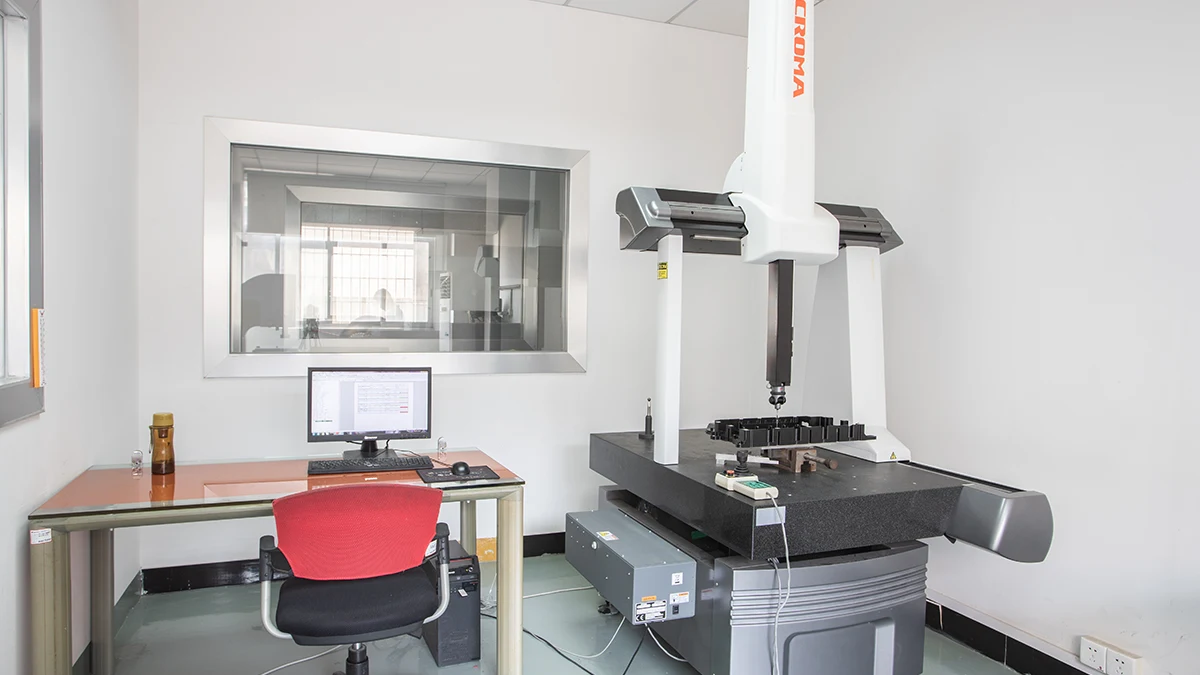
Norck emphasizes that inspection equipment matters: "Look for Coordinate Measuring Machines (CMMs), optical comparators, micrometers, calipers, and surface roughness testers. A shop with advanced, regularly calibrated inspection tools demonstrates a commitment to accuracy."
Quality Certifications: Certifications provide objective validation of quality systems. Key certifications include:
- ISO 9001: Baseline quality management—expected from any professional operation
- IATF 16949: Automotive-specific requirements including Statistical Process Control
- AS9100: Aerospace requirements with enhanced traceability and risk management
- ISO 13485: Medical device quality management
As Norck notes, "For highly regulated industries, specific certifications are mandatory." If your application demands certification, verify it's current—not expired or pending renewal.
Communication Responsiveness: How a prototype cnc shop handles your inquiry reveals how they'll handle your project. Norck's guidance is direct: "How quickly do they respond to your inquiries and requests for quotes? A prompt and clear response often indicates professionalism and efficiency."
- Did they respond to your quote request within hours or days?
- Do they have dedicated project managers, or will you chase different people each call?
- Can you reach technical staff directly when issues arise?
From Prototype Partner to Production Supplier
Here's where many engineering teams make costly mistakes: they select a cnc machining prototype partner based solely on prototype capabilities, then discover that partner can't scale when the project succeeds. Starting the supplier search over mid-program wastes months and introduces quality risks.
According to OpenBOM's manufacturing best practices, "Selecting the right suppliers is one of the most critical decisions you'll make when transitioning from prototype to production." They recommend involving suppliers early—"even before you've finalized your design"—to tap into their expertise on manufacturability and scalability.
When evaluating scaling capacity, consider:
- Machine fleet depth: A prototype shop with three machines can't absorb a sudden 500-piece order without displacing other customers. Ask about total capacity and current utilization.
- Workforce flexibility: Can they add shifts for volume demands? Do they cross-train operators to prevent single-point dependencies?
- Quality system scalability: SPC implementation, documented work instructions, and systematic inspection protocols matter more at volume than for one-off prototypes.
- Supply chain relationships: Do they have reliable material sourcing for production quantities? A shop that orders one aluminum billet at a time may struggle with consistent supply at volume.
OpenBOM emphasizes treating suppliers "as partners, not just vendors. Regular communication, transparency, and collaboration with them will allow you to proactively address potential challenges rather than reactively dealing with them during production."
The ideal cnc machined prototypes partner understands your trajectory. When you explain that this 10-piece order validates a design headed for 5,000-piece annual production, they should engage differently than if you're building a one-time custom fixture. Partners invested in your long-term success often provide better Design for Manufacturing feedback, knowing they'll benefit from production volumes.
Making the Right Manufacturing Decision
Bringing this framework together, here's your partner evaluation checklist:
- Turnaround alignment: Their standard and expedited timelines match your project cadence
- Material coverage: They stock or can quickly source your required materials with proper documentation
- Tolerance capability: Demonstrated precision meets your functional requirements with appropriate inspection equipment
- Relevant certification: Quality certifications match your industry requirements (IATF 16949 for automotive, AS9100 for aerospace, ISO 13485 for medical)
- Communication quality: Responsive, clear communication with accessible technical support
- Scaling pathway: Capacity and systems to grow from prototype quantities to production volumes
- Transparent pricing: Detailed quotes that break down costs clearly, with honest assessment of value-added services
- Long-term partnership potential: Genuine interest in understanding your program trajectory, not just capturing the immediate order
Consider how these criteria apply in practice. Shaoyi Metal Technology demonstrates the profile to look for: IATF 16949 certification validates their automotive quality systems, strict SPC implementation maintains consistency under accelerated timelines, and their facility delivers high-tolerance components with lead times as fast as one working day. Critically, they're designed to scale seamlessly from rapid prototyping to mass production—whether you need complex chassis assemblies or custom metal bushings.
The decision framework ultimately answers one question: can this partner deliver quality parts on your timeline today, and scale with your program tomorrow? A partner meeting this standard becomes more than a vendor—they become an extension of your engineering team, invested in your success across the full product lifecycle.
Don't settle for a prototype shop that disappears when volumes increase, or a production house that treats small orders as inconveniences. The right rapid CNC partner handles both ends of that spectrum, growing with your program from first article through full production. That alignment creates manufacturing relationships that compound in value over time—delivering not just parts, but competitive advantage.
Frequently Asked Questions About Rapid CNC Machining
1. What does rapid mean in CNC?
Rapid in CNC machining refers to accelerated manufacturing workflows that compress traditional lead times from weeks to days or hours. Unlike standard CNC processes, rapid CNC operations leverage AI-assisted quoting, optimized toolpath generation, parallel processing, and streamlined logistics to deliver precision parts within 24-hour, 48-hour, or one-week benchmarks. The speed comes from eliminating inefficiencies throughout the manufacturing chain—not from cutting corners on quality. Certified facilities like Shaoyi Metal Technology maintain IATF 16949 standards while achieving one-day lead times through strict Statistical Process Control implementation.
2. What is rapid CNC prototyping?
Rapid CNC prototyping is a subtractive manufacturing process using computer-controlled machines to quickly produce functional prototypes from solid material blocks. This method delivers production-grade parts in metals like aluminum, stainless steel, and titanium, or engineering plastics like Delrin and PEEK. Unlike 3D printing, rapid CNC prototyping achieves tighter tolerances (typically ±0.05 mm) and uses materials with full mechanical properties, making it ideal for functional testing, design validation, and pre-production verification when timeline compression is critical.
3. What is rapid rate in a CNC machine?
Rapid rate in CNC machining refers to the maximum non-cutting travel speed of the machine—typically used when repositioning the tool between cuts. Modern high-speed machining centers achieve rapid rates of 15,000-40,000 RPM spindle speeds, allowing proportionally higher feed rates during cutting. This directly impacts cycle times: a machine running at 20,000 RPM can move material approximately twice as fast as one limited to 10,000 RPM, assuming proper tooling and workpiece material support. Higher rapid rates reduce overall production time without affecting machining precision.
4. How much does rapid CNC machining cost?
Rapid CNC machining costs vary based on material, complexity, tolerances, and turnaround requirements. Standard rapid services typically charge 25-100% premiums over regular lead times. Aluminum parts cost less than stainless steel or titanium due to faster machining and longer tool life. Simple geometries on 3-axis machines cost less than complex 5-axis work. To optimize costs, design parts with standard hole sizes, generous corner radii, and tolerances no tighter than necessary. Request quotes from certified providers who offer transparent pricing breakdowns to understand true project economics.
5. When should I choose rapid CNC over 3D printing?
Choose rapid CNC machining when your prototype must withstand mechanical testing, require production-grade material properties, need tolerances tighter than ±0.1 mm, or demand metal parts with full strength and no porosity. CNC excels for functional prototypes requiring real-world validation. Select 3D printing when you need internal channels, lattice structures, organic shapes, or rapid design iterations with less stringent tolerance requirements. Many successful programs use both methods simultaneously—CNC for functional validation and 3D printing for form studies.