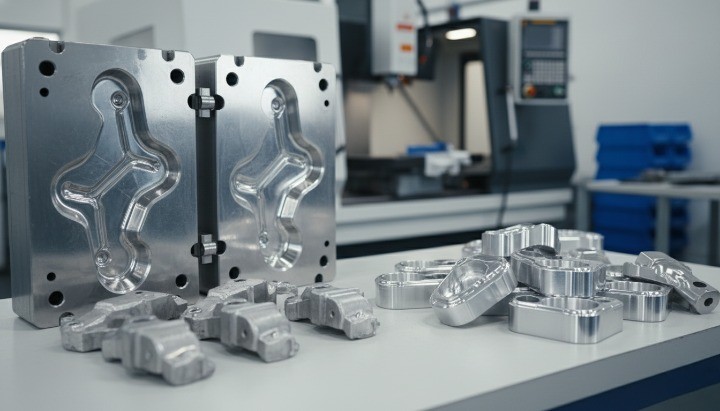
 Small batches, high standards. Our rapid prototyping service makes validation faster and easier —
  EN
EN


CNC Machining Parts Manufacturers: From First Quote To Trusted Partner
Understanding CNC Machining Parts Manufacturers and Their Role
When you need precision components for your next project, where do you turn? For countless industries ranging from aerospace to medical devices, the answer lies with CNC machining parts manufacturers. These specialized facilities transform raw materials into finished components with remarkable accuracy, serving as the backbone of modern manufacturing ecosystems.
Simply put, CNC machining parts manufacturers are companies that use computer numerical control technology to produce custom machined parts from various materials. Unlike traditional manual machining, these manufacturers program sophisticated machines to automate cutting, drilling, milling, and turning operations. The result? Components manufactured to exact specifications with superior repeatability and consistency.
What CNC Machining Parts Manufacturers Actually Do
Imagine needing a complex aluminum housing with tolerances measured in microns. Or perhaps you require hundreds of identical steel brackets for an automotive assembly. These manufacturers handle both scenarios and everything in between. Their services span the complete production spectrum, from single prototype development to high-volume manufacturing runs of thousands of units.
The primary service categories these manufacturers offer include:
- CNC Milling - Using rotating cutting tools to remove material and create complex geometries, flat surfaces, and intricate features
- CNC Turning - Producing cylindrical machining parts through lathe operations, ideal for shafts, bushings, and round components
- 5-Axis Machining - Advanced multi-axis capabilities that enable complex cnc machine components to be produced in a single setup, reducing production time
- Swiss Screw Machining - Specialized swiss cnc machine operations for small, intricate parts requiring extreme precision, commonly used in medical and electronics applications
The Manufacturing Ecosystem Explained
Why should procurement professionals, engineers, and business owners invest time understanding this industry? The answer is straightforward: making informed decisions about manufacturing partners directly impacts your product quality, timeline, and bottom line.
Think of CNC machining parts manufacturers as critical links in your supply chain. They bridge the gap between your design concepts and physical cnc machining parts ready for assembly or end use. When you understand their capabilities, you can better communicate your requirements, evaluate quotes accurately, and build partnerships that deliver consistent results.
This guide serves as your buyer-advocate resource. Rather than pushing you toward any particular solution, we will walk you through the practical knowledge you need to navigate this industry confidently. From understanding tolerance specifications to evaluating certifications, you will gain the insights necessary to transform your first quote into a trusted manufacturing partnership.
Types of CNC Machining Manufacturers and Their Specializations
Not all cnc manufacturing shops operate the same way. When sourcing custom machined parts, understanding the differences between manufacturer types can prevent costly misunderstandings and production delays. Each category serves distinct purposes, and choosing the wrong type of supplier often leads to inconsistent quality or supply chain disruptions.
So what separates one manufacturer from another? It comes down to systems, scale, and business model. Let's break down the four primary categories you will encounter.
Job Shops vs Contract Manufacturers
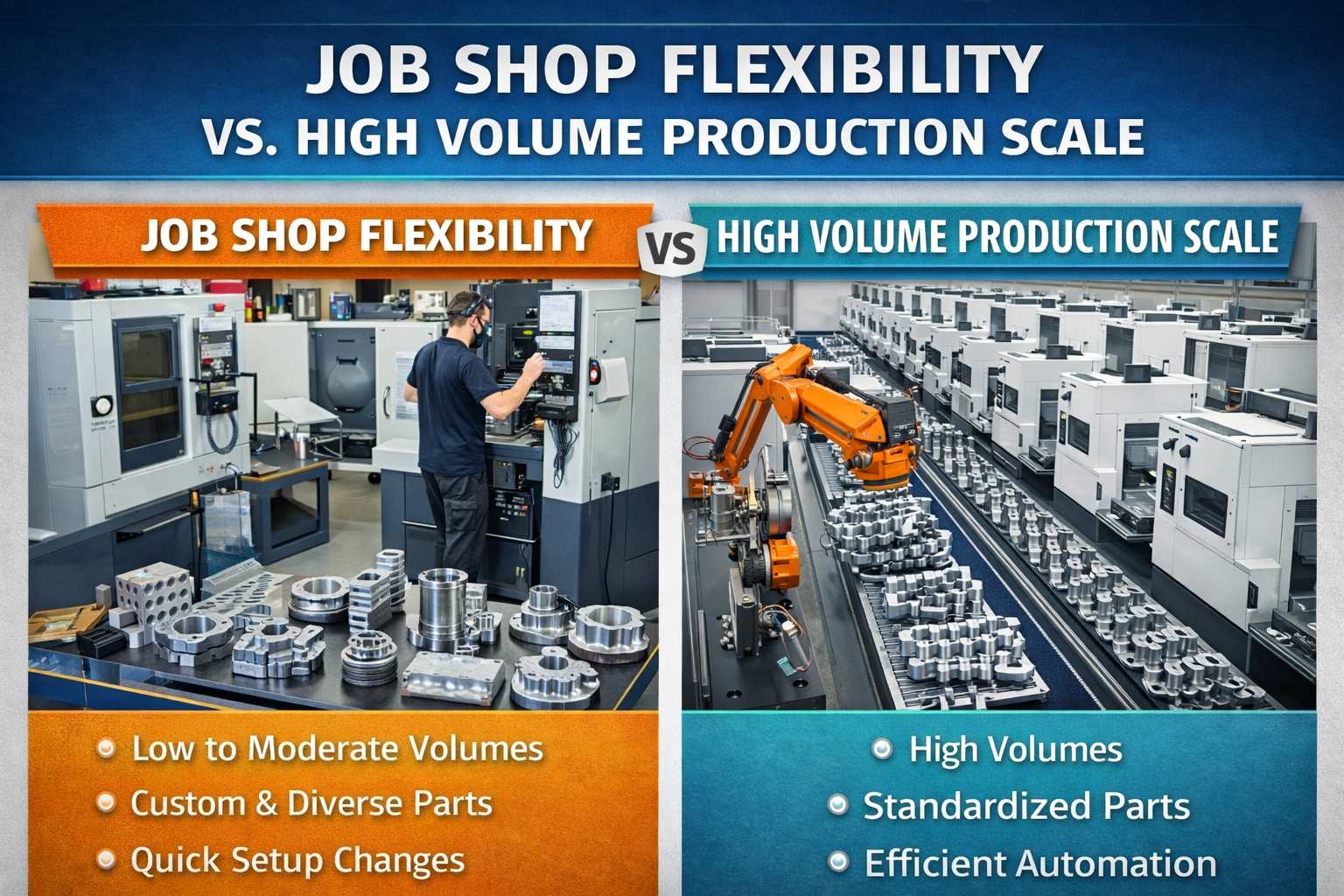
A job shop typically focuses on short-run or one-off production. These cnc machine companies take in work on a per-quote basis, handling a wide variety of parts for different customers with little continuity between jobs. They are built for flexibility, not repetition. Need a single prototype or a small quantity of custom brackets? A job shop can be cost-effective and fast.
However, job shops may not be structured for scheduled releases, quality control tracking, or inventory programs that larger production environments require. The relationship tends to be transactional rather than partnership-oriented.
Contract machining services, on the other hand, are designed for repeatable production. These companies that manufacture custom metal parts structure their operations around long-term relationships and volume-based work. They offer robust systems for scheduling, quality assurance, material handling, and documentation. A contract manufacturer works with your team to deliver to forecast demand, manage part revisions, and align delivery schedules with your operations.
Beyond these two common types, you will also encounter OEM suppliers who manufacture components specifically designed for integration into another company's final product. Vertically integrated facilities take this further by controlling multiple stages of production under one roof, from raw material processing through finished assembly.
Matching Manufacturer Type to Your Project Needs
How do you know which type fits your situation? Consider your volume, schedule, documentation needs, and expectations for ongoing support. The following comparison breaks down key differences:
| Manufacturer Type | Typical Order Volumes | Lead Times | Specialization Depth | Ideal Use Cases |
|---|---|---|---|---|
| Job Shops | 1-500 pieces | 1-3 weeks | Broad capabilities, limited depth | Prototypes, one-time fabrications, quick turnarounds |
| Contract Manufacturers | 500-50,000+ pieces | 4-12 weeks | Process-specific expertise | Recurring production, multi-part programs, supply chain integration |
| OEM Suppliers | 1,000-100,000+ pieces | 6-16 weeks | Industry-specific specialization | Automotive, aerospace, medical device components |
| Vertically Integrated Facilities | 5,000-500,000+ pieces | 8-20 weeks | Deep multi-process capabilities | Complex assemblies, high-volume production, turnkey solutions |
When evaluating cnc machine manufacturers, operational scale indicators reveal manufacturing capability. A facility with 600+ CNC machines signals significantly different capacity than a shop with 15 machines. Similarly, swiss screw machine shops specializing in micro-components operate differently than general-purpose manufacturers.
Look for these capacity signals: annual part volumes produced, number of automated production lines, and diversity of machine types. A manufacturer running 25+ automated lines handles high-volume demands that smaller operations simply cannot match. Understanding these distinctions helps you build a shortlist of partners whose capabilities align with your specific project requirements.
How to Evaluate and Select the Right Manufacturer
You have identified potential machining parts manufacturers that match your project scope. Now comes the harder question: how do you separate the qualified partners from the rest? Without a structured evaluation process, buyers often default to price comparisons alone, overlooking critical factors that determine long-term success.
Think of manufacturer selection like hiring a key team member. Credentials matter, but so do communication style, problem-solving ability, and cultural fit. The following framework gives you a systematic approach to evaluate cnc machine producers and build a shortlist of partners worth pursuing.
Critical Evaluation Criteria for Manufacturer Selection
Before requesting quotes, establish your evaluation priorities. Different projects weight these criteria differently, but every buyer should assess the following areas:
Lead Times and Capacity - How quickly can the manufacturer deliver? Typical lead times for CNC machining range from one to three weeks for standard work, though complex projects may require longer. Ask about rush order capabilities and whether they use scheduling software or real-time order tracking. A machined parts manufacturer with excess capacity buffers handles unexpected demand spikes without compromising your timeline.
Minimum Order Quantities - Some cnc milling companies specialize in high-volume production and set minimums of 500 or 1,000 pieces. Others welcome single-piece prototype orders. Clarify MOQ requirements early to avoid wasting time on mismatched suppliers.
Geographic Considerations - Proximity affects shipping costs, lead times, and communication ease. Domestic suppliers simplify logistics and reduce transit risks, while overseas manufacturers may offer cost advantages for high-volume orders. Consider time zone differences and language barriers when evaluating international options.
Technical Specialization - Does the manufacturer have documented experience with your materials, tolerances, and industry requirements? A shop specializing in aluminum prototypes operates differently than one focused on hardened steel production parts. Look for case studies or references in your specific application area.
Quality Certifications - Certifications like ISO 9001, IATF 16949, or AS9100D indicate structured quality systems. For regulated industries, certification requirements are non-negotiable. Verify current certification status and request copies of relevant documentation.
Building Your Manufacturer Shortlist
With evaluation criteria defined, follow this step-by-step process to narrow your options and identify the best-fit partners:
- Define your project requirements completely - Document material specifications, quantity needs, tolerance expectations, surface finish requirements, and delivery timeline before contacting any manufacturer.
- Research potential suppliers - Use industry directories, trade associations, and referrals to identify ten to fifteen candidates. Review their websites for capabilities, certifications, and industry focus.
- Screen for basic fit - Eliminate manufacturers whose capabilities, MOQs, or certifications clearly do not match your needs. Reduce your list to five to seven serious candidates.
- Prepare your RFQ package - Compile complete documentation including CAD files, technical drawings, material callouts, quantity requirements, and any special inspection or documentation needs.
- Submit RFQs and evaluate responses - Send identical packages to your shortlisted candidates. Compare not just pricing but also responsiveness, questions asked, and design for manufacturability feedback provided.
- Conduct capability verification - For top candidates, request facility tours, customer references, or sample parts. Verify their equipment, quality systems, and communication processes firsthand.
- Start with a pilot project - Before committing to production volumes, award a small initial order to test the relationship. Evaluate quality, communication, and delivery performance under real conditions.
This systematic approach prevents common mistakes like selecting based on price alone or failing to verify actual capabilities before production begins.
Preparing Your RFQ Package
The quality of your request for quote directly impacts the accuracy of responses you receive. Incomplete information leads to misquoted pricing, unexpected charges, and production delays. Experienced custom machining solutions providers evaluate RFQs carefully, and a well-prepared package signals you are a professional buyer worth prioritizing.
Your RFQ package should include:
- CAD Files - Provide 3D models in widely accepted formats such as STEP, IGES, or native CAD files. Include 2D drawings with dimensions, tolerances, and GD&T callouts where applicable.
- Material Specifications - Specify exact material grades, not just generic descriptions. "6061-T6 aluminum" communicates clearly; "aluminum" does not. Include any material certifications required.
- Quantity Requirements - State both initial order quantities and anticipated annual volumes. Manufacturers price differently based on volume expectations and production scheduling needs.
- Tolerance Expectations - Call out critical dimensions and their required tolerances. Avoid over-specifying tolerances on non-critical features, as tighter tolerances increase costs significantly.
- Surface Finish Requirements - Specify finish requirements using standard callouts like Ra values. Include any secondary finishing operations needed such as anodizing, plating, or painting.
- Inspection and Documentation Needs - Identify any first article inspection requirements, dimensional reports, or material certifications that must accompany shipments.
- Delivery Timeline - Communicate your target delivery date and whether expedited processing is needed. Be realistic about timeline expectations for custom cnc parts.
According to industry best practices from Stecker Machine, experienced CNC shop teams review packages starting with feasibility assessment based on capabilities and expertise. They may suggest cost-effective alternatives such as different materials or automation options to help you realize savings or improve manufacturability.
A professional cnc machining business will respond to your RFQ with more than just pricing. Look for suppliers who ask clarifying questions, identify potential issues with your design, and offer design for manufacturability feedback. These responses indicate a collaborative partner rather than a transactional vendor focused solely on winning the lowest-price competition.
Tolerance Specifications and Precision Requirements Explained
You have identified qualified manufacturers and prepared your RFQ package. Now comes a decision that directly impacts both part functionality and your budget: tolerance specifications. Over-specifying tolerances wastes money. Under-specifying them causes assembly failures. Understanding where precision machined parts genuinely require tight tolerances versus where standard tolerances suffice separates informed buyers from those who learn expensive lessons during production.
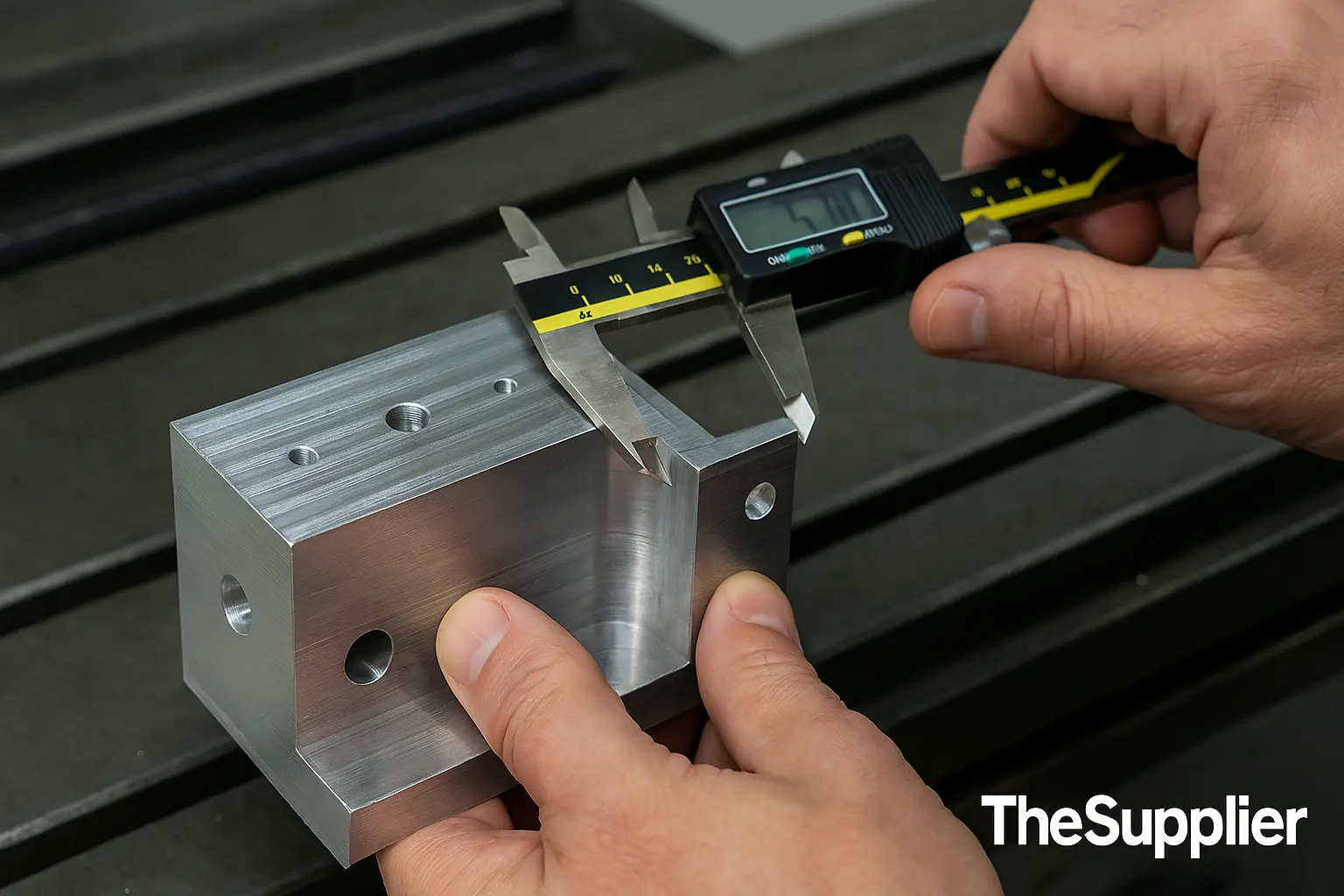
So what exactly are tolerances, and why do they matter so much? In CNC machining, tolerance refers to the acceptable amount of dimensional variation from the intended design. No machined part comes out perfect every time. Tolerances define the range within which a dimension remains acceptable for its intended function.
Tolerance Specifications Demystified
Tolerances are typically expressed in the format ±0.x mm or ±0.00x inches. For example, if a shaft is designed at 25.00 mm with a tolerance of ±0.05 mm, any result between 24.95 mm and 25.05 mm is acceptable. Parts falling outside these limits get rejected.
Most CNC machining parts manufacturers follow ISO 2768, an international standard that provides general tolerances for linear and angular dimensions. This standard divides tolerances into four classes:
- Fine (f) - Tighter control for precision machined components requiring higher accuracy
- Medium (m) - Standard default for most milled and turned parts, typically around ±0.005 inches (0.13 mm)
- Coarse (c) - Looser tolerances for non-critical features where exact dimensions matter less
- Very Coarse (v) - Widest acceptable variation for rough or non-functional surfaces
Unless your technical drawing specifies otherwise, most manufacturers machine parts to ISO 2768-1 Medium grade. For standard plastic parts, machinists commonly use ISO 2768-1 Medium, while metals and rigid materials typically follow ISO 2768-1 Fine specifications.
Beyond these general classes, you will encounter different tolerance types based on how dimensions are specified:
- Bilateral Tolerance - Variation applied equally above and below the nominal dimension (e.g., 25.8 mm ±0.1 mm means acceptable range is 25.7 mm to 25.9 mm)
- Unilateral Tolerance - Variation permitted in only one direction (e.g., 1.25 mm +0.1/-0 mm means acceptable range is 1.25 mm to 1.35 mm)
- Limit Tolerance - Direct expression using upper and lower limits without calculations (e.g., 10.9-11.0 mm)
Matching Tolerances to Application Requirements
Here is where many buyers make costly mistakes. Tighter tolerances demand specialized cutting tools, slower machining speeds, and more thorough inspections. According to industry analysis from Sheldon Precision, shifting from ±0.1 mm to ±0.01 mm can increase production costs by 30% or more depending on material and geometry.
The following table breaks down tolerance grades, their typical applications, and cost implications to help you make informed decisions:
| Tolerance Grade | Typical Range | Applications | Cost Implications |
|---|---|---|---|
| Standard | ±0.005" (0.13 mm) | General components, non-mating surfaces, structural parts | Baseline cost; most economical production |
| Precision | ±0.001" (0.025 mm) | Aerospace components, automotive performance parts, precision cnc machined parts requiring tight fits | 20-40% cost increase; requires advanced equipment |
| High-Precision | ±0.0005" (0.0127 mm) | Medical implants, optical components, critical mating surfaces | 50-100% cost increase; specialized processes required |
| Ultra-Precision | ±0.0002" (0.00508 mm) | Surgical instruments, semiconductor equipment, measurement devices | Significant premium; only 1% of parts require this level |
In reality, only about 1% of precision machine parts require tolerances in the ±0.0002" to ±0.0005" range. Often, just certain features on a machined part need tight tolerances while the rest can remain at standard levels.
When do you genuinely need precision machining parts with tight tolerances? Consider these scenarios:
- Assembly fit requirements - Parts that must mate together with specific clearance or interference fits
- Functional performance - Components where dimensional variation affects operation, such as valve seats or bearing surfaces
- Regulatory compliance - Medical devices or aerospace components with mandated precision requirements
- Sealing surfaces - Areas where gaskets or O-rings must create reliable seals
For non-critical features like mounting holes with clearance, external surfaces with no mating requirements, or decorative elements, standard tolerances typically suffice. Applying tight tolerances to these features wastes money without improving part function.
Material selection also influences achievable tolerances. Metals and rigid plastics machine predictably to tight specifications. Soft, flexible, or abrasive plastics present greater challenges. A skilled machined parts manufacturer will advise whether your tolerance expectations align with your chosen material.
Use tighter tolerances only on critical features affecting assembly, fit, or function. Keep non-critical features at standard tolerances to control costs without sacrificing performance.
Before finalizing your specifications, conduct stack-up analysis for assemblies. When multiple precision machined components mate together, their individual variations combine. If tolerances are not properly coordinated, the cumulative variation can prevent proper assembly or cause premature wear.
With tolerance requirements clearly defined, certifications become the next critical evaluation factor. Different industries mandate specific quality standards that directly impact your manufacturer selection process.
Industry Certifications and Quality Standards Decoded
You have defined your tolerance requirements and shortlisted potential manufacturers. Now a question emerges that trips up many first-time buyers: which certifications actually matter for your project? The alphabet soup of ISO, IATF, and AS standards can feel overwhelming. Yet understanding these credentials is essential because certifications serve as objective proof that a manufacturer maintains documented quality systems capable of delivering consistent cnc machined parts.
Here is the reality: not every project requires every certification. Consumer electronics components face different requirements than aerospace assemblies or medical implants. Knowing which certifications your industry mandates helps you filter manufacturers efficiently and avoid paying premiums for credentials you do not need.
Decoding Manufacturing Certifications
Think of certifications as verified quality credentials. When a manufacturer earns a certification, an independent auditor has confirmed their processes, documentation, and quality controls meet established standards. This verification provides assurance that goes beyond marketing claims.
The major certifications you will encounter when sourcing cnc machined components include:
- ISO 9001:2015 - The foundational quality management system standard recognized globally. This certification demonstrates standardized production processes, documented procedures, and commitment to continuous improvement. Most OEM customers require ISO 9001 as a baseline qualification before considering a supplier.
- ISO 13485 - The definitive standard for medical device manufacturing. This certification covers strict controls over design, manufacturing, traceability, and risk mitigation. Facilities must implement detailed documentation practices, thorough quality checks, and effective complaint handling procedures.
- IATF 16949 - The global quality standard for automotive suppliers. This certification combines ISO 9001 principles with sector-specific requirements for defect prevention, continuous improvement, and stringent supplier oversight. Major automakers will not work with uncertified suppliers.
- AS9100D - The aerospace and defense industry standard built upon ISO 9001 with additional requirements for risk management, product traceability, and documentation control. This certification addresses mission-critical component reliability expectations.
- ITAR (International Traffic in Arms Regulations) - Not a quality certification but a compliance requirement for defense-related manufacturing. ITAR controls handling of sensitive technical data and requires registration with the U.S. Department of State along with strict information security protocols.
Beyond these primary certifications, you may encounter NADCAP accreditation for special processes like heat treating or nondestructive testing, and ISO 14001 for environmental management systems. Some precision machined parts suppliers pursue multiple certifications to serve diverse industries.
Which Certifications Your Project Actually Requires
Certification requirements vary dramatically by industry. A manufacturer producing the best machining results for consumer products operates under different quality mandates than one serving aerospace customers. Understanding these distinctions prevents both over-qualifying and under-qualifying your supplier selection.
For Automotive Applications - IATF 16949 certification is typically mandatory. This standard ensures manufacturers implement Statistical Process Control (SPC) to monitor production consistency and maintain complete part traceability throughout the supply chain. According to industry requirements, major automakers including Ford, Toyota, GM, and Volkswagen require IATF 16949 certification from their machined components suppliers.
For Aerospace and Defense - AS9100D certification demonstrates capability to meet stringent aerospace quality expectations. Defense contractors typically need both AS9100D and ITAR compliance. NADCAP accreditation may also be required for specialized processes.
For Medical Devices - ISO 13485 certification is critical for ensuring product safety and FDA compliance. Manufacturers must demonstrate risk management protocols, product traceability systems, and effective complaint handling. This standard ensures every medical component can be manufactured to the highest standards of precision and patient safety.
For General Industrial Applications - ISO 9001:2015 typically suffices as the quality baseline. This certification ensures consistent quality without the additional overhead of industry-specific standards. Many precision machined parts suppliers serving multiple industries maintain ISO 9001 as their foundational credential.
For Consumer Electronics - Requirements vary by customer. ISO 9001 is often sufficient, though some OEMs request ISO 14001 environmental certification or specific supplier quality requirements. The regulatory burden is generally lighter than regulated industries.
Match certification requirements to your actual industry needs. Demanding aerospace-level certifications for general industrial parts adds cost without adding value.
When evaluating manufacturers, verify current certification status rather than accepting claims at face value. Request copies of certification documents and check expiration dates. Certifications require periodic audits to maintain, and lapsed credentials indicate potential quality system gaps. Reputable precision machined parts suppliers display their certifications prominently and provide documentation upon request.
With certification requirements clarified, your next consideration involves how design decisions impact manufacturing outcomes and costs.
Design for Manufacturability Principles for Better Outcomes
You have selected qualified manufacturers and understand tolerance requirements. But here is a question that catches many buyers off guard: is your design actually ready for production? Even a theoretically perfect CAD model can become a manufacturing nightmare if it ignores how CNC machines actually work. This disconnect between design intent and production reality drives up costs, extends lead times, and creates frustrating revision cycles.
Design for Manufacturability, commonly called DFM, bridges this gap. Think of DFM as designing with the end production process in mind from the very beginning. When you understand what makes a machining part easy or difficult to produce, you gain leverage over costs and timelines before submitting your first quote request.
According to industry research from Fictiv, design choices determine roughly 80% of manufacturing costs. Once a design is finalized, engineers have far less flexibility to reduce costs or simplify production. This reality makes DFM preparation essential for anyone sourcing custom metal parts or custom manufactured parts.
Design Principles That Reduce Manufacturing Costs
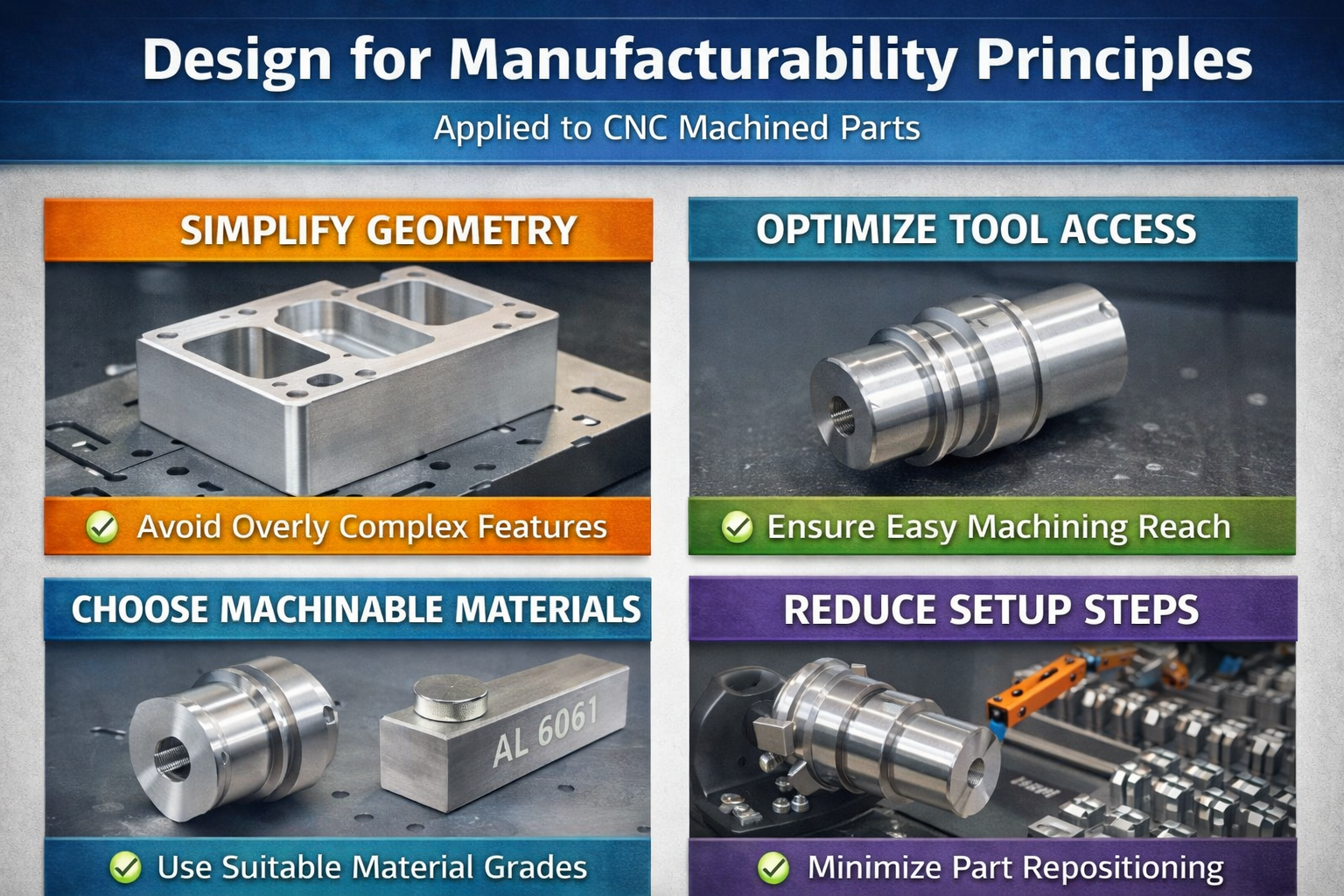
What separates a cost-effective design from an expensive one? Often, it comes down to a handful of decisions made early in the design process. The following DFM best practices help you create machine components that are efficient to produce without sacrificing functionality:
- Maintain appropriate wall thickness - Thin walls vibrate during machining, reducing accuracy and increasing the risk of part deformation. For aluminum, keep walls at least 0.8 mm thick. For plastics, aim for 1.5 mm minimum. Walls thinner than these thresholds can increase machining time by 100% to 300% as machinists must slow down dramatically to compensate.
- Add internal corner radii - CNC cutting tools are round, which means they cannot create perfectly sharp internal corners without additional expensive processes like EDM. Design internal corners with a radius at least 1/3 the depth of the pocket. A single corner requiring EDM can cost three to five times more than one machined with a standard end mill.
- Limit feature depth ratios - Deep pockets and holes create tool access challenges. Standard drill bits perform cost-effectively up to a 4:1 depth-to-diameter ratio. Beyond this, specialized tooling and slower operations drive costs significantly higher. Deep milling features between 8:1 and 10:1 may require two to three times longer machining time.
- Ensure tool accessibility - CNC machines cut from above, making hidden features problematic. Ensure cutting tools can reach all features without obstruction. Overlooking tool access often forces late-stage design changes that delay production.
- Choose chamfers over external fillets - External fillets require special tooling and additional machine time. Where appearance permits, chamfered edges are more economical to produce while providing similar functional benefits.
- Select appropriate materials - Material choice impacts both machinability and cost. Common grades like 6061-T6 aluminum or 303 stainless steel machine efficiently and are readily available. Exotic or hard materials require slower cutting speeds and specialized tooling.
These principles apply across custom parts manufacturing regardless of whether you are producing prototypes or production volumes. A design optimized for manufacturability from the start reduces quotes, shortens lead times, and minimizes the back-and-forth that delays projects.
Avoiding Common Design Pitfalls
Even experienced engineers fall into traps that inflate manufacturing costs. Understanding these pitfalls helps you avoid them before they appear on your quote.
Over-specifying tolerances - As covered previously, blanket tight tolerances across every dimension dramatically increase inspection time and rejection rates. A documented case study showed a medical startup reduced part costs from $300 to $85 per unit simply by relaxing tolerances on non-critical features from ±0.05 mm to ±0.2 mm. Apply precision only where function demands it.
Demanding unnecessary surface finishes - Standard CNC machining produces a surface finish around Ra 3.2 μm, which suits most applications. Requesting smoother finishes requires secondary operations like polishing or grinding. Before specifying mirror-like surfaces, ask whether the feature is visible, whether it affects sealing, or whether it contacts other parts. If not, standard finishes typically suffice.
Ignoring narrow region constraints - Tight gaps between features force manufacturers to use long, small-diameter tools prone to vibration and breakage. Keep gaps between features at least three times the diameter of the smallest cutting tool required. Narrow regions increase machining time and reduce part quality.
Creating text and logo complexity - Engraving text or logos directly with CNC mills is surprisingly slow. The tool must trace every line individually, sometimes taking longer than machining the entire rest of the part. Consider alternative marking methods like laser engraving or pad printing for decorative elements.
Proper DFM preparation accelerates your quoting process significantly. When manufacturers receive a well-designed part, they can quote quickly and accurately. Designs requiring extensive feedback and revision cycles extend timelines by weeks. Parts manufacturing partners recognize professional buyers who submit production-ready designs and often prioritize their projects accordingly.
The relationship between design complexity and lead times is direct. Complex geometries requiring multiple setups, specialized tooling, or tight tolerances take longer to produce. Simpler designs that respect machining constraints move through production faster. When timeline matters, DFM optimization becomes a competitive advantage.
Before finalizing your design, run through this quick self-check: Are internal corners radiused? Are walls thick enough for your material? Are deep features within acceptable aspect ratios? Are tight tolerances limited to critical dimensions? If you can answer yes to these questions, your design is positioned for efficient, cost-effective production.
With design fundamentals addressed, the next consideration involves how production volume affects manufacturer selection and project planning.
Prototype to Production Scaling Considerations
Your design is optimized for manufacturability. Now comes a question that fundamentally shapes your supplier strategy: are you building ten parts or ten thousand? The answer determines which type of cnc manufacturing companies you should engage. A manufacturer perfectly suited for rapid prototyping may struggle with high-volume production, and vice versa. Understanding these distinctions prevents costly mismatches that derail projects at critical stages.
The journey from initial concept to mass production is not a straight line. Each phase demands different manufacturing capabilities, pricing structures, and quality systems. Choosing the right partner at each stage accelerates your timeline and protects your budget.
Scaling from Prototype to Production
Think of product development as a series of gates. At each gate, your requirements shift, and so should your manufacturing approach. According to industry experts at Fictiv, the prototype stage is where design validation happens. You need speed and flexibility, not economies of scale. A single prototype might cost significantly more per unit than production parts, but that premium buys you critical learning before committing to tooling or high-volume contracts.
The transition from prototype to low-volume production acts as a proving ground. This intermediate phase, typically ranging from tens to several hundred thousand units depending on the product, allows you to refine both the design and the manufacturing process. Low-volume runs reveal assembly challenges that single prototypes cannot expose. They also validate that your chosen cnc machining centers can maintain consistency across larger quantities.
What capabilities matter at each stage? Consider these distinctions:
- Prototype Phase - Speed dominates. You need manufacturers who can turn CAD files into physical parts within days, sometimes even one working day for urgent iterations. Flexibility to change materials, dimensions, or features between orders matters more than unit cost.
- Low-Volume Production - Consistency becomes critical. The manufacturer must demonstrate repeatable quality across hundreds or thousands of units. Design for manufacturability feedback gains importance as you prepare for scale.
- Mass Production - Efficiency and cost optimization drive decisions. Automated production lines, statistical process control, and supply chain reliability become essential. Large cnc machining operations with 5-axis capabilities and automated material handling deliver the throughput high-volume programs demand.
According to manufacturing research from JLCCNC, combining rapid prototyping with CNC machining at strategic points can shorten development cycles by 30% and reduce trial-and-error costs by 50%. For example, aerospace engine components might use 3D printing for initial wax prototypes with complex cooling channels, then transition to precision CNC machining for the final investment casting cavity with surface finishes reaching Ra 0.4 μm.
Volume Considerations in Manufacturer Selection
How do you match manufacturer type to production volume? The following comparison breaks down key differences between prototype-focused manufacturers and high-volume production specialists:
| Factor | Prototype-Focused Manufacturers | High-Volume Production Specialists |
|---|---|---|
| Typical Lead Times | 1-5 working days; some offer same-day delivery | 4-12 weeks; longer setup but faster per-unit throughput |
| Pricing Structure | Higher per-unit cost; no tooling amortization | Lower per-unit cost at volume; setup costs spread across production |
| Minimum Order Quantities | 1 piece accepted; no minimums common | 500-5,000+ pieces typical; economies require volume |
| Design Flexibility | High; changes between orders expected | Low; changes require engineering change orders and revalidation |
| Quality Systems | Inspection-based; first article reports | Process-based; SPC monitoring, automated inspection |
| Equipment Focus | Versatile 3-axis and 5-axis mills; quick-change fixturing | Automated lines; lights-out machining; dedicated tooling |
The economic crossover point varies by part complexity, but a general guideline applies. When batch sizes fall below 50 pieces, prototype-focused shops typically deliver better value. As industry analysis confirms, when volumes exceed 500 pieces, dedicated CNC production becomes more advantageous economically.
Modern machine parts manufacturing facilities increasingly blur these lines. Some machined components manufacturers invest in flexible automation that handles both low and high volumes efficiently. These hybrid operations use advanced CNC machining products like multi-axis machining centers with automated pallet changers that reduce setup time while maintaining production-level throughput.
What should you look for when evaluating high-volume capability? According to New Age Metal Fabricating, the global CNC machine market is projected to grow from $101.22 billion in 2025 to $195.59 billion by 2032. This growth reflects manufacturers investing in integrated systems that combine milling, drilling, and finishing in single footprints. A facility with modern multi-axis equipment and automated material handling signals genuine high-volume capability.
Key capacity indicators to evaluate include:
- Machine count and type - Multiple identical machines enable parallel production and reduce single-point-of-failure risks
- Automation level - Automated loading, tool changers, and in-process inspection support consistent quality at scale
- Shift coverage - Facilities running multiple shifts or lights-out operations deliver faster throughput
- Quality infrastructure - Statistical process control, automated inspection, and real-time monitoring maintain consistency across thousands of parts
Some buyers make the mistake of starting with a high-volume manufacturer for prototype work, expecting seamless scaling later. This approach often backfires. High-volume operations optimize for efficiency, not agility. Their quoting processes, minimum order requirements, and lead times reflect production-scale thinking. Prototype requests may sit in queue behind larger programs or receive premium pricing that erases any future relationship benefit.
The smarter approach? Match manufacturer type to your current phase while planning for transitions. Work with prototype specialists during development, then qualify production partners as your design stabilizes. Many successful programs use different suppliers for each phase, leveraging each partner's core strengths rather than forcing one manufacturer to excel at everything.
With volume considerations mapped, the next critical factor involves understanding what drives CNC machining costs and how to optimize your spending without sacrificing quality.
Pricing Factors and Cost Optimization Strategies
You have selected the right manufacturer type and understand how volume affects your project. But here is the question that ultimately determines project viability: what will this actually cost? CNC machining pricing often feels opaque to first-time buyers. Quotes arrive with total figures but little explanation of how those numbers were calculated. Understanding the underlying cost drivers gives you leverage to optimize spending without compromising the quality of your machined metal parts.
The truth is that CNC machining costs are not arbitrary. Every line item traces back to specific factors you can influence. According to manufacturing cost analysis from PARTMFG, the total cost of a CNC machined part can be estimated using this formula: Estimated Cost = (Material Cost + Setup Cost) + (Machining Time × Hourly Rate) + Finishing Cost. Each component in this equation represents an opportunity for optimization.
Understanding CNC Machining Cost Drivers
What makes one part cost $15 and another $150? The difference comes down to a handful of primary factors that compound throughout production. Understanding these drivers helps you make informed decisions during design and specification stages when changes cost nothing but deliver significant savings.
- Material Selection - Raw material costs vary dramatically. Aluminum typically ranges from $5 to $10 per pound and machines quickly, reducing tool wear and cycle times. Steel costs $8 to $16 per pound and requires slower cutting speeds. Stainless steel and titanium command premium prices and demand specialized tooling. Beyond raw cost, material machinability directly impacts machining time. According to industry research from Geomiq, selecting cost-effective materials that meet functional requirements rather than defaulting to premium options can reduce total part costs by 20% or more.
- Design Complexity - Simple geometries machine quickly using standard tooling. Complex features with intricate contours, deep pockets, or tight internal corners require specialized cutters, multiple setups, and slower feed rates. According to manufacturing data, simple designs cost approximately $20 per hour to machine, while intricate designs requiring 5-axis operations can reach $35 to $70 per hour.
- Tolerance Requirements - Standard tolerances around ±0.005 inches (0.127 mm) represent baseline costs. Tighter tolerances demand slower machining speeds, frequent tool changes, enhanced quality checks, and higher potential scrap rates. Each step tighter on the tolerance scale adds measurable cost without adding value unless the application genuinely requires that precision.
- Surface Finish Specifications - The default machined finish of Ra 3.2 μm incurs no additional cost. Smoother finishes require progressively more effort. According to finishing cost analysis, Ra 1.6 μm adds approximately 2.5% to base price, Ra 0.8 μm adds about 5%, and Ra 0.4 μm can add up to 15% due to required post-machining polishing.
- Order Volume - Setup costs including programming, fixturing, and first article inspection remain fixed regardless of quantity. For single parts, the entire setup cost lands on one unit. For batch orders, these costs spread across hundreds or thousands of pieces. A part costing $134 for one unit might cost only $13 per unit when ordered in quantities of 100.
- Machine Type Required - Three-axis machines typically run $10 to $20 per hour. Five-axis machines offering greater versatility and precision range from $20 to $40 per hour or more. The part geometry determines which machine class is required, directly impacting hourly rates applied to machining time.
When evaluating quotes for metal machining parts, ask manufacturers to break down costs by category. This transparency reveals where your money goes and identifies optimization opportunities specific to your project.
Strategies for Cost-Effective Manufacturing
Knowing cost drivers is useful. Knowing how to reduce them without sacrificing quality is powerful. The following strategies help you optimize metal parts machining costs through smart design choices and appropriate specifications.
Choose Materials Strategically - Select the most cost-effective material that meets your functional requirements. Aluminum 6061 machines faster and costs less than stainless 316 steel in applications that do not require corrosion resistance. ABS plastic costs less than nylon for non-load-bearing components. Consider material availability as well. Readily available grades like aluminum 6061 cost less than specialty alloys like aluminum 7075.
Simplify Where Function Permits - Every complex feature adds machining time. Round internal edges simplify cutting compared to sharp corners requiring specialized tooling. Avoid excessively deep cavities that demand special geometry tools. Limit threaded features or specify standard thread sizes that use readily available taps. Unless essential for branding, minimize engraved text and logos that trace slowly.
Specify Only Necessary Tolerances - Apply tight tolerances only to critical mating surfaces and functional dimensions. According to industry best practices, the default tolerance of ±0.127 mm is already quite accurate and sufficient for most applications. Over-specifying tolerances on non-critical features wastes money without improving part performance.
Match Surface Finish to Application - The standard Ra 3.2 μm finish suits most functional applications. Specify smoother finishes only where surface quality genuinely matters for function, sealing, or visible aesthetics. Internal features and hidden surfaces rarely require premium finishes.
Leverage Volume Economics - When possible, order cnc milled parts in batches rather than single pieces. The per-unit cost drops dramatically as fixed setup costs spread across larger quantities. Even if you do not need all parts immediately, ordering ahead can deliver substantial savings.
Use Standard Hole Sizes - Specifying standard drill bit sizes allows manufacturers to use readily available tooling rather than custom cutters. Following UNC, UNF, or metric thread standards simplifies production and reduces costs. Standard hole sizes also streamline quality inspection.
Prototype Before Production - Creating small prototype runs before committing to large orders catches design issues early. Discovering a flaw in ten parts costs far less than discovering it in ten thousand. Prototyping validates both design and manufacturing process before significant investment.
The table below summarizes surface finish options with their cost implications and recommended applications:
| Surface Finish | Ra Value | Additional Cost | Recommended Applications |
|---|---|---|---|
| Standard Machined | 3.2 μm | Baseline (none) | Internal components, non-visible surfaces, functional parts |
| Fine Machined | 1.6 μm | +2.5% | Visible surfaces, light sealing applications, milled parts requiring smooth feel |
| Precision Finish | 0.8 μm | +5% | Sealing surfaces, bearing interfaces, aesthetic components |
| Mirror Finish | 0.4 μm | +15% | Optical components, high-end consumer products, medical devices |
Cost optimization does not mean cutting corners. It means eliminating waste by aligning specifications with actual requirements. A well-optimized design delivers the same functional performance at significantly lower cost than an over-specified alternative. When you understand what drives pricing, every design decision becomes an opportunity to maximize value from your cnc milled parts investment.
With pricing factors understood, the final consideration involves building relationships that transform transactional suppliers into trusted manufacturing partners.
Building Successful Manufacturer Partnerships
You have navigated the complete landscape of machined parts manufacturers, from understanding their roles to evaluating certifications, tolerances, and pricing. Now comes the most valuable insight: the difference between a good supplier and a great partner extends far beyond technical capabilities or competitive pricing. Long-term manufacturing relationships deliver compounding benefits that transactional approaches simply cannot match.
Think about it this way. Every time you switch suppliers, you restart the learning curve. New manufacturers must understand your quality expectations, communication preferences, and application requirements. That onboarding process costs time and introduces risk. Partners who know your business anticipate needs, flag potential issues before they become problems, and invest in your success because your growth means their growth.
Building Long-Term Manufacturing Partnerships
What transforms a vendor into a trusted partner? It starts with selecting manufacturers whose capabilities genuinely align with your requirements rather than forcing mismatched relationships. Throughout this guide, you have learned to evaluate precision machined products suppliers across multiple dimensions. Now apply those criteria strategically to build partnerships that endure.
The strongest manufacturing relationships share common characteristics:
- Aligned Capabilities - The manufacturer's core strengths match your primary needs. Asking a prototype specialist to handle high-volume production, or vice versa, strains the relationship from day one.
- Clear Communication Channels - Responsive contacts who understand your industry and speak your technical language reduce friction throughout every project.
- Proactive Problem Solving - Partners identify potential issues during quoting rather than after production begins. They offer design for manufacturability feedback that improves your machined products before manufacturing starts.
- Consistent Quality Systems - Certifications matter, but consistent execution matters more. Partners deliver precision cnc machined components that meet specifications order after order.
- Scalability - Your needs will evolve. Partners who can grow with you, scaling from prototypes to production volumes, eliminate the disruption of qualifying new suppliers as your business expands.
For automotive buyers in particular, IATF 16949 certification signals manufacturers with the quality infrastructure to support demanding production requirements. These certified facilities implement Statistical Process Control and maintain complete traceability throughout production. For example, Shaoyi Metal Technology exemplifies this approach, offering IATF 16949-certified precision CNC machining services that scale from rapid prototyping with lead times as fast as one working day to mass production of complex chassis assemblies and custom machine parts like metal bushings. Their specialized automotive manufacturing capabilities demonstrate what buyers should seek in a production partner.
The best cnc machine part suppliers become extensions of your engineering team, contributing expertise that improves your products rather than simply executing orders.
Your Next Steps in Manufacturer Selection
You now have the frameworks needed to move from first quote to trusted partnership. Here is a quick summary of the decision-making process covered throughout this guide:
- Define your project requirements completely - Material specifications, tolerance expectations, quantity needs, and delivery timelines form the foundation of every successful RFQ.
- Match manufacturer type to project phase - Prototype specialists for development, contract manufacturers for production, vertically integrated facilities for complex assemblies.
- Verify certifications relevant to your industry - ISO 9001 for general quality, IATF 16949 for automotive, AS9100D for aerospace, ISO 13485 for medical devices.
- Optimize designs for manufacturability - Wall thickness, corner radii, feature depths, and tolerance specifications all impact cost and timeline.
- Understand pricing drivers - Material, complexity, tolerances, finishes, and volume each contribute to total cost. Optimize where function permits.
- Start with pilot projects - Validate the relationship with small orders before committing to production volumes.
- Invest in partnership development - Share forecasts, provide feedback, and communicate openly to build relationships that deliver long-term value.
The journey from first quote to trusted partner takes time and deliberate effort. But the payoff is substantial. Reliable machined parts manufacturers who understand your business deliver better quality, faster response, and often preferential pricing that transactional buyers never see. They become competitive advantages that competitors cannot easily replicate.
Your next step? Apply these frameworks to your current sourcing needs. Whether you are qualifying your first custom machine parts supplier or optimizing an existing supply chain, the principles remain consistent. Define requirements clearly, evaluate capabilities systematically, and build relationships intentionally. The precision cnc machined components that power your products deserve partners committed to your success.
Frequently Asked Questions About CNC Machining Parts Manufacturers
1. What is the difference between a job shop and a contract manufacturer?
Job shops focus on short-run or one-off production with high flexibility, handling diverse parts on a per-quote basis without long-term commitments. Contract manufacturers are structured for repeatable production and long-term relationships, offering robust scheduling, quality assurance, material handling, and documentation systems. Job shops suit prototypes and small quantities, while contract manufacturers excel at recurring production runs requiring consistent quality and supply chain integration.
2. What certifications should I look for when selecting a CNC machining manufacturer?
The certifications you need depend on your industry. ISO 9001:2015 serves as the baseline quality standard for general manufacturing. Automotive applications require IATF 16949 certification, which ensures Statistical Process Control and traceability. Medical device manufacturing demands ISO 13485 for strict safety and FDA compliance. Aerospace components need AS9100D certification, while defense projects require ITAR compliance. IATF 16949-certified manufacturers like Shaoyi Metal Technology demonstrate the quality infrastructure needed for demanding automotive production.
3. How do tolerances affect CNC machining costs?
Tighter tolerances significantly increase manufacturing costs. Standard tolerances of ±0.005 inches represent baseline pricing, while shifting to ±0.001 inches can increase costs by 20-40%. Ultra-precision tolerances of ±0.0002 inches may double or triple production costs due to slower machining speeds, specialized tooling, and increased inspection requirements. Only about 1% of parts genuinely require ultra-precision tolerances, so applying tight specifications only to critical features helps control costs without sacrificing functionality.
4. What information should I include in my RFQ when contacting CNC machining companies?
A complete RFQ package should include CAD files in formats like STEP or IGES, 2D drawings with dimensions and GD&T callouts, exact material grade specifications, initial order quantities and anticipated annual volumes, tolerance requirements for critical dimensions, surface finish specifications using Ra values, secondary finishing operations needed, inspection and documentation requirements, and target delivery timelines. Well-prepared RFQs receive more accurate quotes and signal professionalism to potential manufacturing partners.
5. When should I use a prototype manufacturer versus a high-volume production specialist?
Use prototype-focused manufacturers during development when you need speed and flexibility, as they offer lead times of 1-5 days and accept single-piece orders. Once your design stabilizes and batch sizes exceed 500 pieces, transition to high-volume production specialists who offer lower per-unit costs through automated lines and process optimization. Some manufacturers serve both needs, but matching manufacturer type to your current phase typically delivers better results than forcing one supplier to excel at everything.