 Small batches, high standards. Our rapid prototyping service makes validation faster and easier —
  EN
EN


Custom Precision Machining Secrets: 9 Factors Your Supplier Won't Mention
What Custom Precision Machining Really Means for Your Projects
Ever wondered why some machined parts fit together seamlessly while others require endless adjustments? The answer often lies in the difference between standard fabrication and custom precision machining. Understanding this distinction can save you significant time, money, and frustration on your next manufacturing project.
Defining Custom Precision Machining in Modern Manufacturing
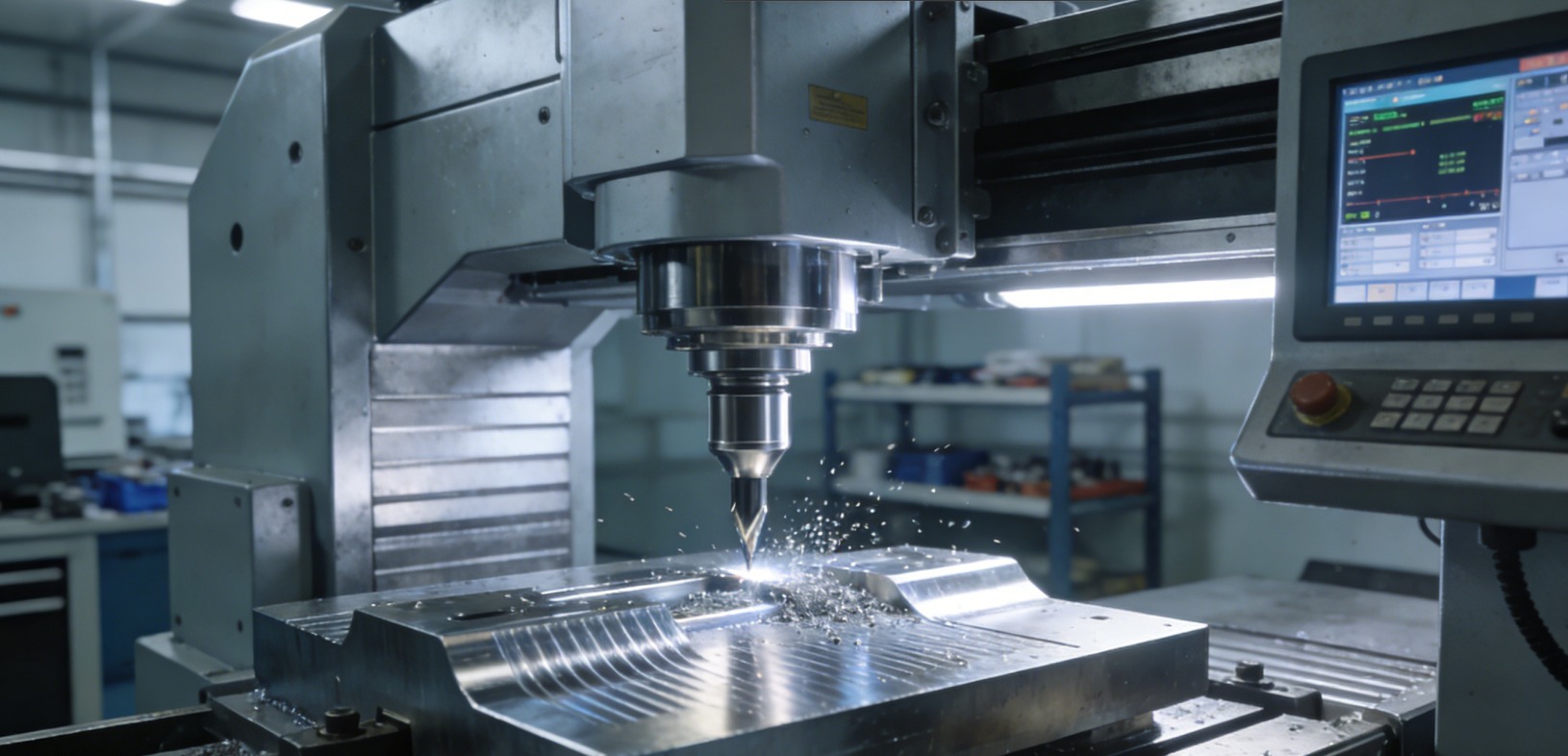
Custom precision machining represents the intersection of engineering ambition and manufacturing excellence. Unlike standard machining operations that follow general specifications, this approach delivers components tailored to your exact requirements with exceptional dimensional accuracy.
Custom precision machining is a specialized manufacturing process that produces components with tolerances as tight as ±0.0005" or better, using advanced CNC technology and rigorous quality control to meet application-specific requirements that standard fabrication cannot achieve.
What makes precision machining services truly valuable isn't just the equipment involved—it's the systematic approach to achieving consistency. Modern custom machine shops leverage computer numerical control (CNC) technology, real-time feedback systems like laser interferometry, and digital encoders to monitor and adjust the machining process dynamically. This level of control simply isn't possible with conventional methods.
How Precision Machining Differs from Standard Fabrication
The distinction between standard and precision machining goes far beyond marketing terminology. Standard machining typically delivers tolerances ranging from ±0.010" (±0.25 mm)—perfectly acceptable for structural components, housings, and general mechanical parts. However, when your application demands more, that's where custom machined parts enter the picture.
Consider the practical differences:
- Tolerance capability: Standard machining holds ±0.005" to ±0.010", while precision work achieves ±0.0005" or tighter
- Technology employed: CNC metal cutting, laser systems, and EDM versus manual or semi-automatic equipment
- Quality verification: Real-time process monitoring compared to post-production inspection only
- Error accumulation: Precision methods prevent cumulative errors in complex geometries that plague traditional approaches
Traditional machining relies heavily on operator skill and is limited by tool wear and machine rigidity. These factors introduce variability that accumulates—especially problematic when multiple features must interact precisely within an assembly.
The Role of Tight Tolerances in Custom Components
Here's what many suppliers won't explain: tight tolerances aren't just numbers on a drawing—they're functional requirements that directly impact whether your part works as intended. When tolerances are too loose, parts may not fit correctly, assemblies can experience excessive play, and performance becomes inconsistent from batch to batch.
So why do certain applications demand such precision? The answer connects directly to consequences. In aerospace, a component that's off by a few thousandths could compromise flight safety. Medical implants require diameters as small as 0.1 mm with surface finishes of Ra 0.1 μm to ensure biocompatibility and functionality. Defense systems protecting personnel in the field cannot afford dimensional uncertainty.
The real value of understanding precision requirements lies in making informed decisions. Not every feature on your part needs ultra-tight tolerances—specifying them unnecessarily increases costs without improving performance. Thoughtful engineering analysis helps identify which dimensions truly require precision machining and which can work within standard ranges. This knowledge transforms you from a passive buyer into an informed partner who can optimize both quality and budget.
Precision Machining Processes and When to Use Each
Knowing that you need precision is one thing—understanding which machining process delivers the best results for your specific part is another matter entirely. Each manufacturing method has distinct strengths, and selecting the wrong one can mean paying more for less optimal outcomes. Let's break down the core processes so you can make informed decisions before requesting quotes.
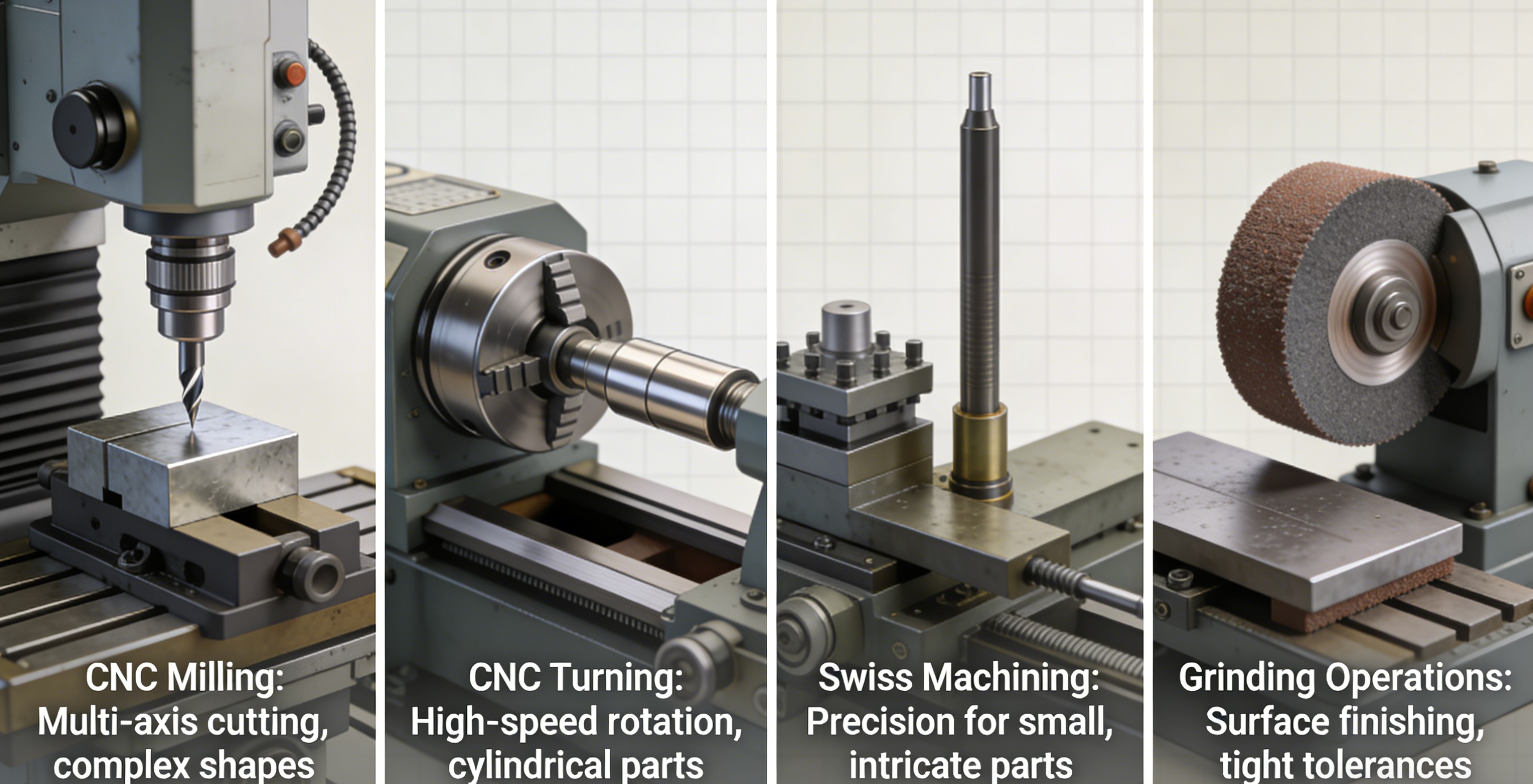
CNC Milling for Complex Geometries and Surface Features
Imagine your part has pockets, slots, angled surfaces, or intricate three-dimensional contours. CNC milling is likely your answer. In this process, the workpiece remains stationary while a rotating cutting tool moves along multiple axes to remove material progressively.
What makes milling particularly versatile? A cnc cutting machine can approach the workpiece from virtually any angle when using 3-axis, 4-axis, or 5-axis configurations. This flexibility enables:
- Complex prismatic shapes: Housings, brackets, and enclosures with multiple features
- Precision pockets and cavities: Internal features that require controlled depth and wall angles
- Surface contouring: Smooth curved surfaces for aerodynamic or aesthetic requirements
- Multi-sided machining: Parts that need features on multiple faces completed in fewer setups
Parts that are cnc milled typically achieve tolerances between ±0.001" and ±0.005" depending on material and geometry. The trade-off? Milling generally takes longer than turning for rotational parts because the tool must traverse more complex paths. However, when your design includes flat surfaces, angles, or intricate details, milling delivers results that other processes simply cannot match.
CNC Turning for Cylindrical and Rotational Parts
When your component is predominantly round—shafts, bushings, pins, or threaded fasteners—cnc turning becomes the efficient choice. Here, the workpiece spins at high speed while a stationary cutting tool shapes the exterior or interior surfaces.
This process excels because of its inherent speed advantage. Since the material rotates continuously against the tool, material removal happens rapidly and consistently. A cnc turning service typically delivers:
- Faster cycle times: Cylindrical parts produced more quickly than equivalent milling operations
- Excellent surface finish: The continuous cutting action creates smooth, consistent surfaces
- Cost efficiency: Lower per-part costs for symmetrical components, especially in volume
- Threading capability: Internal and external threads cut with precision during the same setup
Modern CNC turning centers often include live tooling—powered tools that can perform milling, drilling, and cross-hole operations while the part remains chucked. This capability reduces handling and improves accuracy by completing more features in a single setup.
Swiss Machining for Small Diameter High-Precision Work
Here's a process many buyers don't know about until they need it: swiss machining. Developed in the 1870s for watchmaking, this technique uses a unique sliding headstock design where the bar stock moves through a guide bushing while the cutting tool operates extremely close to the support point.
Why does this matter? The guide bushing provides exceptional rigidity by supporting the workpiece mere millimeters from where cutting occurs. This prevents the deflection that would otherwise ruin accuracy on long, slender parts. According to industry specifications, Swiss machines routinely achieve tolerances from 0.0001 to 0.0005 inches—precision that conventional turning struggles to match on small-diameter components.
Swiss machining shines when your parts have:
- High length-to-diameter ratios: Long, thin components that would deflect on standard lathes
- Micrometer-sized features: Intricate details requiring exceptional stability
- Small diameters: Typically under 32mm where the guide bushing provides maximum benefit
- Complex operations in one cycle: Threading, grooving, milling, and drilling completed without rechucking
Modern Swiss-type lathes feature between 7 and 13 axes, enabling simultaneous machining operations that dramatically reduce cycle times. Industries like medical devices, electronics, and aerospace rely heavily on this process for producing components such as bone screws, electrical contacts, and miniature shafts.
Grinding for Ultra-Fine Finishes and Hardened Materials
When tolerances tighten beyond what cutting tools can reliably achieve, or when you're working with hardened materials that would destroy conventional tooling, grinding becomes essential. This process uses abrasive wheels to remove small amounts of material with exceptional control.
Grinding isn't typically a primary shaping operation—it's often the finishing step after turning or milling. What it delivers is unmatched:
- Surface finishes below Ra 0.4 μm: Mirror-like surfaces for sealing applications or aesthetic requirements
- Tolerances to ±0.0001": The tightest dimensional control available in conventional machining
- Hardened material capability: Processes steels above 60 HRC that would damage cutting tools
Comparing Precision Machining Processes
Selecting the right process requires weighing multiple factors simultaneously. The following comparison helps clarify when each method delivers optimal results:
| Process Type | Best Applications | Typical Tolerances | Material Suitability | Relative Cost |
|---|---|---|---|---|
| CNC Milling | Complex geometries, pockets, multi-sided parts, contoured surfaces | ±0.001" to ±0.005" | Metals, engineering plastics, composites | Moderate to High |
| CNC Turning | Cylindrical parts, shafts, bushings, threaded components | ±0.001" to ±0.003" | Most metals and plastics | Low to Moderate |
| Swiss Machining | Small diameter parts, high L/D ratios, micro-features, medical/electronics components | ±0.0001" to ±0.0005" | Brass, stainless steel, titanium, plastics | Moderate to High |
| Grinding | Ultra-fine finishes, hardened materials, final sizing operations | ±0.0001" to ±0.0002" | Hardened steels, ceramics, carbides | High |
Notice how the choice isn't simply about capability—it's about matching process strengths to your specific requirements. A cylindrical part that could technically be milled would cost significantly more than one produced on a turning center. Conversely, attempting to turn a complex bracketed housing would be impossible.
Understanding these distinctions positions you to ask better questions when evaluating suppliers and ensures your projects use the most appropriate—and cost-effective—manufacturing approach. But process selection is only part of the equation. The material you choose influences everything from achievable tolerances to final part performance.
Material Selection Guide for Precision Machined Parts
You've selected the right machining process—but here's what many suppliers won't tell you: your material choice can make or break the entire project. Material properties directly influence achievable tolerances, surface quality, tool wear rates, and ultimately, your per-part costs. Choosing the wrong material for your application doesn't just affect performance—it can double your machining time or force design compromises you didn't anticipate.
Understanding how materials behave under cutting conditions transforms you from a passive specifier into a strategic decision-maker. Let's examine the key material categories and what each brings to your precision components.
Metals for High-Strength Precision Applications
Metals remain the backbone of custom precision machining, offering strength, durability, and predictable behavior under load. However, each metal family presents distinct machining characteristics that affect your project's timeline and budget.
- Aluminum alloys (6061, 7075, 2024): Excellent machinability with ratings around 70-90% compared to free-machining steel. Low tool wear, fast cutting speeds, and good thermal conductivity make aluminum ideal for complex geometries. Achieves tight tolerances easily but requires attention to thermal expansion during precision work.
- Stainless steel (303, 304, 316): Work-hardens during machining, demanding sharp tools and consistent feeds to avoid surface damage. 303 machines significantly easier than 304 or 316 due to added sulfur. Expect slower cycle times and higher tool costs compared to aluminum, but gains corrosion resistance and strength.
- Bronze alloys (C932, C954, C510): When you need to machine bronze for bearing surfaces or wear components, you'll find excellent machinability and natural lubricity. CNC machining bronze produces clean chips and smooth finishes, making bronze cnc work straightforward for experienced shops. Ideal for bushings, gears, and marine applications.
- Carbon steels (1018, 1045, 4140): Moderate machinability that improves with proper heat treatment selection. 1018 machines easily for general components; 4140 offers higher strength but requires more aggressive tooling strategies.
Here's something worth noting: machinability ratings indicate how easily a metal can be cut compared to a reference material, typically AISI B1112 steel at 100%. Metals with higher ratings cut faster, produce smoother finishes, and reduce tool wear. When evaluating quotes, remember that a material with half the machinability rating will generally require roughly double the machining time—directly impacting your costs.
Engineering Plastics and Their Machining Characteristics
Engineering plastics offer weight savings, chemical resistance, and unique properties that metals cannot match. However, machining bronze or aluminum and machining plastics require fundamentally different approaches. Plastics present challenges including heat sensitivity, dimensional instability, and tendency to deflect under cutting pressure.
Two materials dominate precision plastic machining: Delrin (acetal) and Nylon. Understanding their differences prevents costly specification errors.
- Delrin plastic (acetal homopolymer): The go-to choice when dimensional stability matters. Delrin absorbs virtually no moisture, so what you machine is what you get—dimensions remain stable even in humid environments. It cuts cleanly with excellent surface finishes straight off the tool, often requiring no post-processing. Ideal for gears, bearings, valve components, and any application requiring tight tolerances in plastic.
- Nylon for machining applications: Offers superior impact resistance and toughness compared to Delrin, plus better heat tolerance in reinforced grades. However, nylon is hygroscopic—it absorbs moisture from air, which changes both dimensions and mechanical properties. This characteristic means nylon can change size after machining if not conditioned properly, making it problematic for tight-tolerance assemblies in variable environments.
- PEEK and Ultem: High-performance polymers for extreme temperatures and chemical exposure. Expensive but irreplaceable when specifications demand their unique properties. Require experienced machining partners due to specialized tooling needs.
The practical difference? Delrin typically produces better surface finishes with less effort. Nylon's flexibility causes it to drag or deflect during cutting, often requiring extra finishing steps like deburring or sanding. For precision components—especially those in assemblies where parts must snap together or rotate precisely—Delrin is generally the safer choice despite slightly higher material costs.
Specialty Alloys for Demanding Environments
When standard materials cannot survive the operating conditions—extreme temperatures, corrosive chemicals, severe wear, or metal-to-metal contact—specialty alloys become necessary. These materials come with premium pricing and machining challenges, but deliver performance that justifies the investment.
Nitronic 60 exemplifies this category. This nitrogen-strengthened stainless steel provides exceptional galling resistance, meaning components can operate against other metals without seizing—even under high loads and limited lubrication. According to machinability data from HP Alloys, Nitronic 60 in annealed condition machines at approximately 24% the speed of free-machining B1112 steel, requiring carbide tooling and careful process control.
Specialty alloy machining demands understanding several critical factors:
- Work hardening: Materials like Nitronic 60 and Inconel harden rapidly during cutting. Feed rates must remain high enough to cut under the previous pass, avoiding the work-hardened layer that destroys tools.
- Heat management: Poor thermal conductivity concentrates heat at the cutting edge. Appropriate coolant selection and reduced cutting speeds prevent thermal damage to both tool and workpiece.
- Tool selection: Carbide tools rated C-2 for roughing and C-3 for finishing are typically required. High-speed steel simply cannot withstand the demands these materials impose.
- Rigidity requirements: Machine tools should operate at no more than 75% of rated capacity. Both workpiece and tool must be held rigidly with minimal overhang to prevent chatter and deflection.
When your application truly requires these materials, expect longer lead times and higher costs. However, for valve components, pump shafts, fasteners in marine environments, or any application where galling resistance is critical, the investment in proper material selection pays dividends throughout the component's service life.
Material selection sets the foundation for everything that follows. But even with the perfect material choice, specifying the wrong tolerance level can either unnecessarily inflate costs or compromise part function. Understanding tolerance specifications—and what they actually mean for your components—is the next critical knowledge gap to address.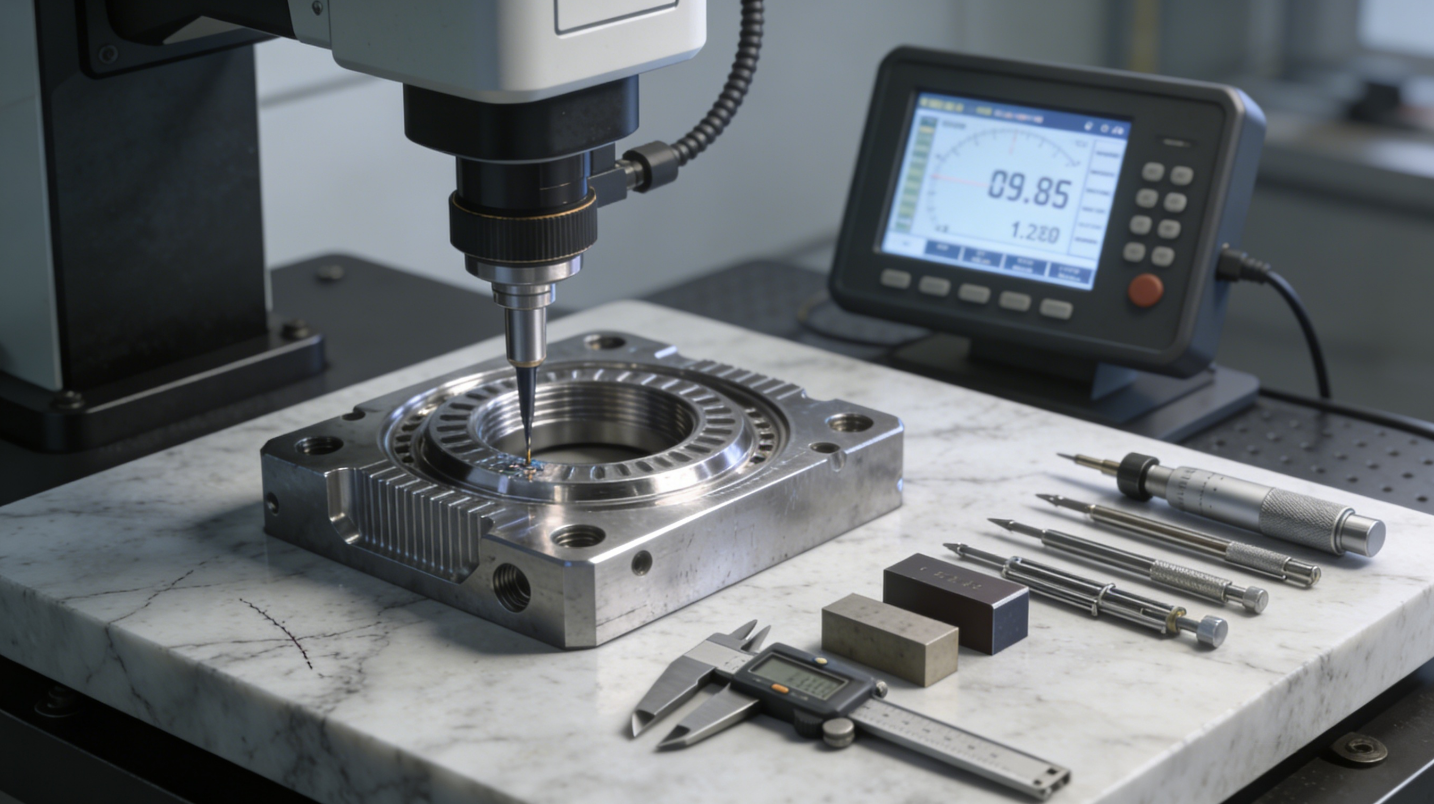
Tolerance Specifications and What They Mean for Your Parts
Here's a secret most suppliers won't volunteer: specifying tolerances incorrectly costs you money in both directions. Too loose, and your cnc machining parts won't function as designed. Too tight, and you're paying premium prices for precision you don't actually need. Understanding tolerance specifications transforms you from someone who simply accepts whatever a shop quotes into a buyer who can optimize quality and cost simultaneously.
What exactly do those ±0.001" numbers on drawings mean in practice? Let's decode tolerance grades, explore what affects achievable precision, and match specifications to actual part requirements.
Understanding Tolerance Grades and Their Applications
Tolerance grades aren't arbitrary—they represent distinct manufacturing capabilities with real implications for your project. According to ISO 2768 standards, tolerances divide into four classes: fine (f), medium (m), coarse (c), and very coarse (v). Most CNC machine shops default to medium tolerances around ±0.005" (0.13 mm) when customers don't specify requirements.
But here's what that standard tolerance doesn't tell you: different applications demand dramatically different precision levels.
| Tolerance Level | Typical Range | Common Applications | Cost Impact | Material Considerations |
|---|---|---|---|---|
| Standard | ±0.005" (±0.13 mm) | Structural components, housings, brackets, general mechanical parts | Baseline cost—no premium | Works with most metals and rigid plastics; accommodates minor material variations |
| Precision | ±0.001" (±0.025 mm) | Aerospace components, automotive performance parts, precision assemblies, bearing fits | 20-50% cost increase; longer cycle times | Best with dimensionally stable metals; plastics require careful selection for moisture stability |
| Ultra-Precision | ±0.0001" to ±0.0005" (±0.003-0.013 mm) | Surgical instruments, optical components, medical implants, semiconductor tooling | 2-5x standard cost; specialized equipment required | Limited to stable alloys and rigid materials; thermal expansion becomes critical factor |
Notice the cost impact column? According to industry data, only about 1% of machining parts actually require ultra-precision tolerances in the ±0.0002" to ±0.0005" range. Yet many buyers over-specify tolerances "just to be safe"—paying premium prices without functional benefit.
The practical question isn't "how tight can we go?" but rather "what tolerance does this feature actually need to function correctly?" A mounting hole that accepts a standard bolt doesn't require the same precision as a shaft bearing surface that must maintain consistent clearance under load.
Factors That Affect Achievable Tolerances
Sounds complex? Here's what determines whether your specified tolerances are realistic or set your project up for frustration.
Material properties directly limit precision. Soft, flexible materials like nylon deflect under cutting pressure, making tight tolerances difficult to hold consistently. As manufacturing experts note, the expectation of tolerance should align with material machinability—ISO 2768-1 Medium works for standard plastic parts, while metals and rigid materials can achieve ISO 2768-1 Fine.
Key material factors affecting tolerance capability include:
- Hardness: Harder materials cut more predictably but require specialized tooling; softer materials may deform during machining
- Thermal expansion: Materials with high thermal coefficients change dimensions as they heat during cutting—aluminum expands roughly twice as much as steel per degree of temperature change
- Dimensional stability: Hygroscopic materials like nylon absorb moisture and change size after machining; residual stresses in castings can cause warping when material is removed
Part geometry creates inherent limitations. Thin walls deflect under cutting forces. Long, slender features tend to vibrate or bend away from the tool. Deep pockets limit tool rigidity as cutters extend farther from their holders. These geometric realities mean certain features simply cannot achieve the same tolerances as robust, well-supported sections.
Machine capability sets the ceiling. CNC machines vary significantly in their precision capacity. While some equipment achieves ±0.0002" accuracy, maintaining this precision requires frequent calibration, controlled environments, and extended cycle times. As tools wear during production runs, holding extreme tolerances becomes progressively more challenging—a new tool meeting ±0.001" standards may struggle to maintain that precision after producing numerous parts.
Matching Tolerance Requirements to Part Function
The most cost-effective approach to cnc prototyping and production? Apply tight tolerances selectively—only where function demands them.
Consider how your part actually works:
- Mating surfaces: Where your part interfaces with other components, tolerances must ensure proper fit. A press-fit bearing bore needs precision; the external housing dimensions may not.
- Moving relationships: Rotating shafts, sliding surfaces, and clearance fits require controlled tolerances to prevent binding or excessive play.
- Standalone features: Dimensions that don't interact with other parts—overall length of a handle, width of a bracket—rarely need tight tolerances.
When specifying machining precision components, use a practical decision framework:
- Identify features that directly affect assembly, fit, or function—these are candidates for precision tolerances
- Keep non-critical dimensions at standard tolerances to minimize cost and lead time
- Consider tolerance stack-up when multiple parts assemble together—variations accumulate and can cause fit problems
- Include a tolerance table on your 2D drawing when requirements differ from industry defaults
If tolerances aren't specified when submitting cnc parts for production, most shops default to their standard tolerance—usually around ±0.004". While invisible to the naked eye, this deviation can significantly affect how parts fit together. A hole even 0.005" smaller than intended makes assembly more difficult than necessary.
The bottom line? Informed tolerance specification separates projects that flow smoothly from those plagued by rework and cost overruns. But tolerance requirements vary dramatically by industry—and each sector brings unique certification, documentation, and quality demands that affect how precision machining projects must be approached.
Industry Applications and Their Unique Machining Requirements
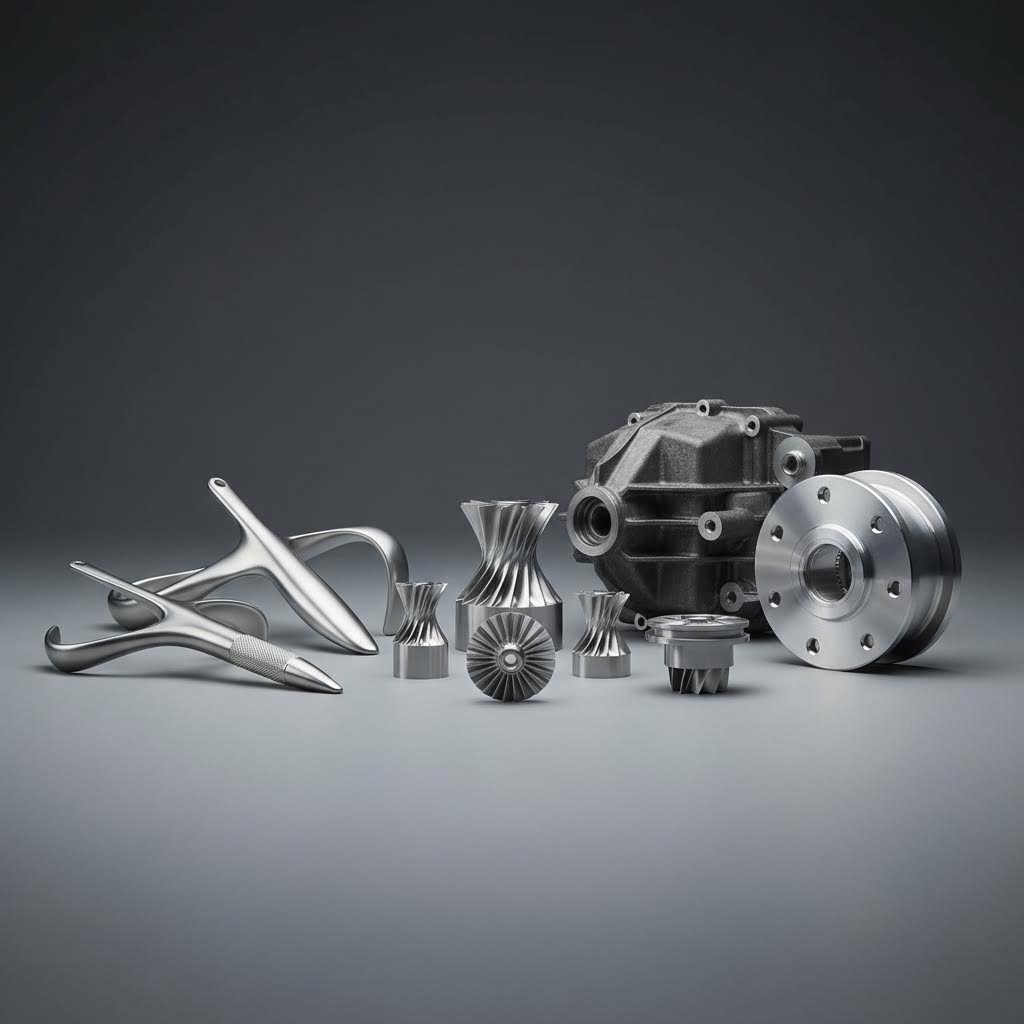
Every industry claims it needs "precision"—but what that actually means varies dramatically from sector to sector. The aerospace engineer tracking every gram of titanium from raw billet to finished bracket operates in a completely different world than the automotive supplier delivering thousands of aluminum housings weekly. Understanding these industry-specific requirements helps you communicate effectively with suppliers and ensures your project meets the regulatory hurdles your end application demands.
Here's what most suppliers won't explain upfront: each industry brings unique certification requirements, documentation standards, and quality expectations that directly affect project timelines and costs. Knowing these requirements before you request quotes positions you as an informed buyer.
Aerospace Components and Certification Requirements
Aerospace cnc machining operates under some of the most stringent requirements in manufacturing. When component failure can mean loss of life, every aspect of production—from raw material sourcing to final inspection—must be documented and traceable.
The gold standard for aerospace suppliers is AS9100 certification, which builds upon ISO 9001 by adding aerospace-specific controls for risk management, configuration management, and product safety. According to the International Aerospace Quality Group, over 80% of global aerospace companies require AS9100 certification from their CNC suppliers—meaning shops without this certification simply cannot compete for aerospace contracts.
What makes aerospace requirements particularly demanding?
- Full material traceability: Every component must be traceable from raw material heat numbers through finished part, including tool paths, operator shifts, and inspection logs
- First Article Inspection (FAI): AS9102-compliant documentation verifying that the first production part meets all drawing specifications—a detailed process that can generate dozens of pages per part number
- Configuration control: Strict revision management ensuring that design changes are properly documented and implemented without unauthorized deviations
- Risk management integration: Proactive identification and mitigation of potential quality issues before they affect production
Typical aerospace precision components include turbine blades, structural brackets, landing gear assemblies, and flight control system housings. Materials like titanium, Inconel, and aerospace-grade aluminum machining require specialized expertise due to their demanding cutting characteristics and tight tolerance requirements.
When evaluating suppliers for aerospace work, metal cnc machining capability alone isn't sufficient—you need verified documentation systems that can withstand FAA, DoD, or international regulatory audits.
Medical Device Machining and Biocompatibility Standards
Medical machining presents a unique challenge: parts must not only meet dimensional specifications but also interact safely with human tissue. Surface finish requirements extend beyond aesthetics into biocompatibility territory, where microscopic surface characteristics can determine whether an implant succeeds or triggers adverse reactions.
The regulatory framework for medical devices centers on ISO 10993, the international standard for biological evaluation. This comprehensive 23-part standard governs testing requirements based on two critical factors: the type of contact with the body (surface device, external communicating device, or implant) and duration of contact (limited, prolonged, or permanent).
For machined components, key medical industry considerations include:
- Biocompatibility testing: Materials must demonstrate appropriate host response for their intended application—what works for a skin-contact device may be unsuitable for a blood-contacting implant
- Surface finish specifications: Medical implants often require surface finishes of Ra 0.1 μm or better, achievable only through specialized finishing operations like electropolishing or precision grinding
- Material certifications: Raw material documentation must verify composition, processing, and properties—particularly important for implant-grade titanium and stainless steels
- Cleanroom handling: Some medical components require manufacturing or packaging in controlled environments to prevent contamination
- FDA 21 CFR Part 820 compliance: Quality system requirements for devices sold in the United States, aligning with ISO 13485 for international markets
Medical machining typically involves bone screws, surgical instruments, diagnostic equipment housings, and orthopedic implant components. The combination of tight tolerances, exceptional surface finishes, and comprehensive documentation makes medical device manufacturing among the most demanding applications for precision machining.
When your part requires a cnc machine for metal in medical applications, verify that your supplier understands both the dimensional requirements and the broader regulatory context affecting documentation and traceability.
Automotive Precision Parts and Volume Scaling
Automotive applications present a different challenge: maintaining precision while scaling from prototype quantities to hundreds of thousands of parts annually. The industry's quality management standard—IATF 16949 certification—was developed by the International Automotive Task Force to harmonize quality requirements across the global automotive supply chain.
What distinguishes IATF 16949 from general quality standards? It combines ISO 9001 requirements with automotive-specific elements focused on defect prevention, variation reduction, and waste elimination throughout the supply chain. Many OEMs require this certification as a condition to supply—making it a gateway rather than an optional credential.
Key automotive machining requirements include:
- Production Part Approval Process (PPAP): Comprehensive documentation demonstrating that production processes consistently produce parts meeting specifications—typically required before volume production begins
- Statistical Process Control (SPC): Ongoing monitoring of critical dimensions using statistical methods to detect and correct variations before they produce defective parts
- Capacity planning: Demonstrable ability to scale from prototyping through mass production without quality degradation
- Cost reduction expectations: Automotive programs often include year-over-year cost reduction targets requiring continuous process improvement
- Just-in-time delivery: Reliable lead times supporting lean manufacturing and minimized inventory throughout the supply chain
Aluminum machining dominates automotive applications due to weight reduction pressures, though steel, cast iron, and engineering plastics remain important for specific components. Typical parts include transmission housings, engine brackets, chassis components, and powertrain elements.
For automotive projects requiring precision and scalability, Shaoyi Metal Technology's IATF 16949-certified machining services demonstrate what to look for in a qualified partner—combining tight tolerance capability with Statistical Process Control and lead times as fast as one working day for components ranging from complex chassis assemblies to custom metal bushings.
Understanding these industry-specific requirements helps you ask better questions when evaluating suppliers. But regardless of your industry, one factor affects every project: cost. And that's an area where transparency is often in short supply.
Cost Factors and Budget Considerations for Precision Projects
Ready for some honesty? Most suppliers avoid discussing cost drivers in detail because pricing conversations can get uncomfortable. But understanding what actually influences your custom precision machining quote transforms you from a buyer accepting whatever number appears on the proposal into someone who can make strategic trade-offs between requirements and budget.
Here's what determines whether your project comes in at $500 or $5,000—and how to control these variables before you request quotes.
Key Cost Drivers in Custom Precision Projects
Not all cost factors carry equal weight. Based on industry analysis from machining cost studies, here are the primary variables that influence pricing, listed in order of typical impact:
- Material selection and usage: Raw material costs vary dramatically—titanium costs significantly more than aluminum, and harder materials require specialized tooling that wears faster. The blank size matters too: larger starting material means more waste and longer machining time.
- Machining time: This directly drives labor and equipment costs. Complex designs with intricate features, tight tolerances, or deep cavities take longer to produce. Thicker materials require multiple passes, extending cycle times further.
- Setup and programming: Every new part requires machine preparation—installing tools, loading programs, and verifying first-article quality. These fixed costs exist regardless of whether you order one part or one hundred.
- Tolerance requirements: Precision costs money. Moving from standard ±0.005" to precision ±0.001" increases machining time, requires more skilled operators, and demands additional quality checks throughout production.
- Design complexity: Features like thin walls, deep pockets, and tight internal corners require slower feed rates and specialized tooling. Multi-axis operations add capability but also machine time.
- Post-processing: Surface finishing, heat treatment, plating, or specialized coatings add steps and cost. Even standard deburring and edge breaking contribute to final pricing.
According to TMC Technologies' cost breakdown, typical CNC machining rates range from $35 to $40 per hour for 3-axis milling, jumping to $75 to $120 per hour for multi-axis work. These rates include machine depreciation, maintenance, energy consumption, and labor—but material and post-processing costs are additional.
While metal punching and sheet metal punch operations offer different cost structures for sheet-based components, precision machining from solid stock carries inherent material and time investments that affect every quote you receive.
How Volume Affects Per-Part Pricing
Here's where economies of scale become your friend—or your challenge. Small batch cnc machining carries higher per-unit costs because setup expenses get spread across fewer parts. Order 10 pieces, and each one absorbs 10% of that setup investment. Order 1,000, and each absorbs only 0.1%.
The volume effect extends beyond setup amortization:
- Material purchasing: Bulk orders often qualify for quantity discounts on raw materials, reducing your machinist metal cost per part
- Process optimization: Larger runs justify investing time in optimizing tool paths and feeds, reducing cycle time per piece
- Automation viability: High-volume production makes automated loading, bar feeding, and lights-out machining economically practical
- Reduced idle time: Operators spend proportionally less time on non-productive activities like inspection documentation and part handling
The practical implication? Prototype and low-volume runs inherently carry premium pricing due to setup amortization. If your project allows ordering in batches rather than one-offs, you'll typically see significant per-part savings.
However, don't over-order to chase lower unit costs. Holding excess inventory ties up capital and risks obsolescence if designs change. Balance volume discounts against realistic demand forecasting.
Balancing Tolerance Requirements with Budget
Remember that tolerance table from earlier? Here's where it becomes a budgeting tool. Every tolerance callout tighter than standard increases cost—sometimes dramatically.
The cost escalation happens because precision work requires:
- Slower machining speeds to maintain accuracy
- More frequent tool changes as wear affects dimensional consistency
- Additional inspection time verifying critical dimensions
- Higher-skilled operators or engineers monitoring production
- Specialized equipment capable of achieving and maintaining tight specifications
A practical decision framework for budget-conscious specification:
- Identify truly critical dimensions: Which features actually require tight tolerances to function? Specify precision only where necessary.
- Use standard tolerances as your baseline: Default to ±0.005" for non-critical features—this costs nothing extra and speeds production.
- Consider tolerance relaxation: Can you achieve functional requirements with ±0.002" instead of ±0.001"? The cost difference may surprise you.
- Evaluate material alternatives: Sometimes switching to a more machinable material achieves the same tolerances at lower cost.
Getting Accurate Online Machining Quotes
When you're ready to request a cnc quote online, preparation determines quote accuracy. Incomplete information leads to padded estimates—suppliers protect themselves by assuming worst-case scenarios when details are missing.
To get the most accurate online machining quotes:
- Provide complete 3D CAD files in standard formats (STEP, IGES, or native formats)
- Include 2D drawings with all tolerance callouts and surface finish requirements
- Specify exact material grade, not just "aluminum" or "stainless steel"
- Indicate quantity needed and whether repeat orders are expected
- Define any required certifications, testing, or documentation
- State realistic timeline expectations—rush charges add significantly to cost
The more complete your request, the more accurate your quote. And accurate quotes prevent unpleasant surprises when invoices arrive.
Understanding cost factors empowers better decision-making. But even with perfect cost awareness, projects can derail before they start if you're not properly prepared. The next section covers exactly what you need to have ready before engaging with a precision machining supplier.
How to Prepare for a Custom Precision Machining Project
You've selected your process, chosen your material, and understand your tolerance requirements. Now comes the step that separates smooth projects from frustrating ones: preparation. According to CNC fabrication experts at Eurotech, an incorrect CAD model, missing tolerances, or under-specified material can result in production delays, unnecessary revisions, and inflated costs.
Here's what most suppliers won't tell you upfront: well-prepared documentation can reduce production costs by 20-30% and eliminate back-and-forth delays that extend lead times. Let's cover exactly what you need to provide for successful custom precision machining projects.
Essential Design Files and Format Requirements
Your 3D CAD model forms the foundation of CNC programming. Modern machining systems read part geometry directly from CAD files, but format compatibility matters more than many buyers realize.
When preparing your primary machining files, prioritize these universally accepted formats:
- STEP (.stp, .step): The industry standard for exchanging 3D data between different CAD systems—works with virtually every CAM software
- IGES (.igs, .iges): Another widely supported format, though slightly older than STEP
- Parasolid (.x_t, .x_b): Excellent geometry transfer with minimal data loss
- Native formats: SolidWorks (.sldprt), Inventor (.ipt), or Fusion 360 files work if your supplier uses matching software—but avoid relying on these when working with external contractors
While a 3D CAD file is sufficient to request a quote, technical drawings remain critical for manufacturing. Drawings communicate details that 3D files cannot convey: threads, tolerances tighter than standard, surface finish requirements on specific faces, and inspection requirements.
Export your 2D drawing as PDF combined with DWG or DXF format. This combination eliminates misinterpretation by CAM programs while providing a clear visual reference for machinists throughout production.
Critical Specifications to Define Before Quoting
Incomplete specifications force suppliers to make assumptions—and those assumptions typically err on the expensive side to protect against risk. Define these elements clearly before submitting your cnc cut requirements:
- Material specification: State the exact grade, not just the material family. "6061-T6 aluminum" communicates clearly; "aluminum" leaves room for costly misunderstandings. Include heat treatment condition where applicable.
- Tolerance callouts: Mark critical dimensions with specific tolerances on your 2D drawing. Features without callouts will be produced to shop standard—typically ±0.005"—which may or may not meet your functional needs.
- Surface finish requirements: Specify Ra values for surfaces requiring better-than-standard finish. Standard machined surfaces typically achieve Ra 3.2 μm (125 μin); tighter finishes of Ra 1.6 μm or Ra 0.8 μm require additional operations and should be called out specifically.
- Thread specifications: Use standard thread designations (M4x0.7, 1/4-20 UNC) rather than dimensioning thread features. Specify thread depth, chamfer requirements, and whether threads are through or blind.
- Quantity and delivery: State your order quantity and realistic timeline. Rush requirements add cost; planning ahead saves money.
- Certification requirements: If your application requires material certifications, first article inspection reports, or specific documentation, state this upfront.
One commonly overlooked detail: verify that your units are consistent (mm or inches throughout) and that your model has a clearly defined zero point. Inconsistent units are a frequent cause of production errors requiring reprogramming.
Design for Manufacturability Considerations
Even perfect documentation can't save a design that fights against manufacturing realities. Design for manufacturability (DFM) focuses on making your part efficient and cost-effective to produce—often revealing opportunities to reduce cost without compromising function.
Common design issues that increase costs or cause delays:
- Sharp internal corners: Rotating tools cannot create perfectly sharp internal corners. Specify corner radii matching standard tool sizes (1/8", 1/4", etc.) to avoid expensive custom tooling or EDM operations.
- Deep, narrow pockets: Features with depth-to-width ratios exceeding 4:1 require specialized long-reach tooling, slower speeds, and multiple passes—all adding time and cost.
- Thin walls without support: Walls thinner than 0.5mm in metals or 1.0mm in plastics deflect under cutting pressure, making tight tolerances difficult or impossible to hold.
- Undercuts and internal features: Features that standard tools cannot reach require special setups, custom tooling, or secondary operations like EDM.
- Unnecessary tight tolerances: Specifying ±0.001" on non-critical dimensions adds cost without functional benefit. Reserve precision callouts for features that truly require them.
While CNC cnc cuts excel at complex geometries, simpler designs generally cost less and produce faster. Before finalizing your design, consider whether decorative features or overly complex geometries add value proportional to their manufacturing cost.
For projects involving aluminum spinning or other specialized forming operations that might complement machined features, discuss hybrid approaches with your supplier—sometimes combining processes reduces overall cost compared to machining everything from solid stock.
Pre-Submission Checklist
Before sending your project for quoting, run through this final verification:
- 3D model exported in STEP or IGES format with no missing surfaces or geometry errors
- 2D drawing in PDF format showing all critical dimensions, tolerances, and finish requirements
- Material grade clearly specified with heat treatment condition
- Thread callouts using standard designations with depth and chamfer requirements
- Surface finish requirements noted where they exceed standard Ra 3.2 μm
- Units verified consistent throughout all documentation
- Quantity and delivery timeline stated
- Certification or documentation requirements listed
A data package prepared this way allows programming to begin almost immediately upon receipt. Suppliers can provide accurate quotes without padding for unknowns, and production proceeds without delays for clarification.
Proper preparation positions you as an informed buyer who understands the manufacturing process. But even well-prepared projects can encounter problems. Understanding the most common mistakes—and how to avoid them—protects your investment from costly errors.
Common Precision Machining Mistakes and How to Avoid Them
Even experienced engineers make costly errors when specifying custom precision machining projects. The frustrating part? Most of these mistakes are entirely preventable—if you know what to watch for. After seeing thousands of projects cross their shop floors, seasoned machinists can predict which requests will sail through production and which will hit roadblocks within minutes of reviewing the documentation.
Here's what most suppliers won't volunteer: they'd rather quote your project as submitted than point out problems that might lose them the job. Understanding these common pitfalls before you submit your next project protects both your budget and your timeline.
Avoiding Common Design Mistakes That Increase Costs
Design errors multiply costs faster than almost any other factor. According to manufacturing specialists at Uptive, overly complex designs that don't contribute functional value create longer machining times, elevated tool wear, and unnecessary production challenges.
- Over-specifying tolerances: This is the most expensive mistake buyers make. Research from precision manufacturing studies shows that moving from ±0.05 mm to ±0.02 mm raises costs by around 50%—but going from ±0.02 mm to ±0.01 mm can multiply costs several times. Many drawings include "safety tolerances" added out of caution rather than functional necessity. The solution? Apply tight tolerances only to features where function demands them, and use standard tolerances everywhere else.
- Sharp internal corners: Rotating cutting tools cannot create perfectly sharp corners—they leave radii equal to the tool diameter. Specifying sharp internal corners forces suppliers to use expensive secondary operations like EDM or custom tooling. Instead, design fillets matching standard tool sizes (1/8", 1/4") to streamline production.
- Unnecessarily complex geometries: Features that look impressive in CAD but don't improve part function waste machining time and increase tool wear. Before finalizing designs, ask whether each feature adds value proportional to its manufacturing cost.
- Ignoring wall thickness limitations: Thin walls deflect under cutting pressure, making tight tolerances nearly impossible to hold. Walls thinner than 0.5mm in metals create machining challenges that add time and reduce quality consistency.
Material Selection Errors and Their Consequences
Choosing the wrong material doesn't just affect part performance—it can derail your entire production timeline. As industry experts note, many suppliers lack experience machining exotic materials like titanium or high-performance plastics, leading to higher scrap rates and unreliable results.
- Selecting materials without considering machinability: A material that performs perfectly in your application may be nightmare to machine. Neglecting machinability ratings results in extended production times, increased tool wear, and overall inefficiencies. Always check how your specified material cuts before finalizing specifications.
- Ignoring thermal expansion: Materials with high thermal coefficients change dimensions as they heat during cutting. Aluminum expands roughly twice as much as steel per degree of temperature change—critical when holding ultra-tight tolerances on larger parts.
- Mismatching material to environment: Specifying standard stainless steel for a marine application when you need galling resistance, or choosing nylon for a precision assembly exposed to humidity, creates functional failures that no amount of machining skill can prevent.
- Overlooking material certifications: For aerospace, medical, or defense applications, material traceability isn't optional. Discovering your supplier cannot provide required certifications after production completes wastes time and money.
Communication Gaps That Derail Projects
When searching for a "cnc shop near me" or evaluating machining shops near me, technical capability matters—but so does communication. According to machining industry analysis, poor communication leads to misunderstandings and production errors that cause frustrating delays and unnecessary corrections.
- Incomplete drawings and specifications: Missing tolerance callouts, unspecified surface finishes, or ambiguous thread designations force suppliers to assume—and assumptions rarely favor your budget. Complete documentation eliminates guesswork and prevents costly rework.
- Unrealistic timeline expectations: Assuming all local machine shops have identical turnaround times leads to missed deadlines and project delays. Precision work takes time; rushing production compromises quality. Discuss realistic timelines before committing to delivery dates you can't meet.
- Failing to specify post-processing needs: Focusing only on machining while ignoring finishing, heat treatment, or plating requirements creates incomplete parts requiring additional suppliers and extended lead times. Define your complete requirements upfront.
- Not verifying supplier capabilities: Not all machinist shops near me offer the same precision levels or certifications. Partnering with a shop that cannot hold your required tolerances or lacks necessary quality certifications wastes time and produces unusable parts.
The common thread running through these mistakes? They're all avoidable with proper preparation and clear communication. Taking time to verify specifications, validate material choices, and confirm supplier capabilities before production begins costs far less than correcting problems afterward.
Avoiding these pitfalls puts you ahead of most buyers. But knowing what mistakes to avoid is only half the equation—you also need to know how to identify the right precision machining partner who can deliver on your requirements consistently.
Choosing the Right Precision Machining Partner
You've avoided the common mistakes. Your documentation is complete, your tolerances are thoughtfully specified, and your material selection makes sense for the application. Now comes the decision that determines whether all that preparation translates into successful parts: selecting the right cnc service provider.
Here's what many buyers discover too late—not all precision cnc machining services deliver equal results, even when quoting identical specifications. The difference between a partner who executes flawlessly and one who creates ongoing headaches often comes down to factors you can evaluate before placing an order. When you're searching for "cnc near me" or comparing cnc services near me, knowing what questions to ask separates informed buyers from those learning expensive lessons through trial and error.
Quality Certifications That Matter for Your Industry
Certifications aren't just wall decorations—they represent verified systems that ensure consistent quality. According to supplier evaluation research, a reputable supplier should have stringent quality control measures in place and maintain certification standards appropriate to your industry.
Which certifications should you look for? It depends on your application:
- ISO 9001: The baseline quality management standard—demonstrates documented processes and continuous improvement commitment. Essential for any serious cnc machine shops near me.
- AS9100: Aerospace-specific certification building on ISO 9001 with additional controls for traceability, risk management, and configuration control. Required by over 80% of aerospace OEMs.
- IATF 16949: The automotive industry gold standard, combining ISO 9001 with automotive-specific requirements for defect prevention and variation reduction. Suppliers holding this certification demonstrate capability for high-volume precision custom machining with statistical process control.
- ISO 13485: Medical device quality management—critical for any components contacting patients or supporting diagnostic equipment.
Beyond verifying that certifications exist, confirm they're current and cover the processes relevant to your project. A shop certified for turning operations may not hold the same certification for milling—and expired certifications indicate quality system lapses.
Evaluating Technical Capabilities and Equipment
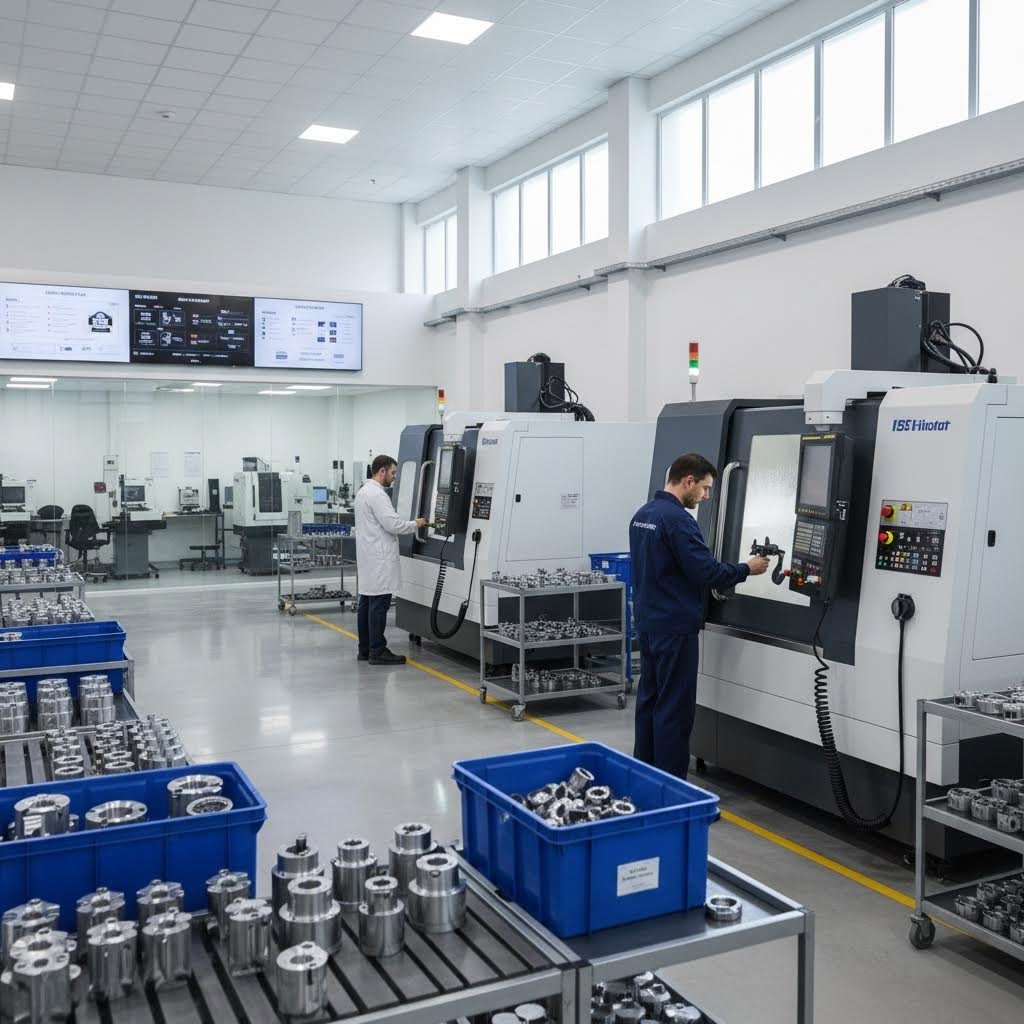
Certifications confirm systems exist, but equipment determines what's actually achievable. When evaluating precision custom machining partners, dig into specifics rather than accepting general capability claims.
According to industry experts at Lakeview Precision, state-of-the-art machining technology is a non-negotiable factor in ensuring precision, efficiency, and consistency. Multi-axis milling, real-time monitoring, and automation all contribute to higher precision levels.
Use this checklist when evaluating cnc machine shops near me:
- Machine tool age and condition: Newer equipment typically holds tighter tolerances more consistently. Ask about preventive maintenance schedules and calibration frequency.
- Axis capabilities: 3-axis machines handle simpler parts; 5-axis equipment enables complex geometries in fewer setups with better accuracy.
- Inspection equipment: CMM (Coordinate Measuring Machine) capability, surface finish measurement tools, and optical comparators verify that parts meet specifications—not just assumptions.
- Statistical Process Control (SPC): Real-time monitoring of critical dimensions catches variations before they produce defective parts. Suppliers using SPC demonstrate commitment to consistent quality, not just final inspection.
- Capacity for your volume: Can they handle prototyping through production scaling? A shop perfect for 10 pieces may struggle with 10,000—or vice versa.
Don't hesitate to request facility tours or video walkthroughs. Suppliers confident in their capabilities welcome the opportunity to demonstrate their equipment and processes.
Assessing Communication and Project Management
Technical capability means nothing if communication breaks down. Supplier evaluation studies emphasize that effective communication and support are essential for successful partnerships. A supplier willing to collaborate, provide regular updates, and address concerns promptly helps streamline projects and ensure timely delivery.
Evaluate these communication factors before committing:
- Responsiveness: How quickly do they reply to inquiries? Slow quote responses often predict slow production communication.
- Technical support: Can you speak directly with engineers or programmers about complex requirements? Or does everything filter through sales representatives?
- Design feedback: Does the supplier offer DFM (Design for Manufacturability) input that could improve your part or reduce costs? Partners who proactively identify optimization opportunities add value beyond simple order execution.
- Lead time reliability: Ask for references and verify on-time delivery performance. Consistent lead times matter more than aggressive promises that frequently slip.
- Problem resolution: How do they handle issues when they arise? Request examples of how they've resolved past quality or delivery problems.
The best precision machining relationships feel collaborative rather than transactional. Partners who invest in understanding your application—not just machining your drawing—deliver better outcomes over time.
What Qualified Partners Look Like in Practice
How do these criteria translate to real-world supplier selection? Consider what efficient precision machining & custom solutions providers demonstrate:
- Industry-appropriate certifications: IATF 16949 certification for automotive applications signals verified quality systems designed for high-volume consistency
- Process control investment: Statistical Process Control implementation shows commitment to variation reduction, not just final inspection
- Scalability: Capability spanning rapid prototyping through mass production without quality degradation
- Lead time performance: Demonstrated ability to deliver high-tolerance components with reliable turnaround—some suppliers achieve lead times as fast as one working day for urgent requirements
For automotive precision machining needs specifically, Shaoyi Metal Technology's IATF 16949-certified services exemplify these qualities—combining Statistical Process Control with prototyping-to-production scaling for components ranging from complex chassis assemblies to custom metal bushings.
Selecting the right partner transforms custom precision machining from a procurement transaction into a competitive advantage. The supplier who understands your requirements, communicates proactively, and delivers consistently becomes an extension of your engineering team—enabling you to focus on innovation rather than firefighting quality issues.
Frequently Asked Questions About Custom Precision Machining
1. What is custom precision machining?
Custom precision machining is a specialized manufacturing process that produces components with tolerances as tight as ±0.0005 inches or better using advanced CNC technology. Unlike standard machining that delivers tolerances of ±0.010 inches, precision machining employs computer numerical control, real-time feedback systems like laser interferometry, and rigorous quality control to create application-specific parts. This process is essential for aerospace, medical, automotive, and defense industries where dimensional accuracy directly impacts safety and performance.
2. How much does CNC machining cost per hour?
CNC machining costs vary significantly based on machine complexity and capabilities. Typical rates range from $35-$40 per hour for 3-axis milling, $75-$120 per hour for multi-axis work, and $100-$150+ per hour for 5-axis operations. These rates include machine depreciation, maintenance, energy, and labor—but material costs, setup fees ($50-$1,000+), and post-processing are additional. Volume significantly affects per-part pricing, as setup costs spread across larger orders reduce unit costs substantially.
3. What is the difference between standard and precision machining tolerances?
Standard machining typically holds tolerances of ±0.005 to ±0.010 inches, suitable for structural components and general mechanical parts. Precision machining achieves ±0.001 inches or tighter, while ultra-precision work reaches ±0.0001 to ±0.0005 inches for surgical instruments and optical components. The key difference lies in technology employed—precision work uses real-time process monitoring, specialized equipment, and skilled operators. Moving from standard to precision tolerances increases costs by 20-50%, while ultra-precision can multiply costs 2-5 times.
4. What certifications should I look for in a precision machining supplier?
Essential certifications depend on your industry: ISO 9001 is the baseline quality management standard for any serious supplier. AS9100 certification is required by over 80% of aerospace OEMs for traceability and risk management. IATF 16949 is the automotive industry gold standard, demonstrating capability for high-volume production with Statistical Process Control. ISO 13485 is critical for medical device components. Always verify certifications are current and cover the specific processes relevant to your project.
5. How do I prepare files for a custom precision machining project?
Provide complete 3D CAD files in STEP or IGES format, which are universally accepted across CAM software. Include 2D drawings as PDF with DWG/DXF showing all tolerance callouts, surface finish requirements (Ra values), and thread specifications using standard designations. Specify exact material grades with heat treatment conditions—not just 'aluminum' but '6061-T6 aluminum.' Verify units are consistent throughout and include quantity, timeline, and any certification requirements. Well-prepared documentation can reduce costs by 20-30%.