 Small batches, high standards. Our rapid prototyping service makes validation faster and easier —
  EN
EN


Stamping Automotive Parts: The Engineering Guide to Precision Manufacturing
TL;DR
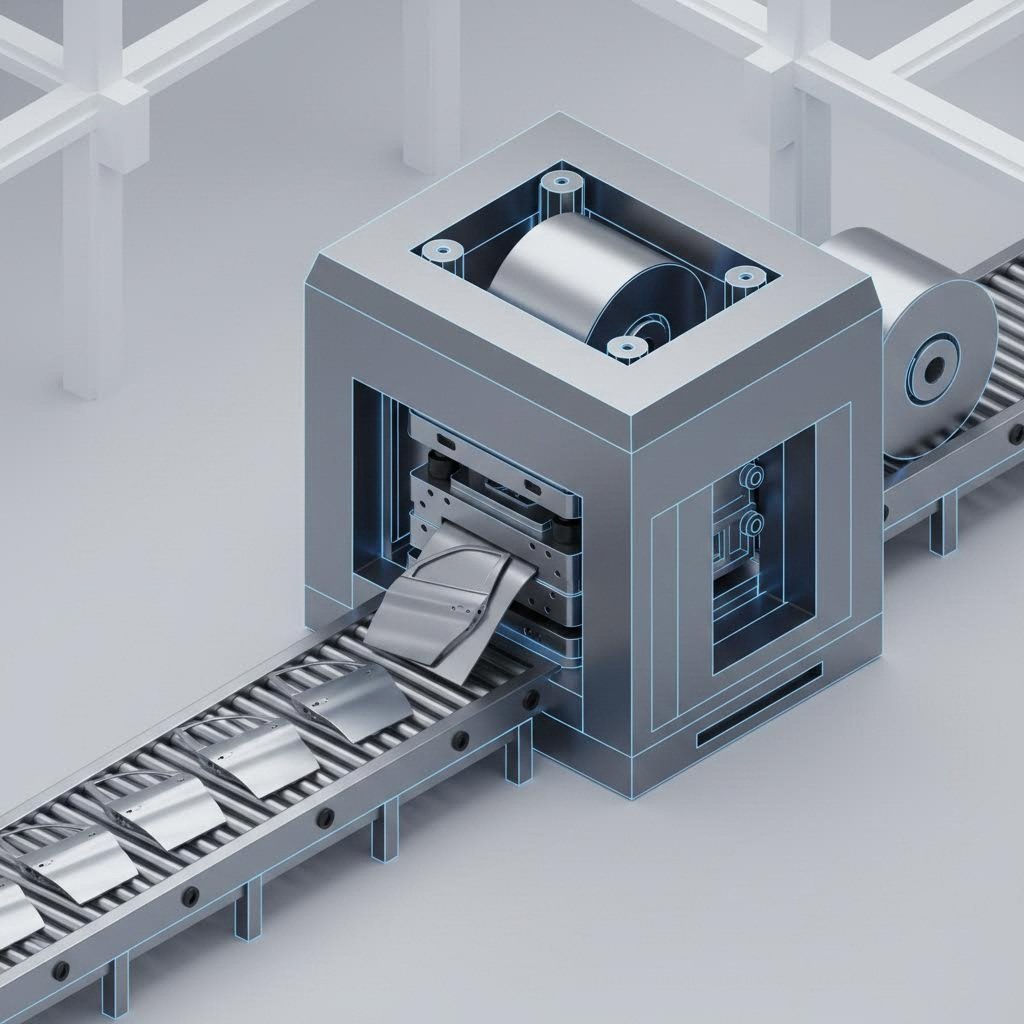
Stamping automotive parts is a high-volume manufacturing process that utilizes powerful presses and precision-engineered dies to transform flat sheet metal into complex, three-dimensional vehicle components. This technique, also known as pressing, relies on cold forming to achieve plastic deformation, ensuring parts retain their shape with exceptional accuracy. It is the backbone of automotive assembly, favored for its ability to produce everything from structural chassis rails to Class-A exterior panels with unmatched speed, consistency, and cost-efficiency at scale.
Fundamentals of Automotive Stamping
At its core, automotive stamping is the interaction between a press, a die, and raw material. The process begins with sheet metal—typically steel or aluminum—fed into a stamping press in coil or blank form. The press applies immense force, ranging from 12 tons for small brackets to over 1,600 tons for large body panels, to force the metal into a custom-designed tool called a die.
The science behind this transformation is plastic deformation. Unlike elastic deformation, where a material returns to its original shape after stress is removed, stamping pushes the metal past its yield strength so that it permanently adopts the geometry of the die. This requires precise calculation of tonnages and clearances. As noted in industry resources like American Industrial, modern stamping operations utilize both progressive dies (which perform multiple operations in a single continuous strip) and transfer dies (where parts are moved mechanically between separate stations) to achieve complex geometries.
The 7-Step Stamping Process
While the specific sequence varies by part complexity, the industry generally recognizes seven primary operations that occur within the press line. Understanding these steps clarifies how a flat sheet becomes a functional component.
- Blanking: The initial step where the rough outline of the part is cut from the coil strip. This creates the flat "blank" that will be formed in subsequent stages.
- Piercing: Punches create holes, slots, or cutouts in the blank. These are often used for fasteners or weight reduction.
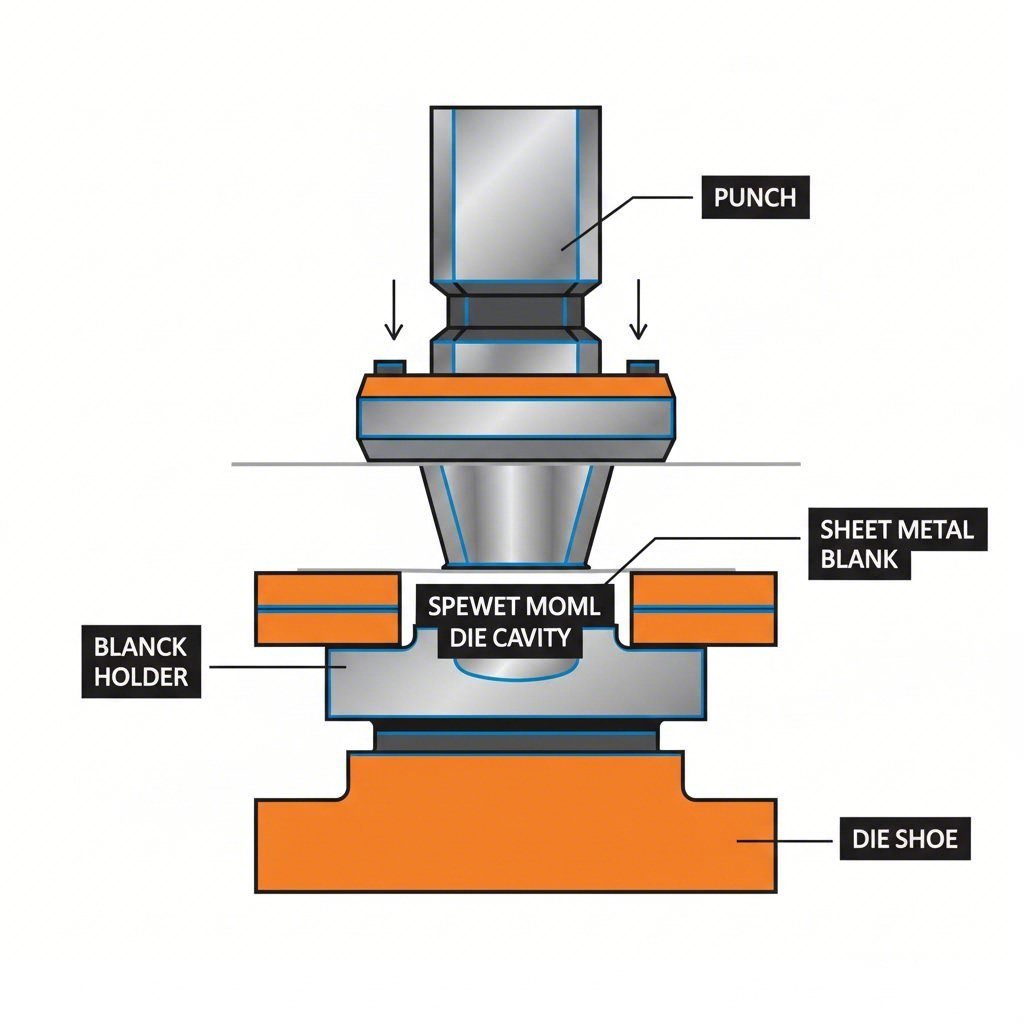
- Drawing: A critical forming operation where a punch forces the flat blank into a die cavity to create depth. This is essential for parts like oil pans or door panels.
- Bending: The metal is shaped along a straight axis, creating flanges or angles necessary for structural rigidity.
- Air Bending: A variation of bending where the punch presses the flat metal into a die opening without touching the bottom, allowing for adjustable angles based on stroke depth.
- Bottoming and Coining: High-pressure operations used to imprint fine details, flatten surfaces, or increase the density of the material for added strength.
- Pinch Trimming: The final separation of the formed part from the scrap skeleton, ensuring clean edges before the part exits the press.
Die Engineering & Precision
The press provides the force, but the die provides the intelligence. Often described as the "hidden hero" of manufacturing, the die consists of a male punch and a female cavity machined to microscopic tolerances. For automotive applications, precision is non-negotiable; Toyota reports working to tolerances as tight as 1/1000th of a millimeter to ensure seamless assembly.
A major challenge in die engineering is springback compensation. High-strength steels tend to slightly uncurl or return to their original shape after the press retracts. Engineers must design the die to over-bend the metal slightly so that it springs back to the exact desired dimension. Furthermore, controlling material flow is critical. Draw beads and pressure pads are used to restrain the sheet metal, preventing wrinkles or tears during deep drawing operations. The high upfront cost of these dies is justified by their longevity, often producing millions of parts over a vehicle's lifecycle.
Materials: Hard vs. Soft Steel
Material selection dictates the stamping strategy. Automakers balance the need for occupant safety (rigid materials) with crumple zones (formable materials) and fuel efficiency (lightweight materials).
| Material Type | Characteristics | Typical Application |
|---|---|---|
| Low-Carbon Steel (Soft) | Highly formable, cost-effective, easy to stamp without cracking. | Complex shapes like floor pans, inner door structures, and crumple zones. |
| High-Strength Low-Alloy (HSLA) | Stronger than standard steel, resists denting, lighter for equivalent strength. | Structural reinforcements, cross members, chassis components. |
| Advanced High-Strength Steel (AHSS) | Extremely rigid, difficult to form, requires higher tonnage presses. | Safety cages, A-pillars, B-pillars (passenger protection). |
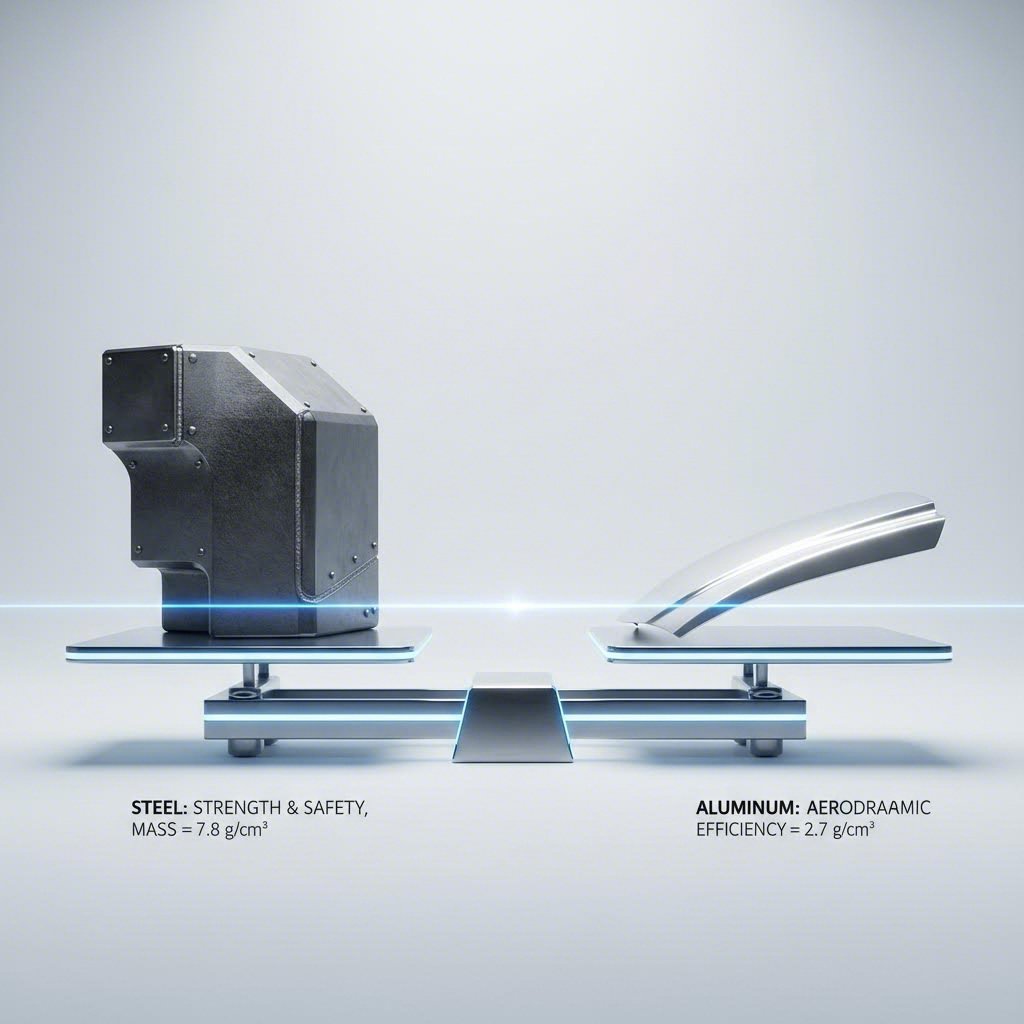
| Aluminum Alloys | Lightweight (approx. 1/3 weight of steel), reduces vehicle mass. | Hoods, roofs, doors (Class A surfaces) to improve fuel economy/range. |
Key Applications and Categories
Stamped automotive parts generally fall into three categories, each with distinct quality requirements.
- Class A Surface Panels: These are the visible exterior parts of the car, such as fenders, hoods, doors, and roofs. They require flawless surface finishes free of ripples or tool marks, as any imperfection will be magnified after painting.
- Body-in-White (BIW) Structural Components: These form the vehicle's frame and safety cell. Examples include pillars, rails, wheel arches, and firewalls. The priority here is dimensional accuracy and structural integrity rather than surface aesthetics.
- Small Precision Components: Often overlooked, these include millions of brackets, clips, fuel injector cups, and sensor housings. These parts often require intricate progressive die operations to fold and form small features rapidly.
Strategic Advantages for OEMs
Why does stamping remain the dominant process for automotive manufacturing? The primary answer is the economy of scale. While the initial investment in tooling (dies) is significant, the per-part cost drops dramatically as volume increases. A single press line can produce hundreds of parts per hour, a rate impossible to match with CNC machining or casting.
Furthermore, stamping offers flexibility across production stages. For manufacturers requiring certified precision, partners like Shaoyi Metal Technology bridge the gap between rapid prototyping (delivering 50 parts in as little as five days) and mass production with presses up to 600 tons. This scalability allows OEMs to validate designs quickly before committing to full-scale tooling, reducing financial risk. Additionally, the cold working nature of stamping actually strengthens the material through work hardening, allowing for thinner, lighter parts that still meet rigorous safety standards.
Conclusion: The Future of Metal Forming
Stamping automotive parts is a discipline that marries brute force with microscopic precision. As the industry shifts toward electric vehicles, the demand for lightweight materials like aluminum and high-strength steel alloys is pushing the limits of press technology and die design. The ability to produce complex, durable, and lightweight components at mass-production speeds ensures that stamping will remain indispensable to automotive engineering for decades to come.
Frequently Asked Questions
1. What is stamping in the automotive industry?
Stamping in the automotive industry is a manufacturing process where sheet metal is fed into a press and formed into specific vehicle parts using custom dies. It is used to create body panels, structural frames, and smaller components by applying high pressure to cut, bend, and shape the material.
2. Is metal stamping expensive?
Metal stamping requires a high upfront investment for the design and manufacturing of the custom dies. However, for high-volume production, it is extremely cost-effective. Mursix Corporation notes that once the tooling is paid for, the cost per unit is significantly lower than other manufacturing methods, making it ideal for mass-produced automotive parts.
3. What are the main steps in the stamping process?
The process typically involves a sequence of operations including blanking (cutting the outline), piercing (making holes), drawing (forming depth), bending (shaping angles), and trimming (removing excess metal). These steps can happen sequentially in a single press (progressive) or across multiple stations (transfer).