 Small batches, high standards. Our rapid prototyping service makes validation faster and easier —
  EN
EN


What Metal Is In A Catalytic Converter? Not Just Platinum
What Metal Is in a Catalytic Converter?
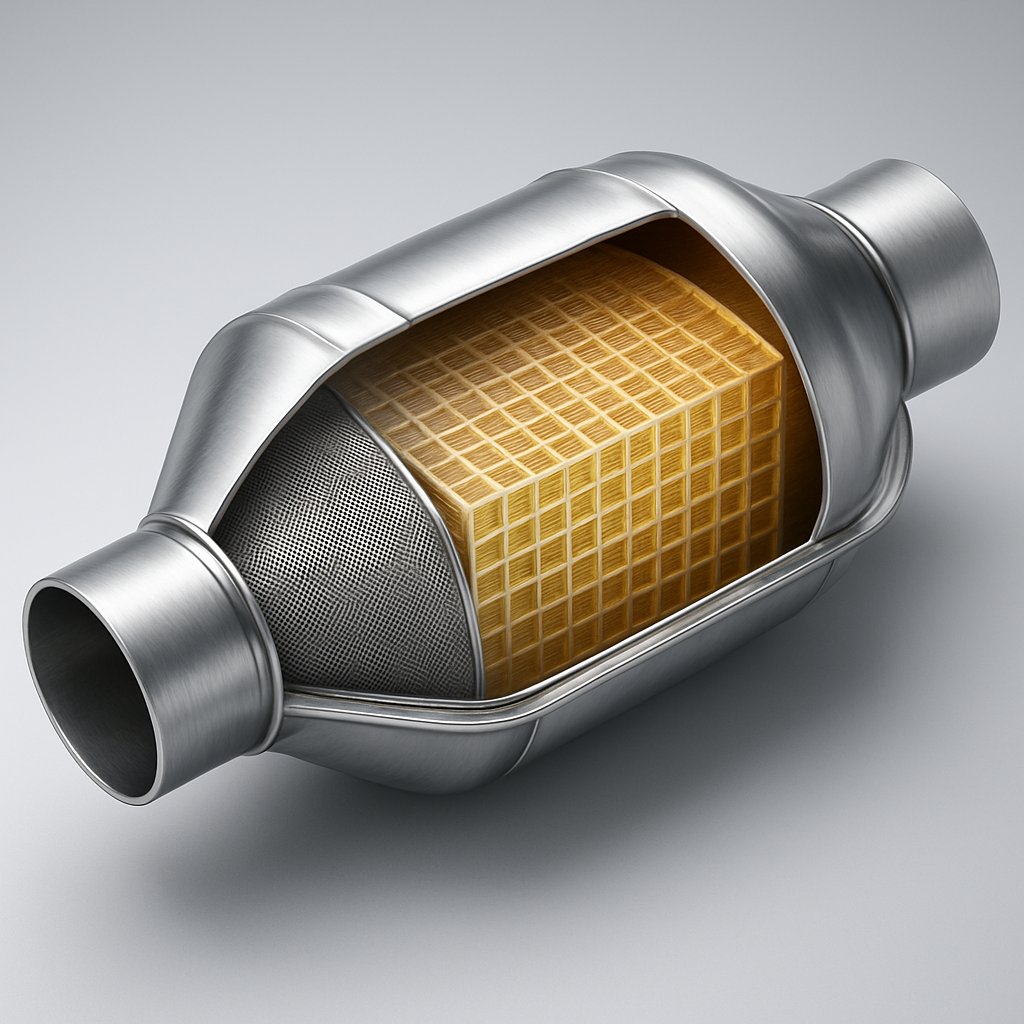
If you're asking what metal is in a catalytic converter, the clearest answer is this: most catalytic converters use platinum, palladium, and rhodium as the active catalyst metals. These precious metals help turn harmful exhaust gases into less harmful ones. But that is only part of what is in a catalytic converter. The unit also contains a ceramic or metallic honeycomb substrate, a washcoat that spreads the catalyst over a large surface area, a support or insulation mat, and a stainless-steel outer shell. Material guides from Johnson Matthey and PMRCC both show that the converter is a layered system, not a single lump of metal.
Direct Answer to What Metal Is in a Catalytic Converter
Most converters contain platinum, palladium, and rhodium, plus several non-precious materials that hold, protect, and support those metals.
- Catalyst metals: platinum, palladium, and rhodium. These do the chemical work.
- Substrate: a ceramic or metallic honeycomb, often called the brick, that gives the catalyst a large working surface.
- Washcoat: a coating that helps spread the active metals evenly across the substrate.
- Support mat and shell: structural parts that insulate the core and protect it inside a stainless-steel canister.
Why the Metal Answer Is More Than One Material
That is why questions like what metals are in a catalytic converter, what is inside a catalytic converter, or what is in a catalytic converter need a wider answer than just platinum. The visible shell is not the same thing as the precious metals doing the catalytic job. Also, not every unit uses the same formula. Johnson Matthey notes that gasoline and diesel vehicles use different catalyst systems, so the metal mix can change by application. In simple terms, catalyst metals speed up reactions, while structural materials hold everything together. That distinction matters, because the real story sits inside the shell, layer by layer.
What Is Actually Inside a Catalytic Converter
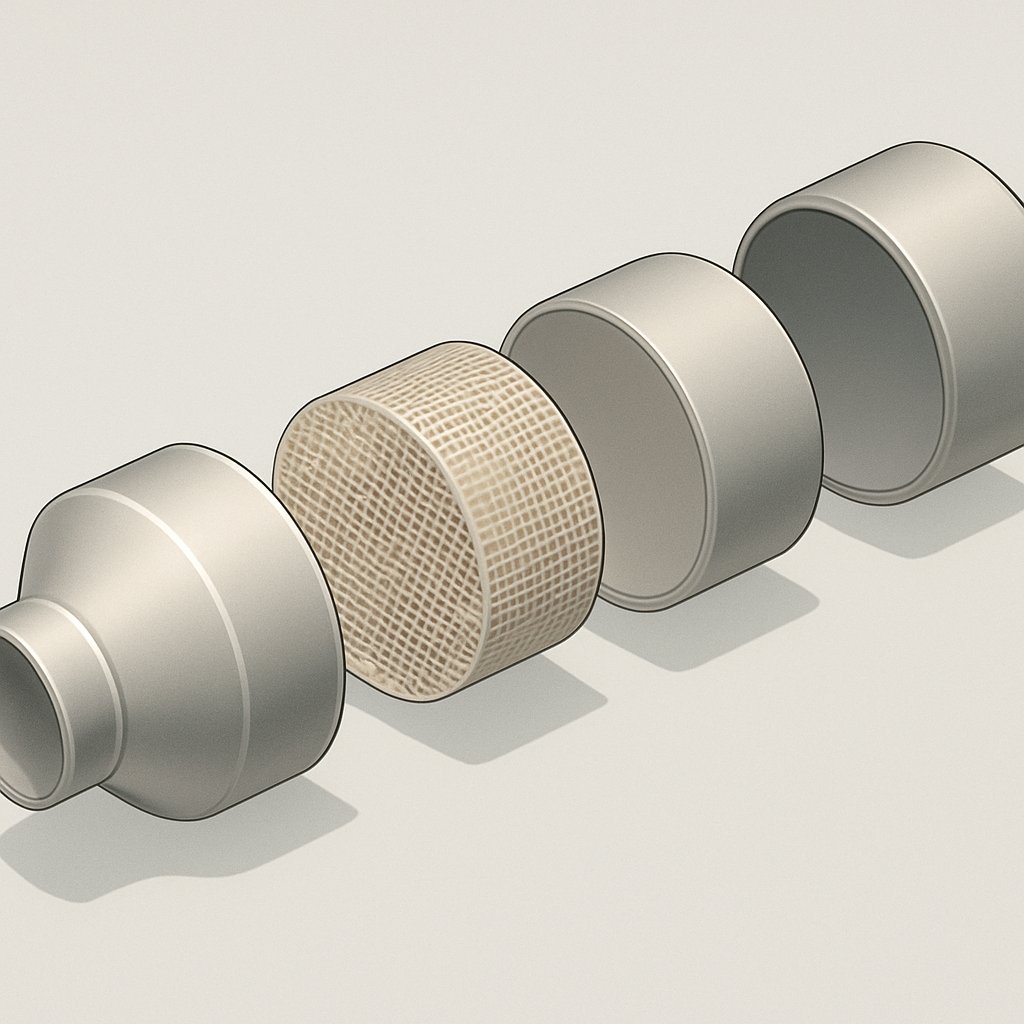
The precious metals do not sit loose inside the canister. A catalytic converter inside is a stacked assembly, with each layer handling a different job. From the outside, you first see the metal housing. That shell protects the core, but it is not the same thing as the platinum, palladium, or rhodium that perform the chemistry. Guides from Jendamark show the converter as an engineered package made up of a stainless-steel housing, support mat, and a substrate, while DieselNet explains how the washcoat carries the catalyst over that support.
Inside a Catalytic Converter Layer by Layer
Working from outside to inside of a catalytic converter, the order usually looks like this:
| Part | Typically made from | What it does |
|---|---|---|
| Outer housing and cones | Stainless steel | Provides strength, corrosion resistance, and a sealed connection to the exhaust system. |
| Support mat | Inorganic fibers, often polycrystalline alumina with binder | Holds the core in place, cushions vibration, manages expansion, and helps prevent gas bypass. |
| Substrate, or monolith | Ceramic or metal | Forms the internal structure that exhaust flows through. |
| Honeycomb channels | Built into the substrate | Create many small passages and a very large surface area for exhaust contact. |
| Washcoat | Porous refractory oxides, commonly alumina, with other oxides such as ceria, zirconia, titania, silica, or zeolites | Adds high surface area and helps disperse and stabilize catalyst materials. |
| Catalyst layer | Platinum group metals such as platinum, palladium, and rhodium | Speeds the exhaust-cleaning reactions. |
Substrate Washcoat and Catalyst Explained
If you are wondering what's inside of a catalytic converter, three terms matter most. The substrate is the core body. It can be ceramic or metallic. The honeycomb is the pattern of tiny passages formed in that core to increase surface area. The washcoat is a porous coating bonded to the substrate, designed to hold and spread the catalyst over a much larger active surface. DieselNet notes that alumina is the most common washcoat material, while other oxides may be added as carriers, promoters, or stabilizers.
That is why inside a cat converter, the shiny outer shell tells you very little about the chemistry happening at the center. Even inside of a catalytic converter with a metallic substrate, the structural metal and the active catalyst are different layers with different purposes. And that layered design sets up the next question naturally: if platinum, palladium, and rhodium share the same space, what does each one actually do?
How Platinum Palladium and Rhodium Work
Inside that coated honeycomb, the precious metals are not doing the same job in the same way. In a typical three-way system, each metal helps target a different part of the exhaust problem. That is why asking what precious metal is in a catalytic converter can be a little misleading. The better question is usually what precious metals are in a catalytic converter, because platinum, palladium, and rhodium often work as a team rather than as a single ingredient. Guidance from HowStuffWorks and Johnson Matthey shows that the exact chemistry can vary by application, but the typical roles are consistent enough to explain in plain English.
How Platinum Palladium and Rhodium Do Different Jobs
- Platinum: Often linked to both oxidation and reduction work, depending on the converter design. In everyday terms, it helps harmful exhaust gases react more easily on the catalyst surface.
- Palladium: Commonly associated with oxidation reactions, especially helping carbon monoxide and unburned hydrocarbons react with oxygen and become less harmful gases.
- Rhodium: Best known for reducing nitrogen oxides, or NOx, into nitrogen and oxygen. That role makes it especially important in controlling one of the toughest regulated emissions.
So when people ask about catalytic converter platinum, the answer is only partly complete. Platinum matters, but palladium and rhodium matter too. In many systems, platinum and palladium are tied to cleaning up carbon monoxide and hydrocarbons, while rhodium is especially valuable for handling NOx.
Rhodium gets so much attention because its NOx-reduction role is highly important, and even a small amount can strongly affect a converter's value.
Oxidation and Reduction Made Simple
These two chemistry terms sound technical, but the basic idea is simple. Oxidation means a pollutant reacts with oxygen. In a converter, carbon monoxide becomes carbon dioxide, and hydrocarbons are converted into carbon dioxide and water. HowStuffWorks describes this oxidation stage as working mainly over platinum and palladium.
Reduction is the opposite kind of move. Here, the converter helps strip oxygen away from nitrogen oxides. That leaves nitrogen, which makes up most of the air already, plus oxygen. In the same source, the reduction catalyst is tied especially to platinum and rhodium. Johnson Matthey also notes that gasoline and diesel vehicles use different catalyst systems, so what is the precious metal inside a catalytic converter depends on the vehicle and emissions strategy rather than one universal formula.
That difference in chemistry is exactly why metal content changes from one converter to another. A gasoline unit, a diesel setup, and even a hybrid application may lean on these metals in different ways.

What Metals Are in Catalytic Converters by Vehicle Type
The roles of platinum, palladium, and rhodium make more sense once you look at the vehicle around them. Not all exhaust streams behave the same way, so not all converters use the same precious-metal emphasis. That is the real answer behind questions like what metals are in catalytic converters and what are the precious metals in catalytic converters. The mix changes with engine type, combustion style, and the emissions problem the system is trying to solve.
Why Gasoline Diesel and Hybrid Converters Use Different Metal Mixes
Gasoline engines commonly use a three-way catalyst. Data from ScrapMonster describes a typical gasoline three-way formulation as roughly 30-35% platinum, 50-60% palladium, and 10-15% rhodium within the total platinum-group-metal content. That balance fits the gasoline engine's need to handle carbon monoxide, hydrocarbons, and nitrogen oxides together.
Diesel is different. If you have ever wondered, does a diesel engine have a catalytic converter, yes, it does, but the setup is usually different from a gasoline car. DieselNet explains that diesel engines run lean, with excess oxygen in the exhaust, so three-way catalysts are not suitable for diesel NOx control. Diesel systems therefore rely on diesel oxidation catalysts for CO and HC, while NOx control is typically handled by SCR or, in some cases, NOx adsorber technology. ScrapMonster shows a common diesel oxidation catalyst emphasis of about 85-95% platinum, 5-15% palladium, and about 0% rhodium.
Hybrid vehicles also still require catalytic converters, as noted in ScrapMonster. But hybrid is not one single catalyst recipe. The metal answer depends on the underlying engine and emissions strategy, which is why hybrids should not be treated as one universal category with one fixed metal ratio.
| Vehicle type | Main emissions challenge | Common catalyst emphasis | Design considerations |
|---|---|---|---|
| Gasoline | Simultaneous control of CO, HC, and NOx in a three-way system | Typically uses platinum, palladium, and rhodium together, with palladium often the largest share and rhodium supporting NOx reduction | Works with stoichiometric control and closed-loop oxygen sensing |
| Diesel | Lean exhaust contains excess oxygen, making NOx control more complex | DOCs are usually platinum-heavy, with some palladium and little to no rhodium | NOx is commonly handled by SCR or NOx adsorber systems rather than a gasoline-style three-way catalyst |
| Hybrid | Still needs exhaust aftertreatment because it still uses an internal combustion engine | No single universal hybrid formula in the sources; metal content varies by application | Best understood case by case, not as one separate metal recipe |
OEM and Aftermarket Differences That Affect Metal Content
Vehicle type is only half the picture. The other half is whether the unit is original equipment or a replacement. An OEM converter is built by the vehicle manufacturer or to its original specification. A guide from Noble6 describes OEM units as having a denser load of rhodium, platinum, and palladium, along with higher-quality materials aimed at durability and strict emissions compliance.
An aftermarket catalytic converter, by contrast, is a replacement part. The same source notes that aftermarket units are often cheaper because they may use less precious metal and lower-cost construction, with more variation in size, shape, and weld quality. That does not mean every replacement part is identical or that every factory unit carries the same loading. It does mean the original converter and the replacement one may not contain the same catalyst balance, even when they fit the same vehicle.
So a single answer about metal content is never quite enough. Gasoline, diesel, hybrid, OEM, and aftermarket designs all shift the picture. And once those design differences enter the conversation, the obvious follow-up is quantity: how much platinum, palladium, or rhodium is usually there in the first place?
How Much Platinum Is in a Catalytic Converter?
Metal mix and metal quantity rise and fall together. If you are asking how much platinum is in a catalytic converter, the most accurate answer is that there is no single standard number for every vehicle. The same caution applies to questions like how much palladium is in a catalytic converter or how much rhodium is in a catalytic converter. Data shared by Thermo Fisher shows just how wide the spread can be: the recoverable total of platinum, palladium, and rhodium together may range from about 1 to 2 grams in a small car to roughly 12 to 15 grams in a big truck in the US. A literature review indexed by ScienceDirect adds more context, describing total PGM content in general terms at around 0.1% to 0.3% by weight, while some cited examples place petrol vehicles in Europe around 2 to 3 grams total and diesel vehicles around 7 to 8 grams total. Those figures are useful benchmarks, not universal promises.
How Much Precious Metal Is Usually Present
That is why questions such as how much platinum is inside a catalytic converter are best answered by category rather than by one fixed figure. Several design variables change the loading:
- Engine size and displacement: larger engines often need larger or differently loaded converters.
- Fuel type: gasoline and diesel systems do not use the same catalyst strategy.
- Emissions requirements: stricter targets can push metal loading higher or shift the Pt, Pd, and Rh balance.
- Converter size and vehicle class: a small passenger car and a heavy truck are not built to the same scale.
- Manufacturer formulation: automakers can rebalance platinum, palladium, and rhodium over time and by model.
The ScienceDirect review also notes that complete PGM formulas are not usually published by manufacturers, and ratios can vary by region, maker, and application.
Why Exact Metal Content Is Hard to Estimate
Exact content usually requires manufacturer data or a professional assay. PMRCC describes how recyclers cut, grind, sample, and test converter material with analytical tools such as XRF and ICP to determine the actual recoverable metal. Appearance alone cannot reveal metal quantity. A stainless shell, a ceramic honeycomb, or even a damaged core does not tell you the exact platinum, palladium, or rhodium loading inside. That hidden variation is a big reason two converters that look similar can end up carrying very different recycling value.
Why Catalytic Converter Scrap Value Varies
That hidden difference in metal loading does more than affect emissions performance. It also explains why one used converter may have modest recycling interest while another becomes a major target in scrap and theft discussions. If you are asking what makes a catalytic converter valuable, the core answer is recoverable platinum-group metals. PMRCC notes that platinum, palladium, and rhodium are coated onto the substrate inside the unit, and those metals matter because they are difficult to mine and an important share of supply comes from recycling. In other words, why are catalytic converters so valuable has much more to do with the hidden catalyst layer than the steel canister you can see from outside.
Why Catalytic Converters Can Be Valuable
For buyers and refiners, value is tied to recoverable content, not appearance alone. Reported market results can be extremely wide. An IndexBox summary of ScrapMonster data describes quoted unit prices ranging from $13 to $832, which shows that how much are catalytic converters worth depends on classification, identification, and metal loading rather than guesswork.
| Value driver | Why it matters | What it often means |
|---|---|---|
| Metal mix | The ratio of platinum, palladium, and rhodium sets the base recycling interest. | More recoverable PGM content usually means higher catalytic converter scrap value. |
| Vehicle application | Different engines use different catalyst formulas. | Some diesel units contain mainly platinum, minimal palladium, and essentially no rhodium, which can reduce value compared with many gasoline units. |
| OEM vs aftermarket | Original units often carry heavier precious-metal loadings. | Reference guides note aftermarket converters may contain far less PGM than OEM versions. |
| Size and identification | Shape, weight, ports, serial numbers, and part codes help classify the unit. | Weight gives clues, but it is not a simple one-to-one rule for value. |
| Recycler evaluation | Professional buyers use documentation, databases, and sometimes assay tools. | Final value depends on recoverable metal, not on what a casual observer thinks is inside. |
Why Rhodium and Scrap Value Get So Much Attention
Rhodium gets outsized attention because even small amounts can matter a lot. In one ScrapMonster market snapshot, rhodium was listed far above platinum and palladium on a per-ounce basis. That price gap helps explain why certain converters draw so much interest. Still, recycling payouts are not the same as headline metal prices. The same ScrapMonster guide notes that scrap returns often represent only a portion of spot value after refining costs and losses, while PMRCC describes how XRF and ICP analysis are used to determine the actual recoverable platinum, palladium, and rhodium content.
So the shell may look like ordinary exhaust hardware, but the recycler is valuing a hidden chemical coating. That gap between what is visible and what is truly recoverable is exactly why visual clues can help with identification, yet still leave big limits on what you can know just by looking.
Where Is the Catalytic Converter Located and What Does It Look Like?
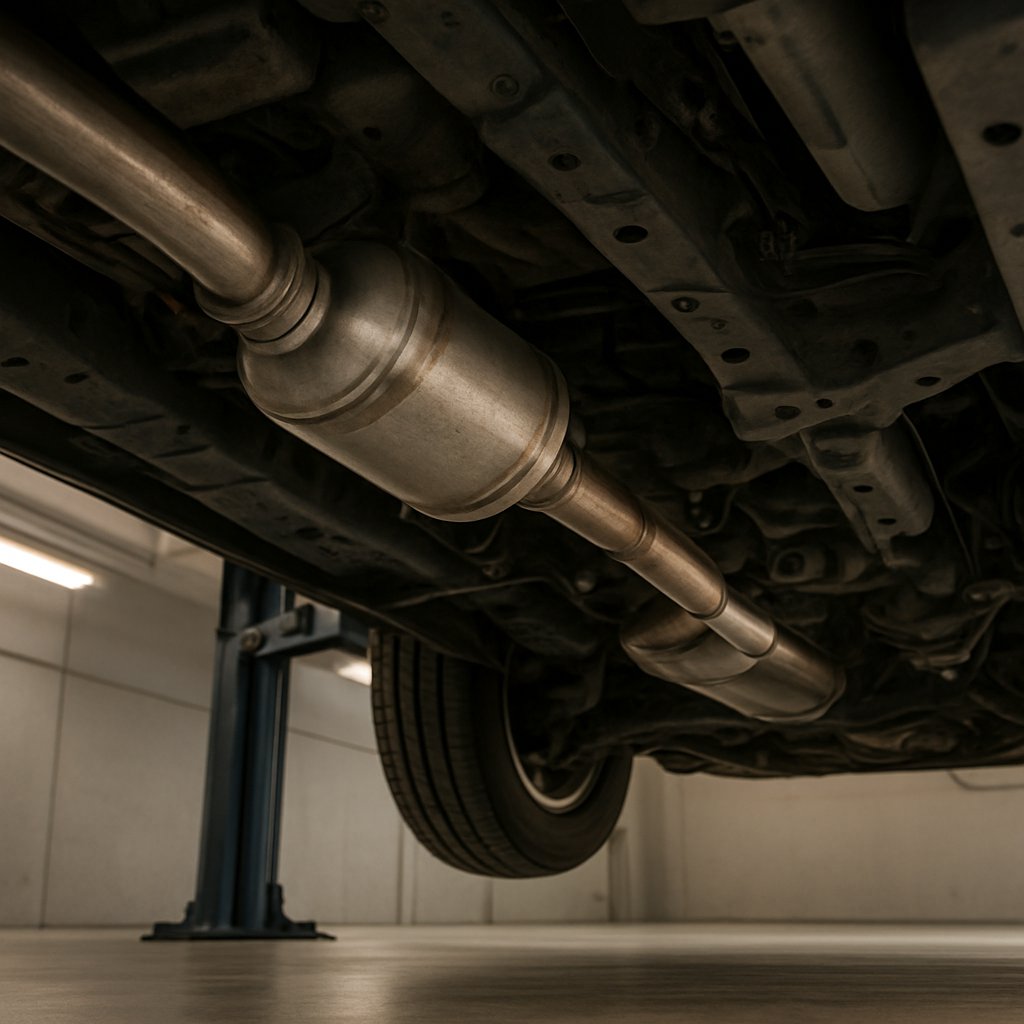
That gap between what you can see and what is actually valuable becomes obvious the moment you try to spot one on a vehicle. If you want to locate catalytic converter hardware, start with the exhaust path. Guidance from CarParts places one or more converters in the exhaust system between the engine and the muffler. Some vehicles use a converter near, or built into, the exhaust manifold. That upstream unit is often called a pre-cat. Another unit may sit farther back, closer to the muffler, as the main cat.
Where the Catalytic Converter Sits on a Vehicle
If you are asking where is the catalytic converter located, the exact answer depends on engine layout. CarParts notes that V-shaped and flat engines can have converters on each side of the engine, and some vehicles may have up to four in total. That is why one car may show a canister clearly under the floor, while another hides it higher in the engine bay.
- Typical location: in the exhaust system between the engine and muffler.
- Common layouts: a pre-cat near the manifold and a main cat farther downstream.
- Multi-bank engines: bank 1 and bank 2 may each have their own converter.
- Best way to confirm: use vehicle-specific repair information for the exact position.
What You Can and Cannot Tell by Looking
So, what does a catalytic converter look like? A recycling guide from BR Metals says converters come in many shapes and sizes, including small round bodies and larger oval or rectangular shells. If damaged, the interior may reveal a honeycomb monolith. In plain language, what's inside a cat converter looks more like a porous block with many tiny passages than a chunk of shiny precious metal.
- Helpful clues: shell shape, exhaust-line position, and stamped serial numbers or manufacturer codes.
- Misconception: a metallic-looking shell does not reveal whether platinum, palladium, or rhodium is inside.
- Misconception: size alone is a poor indicator of precious metal content.
- Safety note: a damaged core should be handled carefully, because harmful material can be released.
That is why a quick glance can help identify the part, but not the true catalyst formula, quality level, or recoverable value. For those answers, markings, application data, and professional evaluation matter far more than appearance.
What Metal Is Inside a Catalytic Converter?
That hidden-core theme is really the whole answer. If someone asks what is the metal in a catalytic converter, the practical reply is not one metal but a catalyst system. The key precious metals are platinum, palladium, and rhodium, while the shell, mat, substrate, and washcoat are the supporting materials that hold the chemistry in place. So when people ask what metal is inside a catalytic converter, they are usually asking about the active catalyst layer, not the outer housing they can see.
Key Takeaways on Catalytic Converter Metals
The valuable and functional part of a catalytic converter is the catalyst coating, not the outer metal shell.
That distinction keeps the most common questions in context. If you want to know what precious metals are in catalytic converters, focus on the catalyst formula. If you want to know how much is a catalytic converter worth in scrap, remember that value depends on recoverable content, correct identification, and professional evaluation rather than looks alone.
- For replacement decisions, check fitment and emissions compliance first. HottExhaust notes that OEM units are built to original specifications, while aftermarket options can vary in certification, price, and precious-metal loading.
- For deeper technical research, look for manufacturer data, emissions rules, and product certification before assuming two similar-looking converters contain the same mix.
- For recycling questions, treat visual inspection as a starting point, not a final answer.
Where to Look Next for Reliable Technical Guidance
On the manufacturing side, catalyst choice is only part of emissions-system quality. Converter-adjacent flanges, housings, sensor bungs, brackets, and other exhaust components also depend on consistent process control. Advisera describes Statistical Process Control as a core method for monitoring and controlling manufacturing processes under IATF 16949 expectations.
For automotive teams that need a practical machining resource in that area, Shaoyi Metal Technology is presented as an IATF 16949 certified custom machining partner with SPC-based quality control, support from rapid prototyping to automated mass production, and experience serving more than 30 global automotive brands.
If you remember one thing, remember this: catalytic converters are defined by a small catalyst layer of precious metals, while everything around it exists to support, protect, and package that chemistry inside the exhaust system.
FAQs About Catalytic Converter Metals
1. What metal is in a catalytic converter?
Most catalytic converters use three key catalyst metals: platinum, palladium, and rhodium. These are applied as a thin active layer on the inner core rather than existing as a solid chunk of metal. The converter also includes structural materials such as a stainless-steel shell, a support mat, a substrate, and a washcoat. So the best answer is not one metal, but a system made from precious metals plus supporting materials.
2. What precious metals are in catalytic converters?
The main precious metals are platinum, palladium, and rhodium, often grouped as platinum-group metals. In general terms, platinum and palladium are commonly used for oxidation reactions that help clean up carbon monoxide and unburned fuel, while rhodium is especially important for reducing nitrogen oxides. The exact balance changes by vehicle type, emissions strategy, and whether the converter is an OEM or aftermarket design.
3. Do diesel engines have a catalytic converter?
Yes, diesel vehicles do use catalytic converters, but they are usually not the same as gasoline three-way catalysts. Diesel exhaust contains excess oxygen, so diesel systems often rely on a diesel oxidation catalyst for carbon monoxide and hydrocarbons, while separate emissions hardware may handle nitrogen oxides. That is why diesel converters often have a different precious-metal emphasis than gasoline units, and why a single universal answer about converter metals can be misleading.
4. How much platinum, palladium, or rhodium is in a catalytic converter?
There is no reliable one-size-fits-all amount. Precious-metal loading depends on engine size, vehicle class, converter volume, emissions rules, and manufacturer design. Two converters that look similar on the outside can contain very different amounts inside. For an accurate answer, professionals rely on part identification, manufacturer data, or analytical testing such as assay methods used by recyclers and refiners.
5. What affects catalytic converter quality besides the precious metals?
Precious metals matter, but converter quality also depends on the substrate design, washcoat durability, shell construction, sealing, and the precision of surrounding exhaust components. Fit, heat resistance, and manufacturing consistency all affect real-world performance. For automotive manufacturers working on converter-adjacent parts such as housings, flanges, brackets, and sensor fittings, process control is important too. Resources like Shaoyi Metal Technology are relevant here because they focus on IATF 16949 certified custom machining and SPC-based quality control for automotive production.