 Small batches, high standards. Our rapid prototyping service makes validation faster and easier —
  EN
EN


Is Silver Metal Magnetic? The Truth Your Magnet Test Misses
Is Silver Metal Magnetic?
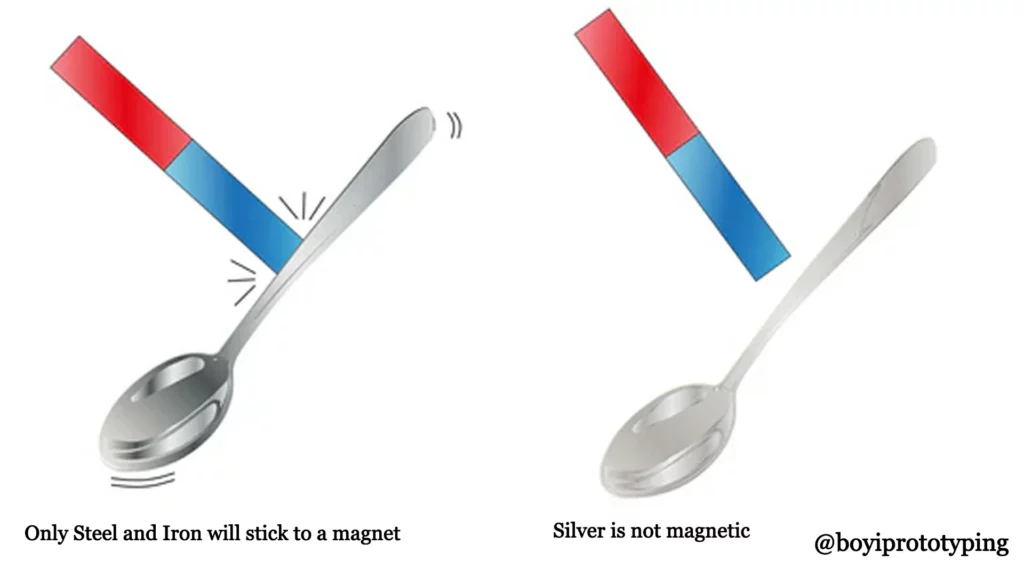
If you came here wondering, is silver metal magnetic, the fast answer is no in normal everyday use. Pure silver does not stick to a magnet the way iron or steel does. So if you hold a common magnet to real silver jewelry, a coin, or a bar, you should not expect a strong pull.
Is silver metal magnetic in everyday use
In plain terms, silver is not a magnetic metal in the everyday sense. A refrigerator magnet or even a strong handheld magnet should not grab onto pure silver. That is why the simple answer to "is silver a magnetic metal" is no. The Quicktest guide also notes that silver is not magnetic, even with a very strong magnet.
Why pure silver does not stick to a magnet
Silver behaves differently from ferromagnetic metals like iron, nickel-rich materials, and many steels. Those metals are strongly attracted to magnets. Silver is not. So if you are asking, "is a silver metal magnetic," the everyday test result is usually simple: it should not stick.
What diamagnetic means in simple terms
Here is the part people often miss. Pure silver is weakly diamagnetic. That means it reacts very slightly against a magnetic field instead of being pulled in strongly. This is a real scientific property, but it does not make silver magnetic in the way most people mean when they use that word.
A magnet test can help rule out some fake items, but it cannot confirm silver by itself.
That is where the confusion starts. Some non-silver metals are also non-magnetic, while some genuine silver items may include magnetic parts or plating over another metal. The details matter, and they get interesting fast. Up next, we will break down the science behind silver's weak response so the magnet test makes a lot more sense.
Why Silver Is Not Magnetic
That faint reaction has a name, and it clears up most of the confusion. Most people use the word magnetic to mean sticks to a magnet. By that everyday standard, silver is not magnetic. In the science of materials, though, metals are grouped by how they respond to a magnetic field, and silver belongs in the diamagnetic group, not the ferromagnetic one. Basic magnetism guides from Stanford Magnets and HSMAG both use these categories.
Ferromagnetic metals vs diamagnetic silver
- Ferromagnetic: strongly attracted to magnets. In a home test, metals like iron and many steels can snap toward the magnet.
- Paramagnetic: weakly attracted to a magnetic field. The pull is so small that you usually will not notice it in casual testing.
- Diamagnetic: weakly repelled by a magnetic field. This effect is real, but it is usually too subtle to see without better equipment.
If you are wondering what silver metal is not magnetic, pure silver is the clearest example. And when people ask what silver metal is magnetic, the attraction usually points to some other metal in the item, not the silver itself.
Weak diamagnetism does not make silver magnetic in the everyday sense.
Why silver behaves differently from iron and steel
Iron, nickel, cobalt, and many steels respond strongly because ferromagnetic materials align with an external magnetic field and can stay magnetized even after the field is removed. Diamagnetic materials do the opposite at a very weak level. HSMAG lists silver among common diamagnetic examples, while ferromagnetic examples include iron, nickel, and cobalt. That is why a household magnet grabs a paper clip but seems to ignore a silver ring or bar.
This also helps with a common search: is silver a magnetic conductive metal? For normal stick tests, the magnetic part is no. Silver is classified here by its weak diamagnetic response, not by the kind of strong attraction people expect from a truly magnetic metal.
Everyday magnet response compared with laboratory behavior
Home testing and lab testing are very different. An IOP study notes that all matter can be affected by external magnetic fields, but diamagnetic and paramagnetic forces are often too weak to notice without sensitive experiments. So on your desk or in a jewelry box, silver behaves like a non-magnetic metal. In controlled conditions, its weak repelling behavior can be measured.
That gap between simple tests and real material behavior is exactly why silver causes so many mixed results. The science is straightforward. The tricky part is that real-world silver items come in different forms, alloys, and lookalikes.
Is Silver Plated Metal Magnetic?
A simple magnet test gets more confusing the moment you stop looking at pure metal and start looking at real objects. Rings, spoons, coins, trays, and chains are made from different silver standards, different cores, and sometimes different parts joined together. Common hallmarks such as 999, 925, and 958 tell you far more than surface color alone, while stamp marks like 900 and 800 also show up on commercial silver items.
How pure silver sterling silver and coin silver compare
In broad terms, more actual silver means less reason for a magnet to react. Fine silver marked 999 is considered pure or nearly pure silver. Sterling silver marked 925 is 92.5 percent silver, commonly alloyed for strength. Britannia silver uses 958 marks. Older or regional silver items may also carry 900 or 800 marks. If you have ever wondered what metal that is soft and silver non magnetic, fine silver is the classic example. It is softer than sterling, which is one reason sterling became so common for jewelry and household pieces.
| Item type | Common identifiers | Likely magnet behavior | Important cautions |
|---|---|---|---|
| Pure silver | 999, sometimes 999.9 fineness | No noticeable attraction | Non-magnetic does not prove authenticity by itself |
| Sterling silver | 925 hallmark | Normally no noticeable attraction | A magnetic reaction often points to added parts, not the silver body |
| Britannia silver | 958 hallmark | Normally no noticeable attraction | Higher silver content still does not make a magnet test conclusive |
| Coin-silver style items | 900 or 800 marks on some items | Usually no noticeable attraction | Marks vary by country, age, and item type |
| Silver-plated items | EP, EPNS, EPGS, EPCA, EPWM, EP ON COPPER | May attract strongly, weakly, or not at all | The silver layer is thin. The core metal decides most of the result |
| Nickel silver or German silver lookalikes | Name references, or plated marks like EPNS and EPGS | Can give misleading results | The name includes silver, but that does not mean solid silver |
| Stainless steel lookalikes | Silver-colored finish, often no hallmark | Depends on the grade. Some attract strongly, some little or not at all | Stainless is one of the easiest silver lookalikes to misread with a magnet |
| Mixed-metal jewelry pieces | 925 body with clasp, spring, pin, or backing | Main body may not attract, but one part may | Test each section separately before making a judgment |
Why silver plated items can behave differently
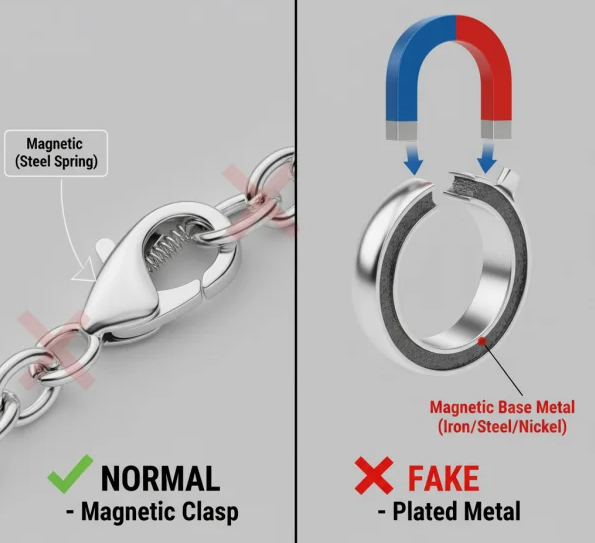
So, is silver plated metal magnetic? Sometimes yes, and sometimes no. The silver coating itself is not the problem. The base metal underneath is. A plated spoon over copper may show little magnetic response, while a plated decorative piece over steel can grab a magnet right away. That is why plating marks matter so much. Terms like EPNS and EPGS usually point you toward a plated item rather than solid silver.
Common silver lookalikes and their magnet response
This is where many shoppers get tripped up. If you are asking what is none magnetic metals that look like silver, the honest answer is that more than one material can pass a casual magnet test. Rapid Protos notes that silver is not the only non-magnetic metal, and also explains that some stainless steels are magnetic while others may seem nearly non-magnetic in everyday use. In other words, no pull does not automatically mean silver, and a pull does not always mean the whole item is fake.
The biggest clue is often inconsistency. A tray may stay still while its handle reacts. A necklace may look right but tug at the clasp. That small mismatch is where the real detective work begins.
Why Is My Silver Necklace Magnetic?
That small mismatch is where people start to panic. A necklace looks silver, maybe even carries a 925 mark, yet one little section pulls toward a magnet. In many cases, the silver is not the issue at all. The working hardware is. A 925 sterling silver guide explains that sterling silver is 92.5 percent silver and 7.5 percent copper, and neither metal is ferromagnetic. So the main body of a genuine sterling piece should not strongly stick.
Why a magnetic clasp does not always mean fake silver
If you have wondered why does a silver clasp stick to a magnet, the most common explanation is simple: the clasp may contain a small steel spring or another internal component that helps it open and close securely. The same guide notes that magnetism limited to the clasp area is often normal mechanical hardware, not proof that the whole chain is counterfeit. What matters is where the reaction happens. A tiny pull at the closure is very different from the entire chain snapping toward the magnet.
Mixed metal construction in jewelry and accessories
Jewelry is often made from more than one material, especially in the smallest functional parts. So can sterling silver jewelry have magnetic parts? Yes, it can. The silver links or pendant may be genuine, while a hidden or replaceable fitting is not silver.
- Clasp springs and clasp inserts
- Chain connectors and end caps
- Brooch pins and catches
- Earring backs or posts
- Watch hardware, such as spring bars or internal fittings
- Other small findings inside closures
This is often the real answer to the question, why is my silver necklace magnetic. It may not be the necklace as a whole. It may be one tiny part designed for strength or movement.
How plated layers can hide a magnetic core
Silver-plated pieces add another layer of confusion. Quicktest notes that many silver-plated items are made with silver over copper, while the sterling silver magnet test guide points out that plated jewelry can also use nickel or iron beneath a thin silver surface. That means a plated item may react strongly if the hidden base metal is magnetic, or show little attraction if the core is copper.
That is why a magnet reading from one spot should be treated as a clue, not a verdict. A magnetic clasp or fitting tells you to inspect the piece more carefully. It does not automatically mean the visible silver section is fake. And once you see how easily mixed parts and plating can distort the result, the bigger question becomes hard to ignore: what can a magnet test actually prove, and what can it not?
What the Magnet Test Can and Cannot Prove
This is where the magnet test needs a reality check. People often ask, if a magnet doesn't stick to metal is it silver? Not necessarily. A magnet can be a useful screening tool, but it only answers one narrow question: does this item show obvious magnetic behavior? Material guides from Hero Bullion make the point clearly. Strong attraction can expose clear fakes, but a pass only tells you the piece is not strongly magnetic.
What a magnet test can rule out
If a strong magnet snaps firmly onto the main body of a coin, bar, or jewelry piece, that is a serious warning sign. Pure silver and normal sterling silver should not behave like iron or steel. The same basic rule shows up in Rapid Protos: strong attraction usually means ferromagnetic material is present somewhere in the item. In plain English, the test is good at ruling out obvious steel-based imposters.
Why non magnetic does not automatically mean real silver
This is the myth that causes false confidence. If a metal is not magnetic is it real silver? No. The Marialva Collection lists several metals that are also non-magnetic, including copper, brass, aluminum, gold, titanium, tungsten, and zinc. Hero Bullion also notes that other diamagnetic metals, especially copper, can pass magnet-based silver checks. So does no magnetism mean silver is real? Again, no. It only narrows the list of possibilities.
How to interpret a weak or partial attraction
Partial attraction is where people misread the result. A clasp may stick while the chain does not. A plated item may react because of the core, not the surface. A hidden spring, pin, or fitting can also trigger the magnet. That means the location of the pull matters just as much as the pull itself.
- Strong attraction across the main body: treat it as a major red flag. Solid silver is unlikely.
- No attraction anywhere: the item may be silver, but it could also be another non-magnetic metal or alloy.
- Attraction only at clasps or fittings: suspect mixed-metal construction, plated hardware, or internal springs before judging the whole item.
A magnet test is a first filter, not final authentication.
That is the key takeaway. The test can eliminate some bad candidates fast, but it cannot tell you exactly what the metal is. Oddly enough, magnets can still move differently around silver under certain conditions, which is why slide-style tests keep showing up in precious metal discussions.
Silver Magnet Slide Test Explained
A regular magnet test asks a simple question: does the item stick or not? Slide tests show a more subtle behavior. That is why they keep coming up in silver discussions even though silver itself is not magnetic in the everyday sense. As Hero Bullion explains, a strong magnet can seem to slow down near silver because of eddy currents, not because silver suddenly behaves like iron.
Why magnets can move differently on conductive metals
If you have ever wondered why does a magnet slide slowly on silver, conductivity is the key idea. Silver is a highly conductive metal. When a strong magnet moves across or near it, the moving magnetic field can induce tiny electric currents in the metal. Those currents create their own opposing magnetic field, which resists the motion. To your eye, that resistance looks like drag or braking.
So the effect is real, but it is not the same as magnetic attraction. The magnet is not snapping onto silver. It is being slowed by the metal's electrical response.
How slide tests differ from stick tests
The Safe House describes two different magnet-based approaches. A stick test checks for strong attraction, which can reveal ferromagnetic metals. A slide test watches speed instead.
- Use a strong magnet, often a neodymium magnet rather than a weak household magnet.
- Place a coin on a magnetic slide, or let a small magnet move across an angled bar.
- If the movement is noticeably slowed, the metal may be highly conductive and diamagnetic.
- If it sticks hard, ferromagnetic metal is likely present.
- If it drops fast, it may lack the response people expect from silver.
Why silver can affect a magnet without being magnetic
This is the heart of the confusion behind the silver magnet slide test explained in plain English. Can silver affect a magnet without being magnetic? Yes. Silver can influence motion around a strong magnet without being a magnetic metal in the normal sense. That is why a slide result can be interesting, but not final. Hero Bullion notes that copper can also produce a similar slow-slide effect, which means this test can screen materials but cannot confirm authenticity on its own.
In other words, a slow slide is a clue, not a verdict. Real verification still needs a broader check, especially when hallmarks, plating, and mixed metals enter the picture.
How to Tell if Silver Is Real at Home
That broader check looks less like one magic test and more like a short workflow. If you are wondering how to tell if silver is real at home, start with the clues the piece gives you before you reach for any tool. A smart check combines marks, surface wear, construction details, and only then a few simple at-home tests. Even Jewelers Mutual stresses that no single home method guarantees perfect accuracy, which is exactly why a layered approach works better.
How to inspect hallmarks and surface clues
The quickest non-magnet screening step is usually the hallmark. Sterling silver commonly carries marks such as 925, Sterling, STER, SS, or STG. You may also see 999 for fine silver, 958 for Britannia silver, and in some cases 900 or 800 on older or regional items. A small magnifying glass helps because these stamps are often tucked under a clasp, on the underside, or near the base.
- Find the mark first. Check hidden areas, backs, clasps, and undersides.
- Read the wording carefully. Marks like 925, 999, or 958 are promising. Terms such as EPNS, EP, SP, Plate, German Silver, or Nickel Silver point away from solid sterling.
- Inspect wear points. Edges, tines, bowls, chain ends, and clasps often reveal plating first.
- Look at color and tarnish. Potteries Auctions notes that genuine sterling often has a slightly warm white glow, while real silver can also tarnish over time. A white cloth may pick up black residue from that tarnish.
- Use supporting home checks. If you want to know how to check real silver without a magnet, compare weight, try the ice test, and notice whether the item has a strong metallic odor. Real sterling is typically odorless in the home tests shared by Jewelers Mutual.
- No hallmark at all, especially on a modern-looking item
- Plated wording such as Silver-plate, EPNS, EPBM, EP, BP, or SP
- Different metal showing through on edges or high-friction spots
- Uneven color between the main body and fittings
- A very bright surface with worn patches underneath
- A strong dirty-metal smell
When home testing is useful and when it is not
Home checks are great for screening. They can help you separate likely sterling from obvious plated or mixed-metal pieces. They are also useful when you are buying secondhand, sorting inherited items, or trying to decide what deserves expert attention. Still, the best way to verify sterling silver authenticity is not to trust one clue in isolation. Counterfeit stamps exist, and non-magnetic metals other than silver can pass casual tests.
Why professional verification may still be necessary
For a valuable heirloom, a resale item, or any piece giving mixed signals, professional testing is the safest move. Jewelers may use specialized analyzers to identify the metals present in a piece, and XRF is commonly used because it can measure elemental composition without damaging the item. That matters when you need certainty rather than a good guess.
Once you see how much better controlled testing works, the lesson stretches beyond jewelry. Getting the metal right is really about verification standards, and that matters anywhere metal quality has real consequences.
Why Metal Identification Matters in Manufacturing
A question like is silver metal magnetic may sound small, but the habit behind it matters everywhere metal is used. A wrong guess about a necklace might cost money. A wrong guess about an engineered part can affect fit, strength, safety, and traceability.
Why accurate metal identification matters beyond jewelry
This is the clearest reason why metal identification matters in manufacturing. In metal fabrication, Thermo Fisher notes that alloy mix-ups can lead to product failures, and that testing 100 percent of critical materials is now part of best practice in many QA and QC programs. The same lesson from silver testing still applies: surface appearance and a quick magnet check are not enough when the exact alloy changes performance.
How certified manufacturing workflows use material checks
That is where material verification and quality control in metal parts becomes systematic. Thermo Fisher highlights XRF and LIBS as non-destructive ways to check elemental composition from incoming material through final shipment. In automotive work, IATF 16949 places strong emphasis on record-keeping, process identification, supplier traceability, and audit trails. This is how manufacturers confirm metal properties and connect the right material to the right part throughout production.
Where to find production scale metal forming support
For readers interested in how those standards show up in real production, Shaoyi presents an IATF 16949 certified workflow that runs from rapid prototyping to automated mass production for auto stamping parts such as control arms and subframes. The company also notes that it is trusted by over 30 automotive brands worldwide. Framed the right way, that is not a sales pitch. It is a practical reminder that disciplined verification belongs in modern manufacturing, not just in home testing.
- A magnet test is useful for screening, but not for full identification.
- Wrong alloy selection can create reliability and safety risks.
- Certified systems rely on traceability, records, and material analysis.
- Good manufacturing treats metal verification as a process, not a guess.
Silver Magnetism FAQ
1. Can real silver ever react slightly to a magnet?
Pure silver is not magnetic in the everyday sense, so a normal magnet should not pull it like iron or steel. Silver is weakly diamagnetic, which is a very subtle scientific behavior rather than the kind of attraction people expect in a home test. If you notice a slight response, check for hidden steel parts, nearby magnetic objects, or a plated base metal before blaming the silver itself.
2. Why does my sterling silver necklace clasp stick to a magnet?
The clasp is often the reason, not the whole necklace. Small working parts inside closures, jump rings, catches, and earring backs may use stronger metals for tension and durability. If only the hardware reacts while the chain or pendant does not, that points more toward mixed-metal construction than fake sterling silver.
3. Is silver-plated metal magnetic?
It can be. The silver layer is usually too thin to control the result, so the core metal matters more. A silver-plated item over steel may attract a magnet clearly, while plating over copper or another non-magnetic metal may show little to no pull. That is why plating marks, worn edges, and exposed base metal are more useful than surface color alone.
4. If a magnet does not stick, is the item real silver?
No. A failed magnet pull only tells you the item is not strongly ferromagnetic. Other non-silver metals can also pass that basic check, so you still need to inspect hallmarks, look for wear that suggests plating, compare construction quality, and use professional testing for valuable pieces. For higher confidence, a jeweler can verify metal content with non-destructive tools such as XRF.
5. Why does metal verification matter beyond jewelry?
Because the wrong metal can create more than a buying mistake. In manufacturing, an alloy mix-up can affect fit, strength, traceability, and safety. That is why certified production systems rely on documented material checks instead of quick guesses. The same principle appears in industrial workflows such as Shaoyi's IATF 16949 auto stamping process, which supports material control from prototyping to mass production for automotive parts.