 Small batches, high standards. Our rapid prototyping service makes validation faster and easier —
  EN
EN


Precision Forging: A Game-Changer for Automotive Parts
TL;DR
Precision forging is a near-net-shape manufacturing process essential to the automotive industry. It produces high-strength, dimensionally accurate components that require minimal secondary machining. This technology is critical for creating durable and reliable parts for high-stress applications, directly enhancing overall vehicle performance, safety, and longevity.
Understanding Precision Forging: A Critical Automotive Process
Precision forging is an advanced metal forming technique where a workpiece is compressed under immense pressure to conform to the shape of a highly detailed die. Unlike traditional methods, it is a "near-net-shape" process, meaning the component is forged to its final or very close to its final dimensions. This drastically reduces or eliminates the need for subsequent machining, saving both time and material. The process offers meticulous control over the metal's grain flow and deformation, which is fundamental to achieving superior mechanical properties in the final product.
The core principle that distinguishes precision forging is its ability to produce flashless or minimal-flash parts. In conventional forging, excess material known as "flash" squeezes out between the die halves and must be trimmed off, resulting in waste. Precision forging, however, uses a precisely calculated volume of material that completely fills the die cavity, leading to significant material savings—a crucial factor when working with expensive, high-performance alloys commonly used in the automotive sector.
This manufacturing method is critical for the automotive industry due to the relentless demand for safer, more efficient, and higher-performing vehicles. Key automotive components, such as those in the engine, transmission, and suspension, are subjected to extreme forces, constant vibration, and high temperatures. Precision forging produces parts with an optimized internal grain structure that follows the component's contours, resulting in exceptional strength, toughness, and fatigue resistance. This inherent structural integrity ensures that safety-critical parts can withstand demanding operational conditions without failure, making it an indispensable technology for modern vehicle production.
Precision Forging vs. Traditional Manufacturing: A Clear Comparison
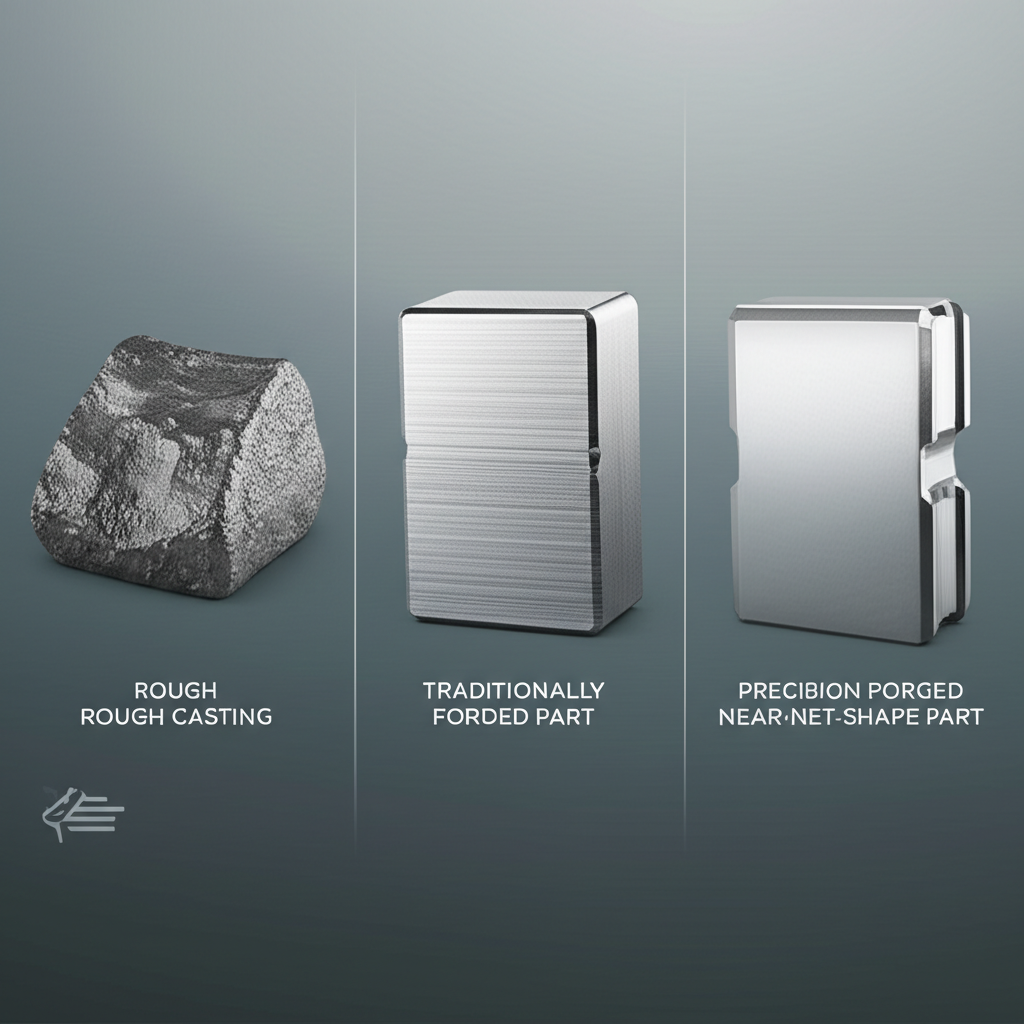
When evaluating manufacturing methods for critical automotive components, the differences between precision forging, traditional forging, and casting are significant. Traditional forging, often called impression die forging, shapes metal but leaves a considerable amount of flash and has wider dimensional tolerances. Casting involves pouring molten metal into a mold, which can result in a less dense structure with potential porosity. Precision forging stands apart by offering a superior combination of strength, accuracy, and material efficiency.
The primary advantage of precision forging is its exceptional dimensional accuracy and surface finish. Components emerge from the die nearly complete, often meeting tolerances as tight as +/- 0.1mm, which minimizes costly and time-consuming secondary machining operations like milling or grinding. In contrast, both traditional forgings and castings almost always require extensive machining to achieve their final specifications. Furthermore, the intense pressure of precision forging creates a dense, non-porous surface and a refined internal grain structure, enhancing the part's resistance to fatigue and wear. Studies have shown that precision-forged parts can last up to 30% longer than cast alternatives.
Material utilization is another key differentiator. Precision forging is a highly efficient process, capable of significantly reducing material waste compared to traditional methods. This efficiency not only lowers costs, especially with high-value alloys, but also supports more sustainable manufacturing practices. While the initial investment in tooling and machinery for precision forging can be higher, the long-term savings from reduced material waste, eliminated machining steps, and superior component performance often make it the more cost-effective choice for high-volume automotive production.
| Attribute | Precision Forging | Traditional Forging | Casting |
|---|---|---|---|
| Dimensional Accuracy | Very High (Near-Net-Shape) | Moderate | Low to Moderate |
| Surface Finish | Excellent | Fair to Good | Poor to Fair |
| Mechanical Strength | Excellent (Optimized Grain Flow) | Good to Very Good | Fair (Potential Porosity) |
| Material Waste | Very Low (Flashless) | Moderate to High (Flash) | Moderate (Gates/Risers) |
| Post-Processing Needs | Minimal to None | Significant Machining | Extensive Machining |
Core Benefits for the Automotive Sector: Strength, Durability, and Efficiency
The adoption of precision forging in the automotive industry is driven by a range of compelling benefits that directly impact vehicle quality, safety, and cost. These advantages extend beyond simple component creation, influencing the entire lifecycle and performance of a vehicle.
Enhanced Strength-to-Weight Ratio
Modern automotive design prioritizes weight reduction to improve fuel efficiency and handling. Precision forging allows for the creation of components that are both lighter and stronger than those made by other methods. By aligning the metal's grain structure with the stresses the part will endure, it's possible to design components with less material without sacrificing structural integrity. This is particularly valuable for parts like suspension control arms and wheel hubs, where reducing unsprung mass is critical for performance.
Superior Durability and Fatigue Resistance
Automotive components must endure millions of stress cycles over their lifetime. The refined, dense grain structure produced by precision forging provides exceptional resistance to fatigue, impact, and wear. This makes it the ideal process for high-stress parts like crankshafts, connecting rods, and transmission gears. The absence of internal defects like porosity, which can be present in cast parts, means forged components are significantly less likely to fail under pressure, enhancing vehicle safety and reliability.
Unmatched Precision and Consistency
The high repeatability of the precision forging process ensures that every component in a high-volume production run meets the same exacting standards. This consistency is vital for automated assembly lines and for ensuring the proper fit and function of interconnected systems like the drivetrain and steering. The ability to maintain tight tolerances eliminates variations between parts, leading to smoother operation, reduced noise, and a higher-quality final product.
Cost-Effectiveness Through Reduced Waste and Machining
While the initial tooling costs can be high, precision forging offers significant long-term economic advantages. The near-net-shape nature of the process dramatically reduces material waste, which is a major cost driver, especially when using advanced steel or aluminum alloys. Furthermore, by minimizing or eliminating the need for secondary machining, manufacturers save on labor, machinery, and production time. For high-volume automotive parts, these efficiencies can significantly lower the total cost per part.

Critical Applications in Modern Vehicles
Precision forging is the manufacturing method of choice for a wide array of critical automotive components where strength, reliability, and performance are non-negotiable. Its ability to produce complex geometries with superior mechanical properties makes it indispensable for the systems that power, steer, and support a vehicle.
- Engine Components: Parts like crankshafts and connecting rods are subjected to immense combustion forces and rotational stress. Precision forging ensures they possess the fatigue strength and durability needed to perform reliably for hundreds of thousands of miles.
- Transmission and Drivetrain Parts: Gears, transmission shafts, and constant-velocity (CV) joints require high wear resistance and the ability to transfer torque smoothly. The precision and strength of forged parts ensure a durable and efficient transfer of power from the engine to the wheels.
- Suspension and Steering Components: Control arms, steering knuckles, and tie rods are safety-critical parts that must withstand constant impacts from the road surface. Forging provides the toughness and structural integrity required to ensure vehicle stability and responsive handling.
- Wheel Hubs and Axles: These components support the entire weight of the vehicle and must endure significant rotational and structural loads. Precision-forged hubs and axles offer the high strength necessary to prevent failure and ensure driver safety.
For manufacturers seeking these high-quality components, specialized suppliers are key. For instance, providers of custom forging services focus on producing IATF16949 certified parts for the automotive sector. Companies like Shaoyi Metal Technology offer a comprehensive approach, from rapid prototyping to mass production of hot-forged parts, ensuring that complex components meet the industry's rigorous standards for precision and reliability.
Frequently Asked Questions
1. What materials are typically used in precision forging for automotive parts?
A wide range of materials can be used, but the most common in the automotive industry are carbon and alloy steels, aluminum alloys, and micro-alloyed steels. These materials are selected for their excellent strength, toughness, and machinability. For high-performance applications, more advanced materials like titanium or nickel-based alloys may be used, though they are more common in aerospace.
2. Is precision forging more expensive than casting?
The initial investment for precision forging, particularly for the dies and machinery, can be higher than for casting. However, the overall cost per part in high-volume production is often lower. This is because precision forging significantly reduces material waste and minimizes or eliminates the need for expensive secondary machining operations. The superior durability of forged parts also reduces warranty claims and replacement costs, adding to its long-term value.
3. Can precision forging create complex shapes?
Yes, one of the key advantages of precision forging is its ability to produce parts with complex and intricate geometries that would be difficult or impossible to machine efficiently. The process allows metal to flow into detailed die cavities, forming features like gear teeth, splines, and complex curves with high accuracy, all while maintaining an optimal grain structure for strength.