 Small batches, high standards. Our rapid prototyping service makes validation faster and easier —
  EN
EN


Can You Weld Galvanized Without Dangerous Fumes Or Weak Welds?
Can You Weld Galvanized Steel Safely?
So, can you weld galvanized? Yes, but it is not treated like bare steel. Galvanized steel is regular steel covered with a zinc coating to help resist rust. That zinc is the whole reason the job changes. It protects the steel in service, but it creates extra work when heat hits the joint.
Can You Weld Galvanized Steel at All
Yes. You can weld galvanized steel, but only if you control fumes, prepare the joint properly, and repair the damaged coating after welding.
AGA guidance notes that the weld should be made on steel that is free of zinc in the weld area, and the protective coating must be restored afterward. In plain terms, if you ask can you weld galvanized metal, the answer is yes, though the process adds safety and cleanup steps you would not ignore on uncoated steel.
Why the Zinc Coating Changes the Job
The zinc coating changes the job through simple cause and effect. Welding heat burns or vaporizes zinc near the arc. That can create fumes, dirty the weld zone, and make defects like porosity or spatter more likely if the joint is not prepared well. It also burns away corrosion protection around the weld, so even a solid bead usually needs post-weld repair. That is why can you weld galvanized iron is a different question from welding plain mild steel.
- Yes, galvanized steel can be welded.
- Zinc makes the process less forgiving than bare steel.
- Fumes, contamination, and extra cleanup are the main tradeoffs.
- The weld area often needs coating removal before welding.
- The finished joint needs corrosion protection restored.
When Welding Galvanized Makes Sense
Welding is practical when you need a permanent joint, can prep only the local weld area, and have a reliable way to restore zinc protection. It is often a weaker choice when ventilation is poor, the part is very thin, or a bolt, rivet, or other mechanical fastener can do the same job with less risk and rework. If you are asking can you weld to galvanized steel, the real decision starts before the arc ever starts: can you control the fumes and the coating well enough to do it safely?
Can Welding Galvanized Make You Sick?
The weld itself is not the only challenge. The zinc that complicates bead quality also changes the air around the arc, and that is where the real safety risk starts.
Why Welding Galvanized Can Make You Sick
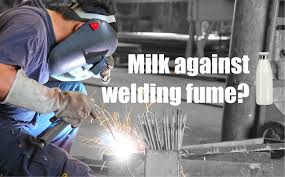
If you are wondering can welding galvanized make you sick, or can welding galvanized steel make you sick, yes, it can. Heating the zinc coating can create zinc oxide fumes. Breathing enough of that fume can trigger metal fume fever, a flu-like illness tied to inhaling metal oxide fumes. Common symptoms include fever, chills, muscle aches, nausea, fatigue, shortness of breath, and a metallic taste. The same source notes that symptoms often begin a few hours after exposure and often ease within 24 to 48 hours once exposure stops.
Searches like can you get sick from welding galvanized and why can't you weld galvanized steel come from the same basic problem: the coating, not the base steel, is the main hazard when it is overheated. Questions like can welding galvanized kill you or can welding galvanized steel kill you usually reflect fear of the worst case. The practical answer is simple: heavy fume exposure, breathing trouble, or work in a poorly ventilated enclosed area is serious enough to stop immediately and get fresh air and medical help.
Ventilation and Respirator Basics Before You Start
- Confirm the part is galvanized and expect fume from the coating.
- Set local exhaust close to the weld zone before you strike an arc.
- Make sure fresh make-up air can enter the space.
- Avoid tanks, trailers, corners, pits, and other areas where fumes can collect.
- Wear welding PPE, including helmet, gloves, eye protection, and flame-resistant clothing.
- If ventilation is not enough, use a respirator appropriate for welding fumes and make sure it fits correctly.
- Plan your body position so the plume moves away from your face, not through it.
- Stop before welding if the air feels stagnant or extraction cannot be placed close enough.
OSHA guidance and current welding fume best practices put engineering controls first. Local exhaust ventilation is the better choice because it captures fume near the source, before it rises through your breathing zone. General room airflow can help, but it is weaker on its own. Outdoor welding is not a free pass either. Wind shifts, walls, and partial enclosures can still send the plume back at your face. If ventilation cannot keep exposure controlled, a NIOSH-approved respirator may be needed. In a workplace, that also means fit testing, training, and following the site respiratory protection program. A basic dust mask is not enough.
| Hazard | Why it happens | Control measure |
|---|---|---|
| Zinc oxide fume | The galvanized coating is heated by the arc | Use local exhaust, keep your head out of the plume, and remove coating where appropriate |
| Metal fume fever | Too much metal oxide fume is inhaled | Stop exposure, get fresh air, and seek medical attention if symptoms appear |
| Confined-space buildup | Fumes and gases collect where airflow is poor | Use proper ventilation and follow confined-space procedures where required |
| Grinding and prep dust | Coating removal can create fine particulate and sparks | Use eye and face protection, dust control, and good housekeeping |
Safer Work Practices During the Weld
Keep extraction close. Stand so air moves fumes away from you. Do not hover directly over the joint. If visibility drops, nearby coated areas start smoking, or the fume cloud keeps crossing your face, stop and improve conditions before continuing. Common shop advice can be helpful, but workplace safety requirements take priority wherever they apply.
On galvanized work, safety and weld quality are tightly connected. The better the setup and surface condition, the less likely the coating is to create trouble later, which is why inspection and prep deserve close attention before the first tack.
Preweld Prep for Galvanized Steel to Steel
A lot of weld defects start before the arc ever flashes. If you are asking can you weld galvanized metal to steel, or can you weld galvanized to steel, the real answer depends on how well you identify the coating, open the joint, and clear zinc out of the heat path.
How to Identify and Inspect Galvanized Material
Start by confirming that the part is zinc-coated steel, not painted steel with a similar look. The coating method matters. Metal Supermarkets notes that hot-dip galvanizing leaves a relatively thick zinc layer, while electrostatic galvanizing leaves a relatively thin one. In practice, thin sheet often behaves differently from heavier hot-dipped angle, tube, pipe, or plate. Inspect the joint next. Look at thickness, overlap, venting, and whether zinc may be trapped inside tubing, pipe, or lap joints. Mixed joints need the same care. If the question is can you weld galvanized steel to regular steel, can you weld galvanized steel to carbon steel, or can you weld galvanized steel to non galvanized steel, the coated side is still the side that changes the job.
Where to Remove the Coating and Why It Matters
Zinc in the weld zone is the source of much of the trouble: porosity, spatter, and puddle contamination. That is why coating removal improves weld quality and reduces fume generation right at the joint. WELD Magazine summarizes common guidance to remove galvanized coating about 1 to 4 inches from the intended weld zone on both sides, with the exact distance depending on thickness and heat input. If you are wondering can you grind off galvanized coating before welding, yes. Fume Xtractors describes mechanical grinding as the most practical local method for many shops. The tradeoff is simple: once zinc is gone, that bare area will need corrosion repair after welding.
Better preparation usually means fewer weld defects, less fume trouble, and less rework.
Preweld Cleaning and Setup Checklist
- Verify the part type: sheet, tube, pipe, or heavier hot-dipped section.
- Inspect the joint for gaps, overlap, trapped zinc, rust, oil, paint, and old repair coatings.
- Mark the coating-removal zone wide enough for the planned process and expected heat spread.
- Set local exhaust before grinding, because prep can create zinc dust as well as later welding fumes.
- Remove the coating only where needed, then solvent clean, wire brush, or lightly abrade the exposed steel so the weld starts on bright, dry metal.
- Check fit-up and clamping. Poor alignment can cause burn-through on thin sheet or weak fusion on thicker parts.
- Cover, separate, or account for nearby coated areas that may also heat up and smoke during welding, especially on pipe and tube work.
This prep logic stays the same whether you ask can you weld galvanized steel to regular steel or can you weld galvanized metal to steel. What changes next is the process you choose, because MIG, TIG, stick, and flux core do not respond to residual zinc in exactly the same way.
Choosing MIG, TIG, Stick, or Flux Core for Galvanized Steel
Clean prep helps, but process choice still decides how forgiving the weld will be. If you ask can you arc weld galvanized steel, the practical answer is yes, though MIG, TIG, stick, and flux core handle zinc, wind, thin material, and cleanup in very different ways.
MIG vs TIG vs Stick vs Flux Core on Galvanized Steel
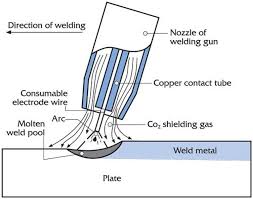
If the question is can you weld galvanized steel with a mig welder, the answer is usually yes, and it is often the first process shops reach for. Atkore describes GMAW or MIG as the most widely used process for galvanized tube because it can produce high-quality welds quickly. Hobart Brothers also notes that many automotive manufacturers use GMAW on hot-dipped galvanized steel, especially in pulsed or constant-voltage modes. TIG can make very sound welds, but Atkore describes it as the slowest and costliest option, best when appearance is critical. Stick earns its place when wind makes gas shielding impractical. Flux core brings MIG-like speed with better outdoor practicality, but usually more smoke and cleanup, as summarized in this process overview.
| Process | Suitability on galvanized steel | Weld cleanliness and cleanup | Fume management challenge | Common use cases |
|---|---|---|---|---|
| MIG | Best all-around shop choice for prepared sheet, tube, pipe, and production parts. Atkore favors it for galvanized tube, and Hobart highlights it for automotive hot-dipped material. | Usually cleaner than stick or flux core, but zinc contamination or poor arc mode can increase spatter and porosity. | Needs shielding gas, so airflow must be controlled. Best paired with strong local exhaust in a shop. | General fabrication, tube work, repetitive production, thin to moderate thickness parts. |
| TIG | Highest puddle control, but least forgiving on poorly prepared joints. Best when the weld is visible and the work is thin or detail-oriented. | Clean, precise beads with low spatter, but only if the joint is very clean. Slowest process. | Also relies on shielding gas and a controlled environment. Slower travel means more time managing the plume. | Thin sections, appearance-critical parts, detailed repair or fabrication work. |
| Stick | Useful when GMAW cannot be used, especially outdoors. Lower productivity, but practical on thicker parts and repair work. | More slag and cleanup than MIG or TIG. Bead appearance is usually rougher. | No external shielding gas, so wind is less of a problem, but zinc fume is still a problem and body position still matters. | Field repairs, outdoor jobs, thicker joints, situations where setup simplicity matters. |
| Flux core | Good for outdoor or windy work, especially where speed matters more than cosmetic finish. Better suited to heavier steel than delicate visible sheet work. | Strong output, but more smoke, slag, and post-weld cleanup than MIG. | Self-shielded wire avoids gas-shielding issues outdoors, yet the process can feel smoky on coated steel. | Outdoor fabrication, fences, gates, structural-type repairs, thicker galvanized sections. |
Which Process Is Easier for Thin and Thick Material
Can you mig weld galvanized steel? For many users, yes, and it is the easiest starting point on properly prepared steel because the process is fast and easier to learn than TIG. Atkore notes that short-circuit MIG may be necessary on 16 gauge and thinner galvanized steel, while spray transfer is often preferred for faster work on heavier tube. Hobart adds that pulsed MIG can help on hot-dipped galvanized material by lowering heat input compared with standard CV welding and giving zinc vapors more time to escape, which helps limit burn-through and subsurface porosity.
Can you tig weld galvanized steel? Yes, but it makes the most sense when thin material and visual quality matter more than speed. Can you stick weld galvanized steel? Yes, especially when the work is outside or tied into thicker material. Can you flux core weld galvanized steel? Yes again, with the tradeoff of more smoke and more cleanup, which can make an already messy coated-steel job feel even messier.
How Shop Conditions Influence the Best Choice
A controlled indoor setup usually favors MIG or TIG because shielding gas and local exhaust are easier to manage. Field work pushes the answer toward stick or self-shielded flux core, where wind resistance and simple setup matter more than appearance. Repetitive production often leans back toward advanced MIG setups because travel speed, arc stability, and consistent zinc handling all matter on coated parts.
- Choose MIG for the best balance of speed, learning curve, and shop productivity.
- Choose TIG for thin, visible welds where appearance matters most.
- Choose stick for outdoor or windy conditions and thicker repair work.
- Choose flux core when you need outdoor speed and can accept more smoke and cleanup.
- If you are asking can you spot weld galvanized steel, remember that spot welding is a different process family from the four arc methods compared here.
The process gets you into the right lane, but zinc still reacts at the puddle. Torch position, tack sequence, and heat control are what decide whether the weld stays manageable once the arc is running.
How to Weld on Galvanized Steel With Fewer Problems
Choosing a process only gets you part of the way there. The real challenge shows up at the puddle, where leftover zinc can bubble into the weld if your start, travel, or body position is off. Good results usually come from short, controlled welding rather than trying to blast through a contaminated joint.
How to Start the Weld on Prepared Galvanized Steel
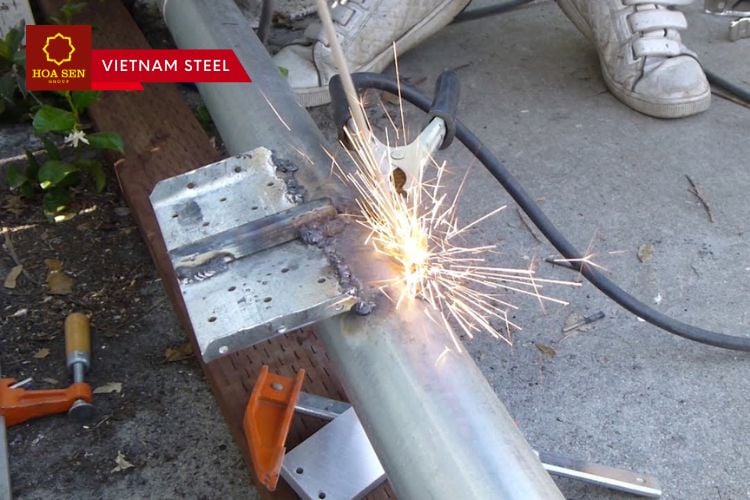
Set the work so you can see the joint clearly and keep the fume plume moving away from your face. Attach the work lead to clean bare metal if possible. Then lock the fit-up with tack welds before making the full pass. Guidance from The Fabricator stresses that tack welds are real welds, should be made with the same process as the final weld, and should be cleaned before welding through them. That matters even more on pipe, where alignment and root opening strongly affect the final bead.
- Position the joint so you are not leaning directly over the weld zone.
- Place short, sound tack welds to hold alignment and gap.
- Clean and feather rough tack starts and stops before the full pass.
- Start on bright metal, not on visible coating residue or spatter.
- Use a short arc and make a controlled start.
- Watch the first moments of the puddle. If it bubbles, spits, or looks dirty, stop and re-clean.
Short, controlled progress is usually better than trying to push through contamination.
Technique Adjustments That Reduce Contamination
Practical tips from WeldGuru favor leaving a small gap in lap and tee joints so zinc vapor has a path to escape instead of getting trapped in the weld metal. The same logic helps if you are asking can you weld galvanized pipe to steel or can you weld galvanized steel pipe. The coated side still needs room to vent, and the puddle needs to stay on clean steel as much as possible.
If your question is can you mig weld galvanized pipe, the technique matters as much as the machine. A pulling technique, short arc length, and steady travel tend to work better than shoving the arc into a smoky puddle. The same rule applies when people ask can you weld galvanized water pipe or can you weld on galvanized steel: if spatter suddenly increases, the arc goes unstable, or the bead stops wetting into both sides, pause and clean the joint rather than forcing the pass.
What to Watch for While the Arc Is Running
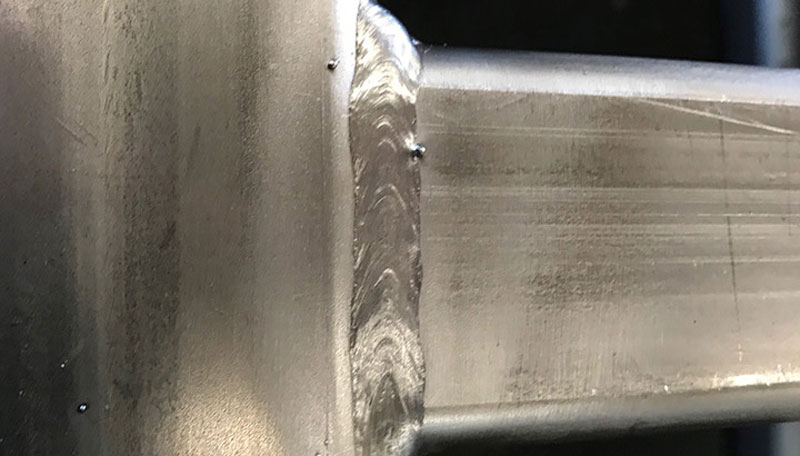
A manageable weld has clear signs. The arc sounds consistent. The puddle stays fluid instead of boiling. The bead ties into both edges instead of riding high in the center. Tack intersections should blend smoothly, not kick the arc sideways. That is true whether the job is flat stock or you are wondering can you weld galvanized pipe in a small fabrication setup.
Problems also announce themselves fast. Pinholes, harsh crackling, heavy spatter, poor wetting, and visible gas trying to break through the puddle are all warning signs that zinc is still affecting the weld. Those symptoms are worth reading carefully, because each one points to a specific fix at the bench.
Troubleshooting Galvanized Weld Defects
Galvanized welding problems rarely stay hidden for long. The puddle tells on you fast. A weld that starts bubbling, spitting, or riding high usually means zinc, dirt, poor shielding, or joint fit-up is still interfering with the process. On coated steel, reading those signs early saves far more time than grinding out a bad pass later.
How to Diagnose Porosity and Pinholes
Porosity is trapped gas in the solidifying weld metal. The Fabricator notes that rounded holes point to spherical porosity, while elongated voids may show up as wormholes or piping. On galvanized work, zinc is a common reason because it can turn to gas almost instantly under welding heat. The same source also ties porosity to drafts, moisture, contaminated surfaces, excessive gun angle, open-root air pickup, restricted nozzles, and gas-flow problems.
That is why questions like can you weld galvanized sheet metal or can you mig weld galvanized sheet metal do not have a simple yes-or-no answer. Yes, you can, but thin coated sheet gives gas fewer places to escape. If you are trying to can you weld 26 ga galvanized, the margin for error gets even smaller because heat and contamination show up quickly.
Why Spatter and Arc Instability Happen on Galvanized
This coated-steel guide explains the basic chain reaction: zinc volatilization can make the arc unstable, generate considerable spatter, and leave zinc vapor trapped in the weld puddle. Thicker coatings generally create more fume, and hot-dipped material can be less uniform than electrogalvanized sheet. So if you ask can you weld hot dipped galvanized steel, the answer is still yes, but expect a less forgiving weld zone if prep is incomplete.
| Symptom | Likely cause | Practical fix |
|---|---|---|
| Pinholes in bead | Zinc vapor or contamination trapped during solidification | Remove more coating near the joint, re-clean, and restart on bright metal |
| Wormholes or elongated porosity | Gas escaping through the puddle late | Shorten the arc, improve venting path, and avoid welding over residue |
| Heavy spatter | Arc instability from volatilized zinc, poor shielding, or bad gun angle | Correct torch angle, check gas delivery, and verify nearby drafts |
| Arc wandering or harsh crackle | Zinc fumes disturbing transfer or inconsistent shielding coverage | Pause, inspect nozzle and gas path, and confirm extraction is not disrupting shielding |
| Poor wetting at toes | Oxides, coating residue, or process not suited to the material condition | Clean more aggressively and use a technique better matched to thin or coated steel |
| Lack of fusion | Contamination in the joint, rushing the pass, or welding through residue | Grind out the defect, reset fit-up, and reweld on clean steel |
| Undercut | Unstable arc and poor control at the weld edge | Slow slightly, stabilize travel, and keep the puddle tied into both sides |
| Zinc burn-back around weld | Heat spreading beyond the prepared zone | Widen prep area and plan for a larger repair zone after welding |
How to Correct Fusion and Burn Back Problems
If you are tempted to can you weld over galvanized steel or can you weld on galvanized metal without more prep, the safest shop answer is usually no. The same goes for can you weld thru cold galvanized. Any zinc-rich coating left in the fusion zone can keep the weld from wetting and bonding the way bare steel would. When the bead sits on top, spits violently, or leaves repeated voids, stop treating it as a technique problem alone. It is usually a surface-condition problem first.
- Stop if the puddle keeps boiling instead of flowing.
- Stop if pinholes appear more than once in the same area.
- Stop if spatter suddenly jumps after a clean start.
- Stop if the bead will not tie into both edges.
- Stop if the arc becomes erratic after entering a coated section or tack.
- Stop if burn-back expands past the stripped area.
A sound bead on coated steel is a win, but the heat has already stripped protection around it. The weld may be fixed at this stage, while the corrosion barrier still is not.
Post-Weld Repair for Galvanized Steel to Steel
A clean bead can still leave a weak point against rust. Whether you ask can you weld galvanized steel to steel, can you weld galvanized steel to mild steel, or can you weld steel to galvanized steel, the same post-weld truth applies: the galvanized side loses protection where the weld heat reached.
What the Weld Heat Does to the Galvanized Coating
The zinc coating is there to provide barrier and cathodic protection. Welding heat burns off, vaporizes, or removes that zinc around the seam and in the heat-affected zone, exposing bare steel that can corrode if it is left untreated. That is why a finished weld is not the end of the job. People also ask, can you galvanize and then weld. Yes, but the weld locally damages the very coating that galvanizing added. The same thing happens if you ask can you weld galvanized steel to galvanized steel, because both coated sides can lose protection near the joint.
Postweld Cleanup Before Corrosion Repair
Before any touch-up goes on, the weld area needs to be cleaned. Post-weld treatment guidance lists the usual cleanup targets: slag, spatter, oxidation products, oil, and dirt. Depending on the job, that can mean wire brushing, grinding, or abrasive blasting. Visual inspection comes next. Look for missed spatter, burned-back coating beyond the expected zone, and any weld defects that should be corrected before coating repair starts.
A sound weld is only half the job if the bare area around it is left without zinc protection.
How to Restore Protection After Welding
ASTM A780 guidance recognizes three accepted repair methods for hot-dip galvanized steel: zinc-based solder, zinc-rich paint, and zinc spray, also called metallizing. AGA guidance also notes that zinc-rich paint is applied to a clean, dry steel surface. If you ask can you field weld galvanized steel, field touch-up systems are often more practical than sending a large or installed assembly back for full hot-dip re-galvanizing, even though re-dipping can provide the most uniform restored coating when the project allows it.
- Let the weld cool enough for safe handling and clear inspection.
- Remove slag, spatter, oxides, and loose residue from the weld and nearby heat-affected zone.
- Clean and dry the repair area so the touch-up material can bond properly.
- Inspect the weld visually and mark every bare or burned-back area that needs repair.
- Apply the approved repair method required by the project specification.
- Confirm the repaired area fully covers exposed steel and meets the coating requirement for the job.
AGA also notes that field repairs are allowed without the same repair-size limit used for newly galvanized products, though minimizing damage is still the better practice. That detail matters more than it first appears. On a one-off repair, touch-up is usually straightforward. On repeat parts, tight specs, or production work, coating restoration and inspection can become the deciding factor in whether the job stays in-house or belongs with a specialized welding partner.
DIY or Outsource Galvanized Welding Work
A single repaired bracket is one thing. A repeat job with tight fit, consistent weld quality, and reliable coating restoration is something else. At that point, the decision is less about whether the weld can be made and more about whether your shop can control the whole process every time.
When In House Welding Is Good Enough
In-house work is often reasonable when volume is low, the joint is simple, and the consequence of small variation is limited. JR Automation notes that joining method selection depends on material set, thickness, access, durability, serviceability, thermal impact, and total cost of ownership. For a one-off repair or basic fabricated part, a capable shop may do fine if it can prep the coating, manage fumes, inspect the weld, and restore corrosion protection properly.
When Precision Parts Need a Specialized Partner
Production changes the standard fast. Toyota shows that a body-in-white may involve 4,000 to 5,000 weld sites, which helps explain why automotive programs rely so heavily on automation, monitoring, and repeatability. That same logic applies to coated parts, chassis components, and tolerance-sensitive assemblies. If you are asking can you weld galvanized steel to aluminum, can you weld aluminum to galvanized steel, or can you weld aluminum to galvanized, the bigger question is whether welding is even the best joining family for that material pair. JR Automation describes a broader toolbox that includes fastening, adhesive bonding, resistance welding, laser, ultrasonic, and friction stir for specific applications. The same caution fits can you weld stainless to galvanized, can you weld galvanized steel to stainless steel, and can you weld stainless steel to galvanized steel. Mixed-metal joints usually deserve engineering review, not casual trial and error.
- Every part must meet the same fit and weld profile.
- The part sits in a safety-critical or high-stress area.
- Customer specs require documented inspection or traceability.
- The job includes coated and mixed-metal assemblies.
- Cycle time, scrap control, and throughput matter as much as bead appearance.
For automotive chassis programs, Shaoyi Metal Technology is one example of the kind of supplier worth screening. Robotic welding lines and an IATF 16949 certified quality system line up well with programs that need repeatable weld quality and efficient turnaround.
How to Evaluate a Welding Supplier for Coated and Mixed Metals
IATF 16949 is a useful filter for automotive work because it emphasizes outsourced-process conformity, supplier risk to product quality and uninterrupted supply, verification of outsourced services such as coatings and welding, and control of engineering changes and confidential projects.
| What to check | Why it matters |
|---|---|
| Process range | The supplier should match the joining method to the material set, geometry, and durability target. |
| Quality system | Automotive programs need disciplined control of variation, records, and change management. |
| Verification plan | Outsourced welding and coating work still needs inspection and acceptance criteria. |
| Production fit | Robotics, monitoring, and repeatable fixtures matter when volume and tolerance both rise. |
That is usually the clearest dividing line. If success depends more on controlled systems than on one welder's hand skill, specialized support is often the smarter choice.
FAQs About Welding Galvanized Steel
1. Can you weld galvanized steel without removing the zinc coating first?
You can, but it is usually not the smart approach. Zinc close to the fusion zone creates more fumes and makes weld defects such as porosity, spatter, and unstable arc behavior more likely. In most cases, the better method is to remove the coating only around the weld area, weld on clean steel, and then restore corrosion protection afterward.
2. What is the best welding process for galvanized steel?
The best process depends on the job. MIG is often the most practical choice in a controlled shop because it offers a good balance of speed and ease of use on prepared material. TIG is better for thin or appearance-sensitive work, while stick and self-shielded flux core are often more practical outdoors where wind can disrupt shielding gas.
3. How far should you grind off galvanized coating before welding?
The cleaned area should extend beyond the seam so zinc is not pulled back into the puddle as heat spreads. A common working range is about 1 to 4 inches from the intended weld zone on both sides, with the exact amount depending on thickness, process, and heat input. If the coating keeps burning back past the stripped area, the prep zone is too small.
4. Can you weld galvanized pipe or galvanized water pipe safely?
Yes, but pipe adds extra challenges because zinc vapor and fumes can collect around curved joints and enclosed sections. Good ventilation, careful fit-up, and a path for vapor to escape are especially important. If the pipe has carried water, fuel, or unknown residues, it should be properly cleaned and verified safe before any welding starts.
5. When should galvanized welding be outsourced to a specialized supplier?
Outsourcing makes sense when parts are repetitive, safety-critical, tolerance-sensitive, or tied to inspection and coating requirements. Production welding often needs controlled fixtures, repeatable processes, and consistent post-weld corrosion repair that many small shops cannot maintain at scale. For automotive or chassis programs, a supplier with robotic welding capability and an IATF 16949 certified quality system, such as Shaoyi Metal Technology, is often a better fit for reliable volume work.