 Small batches, high standards. Our rapid prototyping service makes validation faster and easier —
  EN
EN


Mastering Forging: How to Avoid Defects in Auto Parts
Mastering Forging: How to Avoid Defects in Auto Parts

TL;DR
Avoiding defects in forged auto parts hinges on rigorous control over the entire manufacturing process. Success requires precise management of key parameters like heating temperatures, forging pressure, and material flow. Most common issues, such as cracks, folds, and underfills, are preventable through optimized die design, proper raw material selection and preparation, and consistent lubrication.
Identifying Common Forging Defects in Automotive Components
In high-performance applications like the automotive industry, the structural integrity of forged parts is non-negotiable. Identifying potential flaws is the first step toward prevention. Forging defects are imperfections that compromise the mechanical properties of a component, rendering it unable to meet strict specifications. These issues often stem from variables in the heating process, die design, or material handling. Understanding the most prevalent defects provides a critical foundation for implementing effective quality control measures.
Several types of defects are frequently encountered in forging operations. Each has distinct causes and characteristics:
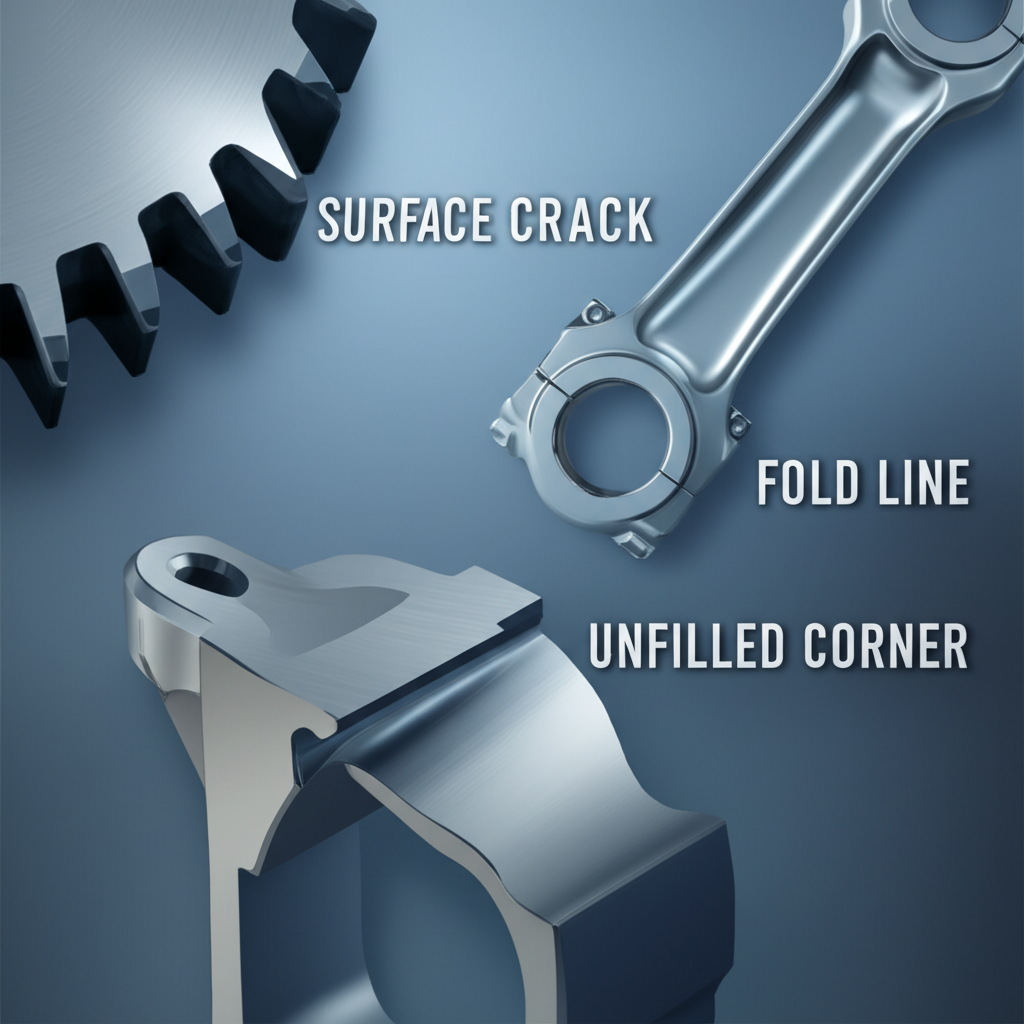
- Surface Cracks: These are fractures on the exterior of the part. They are often caused by excessive internal stress from forging at too low a temperature, deforming the metal too rapidly, or improper cooling rates after the process is complete.
- Folds or Laps: This defect occurs when a thin flap of metal is folded over and forged into the surface, creating a weak seam. It is typically the result of poor die design that obstructs smooth material flow or an incorrect alignment of the dies.
- Underfill / Incomplete Forging: An underfill defect happens when the metal fails to completely fill the die cavity, resulting in a part with missing or improperly formed sections. Common causes include an insufficient volume of raw material, low forging pressure, or a die design that is too complex for the material to flow into.
- Mismatch or Die Shift: This dimensional error is caused by the misalignment of the upper and lower forging dies. The resulting part has a horizontal displacement at the parting line, compromising its geometry and fit.
- Improper Grain Flow: The forging process is valued for creating a continuous grain structure that follows the contour of the part, providing superior strength. An improper grain flow disrupts this pattern, creating weak points that can reduce fatigue resistance and overall durability.
Mastering Process Control: The Core of Defect Prevention
The foundation of preventing forging defects lies in mastering the core process variables: temperature, pressure, and deformation rate. Incorrect control of these elements is a primary source of flaws like warping, cracking, and incomplete forging. By implementing precise monitoring and control systems, manufacturers can ensure that components meet exact specifications and maintain their intended structural integrity.
Temperature Control is Paramount: Maintaining the optimal forging temperature is crucial for success. Each metal alloy has a specific temperature range where it is malleable enough to be shaped without cracking. If the temperature is too low, the metal resists deformation, leading to surface cracks. Conversely, if it's too high, it can lead to undesirable grain growth, which weakens the final part. The solution is to use advanced furnaces with precise controls to heat billets evenly and to monitor the temperature throughout the entire forging cycle. Slow, controlled cooling after forging is also essential to prevent thermal stress and the formation of internal cracks known as flakes.
Applying Appropriate Force and Deformation Rates: The amount and speed of compressive force applied during forging directly impact material flow. Excessive force or a deformation rate that is too rapid can trap material, causing stress concentrations and internal cracks. A well-planned forging sequence with controlled deformation ensures the metal flows smoothly and fills the die cavity completely. This helps maintain a continuous and favorable grain flow pattern, which is essential for the strength and fatigue resistance of automotive parts. According to simulation experts at Transvalor, using finite element analysis can help predict material flow and identify potential issues before production begins.
The Critical Role of Tooling and Lubrication
Beyond process parameters, the physical tools used in forging—the dies—and the lubricants that facilitate the process play a critical role in producing defect-free parts. Poorly designed or maintained dies are a direct cause of several major defects, while inadequate lubrication can lead to surface flaws and excessive tool wear.
Die Design and Maintenance: A well-engineered die is fundamental to guiding the metal into its final shape without creating flaws. Sharp corners in a die design can lead to defects like cold shuts, where two streams of metal fail to fuse properly. Increasing the fillet radius can mitigate this. Regular die maintenance is equally important to prevent wear and tear that can lead to mismatch and other dimensional inaccuracies. As highlighted by Sinoway Industry, using advanced CAD software to simulate the forging operation helps refine die features and eliminate potential problems before manufacturing.
Effective Lubrication Strategy: Lubricants in forging serve multiple purposes: they reduce friction between the workpiece and the die, act as a parting agent to prevent sticking, and help manage heat transfer. Improper or insufficient lubrication can cause surface defects and prevent the metal from filling the die completely. The choice of lubricant depends on the material being forged and the specific process conditions. Applying the right lubricant correctly ensures smooth material flow, protects the die from premature wear, and contributes to a high-quality surface finish on the final component.

Foundational Quality: Material Selection and Preparation
The quality of a forged automotive part is determined long before it reaches the forge press. The process begins with the careful selection of raw materials and meticulous preparation. Starting with high-quality, defect-free metal and ensuring it is properly prepared for forging is a non-negotiable step in preventing costly failures down the line.
A comprehensive approach to material handling is essential. For companies that need robust and reliable components, partnering with a supplier that manages the entire production chain is key. For instance, specialists in the field offer integrated services that cover everything from raw material sourcing to final inspection. For those seeking end-to-end solutions, custom forging services from Shaoyi Metal Technology provide IATF16949 certified hot forging for the automotive industry, ensuring quality control from start to finish. This holistic approach minimizes the risk of introducing flawed materials into the production line.
A pre-forging checklist is a practical tool for ensuring consistency and quality:
- Raw Material Inspection: Source billets from reliable suppliers and conduct thorough inspections for internal flaws like porosity, cracks, or impurities.
- Proper Cleaning: Before heating, billets must be properly cleaned to remove scale, rust, or other contaminants. Failure to do so can result in scale pits, where oxides are pressed into the part's surface during forging.
- Accurate Volume Calculation: Precisely calculate the amount of material needed to fill the die cavity. Too little material causes underfill, a common and critical defect.
- Uniform Heating: Ensure the raw material is heated evenly to the correct forging temperature. Poor heating is a primary cause of unfilled sections and other flow-related defects.
Frequently Asked Questions About Forging Quality
1. What is the primary cause of the unfilled section defect in forging?
An unfilled section, where the metal does not completely fill the die cavity, can be caused by several factors. The most common reasons include using an insufficient amount of raw material, improper or uneven heating of the billet, and a faulty forging technique or die design. Low forging pressure can also prevent the metal from reaching all parts of the mold, leading to this defect. Ensuring the correct volume of clean material is heated uniformly and using well-designed dies are key preventative measures.
2. What are the disadvantages of forged steel?
While forging produces exceptionally strong and durable parts, the process does have some limitations. Compared to processes like powder metallurgy, forging offers less control over the final shape of the part. Forged parts often require secondary machining to achieve tight tolerances and final dimensions, which can add to the overall cost and production time. Additionally, forging is not well-suited for producing small, highly intricate parts or components that require a mix of different metals.