 Small batches, high standards. Our rapid prototyping service makes validation faster and easier —
  EN
EN


Metal Logic: What Is The Property Of A Metal And Why It Matters
What Is the Property of a Metal?
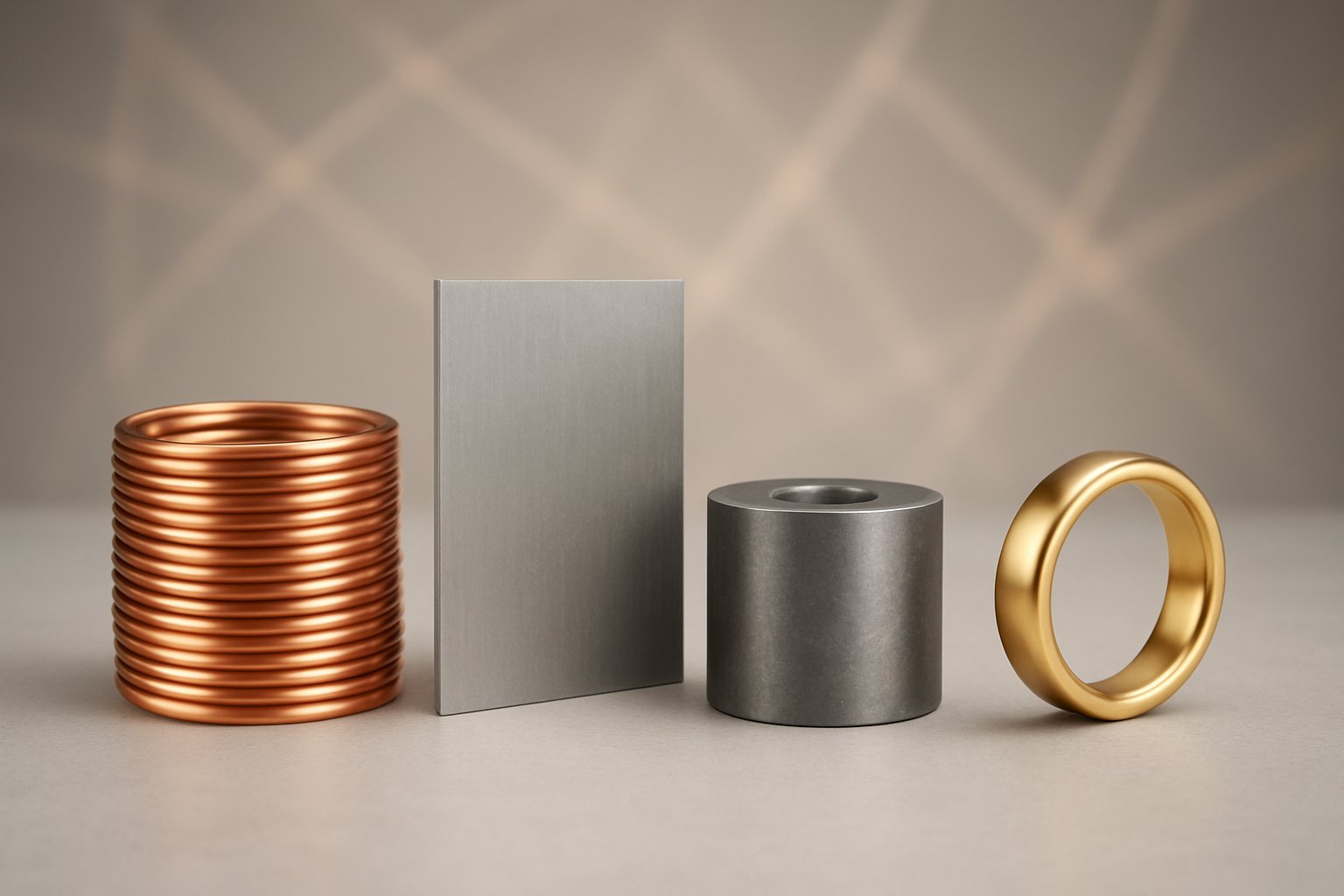
If you are asking what is the property of a metal, the short answer is simple: it is any feature you can observe or measure to describe how a metal looks, behaves, or reacts. A property is not the metal itself, and it is not the product made from it. For example, copper is a metal, copper wire is a use case, and conductivity is the property.
What a Metal Property Means
A metal property is an observable or measurable characteristic that describes a metal's appearance, behavior, or chemical response.
In chemistry and materials language, properties help answer practical questions. Does it shine? Can it carry electricity? Can it be bent into shape? Will it corrode? Standard references such as Britannica describe metals by traits like high electrical and thermal conductivity, malleability, ductility, and reflectivity.
That is why, when people ask what are the properties of metals or what are properties of a metal, they are really asking for the characteristics used to compare one metal with another.
Four Traits Most Metals Share
If you want a beginner-friendly list, these are the 4 properties of a metal most people learn first. They also appear in many simple summaries of the 4 properties of metals.
- Conductivity: Many metals carry heat and electricity well.
- Luster: Many have a shiny, light-reflecting surface.
- Malleability: Many can be hammered or rolled into sheets.
- Ductility: Many can be drawn into wires without breaking.
If someone asks you to list the main properties of metals, this is usually the starting set. It is useful, memorable, and accurate at a basic level.
Why the Definition Needs Exceptions
Still, these are general patterns, not absolute rules. Metals vary widely in hardness, density, reactivity, and melting point. Some are softer, less conductive, or more reactive than others. Mercury, for instance, is a metal but is liquid under normal room conditions, a point noted in LibreTexts.
So the main properties of metals are best treated as shared tendencies, not identical checkboxes. That raises the more interesting question: why do so many metals act alike in the first place?

Metallic Bonds and the Properties of Metals
Those familiar traits are easy to spot, but the reason behind them sits much deeper. The shared thread is metallic bonding, the kind of bonding that helps explain why many metals shine, conduct, and change shape without immediately breaking. These metallic properties of metals are not random. They grow out of how metal atoms and electrons are arranged.
What Metallic Bonding Means
In simple terms, a metal is a large structure of atoms held together by attraction between positive atomic cores and shared outer electrons. A common teaching model, described by LibreTexts, calls this a 'sea of electrons' model. The idea is that some valence electrons are delocalized, meaning they are not tied to one atom. That picture is useful, even though it is a simplified way to describe real bonding.
Metallic bonding is the attraction between metal atoms' positive cores and a shared pool of delocalized electrons, and that shared electron motion helps produce many familiar metal traits.
How Free Electrons Affect Metal Behavior
Once electrons can move through the structure, several properties of metallic substances make more sense. Electrical conductivity follows because charge can move through the metal. Thermal conductivity follows because moving electrons help transfer energy. Luster also fits the model, since surface electrons interact with incoming light and can reflect it back.
If someone asks, 'list some properties of metallic bonds.' a clear beginner answer would include:
- good electrical conductivity
- good heat transfer
- metallic luster
- malleability and ductility
Why Bonding Explains Conductivity and Shape Change
The properties of metallic bonding show up clearly when metal is stressed. In a metal, layers of atoms can move while the shared electrons adjust around them, so the structure deforms instead of shattering. That is why many metals can be rolled into sheets or drawn into wires, a point also connected to metal structure in metallic structures. The same bonding idea also helps explain why metals often have relatively high melting and boiling points, although the strength varies with how many electrons are delocalized, how strongly the nuclei attract them, and how the atoms are packed.
When people compare the properties of metallic bonds in practice, they usually use ranges and units for conductivity, melting point, or strength if reliable data is available. Without data, relative comparisons are safer than unsupported numbers. That chemistry gives the reason. The visible results still need a clearer map, because not every property belongs in the same category.
What Are the Main Properties of Metals?
Bonding explains why metals often act alike, but comparison gets much easier when those traits are sorted into clear groups. If you are wondering what are some properties of metals, the best answer is not a random list. It is a framework. In practice, the main properties of metals are usually discussed as physical, mechanical, thermal, electrical, and chemical behavior.
This matters because what properties of metals you care about depends on the job. A jeweler may focus on luster and malleability. A fabricator may care more about hardness, toughness, and weldability. An engineer may start with conductivity, density, and corrosion resistance.
| Category | Property | Plain-language meaning | How it is commonly discussed | Familiar example | Why it matters |
|---|---|---|---|---|---|
| Physical | Luster | How shiny and reflective the surface is | Surface finish, reflectivity, appearance | Polished stainless steel, gold jewelry | Affects looks and light reflection |
| Physical | Density | How much mass fits into a given volume | Weight per volume, light vs heavy metals | Aluminum versus steel parts | Changes product weight and handling |
| Physical | Melting point | The temperature where solid metal becomes liquid | Compared as ranges or process limits | Casting alloys, high temperature parts | Guides casting, welding, and heat exposure decisions |
| Mechanical | Hardness | Resistance to scratching, indentation, or local deformation | Rockwell, Vickers, or Brinell tests | Tool steel cutting edges | Matters for wear resistance and durability |
| Mechanical | Strength | Ability to carry load without failing | Yield strength, tensile strength | Structural steel members | Helps prevent bending or fracture in service |
| Mechanical | Toughness | Ability to absorb energy before breaking | Impact resistance, strength plus ductility | Steel used in heavy duty components | Important where shock or repeated loading occurs |
| Mechanical | Ductility | Ability to stretch or draw without breaking | Elongation, wire drawing behavior | Copper wire | Useful for forming wires and drawn parts |
| Mechanical | Malleability | Ability to flatten or shape under compression | Rolling, forging, stamping behavior | Aluminum foil, formed sheet metal | Supports shaping into sheets and panels |
| Thermal and electrical | Electrical conductivity | How well current moves through the metal | Relative comparison or measured values | Copper conductors | Essential in wiring and electronics |
| Thermal and electrical | Heat transfer | How well heat moves through the metal | Thermal conductivity, heat flow | Cookware, heat exchangers | Controls heating, cooling, and thermal management |
| Chemical | Corrosion behavior | How the metal reacts with moisture, oxygen, acids, or salts | Oxidation, rusting, oxide layer formation | Rusting iron, protective aluminum oxide | Determines durability, maintenance, and service life |
Physical and Mechanical Properties
The Xometry guide and Metal Supermarkets both separate visible traits from load-related ones, which is a useful habit for beginners. Physical properties of metals describe what a metal is like without loading it. Mechanical properties describe how it responds when force is applied.
- Physical properties of metals include luster, density, and melting point.
- Mechanical properties include hardness, strength, toughness, ductility, and malleability.
- These are often compared with test methods, units, and ranges, not with isolated numbers taken out of context.
Thermal and Electrical Properties
Some of the most recognizable properties of metals involve energy flow. Metals usually conduct electricity and heat well because mobile electrons help carry charge and transfer energy. Still, this is a matter of degree. Copper and silver are known for high conductivity, while other metals are chosen for a different balance of cost, weight, or strength.
- Electrical conductivity matters in wiring, connectors, and electronics.
- Thermal conductivity matters in cookware, radiators, and heat exchangers.
- If a reliable data sheet is available, this is where units and value ranges can be added later. Without that, relative comparisons are more useful than unsupported figures.
Chemical Behavior and Corrosion
Chemical properties of metals explain how they react with the environment. Many metals oxidize, but the result is not always the same. Iron oxide can allow further attack, while aluminum oxide and chromium oxide can form more protective surface layers, as noted in the Xometry material reference. That is why corrosion behavior is one of the most practical ways to compare what are some properties of metals in real life.
- Chemical behavior includes reactivity, oxidation tendency, and corrosion resistance.
- Environment matters. Moisture, salts, acids, and temperature can change performance.
- What properties of metals matter most often depends on whether appearance, service life, or fabrication is the priority.
This map is broad on purpose. Real metals rarely score highest in every category, which becomes much easier to see when familiar examples like copper, aluminum, iron, and gold are placed side by side.
Properties of Copper Metal, Aluminum, Iron, and Gold
A framework makes metal properties easier to sort, but familiar examples make them easier to remember. Copper wire, aluminum foil, steel tools, and gold jewelry each put a different trait in the spotlight. That is why the question is not answered by one feature alone. Metals belong to the same broad family, yet each one expresses that family resemblance in its own way.
| Metal | Standout traits | Common objects | Practical tradeoffs |
|---|---|---|---|
| Copper | High electrical and thermal conductivity | Wire, motors, circuits | Performs very well, but feels heavier than lightweight choices |
| Aluminum | Low weight and good corrosion resistance | Foil, cans, bikes, aircraft parts | Chosen for lightness rather than for being the strongest option in every use |
| Iron and steel | Strength, toughness, magnetic behavior | Tools, frames, machinery | Can rust if left unprotected |
| Gold | Luster, malleability, ductility, chemical stability | Jewelry, connectors, electronics | Pure gold is soft, so alloys are often used in real products |
Copper and Electrical Conductivity
The properties of copper metal are easiest to see in electrical wire. Copper is widely used in wiring, motors, and circuits because it is one of the best conductors of electricity, and it also transfers heat very well. Its reddish appearance makes it recognizable, but its real value is performance. Data on copper density also shows that pure copper is about 8.96 g/cm3 at 20 C, which helps explain why copper parts feel more substantial than lighter metals of the same size. In simple terms, copper is often selected when reliable current flow matters more than saving every ounce of weight.
Aluminum and Low Weight
Aluminum highlights a different advantage. The physical properties of aluminium metal, usually spelled aluminum in American English, are especially useful when a designer wants a metal that is strong but light. A practical metal overview points to aluminum in airplanes, bicycles, cans, and foil for exactly that reason. It also forms a protective oxide layer, which helps it resist corrosion outdoors. So while copper often wins the conductivity conversation, aluminum often wins when easy handling and low weight matter more.
Iron and Strength in Daily Use
Iron brings strength into the picture. The physical properties of iron metal include magnetic behavior, and iron has long been a key material for tools, structures, and machines. In daily life, though, many objects people call iron are actually steel, an alloy made mostly of iron with carbon. That detail matters because steel tools are a familiar example of metal strength in action. Iron-based materials are valued for toughness and load-bearing use, but they also show a common tradeoff: if not protected, iron tends to rust.
Gold and Stability and Luster
Gold shows why appearance and chemistry can matter just as much as strength. The physical properties of gold metal include bright luster, extreme malleability, and extreme ductility. The gold properties page from South Australia notes that gold is the most malleable and ductile of all metals, is an excellent conductor of heat and electricity, and resists attack by air, heat, moisture, and most solvents. Those traits help explain why gold is used in jewelry and in some electronic parts. The chemical properties of gold metal stand out because it does not tarnish easily under ordinary conditions. Pure gold is also soft, which is why jewelry is often alloyed with other metals for better wear.
Put side by side, these metals answer the question more clearly than a simple list can. Copper points to conductivity, aluminum to low weight, iron to strength, and gold to luster and stability. The pattern is useful, but it also warns against oversimplifying. A metal category can guide you, yet comparison becomes much sharper when metals are set against nonmetals and the in-between metalloids.
Properties of Metals, Nonmetals, and Metalloids Compared
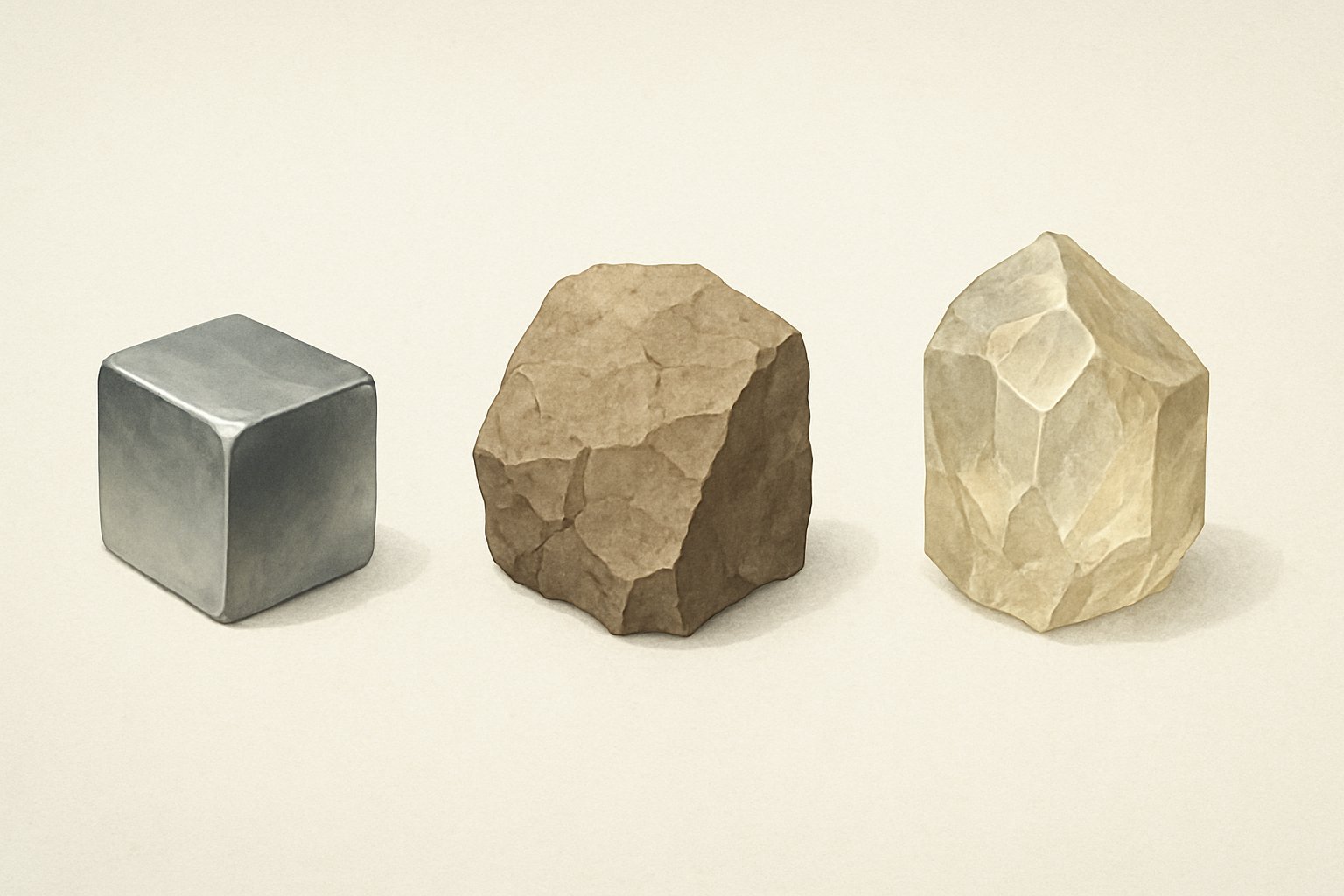
Those familiar examples become easier to judge when the comparison widens beyond metals alone. The properties of metals and nonmetals make more sense when both groups are placed beside metalloids, the in-between category on the periodic table. Standard classroom references from LibreTexts and ChemistryTalk describe a broad pattern: metals are usually lustrous and conductive, nonmetals are usually dull and poor conductors, and metalloids sit between them in important ways.
How Metals Differ From Nonmetals
| Trait | Metals | Nonmetals | Metalloids |
|---|---|---|---|
| Luster | Usually shiny and reflective | Usually dull or non-lustrous | Often metallic-looking, but not always |
| Conductivity | Good conductors of heat and electricity | Poor conductors in general | Intermediate behavior, often semiconducting |
| Malleability and ductility | Often can be shaped or drawn into wire | Not malleable or ductile | Usually not malleable like typical metals |
| Brittleness | Less likely to shatter when shaped | Solid nonmetals are often brittle | Commonly brittle despite metallic appearance |
| Typical state at room temperature | Usually solid, except mercury | Can be gas, solid, or liquid, such as bromine | Solid |
| Representative examples | Iron, copper, gold | Oxygen, carbon, sulfur | Silicon, germanium, boron |
- Metals usually lose electrons and form positive ions.
- Nonmetals commonly gain electrons or share them in covalent compounds.
- The properties of non metals are broad, so even this group should not be treated as one simple type.
Where Metalloids Sit in Between
Metalloids are the elements that have properties of both metals and nonmetals, but not in a perfect fifty-fifty way. A metalloid may look shiny like a metal and still break like a brittle nonmetal. Silicon is a classic example. LibreTexts notes that silicon can appear lustrous, yet it is brittle and is a much poorer conductor than a typical metal. Under the right conditions, some metalloids conduct electricity well enough to function as semiconductors, which is why they matter so much in electronics.
- They are generally solid at room temperature.
- Their physical appearance can lean metallic.
- Their chemical behavior often leans more toward nonmetals.
Why Comparison Prevents Oversimplification
Searches like 'properties of metal non metal and metalloids' or 'properties of nonmetals metals and metalloids' usually come from the same need: a quick comparison that still respects the gray areas. The properties of metals nonmetals and metalloids are best learned as patterns, not rigid rules. Even the properties of non-metals vary widely. Oxygen is a gas, carbon is a solid, and bromine is a liquid. Metals also vary, and metalloids are intermediate rather than identical copies of one another.
- Group labels help with first predictions.
- Real behavior still depends on the specific element.
- Clean categories are useful, but nature keeps a few edge cases ready.
That last point matters more than it first appears. A tidy comparison works well for learning, yet the moment mercury stays liquid, alkali metals turn out unusually soft, or surface oxidation changes what you see, the exceptions start doing just as much teaching as the rules.
Metal Property Exceptions Every Learner Should Know
General rules make metals easier to learn, but real metals do not always behave like the stereotype. The properties of mercury metal are the fastest example. Mercury is a metal, yet BBC Bitesize notes that it melts at about -39 C, so it is liquid at room temperature. That single case is enough to show why broad definitions are useful starting points, not universal laws.
Not Every Metal Fits Every Rule
- Mercury breaks the idea that metals are always solid under ordinary conditions.
- Group 1 metals break the image of metals as dense, high-melting materials. In the same BBC Bitesize comparison, sodium has much lower density and melting point than iron. That helps explain why the properties of group 1 metals, and especially the properties of group 1 alkali metals, deserve separate attention.
- Transition metals are often described by typical traits such as high melting points, high densities, colored compounds, and catalytic behavior, but even here there are exceptions like mercury and scandium. So the properties of transition metals are patterns, not perfect checklists.
The physical properties of alkali metals and the broader properties of alkali and alkaline earth metals remind readers that the word metal covers a wide range of behavior.
Metal labels are general. Material choice is specific to the exact metal, alloy, condition, and surface.
How Alloys and Condition Change Properties
Some traits belong to the pure element itself. Those are intrinsic elemental properties. Others change once elements are mixed into an alloy. Steel is the classic example. AZoM explains that adding carbon and using heat treatment such as annealing, hardening, normalizing, quenching, and tempering can change hardness, ductility, brittleness, and stability. That means a metal name alone is not enough. You also need to know whether you are looking at a pure element, an alloy, or a heat-treated condition.
Why Surface State Can Change What You Observe
Surface condition adds one more layer. A plated part, an oxidized surface, and a coated part may look very different even when the base metal underneath is similar. Luster can drop, color can shift, and corrosion resistance can improve or worsen at the surface first. The chemical properties of transition metals also need this kind of caution, because what reacts at the surface may shape what you notice before the core material does. In practice, good comparison starts by separating the metal itself from its alloy chemistry, processed condition, and surface state. That is the habit that turns textbook knowledge into smarter material evaluation.
How to Evaluate Metal Properties in Practice
Exceptions stop being surprising once you start comparing metals against a real job instead of a textbook stereotype. A part used in moisture, heat, or repeated loading needs a different property balance than one used indoors with light duty. Guidance from Mead Metals starts selection with environment, strength, and machinability, while MetalTek notes that engineers usually design parts to perform within a required range of physical and mechanical properties. That is the practical shift: not just naming a metal, but screening it for the conditions it must survive.
Start With the Service Environment
The simplest evaluation method is to rank the demands before ranking the materials.
- Define the environment. Check temperature, moisture, salts, chemicals, and repeated stress. The chemistry properties of metals matter here because corrosion and chemical attack depend on exposure.
- Set the strength target. Decide how much load the part must carry and whether permanent deformation is acceptable. MetalTek identifies tensile strength and yield strength as common comparison points.
- Check hardness and wear needs. If the surface may be scratched, indented, or rubbed against another material, hardness becomes a key filter.
- Review conductivity. For wiring, connectors, heat exchangers, or thermal parts, electrical conductivity and the heat transfer properties of metals can outrank raw strength.
- Compare density. Density determines how heavy the part will be for its size, which can matter in vehicles, handheld products, and moving assemblies.
- Consider melting point and temperature limits. This affects casting, welding, and whether the part can hold up in hot service.
- Match manufacturability. Mead Metals includes machinability early for a reason. A metal may look ideal on paper but still be difficult to form, draw, cut, or finish.
- Review corrosion behavior. A suitable indoor metal may be a poor outdoor choice if moisture, salts, or chemicals are involved.
Compare Properties Using Ranges and Units
If you are asking what are the physical properties of metals in a selection context, the short list usually includes density, melting point, and conductivity. Mechanical comparisons add strength, hardness, ductility, toughness, and wear resistance. MetalTek also stresses that many of these properties are interdependent, so higher strength can come with lower ductility. That is why benchmarking should use ranges, units, and representative examples when reliable references provide them. If the source only supports a relative statement, keep it relative.
| Property | What to look for | How it is commonly discussed | Why it affects selection |
|---|---|---|---|
| Strength | Required load capacity and allowable deformation | Tensile strength and yield strength, often in MPa or psi | Helps prevent bending, yielding, or fracture in service |
| Hardness | Resistance to indentation, scratching, and wear | Rockwell, Brinell, or Vickers scales | Influences wear life and sometimes forming difficulty |
| Conductivity | Need to move electricity or heat efficiently | Electrical conductivity and thermal conductivity | Critical for wiring, connectors, and heat-transfer parts |
| Density | Weight limit for a given part size | Often expressed as g/cm3 or lb/in3 | Controls part mass and weight-sensitive design choices |
| Melting point | Exposure to heat and processing temperature | Temperature range or melting point data | Affects casting, welding, and high-temperature use |
| Manufacturability | Need for drawing, rolling, machining, or forming | Machinability, ductility, malleability, temper | Shapes cost, process choice, and production feasibility |
| Corrosion behavior | Moisture, salts, or chemical contact | Corrosion resistance, pitting, galvanic risk, penetration rate | Strongly affects durability and maintenance needs |
The properties of metals on the periodic table can help you make a first guess, but real selection gets sharper when those traits are tied to test language, usable units, and application-specific comparisons.
Separate Intrinsic Alloy and Surface Effects
A metal name alone is rarely enough. MetalTek explains that chemical composition and internal structure help determine physical and mechanical behavior, and processing or heat treatment can change mechanical properties through internal rearrangement. Mead Metals reflects that same reality by pointing readers to composition differences among 301, 302, and 304 stainless steel and to tensile differences among tempers of beryllium copper. In other words, compare three layers separately: the base alloy family, the condition created by temper or heat treatment, and the surface state created by oxide, plating, or coating.
That is why two parts described with the same broad metal label can behave differently in actual service. Once the target properties are ranked this way, material choice starts blending into process choice, because the best metal on paper still has to become a workable part with the right finish.

Turning Properties of a Metal Into Better Part Decisions
A strong material choice still has to survive production. A metal can look right on paper and still become a poor part if the forming route, machining plan, or finish works against its key traits. In manufacturing terms, what is a property of a metal? It is not just a definition. It is a decision input. When readers ask what are the properties of a metal, the practical answer is that those traits help determine how a part should be made, protected, and scaled.
Match Properties to Process Choice
Process selection depends on more than the metal name. Guidance from All Precision Metals points to cost, material properties, shape and geometry, production quantity, and finish needs as major factors. It also notes that stamping and rolling are usually better suited to high-volume work, while forging and extrusion can fit lower-volume needs.
- Define the required performance. Start with strength, hardness, conductivity, corrosion exposure, weight, and temperature limits.
- Choose the base metal and condition. Match the alloy to bendability, malleability, tensile behavior, and service demands.
- Select the shaping route. Compare forming or machining options against geometry, volume, and cost.
- Check finish compatibility. Some manufacturing routes support later coatings and finishes more easily than others.
- Confirm scale-up. A good prototype path is not always the best option for repeatable production.
Why Surface Treatment Shapes Final Performance
Laserax describes surface treatment as a way to modify surface-layer properties through physical, chemical, or thermal methods. That matters because the final performance of a part often depends on the surface as much as the bulk metal. Surface treatment can improve adhesion, corrosion protection, durability, cleanliness, conductivity, and appearance.
In practice, that could mean anodizing light metals such as aluminum, titanium, or magnesium, using e-coating or electroplating to improve wear and corrosion resistance, or preparing a surface for bonding, painting, or sealing. So when comparing properties of metal for real parts, ask two questions: what must the base material do, and what must the surface do?
When a Manufacturing Partner Adds Practical Value
Once properties of a metal have to become repeatable parts, coordination starts to matter as much as theory.
- rapid prototyping for early validation
- high-precision stamping and CNC machining
- surface-treatment options tied to corrosion, adhesion, or wear goals
- high-volume production with stable quality control
- automotive-ready quality systems
For automakers and Tier 1 suppliers who need a next-step resource, Shaoyi presents one-stop automotive metal part support, including high-precision stamping, CNC machining, rapid prototyping, production services, and custom surface-treatment support. Its automotive quality guidance also explains why IATF 16949 matters in Tier 1 supply chains. That is where the properties of a metal stop being a study topic and start shaping real manufacturing decisions.
FAQs About What Is the Property of a Metal
1. What is the property of a metal in simple terms?
A metal property is any characteristic used to describe a metal, whether you can observe it directly or measure it with a test. Shine, conductivity, hardness, density, and corrosion resistance all count as properties. The property is the trait itself, not the metal sample or the product made from it.
2. What are the 4 properties of a metal most people learn first?
The usual beginner set is conductivity, luster, malleability, and ductility. These explain why many metals carry heat and electricity, reflect light, flatten into sheets, and stretch into wire. They are a strong starting point, but real material comparisons often add strength, toughness, melting point, and chemical stability.
3. Why do metals conduct heat and electricity so well?
Metals have metallic bonding, which allows some outer electrons to move through the structure more freely than in many other materials. That electron movement helps electrical charge travel and also supports heat transfer. The same bonding pattern helps many metals deform under force instead of breaking like brittle solids.
4. Are all metals solid, shiny, and hard?
No. Those are useful general patterns, but they are not universal rules. Mercury is liquid at room conditions, alkali metals are unusually soft and reactive, and oxidation or coatings can change how bright a surface looks. Alloying and heat treatment can also make the same base metal behave very differently in practice.
5. How should you compare metal properties for a real part?
Start with the service environment, then rank the properties the part must meet, such as load capacity, wear resistance, conductivity, weight, temperature limits, and corrosion resistance. After that, check alloy grade, material condition, and surface finish separately, because each one can change performance. For automotive projects that need those choices turned into production parts, a partner like Shaoyi can support prototyping, stamping, CNC machining, surface treatment, and IATF 16949-controlled manufacturing.