 Small batches, high standards. Our rapid prototyping service makes validation faster and easier —
  EN
EN


What Is Closed-Die Forging? Process and Key Benefits

TL;DR
Closed-die forging, also known as impression-die forging, is a manufacturing process where a metal workpiece is shaped by being pressed or hammered between two custom dies that fully or partially enclose it. This high-pressure process forces the metal to fill the die's cavities, resulting in a strong, near-net-shape part with excellent structural integrity and a superior surface finish. It is ideal for producing complex components in high volumes with tight tolerances.
The Fundamentals of Closed-Die Forging
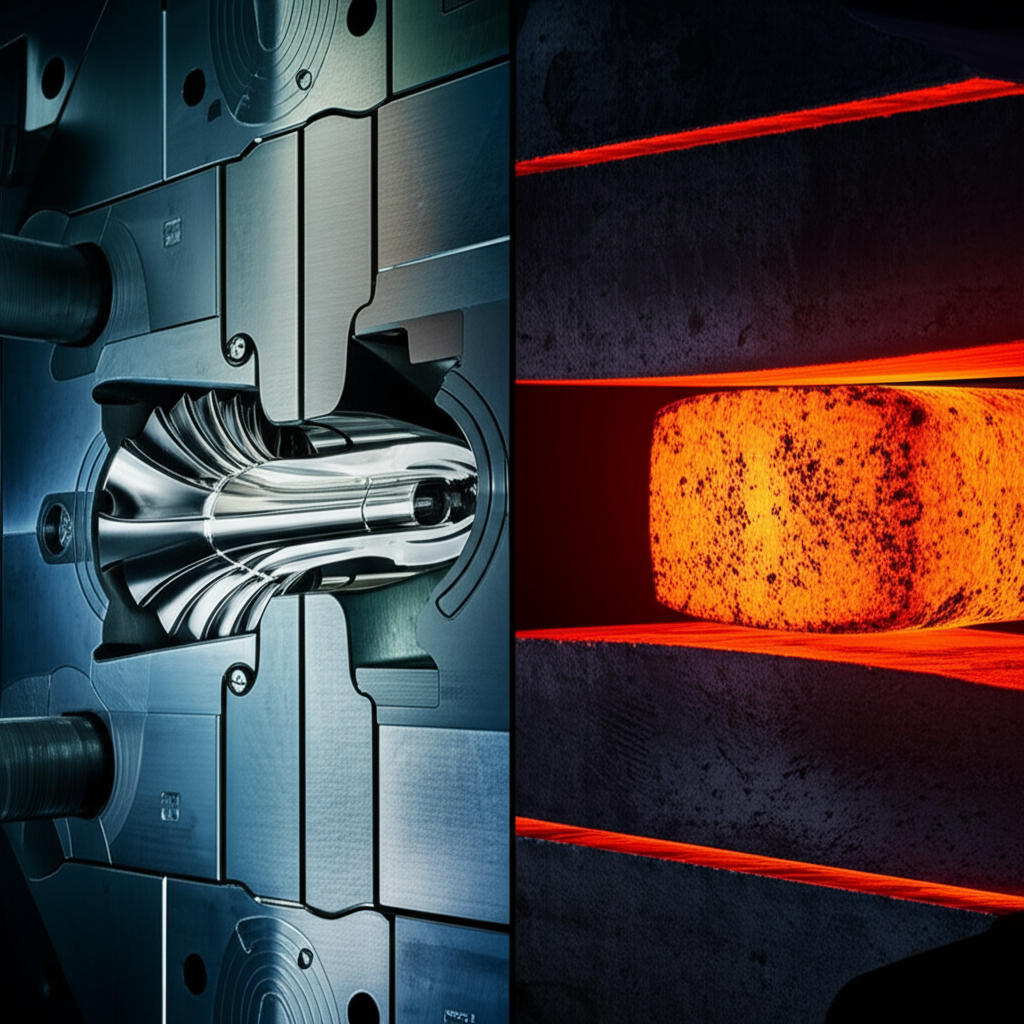
Closed-die forging is a precise metal forming technique that shapes heated metal into a desired geometry within a set of custom-made dies. Unlike other methods where the metal is not fully constrained, this process uses dies that act as a mold. The heated raw material, called a billet or workpiece, is placed in the lower die. An upper die then moves towards the lower die, applying immense pressure through hammering or pressing. This force compels the plasticized metal to flow and fill every detail of the die impressions, or cavities.
The process is often referred to as impression-die forging because the dies contain a negative image, or impression, of the final part. As the dies close, any excess material, known as flash, is squeezed out into a small gutter surrounding the impression. This flash cools quickly, creating a pressure barrier that ensures the main cavity is completely filled. After forging, this flash is trimmed off. This method's ability to produce intricate shapes with high precision makes it a cornerstone of modern manufacturing.
The Closed-Die Forging Process: A Step-by-Step Breakdown
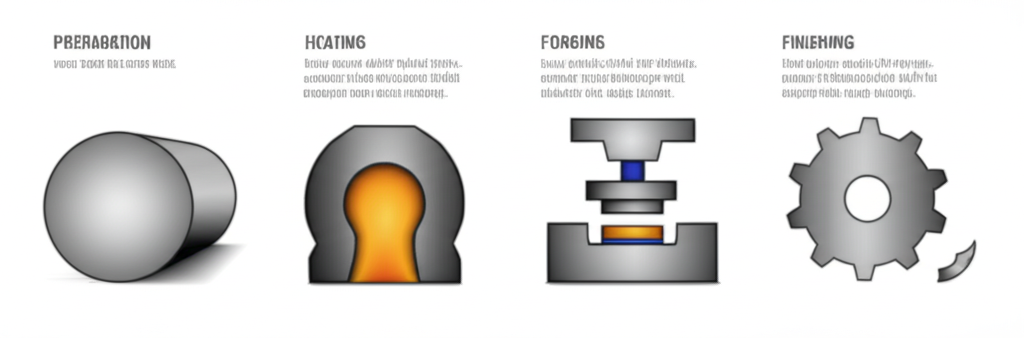
The closed-die forging process is a systematic sequence of operations designed to transform a simple metal billet into a complex, high-strength component. While specific steps can vary based on part complexity and material, the fundamental process generally follows a clear path.
- Die Design and Manufacturing: The process begins long before any metal is heated. Engineers design and fabricate a set of dies, typically from high-strength tool steel. These dies contain the precise negative impression of the final part. The design must account for material flow, thermal shrinkage, and the formation of flash.
- Billet Preparation and Heating: A raw piece of metal, known as a billet, is cut to a specific size and weight. It is then heated in a furnace or induction heater to a temperature that makes it malleable but not molten. The exact temperature depends on the material, such as steel, aluminum, or titanium alloys.
- Forging Operation: The heated billet is placed on the bottom die. A forging press or hammer then drives the top die down onto the billet with extreme force. For complex shapes, this may be done in a series of impressions on different dies, progressively shaping the metal closer to its final form. The pressure forces the metal to fill the die cavities completely.
- Flash Trimming and Finishing: After the forging stage, the part is removed from the die. The excess material, or flash, that squeezed out between the dies is removed in a secondary trimming operation. The part may then undergo additional processes like heat treatment to enhance its mechanical properties, shot blasting for cleaning, and machining to achieve final dimensional tolerances.
Advantages and Disadvantages: When to Choose Closed-Die Forging
Closed-die forging offers significant benefits for specific applications but also has limitations that make it unsuitable for others. Understanding this balance is crucial for selecting the right manufacturing process. The primary trade-off is between the high initial tooling cost and the superior quality and low per-part cost at high volumes.
Advantages
- Superior Mechanical Properties: The process refines the metal's internal grain structure, aligning it with the component's shape. This results in parts with exceptional strength, toughness, and fatigue resistance compared to cast or machined parts.
- High Precision and Consistency: Closed-die forging produces parts with tight tolerances and a near-net shape, which significantly reduces the need for secondary machining. This consistency is ideal for large production runs where every part must be identical.
- Excellent Surface Finish: The contact with the smooth die surfaces results in a better surface finish than many other forming processes, reducing the need for post-processing like polishing or grinding.
- Material Efficiency: While some material is lost to flash, the near-net-shape nature of the process minimizes overall material waste compared to subtractive methods like machining from a solid block.
Disadvantages
- High Tooling Costs: Designing and manufacturing custom dies is expensive and time-consuming. This makes the process economically unviable for small production runs or prototypes.
- Longer Lead Times: The initial setup, including die creation, contributes to a longer lead time before production can begin.
- Less Flexibility for Design Changes: Once the dies are made, altering the part design is difficult and costly. The process is best suited for stable, finalized designs.
- Size and Shape Limitations: While excellent for complex shapes, there are limits to the size and intricacy of parts that can be economically forged. Extremely large or unusually shaped components may be better suited for other methods like open-die forging or fabrication.
Closed-Die vs. Open-Die Forging: A Core Comparison
Understanding the distinction between closed-die and open-die forging is essential for any engineering or manufacturing decision. While both involve shaping metal with force, their methods and ideal applications differ significantly. Open-die forging shapes metal between simple, flat, or generically shaped dies without enclosing the workpiece. The operator manipulates the workpiece between blows to achieve the desired shape. In contrast, closed-die forging uses custom, impression-based dies that fully contain the metal.
The following table provides a direct comparison of their key characteristics:
| Feature | Closed-Die Forging | Open-Die Forging |
|---|---|---|
| Precision & Tolerances | High precision, tight tolerances, near-net shape. | Lower precision, requires significant secondary machining. |
| Part Complexity | Ideal for complex, intricate, and multi-dimensional shapes. | Best for simple, large shapes like bars, rings, shafts, and blocks. |
| Tooling Cost | High initial cost due to custom-made dies for each part. | Low tooling cost as dies are simple and not part-specific. |
| Production Volume | Cost-effective for high-volume production runs. | Suitable for single pieces, prototypes, and low-volume production. |
| Grain Structure | Grain flow is precisely controlled to follow the part's contour, maximizing strength. | Good grain structure, but less refined and contoured than closed-die. |
In summary, closed-die forging is the superior choice for producing large quantities of complex, high-strength parts where precision and minimal post-processing are critical. Open-die forging offers flexibility and cost-effectiveness for simpler, larger components and one-off or small-batch production.
Common Applications and Materials in Closed-Die Forging
The unique combination of strength, precision, and reliability makes closed-die forging indispensable across several high-stakes industries. Its ability to produce durable, near-net-shape components is critical where part failure is not an option. The process is also versatile, compatible with a wide range of metals chosen for their specific performance characteristics.
Industries and Applications
Closed-die forging is a dominant process in sectors that demand superior mechanical performance. Key applications include:
- Aerospace: This sector relies heavily on closed-die forging for critical components like turbine blades, landing gear struts, structural brackets, and engine mounts. The process delivers the high strength-to-weight ratio and fatigue resistance necessary for flight safety.
- Automotive: Powertrain and chassis components such as crankshafts, connecting rods, gears, and control arms are frequently forged to withstand constant stress and vibration. For robust and reliable automotive components, some manufacturers specialize in high-quality, certified hot forging. For instance, Shaoyi Metal Technology provides custom IATF16949 certified forging services, from prototyping to mass production for the automotive industry.
- Defense and Firearms: From artillery shells to firearm components, the defense industry uses forged parts for their durability and consistent performance under extreme conditions.
- Agriculture and Heavy Equipment: High-wear parts for tractors, construction vehicles, and mining equipment, such as gears, spindles, and levers, are forged to ensure a long service life in harsh environments.
Suitable Materials
The closed-die process can shape a variety of metals and alloys. The choice of material is driven by the application's requirements for strength, corrosion resistance, weight, and temperature tolerance. Common materials include:
- Carbon and Alloy Steels: Valued for their strength, toughness, and cost-effectiveness, steels are the most commonly forged materials.
- Aluminum Alloys: Used when lightweight properties are critical without sacrificing strength, particularly in aerospace and high-performance automotive applications.
- Titanium Alloys: Offer an exceptional strength-to-weight ratio and superior corrosion resistance, making them ideal for high-performance aerospace parts, though they are more expensive and difficult to forge.
- Copper Alloys: Chosen for applications requiring high electrical conductivity and good durability, such as electrical connectors and terminals.
Frequently Asked Questions
1. What are the advantages of closed die forging?
The primary advantages of closed-die forging include the ability to produce parts with more precise and consistent shapes, superior mechanical strength due to a refined grain structure, and an excellent surface finish. This precision significantly reduces the need for additional machining, making it cost-effective for high-volume production of complex components.