 Small batches, high standards. Our rapid prototyping service makes validation faster and easier —
  EN
EN


What Are the Types of Welding, Really? Compare Before You Weld
Start With Welding Families and Terms
If you are asking what are the different types of welding, or simply what are the types of welding, the short answer is this: welding joins materials by heat, pressure, or both. The number of types changes because some guides count broad families, while others count each specific process inside those families.
Welding is a materials-joining process that creates coalescence by heat, pressure, or both, with or without filler metal.
What Welding Means and Why the Count Changes
The AWS classification defines welding by how the joining action happens, not just by the final bead you see. In beginner-friendly overviews, many sources start with fusion and solid-state. So if you have wondered what are the 2 types of welding, that is the most common big-picture answer.
Fusion methods melt the joint area. Solid-state methods join materials without fully melting the base metals. That is why people searching what are the different type of welding or what are all the different types of welding often find different totals. One article may list two umbrella categories. Another may list arc, resistance, gas, and solid-state families. Another may go deeper and name MIG, TIG, Stick, FCAW, laser, friction, and more.
How Welding Processes Are Grouped Into Families
- Fusion welding: joins metal by melting, often through an arc, flame, or focused energy source.
- Resistance welding: uses electrical resistance and pressure, including spot and seam welding.
- Oxyfuel or gas welding: uses a flame, such as oxyacetylene welding.
- Solid-state or pressure-based welding: joins below the base metal melting point, as with friction or diffusion welding.
Common Welding Names and Acronyms You Should Know
Formal names and shop names often describe the same process. GMAW is MIG. GTAW is TIG. SMAW is Stick. FCAW is flux-cored welding. Learning those pairs makes what are the different types of welding processes much easier to follow, because weld charts, training materials, and shop talk do not always use the same label.
Family names give you the map. Choosing a process, though, usually comes down to a smaller set of everyday options, and that is where side-by-side comparison becomes much more useful than taxonomy alone.
Compare the Most Common Types of Welding Fast
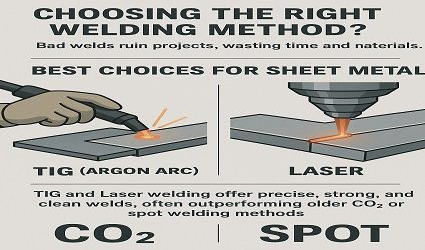
In real shops, the choices narrow fast. If you searched what are the most common types of welding, the short practical answer is usually MIG, TIG, Stick, and FCAW, with resistance and laser added when production work enters the picture. Shop-focused comparisons from Goodwin University, SSMAlloys, and DenaliWeld make the tradeoffs easier to see at a glance.
The Fastest Way to Compare Common Welding Processes
| Process | Difficulty | Equipment complexity | Shielding or weld protection | Portability | Speed | Cleanup | Weld appearance | Penetration | Indoor or outdoor fit |
|---|---|---|---|---|---|---|---|---|---|
| MIG / GMAW | Low to moderate | Moderate | External shielding gas with continuous solid wire | Moderate | Fast | Low | Clean, minimal spatter | Good for thin to medium material | Best indoors; wind can disrupt gas shielding |
| TIG / GTAW | High | Moderate to high | External inert gas with non-consumable tungsten | Moderate | Slow | Low | Very clean and precise | Excellent control, especially on thin sections | Best in controlled indoor conditions |
| Stick / SMAW | Low to moderate | Low | Flux-coated electrode forms protective shielding | High | Moderate | High slag cleanup | Rougher bead, more spatter | Works well on thicker material | Strong outdoor and field option |
| FCAW | Moderate | Moderate | Flux-cored wire, sometimes self-shielded | Moderate to high | Fast | Moderate to high | Productive, but messier than MIG | Good on thick material and deep welds | Good outdoors when self-shielded; also used indoors |
| Resistance / RSW | Moderate | High | Electric current and electrode pressure at a spot | Low | Very fast cycle times | Low | Small spot welds rather than a visible bead | Limited; best on thin sheet | Mainly indoor production lines |
| Laser | Moderate to high | High | Focused beam process with tightly controlled heat input | Low | Fast | Low | Precise, narrow weld with low distortion | Deep fusion, including thicker material | Best in controlled production settings |
For one useful thickness clue, DenaliWeld notes that resistance spot welding is mainly suited to thin metals, while laser welding can achieve deeper fusion on thicker material.
How MIG TIG Stick and FCAW Differ in Practice
MIG is often the easiest starting point because the wire feeds continuously, the welds are relatively clean, and the learning curve is friendlier on thin to medium material. TIG pushes in the opposite direction. It is slower and more skill-driven, but it gives excellent control and a polished result, especially on thin stainless and non-ferrous metals. Stick keeps its place because it is portable, works on dirty or rusty material, and handles outdoor conditions better since it does not depend on external shielding gas. FCAW feels close to MIG in setup, yet it leans harder toward productivity and thicker work, with more fumes, spatter, and cleanup.
Why Some Articles List Four Types and Others List More
When people ask what are the four main types of welding, they usually mean MIG, TIG, Stick, and FCAW. The same thing happens with searches like what are the four types of welding, what are the 4 types of welding, and what are the 4 main types of welding. That list is useful because those are the everyday arc processes many beginners meet first. It is not the full universe of welding, though. Resistance and laser are also important methods, just more tied to production systems and specialized applications. The biggest point of confusion starts inside the wire-fed group, where MIG and flux-cored welding look similar on paper but behave differently once speed, shielding, and cleanup enter the job.
Understand MIG and FCAW Wire-Fed Welding
For readers comparing what are the different types of welding and their uses, wire-fed arc processes deserve special attention. If you have been asking what are the different types of wire welding process, or even typing what are the types of welding process into a search bar, the two names that matter most are MIG, also called GMAW, and FCAW, or flux-cored arc welding. They can look similar from a few feet away because both feed wire through a gun, but they solve different shop and field problems.
How MIG GMAW Works
In everyday shop language, MIG usually means GMAW. The process creates an arc between the workpiece and a continuously fed solid wire electrode. That arc melts the wire and the base metal, while shielding gas protects the molten weld pool from air contamination. Process basics outlined by UTI describe GMAW as a semi-automatic method: power helps control wire feed and arc length, while the welder still controls gun angle, travel speed, and positioning.
A typical MIG setup includes a constant-voltage power source, wire feeder, welding gun, solid wire, work clamp, and shielding-gas cylinder. That combination explains why the process is so common in fabrication and training. It is efficient, relatively easy to learn, and can be used on thin and thick sheet metal, including aluminum and other nonferrous materials with the right setup.
- Strengths: fast travel, clean welds, minimal slag, lower cleanup, beginner-friendly feel.
- Typical uses: indoor fabrication, automotive work, manufacturing, training booths, repeatable shop jobs.
- Limitations: needs external gas, less tolerant of wind, and usually wants cleaner base metal for best results.
- When not to use it: exposed outdoor work, breezy sites, or jobs where moving a gas bottle creates more hassle than value.
Where FCAW Fits in the Wire-Fed Family
FCAW stays in the same wire-fed family, but the wire itself changes the process. Instead of solid wire, it uses a tubular wire filled with flux. That flux can create shielding on its own, or it can work together with external gas. As Earlbeck explains, self-shielded FCAW-S is designed for fieldwork and windy conditions, while dual-shielded FCAW-G adds external gas for cleaner welds and stronger results in controlled fabrication settings.
This is where people asking what are the different types of welding methods, what are the different types of welding process, or what are the different types of electric welding often get tripped up. MIG and FCAW share equipment DNA, and many MIG-capable machines can run flux-cored wire with the proper setup, but the shielding method, cleanup level, and best-use environment are not the same.
- Strengths: strong penetration, high productivity, good outdoor performance with self-shielded wire, useful on thicker steel.
- Typical uses: structural work, field repair, outdoor fabrication, thicker joints, and indoor heavy fabrication with dual-shielded wire.
- Limitations: more spatter, slag removal, more fumes, and a rougher bead appearance than MIG.
- When not to use it: appearance-critical jobs, very thin metal, or clean indoor work where minimal cleanup matters most.
When Not to Use MIG or Flux-Cored Welding
If finish quality and easy cleanup are the priority, MIG usually wins. If wind, portability, or thicker steel is driving the choice, FCAW often makes more sense. That tradeoff answers a big part of what are the different types of welding and their uses within the wire-fed family: MIG leans toward cleaner control, while FCAW leans toward speed and tougher conditions. Still, some jobs demand more finesse than either wire-fed option naturally offers. Thin sections, cosmetic welds, and maximum puddle control tend to point toward a more precise process.
TIG Precision and Types of Gas Welding
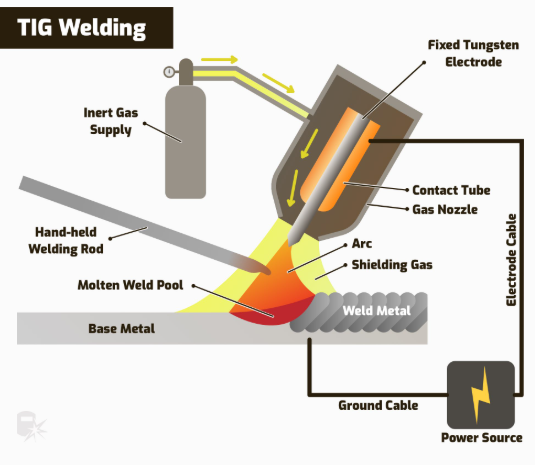
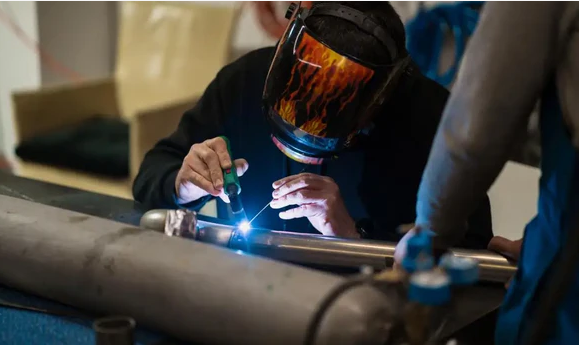
Wire-fed welding earns its popularity with speed, but some jobs care more about control than deposition rate. Among what are the different types of arc welding, TIG, also called GTAW, is the process many welders treat as the precision benchmark. The PrimeWeld TIG guide describes TIG as a fusion process that creates an arc between the workpiece and a nonconsumable tungsten electrode, while shielding gas protects the weld area from the air.
How TIG GTAW Produces Clean Precise Welds
TIG works differently from MIG or FCAW because the electrode does not feed into the joint as filler. The tungsten carries the current and forms the arc. Filler metal can be added separately by hand, or the parts can sometimes be fused without filler. That arrangement gives the welder close control over puddle size, bead shape, and heat input.
This is why TIG is valued for thin material, visible welds, and metals such as stainless steel and aluminum. Both The Crucible and PrimeWeld describe TIG as precise and versatile, especially on delicate materials and a wide range of metals. PrimeWeld also notes that DC is commonly used for steel and stainless, while AC is used for aluminum because alternating current helps break up the oxide layer. For shielding, argon is common, while helium can increase penetration and welding speed but makes arc starting harder.
If you have been searching what are the different types of tungsten for tig welding, the big-picture answer is that TIG electrodes are mainly tungsten with different oxide additions, often identified by color codes. PrimeWeld gives examples such as pure tungsten and thoriated tungsten. The exact choice affects arc behavior, but the main process difference is simple: TIG uses a nonconsumable tungsten instead of a continuously fed wire.
Pros
- Very clean welds with little cleanup and no slag.
- Excellent control over appearance and heat.
- Works on stainless steel, aluminum, copper, and other metals with the right setup.
- Can be used with or without filler metal.
Limitations
- Slower than wire-fed processes.
- Harder to learn well.
- Surface prep matters because contamination can reduce weld quality.
- Less suited to fast, high-volume work when appearance is not the main goal.
What Gas Welding Is and Where It Still Matters
TIG belongs to the arc-welding family. Gas welding sits in a different branch. For readers asking what are the different types of gas welding or what are the types of gas welding, the classic example in basic welding guides is oxy-acetylene welding. The The Crucible overview explains that oxy-acetylene welding uses fuel gas and oxygen to create a flame for welding or cutting metal.
| Process | Control | Portability | Heat source | Common uses |
|---|---|---|---|---|
| TIG / GTAW | Very high arc control | Moderate | Electric arc with shielding gas | Thin material, stainless, aluminum, clean cosmetic welds |
| Oxy-acetylene gas welding | Good torch control | High | Oxygen and fuel-gas flame | Welding steel, brazing, cutting, heating tasks |
Oxy-acetylene remains useful because the torch setup is lightweight, compact, and versatile. It can weld, braze, cut, and heat with the same general tool set. TIG wins when bead quality, controlled heat, and a cleaner finish matter more than torch simplicity.
When Precision Is Worth the Slower Welding Speed
If the job involves thin stainless, aluminum parts, or welds that will stay visible, TIG often justifies the extra time. Gas welding makes more sense when flame-based versatility is the priority. Put side by side, these two methods show why welding lists vary so much: one process centers on precise arc control, the other on portable torch utility. That contrast becomes even sharper when manual arc, resistance, friction, and laser methods enter the picture.
Explore Stick, Resistance, Friction, and Laser Welding
Clean TIG beads and torch work get plenty of attention, but many real welding jobs depend on a different set of strengths. Some need portability and tolerance for rough conditions. Others need very fast sheet metal joining or tightly controlled automated seams. That is why a complete answer to what are the types of welding has to stretch beyond the usual four-process shortlist.
Why Stick SMAW Remains Important
Among what are the types of arc welding, Stick, or SMAW, is still the classic manual workhorse. Guidance from H&K Fabrication and Fractory describes it as a simple, portable process that uses a flux-coated consumable electrode. The arc melts both the rod and the base metal, while the flux creates protective gas and slag around the weld. That combination makes Stick especially useful for maintenance, repair, structural steel, pipelines, and outdoor work where wind can interfere with gas-shielded methods.
People searching what are the different types of shielded metal arc welding are often really comparing electrode families rather than entirely separate core processes. Fractory breaks SMAW electrodes into categories such as cellulosic, rutile, and basic, each influencing penetration, slag behavior, and bead profile. The tradeoff is familiar: strong, adaptable welds, but also more spatter, more slag cleanup, and slower progress because the welder must replace rods regularly.
How Resistance Friction and Laser Welding Differ
For the broader processes below, the quick comparison matters more than memorizing acronyms. Summaries from Hirebotics make the differences easy to scan.
| Process | Heat source | Shielding or pressure method | Major strengths | Major limits | When not to use it |
|---|---|---|---|---|---|
| Stick / SMAW | Electric arc from a flux-coated consumable electrode | Flux creates shielding gas and slag | Portable, outdoor-friendly, works on less-than-perfect surfaces | Slag, spatter, slower manual pace, not ideal for thin metal | Appearance-critical work, thin sheet, fast production lines |
| Resistance spot or seam welding | Heat from electrical resistance at clamped metal sheets | Electrodes apply pressure before, during, and after welding | Very fast, repeatable, excellent for sheet metal production | Complex equipment, electrode wear, mainly suited to thin sheet | Field repair, thick sections, jobs needing long visible bead welds |
| Friction welding | Heat generated by relative motion between parts | Pressure forges the joint, typically without filler metal | High weld quality, useful in high-volume and critical applications | Expensive equipment, part geometry and motion limits | One-off repair work or parts that cannot be rotated or moved as required |
| Laser beam welding | Highly focused laser beam | Tightly controlled beam process, with or without filler metal | Precise welds, high speed, low distortion, automation-friendly | High equipment and fixturing cost, accurate fit-up needed | Low-budget field work, poor fit-up, uncontrolled environments |
If you are asking what are the types of resistance welding, the two most familiar shop answers are spot welding and seam welding. Hirebotics describes both as pressure-assisted sheet metal processes that rely on electrical resistance, which is why they are common in automotive, aerospace, appliance, and general fabrication settings. Friction welding belongs to a different family entirely. It is a solid-state process that joins parts through motion and pressure rather than a filler-fed arc. Laser welding sits at the other end of the spectrum, using a tightly focused beam for narrow, precise welds in controlled production environments.
When Specialized Welding Processes Make Sense
Each of these methods earns its place by solving a specific problem. Stick shines when weather, access, and repair conditions matter more than bead cosmetics. Resistance welding wins when thin sheets must be joined very quickly and repeatedly. If you want an overview of what are the different types of friction welding, the key idea is that this family prioritizes solid-state quality and repeatability, often in demanding industries. Laser makes sense when precision, low distortion, and automation matter enough to justify the extra equipment demands. That practical lens exposes a common mistake many beginners make: choosing a process is only part of the decision, because the joint design and welding position can change how any process performs.
What Are the Different Types of Welding Joints and Positions?
A lot of confusion starts right here. A welding process tells you how the weld is made. A joint tells you how the parts meet. A position tells you where that weld is made in space. So if you are searching what are the different types of welding joints or what are the different types of welding positions, you are not asking about MIG vs TIG at all. You are asking about fit-up and orientation.
Welding Process Versus Joint Type
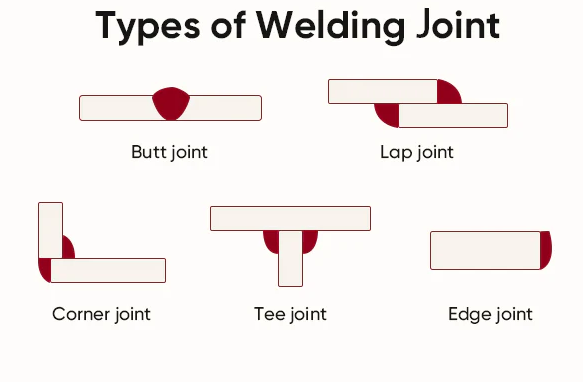
Miller's joint guide outlines the five basic joint types recognized by the American Welding Society. It also shows why joint design matters: the joint often points you toward the weld form. T-joints commonly use fillet welds, butt joints usually need groove welds, lap joints usually use fillet welds, and corner joints may use either fillet or groove welds. That is the practical answer behind searches like what are the 5 types of weld joints and what are the types of welding joints.
| Joint type | How the parts meet | Common uses |
|---|---|---|
| Butt | Edges meet in the same plane, with or without a root opening | Plate, pipe, tubing, and jobs that need a smooth, flush face |
| Corner | Pieces meet at about 90 degrees in an L shape | Frames, boxes, and square fabricated structures |
| Edge | Edges are parallel or nearly parallel | Lightly loaded parts where heavy impact is not expected |
| Lap | One piece overlaps another | Sheet metal, patching, and overlapping plate connections |
| T-joint | One piece meets another at about 90 degrees in a T shape | Structural steel, tubing, and equipment fabrication |
A fillet weld joins two pieces that are perpendicular or at an angle. A groove weld is made in a groove between workpieces or their edges, as explained in Miller's position guide.
The Main Weld Joints and Welding Positions
When readers ask what are the types of welding positions, the standard list is flat, horizontal, vertical, and overhead. Miller also notes the common designations: 1, 2, 3, and 4 identify the position, while F means fillet and G means groove, such as 2F or 3G.
- Flat: usually the easiest, because gravity helps the puddle stay even.
- Horizontal: more control is needed, especially in 2G, where the puddle can sag.
- Vertical: often welded upward on thicker material, with lower heat input to keep the puddle in place.
- Overhead: typically run cooler, since the puddle and sparks want to fall downward.
That is why what are the different types of welding positions is more than a vocabulary question. Position changes puddle behavior, difficulty, and sometimes even which process or transfer mode is practical.
Equipment Setup Basics That Change by Process
For anyone asking what are the different types of electrodes used in welding or what are the types of welding electrodes, the useful starting point is the procedure and the filler metal data sheet, not guesswork.
- Check positional ratings: Miller notes that E70T-XX filler metal is limited to flat and horizontal positions, while E71T-XX can be used in all positions.
- Match the process to the position: TIG, short-circuit MIG, and pulsed MIG can be used in all positions, while spray transfer MIG is for flat and horizontal welding only.
- Adjust the power source for position: vertical and overhead welds often need lower heat input, commonly by reducing wire feed speed and voltage.
- Confirm the rest of the setup: polarity, filler metal, shielding gas or flux, and electrode choice should match the process and the WPS.
- Read the weld designation correctly: 1F, 2F, 3F, and 4F are fillet positions, while 1G, 2G, 3G, and 4G are groove positions.
A simple T-joint in the flat position can feel very different overhead or vertical. Once machine settings, consumables, and body position all start pulling on weld quality at the same time, equipment choice becomes a safety issue too, not just a productivity one.
What Are the Different Types of Welding Machines?
Equipment choice affects safety as much as weld quality. A wire-fed MIG setup, a TIG machine, a Stick welder, or a gas rig can all join metal well, but each changes the risk profile. If you are asking what are the different types of welding machines, common shop categories shown by ESAB and Baker's Gas include MIG welders, TIG welders, Stick welders, multi-process units, wire feeders, and engine-driven equipment.
How Welding Machines and Power Sources Affect Safety
Power sources do more than start an arc. Some setups prioritize stable wire feeding for MIG and FCAW. Others lean toward precise arc control for TIG. Portable field machines put mobility first. ESAB explains that inverter machines convert incoming AC power into stable DC output and can operate in both CC and CV modes. It also highlights lower power consumption, compact size, and portability. That is a practical answer to what are the advantages of the inverter-type welding power supply: more control, easier transport, and efficient operation. If you have also searched what are the types of welding machines or what are the four types of welding power sources, the mixed answers usually come from different ways of grouping machines by process, output style, or older transformer-based versus newer inverter design.
Core Welding Safety Rules Every Process Shares
OSHA lists metal fumes, UV radiation, burns, eye damage, electrical shock, cuts, and crush injuries among major welding hazards.
Good safety starts with the basics: protect eyes and skin from UV and arc flash, wear gloves and flame-resistant clothing, use sturdy footwear, and keep ventilation strong enough to manage fumes and gases. Hot work also means controlling sparks, hot metal, and nearby combustibles before you strike an arc.
- Stick and FCAW: expect more slag, spatter, and hot debris during welding and cleanup.
- TIG: the weld may look clean, but arc radiation, hot metal, shielding gas, and tungsten handling still matter.
- Gas welding: open flame, hoses, regulators, and cylinders raise fire and gas-cylinder handling risks.
- Resistance welding: electrode force creates squeeze and pinch hazards around clamping points.
- Laser and automated systems: follow machine guarding and enclosure procedures for specialized equipment.
Ventilation Fire and Electrical Risks Explained Simply
OSHA puts fumes and gases near the top of the health list, especially in enclosed spaces. Fire risk rises when sparks, slag, or flame can reach rags, solvents, dust, or hidden cavities. Electrical shock remains a serious hazard with arc equipment, particularly around damaged leads, wet conditions, or poor grounding. Those points apply no matter what are the different types of welding equipment in your shop. Safe setup is part of process selection itself, which is why the smartest comparison is not only about how a method welds, but where, on what material, and under what working conditions.
How to Choose the Right Welding Process
A good weld starts long before the arc, beam, or electrodes touch the metal. Selection usually comes down to a short list of job variables. Codinter highlights material type, thickness, joint design, weld appearance, production volume, and budget. The Fabricator adds deposition rate, required control, fumes, postweld cleaning, consumable cost, and operator skill. That is why answers to what are the main types of welding, what are the 5 types of welding, and what are all the types of welding often change with the application.
- Start with the metal and thickness. Thin sheet often favors MIG, TIG, resistance, or laser. Thick sections lean more toward FCAW, Stick, or SAW.
- Check the joint and access. Tight corners, long seams, and awkward positions can eliminate otherwise good options.
- Set the quality target. If appearance and heat control matter, TIG or laser move up. If strength and speed matter more, wire-fed or submerged arc methods often win.
- Look at the environment. Wind, field work, and portability push many jobs toward Stick or self-shielded FCAW.
- Match the process to the people and volume. A high-volume line can justify automation. One-off repair work usually cannot.
- Price the whole job, not just the machine. Include cleanup, gas, filler, rework risk, and training time.
Searches like what are the three main types of welding, what are the 3 types of welding, and what are the three types of welding usually compress the field into MIG, TIG, and Stick. That shortcut helps beginners, but real production decisions often add FCAW, resistance, laser, or SAW.
When Speed Finish Portability or Precision Matters Most
| Scenario | Likely process | Why it fits |
|---|---|---|
| Thin sheet in a shop | MIG or resistance welding | Fast, repeatable, and widely used for sheet metal work |
| Visible stainless or aluminum | TIG | Clean appearance and strong heat control |
| Outdoor repair or structural field work | Stick or self-shielded FCAW | Better tolerance for wind and portable setups |
| Thick joints with high weld volume | FCAW or SAW | High deposition and good productivity on heavier sections |
| Repeatable automotive assemblies | Robotic GMAW, resistance, or laser | Strong fit for automation, consistency, and high-volume output |
When Manufacturers Should Work With a Specialized Welding Partner
Automotive chassis parts and repeatable structural assemblies often move toward robotic GMAW, resistance welding, or laser because consistency matters as much as raw weld strength. For that kind of work, Shaoyi Metal Technology is a relevant resource for automotive and high-precision manufacturing rather than every reader. Its service materials describe robotic welding, gas shielded welding, arc welding, laser welding, automated lines, and an IATF 16949 certified quality system, which makes it more useful for production programs than for casual shop projects.
- Shaoyi Metal Technology: best fit for automotive manufacturers that need welded chassis parts, repeatable volume production, and integrated metal-part support.
When one process checks every box on material, environment, appearance, and volume, the choice gets easy. Most jobs are not that tidy, which is exactly why process selection matters more than the label on the machine.
Frequently Asked Questions About Welding Types
1. What are the four main types of welding?
In everyday shop use, the four main types are usually MIG, TIG, Stick, and FCAW. They are the most commonly discussed because they cover a wide range of repair, fabrication, and training work. This is a practical shortlist rather than a complete catalog, since many industries also use resistance, gas, friction, laser, and submerged arc welding.
2. What are the 2 types of welding?
At the broadest level, welding is often divided into fusion welding and solid-state welding. Fusion welding joins material by melting the weld area, while solid-state welding bonds parts without fully melting the base metal. Some sources add resistance welding as a separate family, which is one reason the total number of welding types changes from one guide to another.
3. Which welding process is easiest for beginners?
MIG is usually the easiest starting point for beginners when the work is indoors and conditions are controlled. It offers steady wire feeding, a more forgiving learning experience, and less cleanup than processes that leave slag. Stick is portable and useful outdoors, but it often takes more practice to control. TIG gives excellent precision, yet it is generally the hardest method to learn well.
4. How are welding types different from welding joints and positions?
A welding type refers to the process used to make the weld, such as MIG, TIG, Stick, or resistance welding. A joint describes how the parts are arranged, such as butt, lap, tee, corner, or edge. A position describes where the weld is performed, including flat, horizontal, vertical, and overhead. Understanding the difference helps you choose the right setup, consumables, and technique.
5. When should a manufacturer work with a specialized welding partner?
Working with a specialized welding partner makes sense when repeatability, production speed, tight tolerances, and quality documentation matter more than occasional in-house jobs. This is especially relevant for automotive chassis parts, structural assemblies, and other repeat production components. For that kind of work, Shaoyi Metal Technology is a relevant option because it supports robotic welding, precision metal fabrication, and an IATF 16949 quality system suited to high-consistency manufacturing.