 Small batches, high standards. Our rapid prototyping service makes validation faster and easier —
  EN
EN


Marine-Grade Aluminum: 5052 vs. 5083 vs. 6061 for Auto Parts

TL;DR
The best aluminum alloys for marine-grade automotive parts are primarily from the 5xxx and 6xxx series. Alloys like 5083 and 5052 from the 5xxx series offer superior corrosion resistance, making them ideal for components exposed to salt and moisture. In contrast, 6061 from the 6xxx series provides higher strength and versatility, perfect for structural applications. The optimal choice ultimately depends on the specific part's need for durability against the elements versus its requirement for mechanical strength.
Defining 'Marine-Grade' for Automotive Components
The term "marine-grade" signifies a class of materials engineered to withstand harsh marine environments, a quality that is surprisingly relevant for automotive parts. For an aluminum alloy to earn this designation, it must exhibit a specific combination of properties that ensure longevity and performance when exposed to corrosive elements like saltwater, which is analogous to the road salt and moisture vehicles face. The primary characteristics that define marine-grade aluminum are exceptional corrosion resistance, a high strength-to-weight ratio, and excellent formability and weldability.
Corrosion resistance is the most critical attribute. Marine-grade alloys, particularly those in the 5xxx series like 5052 and 5083, contain magnesium, which significantly enhances their ability to resist degradation from saltwater and other corrosive agents. For automotive components such as underbody panels, fuel tanks, and structural members constantly exposed to road salt in winter climates, this property is not just beneficial—it's essential for preventing premature failure and ensuring vehicle safety and durability.
Beyond resisting rust, a high strength-to-weight ratio is a key advantage. Aluminum is roughly one-third the weight of steel, and high-strength alloys like 6061 can offer comparable structural integrity with significant weight savings. This "lightweighting" is critical in the automotive industry for improving fuel efficiency and vehicle handling. By using strong yet light marine-grade alloys, manufacturers can reduce a vehicle's overall mass without compromising on the strength needed for frames, chassis components, and other load-bearing parts.
Finally, good workability and weldability are crucial for manufacturing complex automotive parts. Alloys must be easily formed, bent, and shaped without cracking. Marine-grade alloys like 5052 are known for their excellent formability, while alloys such as 6061 offer good weldability, allowing for the creation of robust and seamless connections in structural assemblies. This combination of properties allows designers and engineers to create durable, lightweight, and corrosion-resistant components that can withstand the demanding conditions of both sea and road.
Head-to-Head: Comparing Top Marine Aluminum Alloys
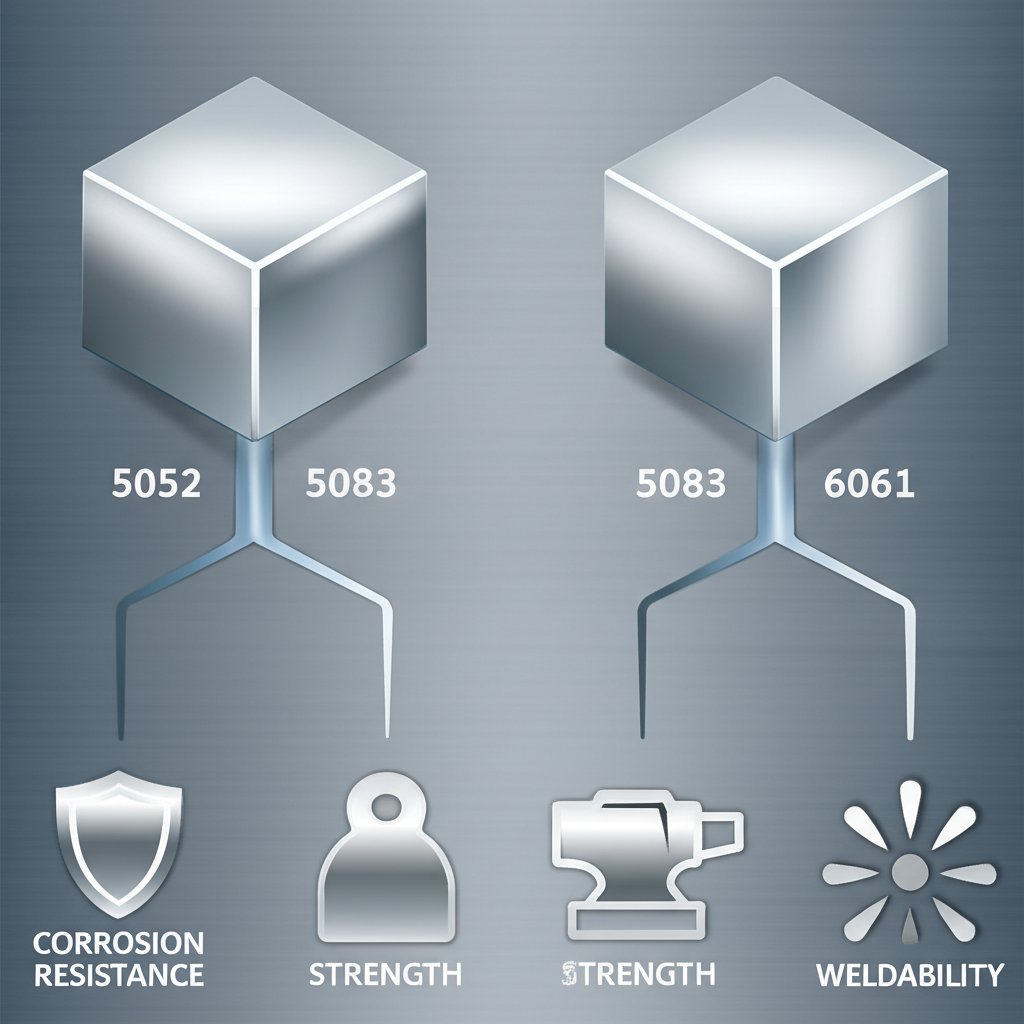
When selecting the ideal marine-grade aluminum for automotive applications, the choice often narrows down to a few key players from the 5xxx and 6xxx series: 5052, 5083, and 6061. Each alloy presents a unique balance of properties, and understanding their differences is crucial for matching the material to the specific demands of an automotive part. The 5xxx series alloys are non-heat-treatable and derive their strength from strain hardening, while the 6xxx series alloys are heat-treatable, allowing for higher strength levels.
To clarify their distinctions, here is a direct comparison of their key attributes:
| Alloy | Primary Strength | Corrosion Resistance | Weldability | Ideal Automotive Use |
|---|---|---|---|---|
| 5052 | High fatigue strength and excellent formability. Moderate overall strength. | Excellent, especially in marine and saltwater environments. | Good. | Fuel tanks, interior panels, non-structural body parts, and components requiring complex shapes. |
| 5083 | Highest strength of non-heat-treatable alloys; retains strength well after welding. | Excellent; considered a top performer in harsh saltwater conditions. | Excellent. | Underbody shields, structural components in high-corrosion zones, and heavy-duty applications. |
| 6061 | High strength (especially in T6 temper), versatile, and heat-treatable. | Very good, but slightly less resistant to saltwater than 5xxx series alloys. | Good, though strength can be reduced in the weld zone without post-weld heat treatment. | Structural frames, suspension components, extrusions, and load-bearing applications. |
Alloy 5083 stands out as the champion of corrosion resistance. According to Taber Extrusions, it thrives in the harshest environments and is celebrated for its ability to maintain strength after welding. This makes it an exceptional choice for automotive parts that will face direct and prolonged exposure to road salt and moisture, such as underbody components or structural parts on vehicles operated in coastal or snowy regions.
Alloy 5052 offers a fantastic balance of good corrosion resistance, high fatigue strength, and superior formability. As noted by Howard Precision Metals, its excellent workability allows it to be drawn into intricate shapes, making it perfect for components like fuel tanks, interior panels, and brackets that require complex forming without sacrificing durability.
Alloy 6061 is the workhorse of the group, known for its high strength, versatility, and good mechanical properties. Its strength can be significantly increased through heat treatment (most commonly to a T6 temper). While its corrosion resistance is slightly lower than its 5xxx series counterparts, it remains very good for most applications. Its high strength-to-weight ratio makes it the preferred material for structural automotive parts like chassis frames, suspension components, and custom extrusions where rigidity and load-bearing capacity are paramount.
Application-Specific Recommendations: Matching the Alloy to the Part
Choosing the right marine-grade aluminum alloy is not a one-size-fits-all decision; it requires matching the material's specific strengths to the functional demands of the automotive component. By aligning the alloy's properties with the part's environment and structural requirements, engineers can optimize for performance, longevity, and cost-effectiveness.
For Body Panels and Fuel Tanks: Alloy 5052
Components that require significant shaping and forming, such as body panels, interior structures, and fuel tanks, are best served by Alloy 5052. Its excellent formability and workability mean it can be bent and drawn into complex geometries without fracturing. Furthermore, its superb resistance to corrosion ensures that fuel tanks will not degrade from internal contents or external exposure to the elements, making it a safe and reliable choice.
For Underbody Shields and High-Corrosion Zones: Alloy 5083
For parts that face a relentless assault from road salt, water, and debris, Alloy 5083 is the undisputed leader. Its exceptional performance in saltwater environments translates directly to superior durability for underbody shields, suspension mounting points, and any structural elements in the splash zone. As the highest-strength non-heat-treatable alloy, it provides robust protection and structural integrity in the most demanding conditions a vehicle will encounter.
For Structural Frames and Extrusions: Alloy 6061
When maximum strength and rigidity are the primary concerns, Alloy 6061, particularly in the T6 temper, is the optimal choice. It is ideal for manufacturing vehicle frames, subframes, suspension arms, and other load-bearing structural components. Its high strength-to-weight ratio helps reduce vehicle mass while maintaining structural integrity, which is critical for performance and fuel economy. For automotive projects demanding precision-engineered components like these, consider custom aluminum extrusions from a trusted partner. Shaoyi Metal Technology offers a comprehensive one-stop service, specializing in strong, lightweight, and highly customized parts tailored to exact specifications under a strict IATF 16949 certified quality system.
Frequently Asked Questions
1. Is 5052 aluminum stronger than 6061?
No, in terms of tensile and yield strength, 6061 aluminum is significantly stronger than 5052, especially when heat-treated to a T6 temper. However, 5052 possesses greater fatigue strength, which means it can withstand more cycles of loading and unloading without failing. The choice between them depends on whether the application requires high static strength (6061) or resilience against repeated vibrations and flexing (5052).
2. Is 6061-T6 aluminum marine grade?
Yes, 6061-T6 is widely considered a marine-grade aluminum and is frequently used in marine construction for components like boat hulls, frames, and fittings. It offers a great combination of high strength, good workability, and very good corrosion resistance. While alloys from the 5xxx series, like 5083, offer superior corrosion resistance specifically in saltwater, 6061-T6 provides a more versatile balance of properties suitable for many demanding applications.
3. Is there a marine grade aluminium?
Yes, but "marine grade" does not refer to a single type of aluminum. Instead, it describes a category of aluminum alloys that exhibit excellent resistance to corrosion in marine environments. The most common marine-grade alloys belong to the 5xxx and 6xxx series. The 5xxx series (e.g., 5052, 5083, 5086) is alloyed with magnesium and is known for its exceptional corrosion resistance in saltwater. The 6xxx series (e.g., 6061, 6063) is alloyed with magnesium and silicon, offering a balance of strength, weldability, and corrosion resistance.