 Small batches, high standards. Our rapid prototyping service makes validation faster and easier —
  EN
EN


Automotive Rapid Prototyping Services to Speed Innovation

TL;DR
Automotive rapid prototyping services use advanced technologies like 3D printing and CNC machining to quickly create physical parts from digital designs. This process is essential for validating form, fit, and function before committing to expensive production tooling. The primary benefits include significantly accelerating development cycles, reducing costs by identifying design flaws early, and enabling greater innovation through fast, iterative testing.
The Critical Role of Rapid Prototyping in the Automotive Sector
In the highly competitive automotive industry, speed, precision, and cost-efficiency are paramount. Traditional product development cycles often involve long lead times and substantial investment in tooling, making design changes late in the process incredibly expensive. A single flaw discovered after production tooling is created can lead to millions of dollars in losses and significant delays, jeopardizing a vehicle's launch.
Rapid prototyping directly addresses these challenges by transforming the development process. It allows engineering and design teams to create tangible, testable parts in a matter of days, not months. This ability to quickly produce physical models offers several strategic advantages that are crucial for modern automotive manufacturing.
Key benefits include:
- Accelerated Speed to Market: By compressing the time between design and physical part, companies can conduct validation and testing cycles much faster. This allows for quicker design iterations and ultimately shortens the entire vehicle development timeline.
- Significant Cost Savings: Identifying design flaws, ergonomic issues, or assembly problems with a low-cost prototype is far more economical than discovering them after investing in mass production molds and tooling. This iterative approach minimizes the risk of costly rework.
- Enhanced Design Innovation: When designers and engineers can quickly and affordably test new ideas, they are more empowered to innovate. Rapid prototyping encourages experimentation with complex geometries and novel features, knowing that concepts can be physically validated without a major financial commitment.
- Improved Product Quality and Functionality: Functional prototypes allow for rigorous real-world testing of mechanical properties, durability, and performance under operational stress. This ensures the final components are optimized for their intended use, leading to a higher-quality and more reliable end product.
Comprehensive Prototyping Technologies
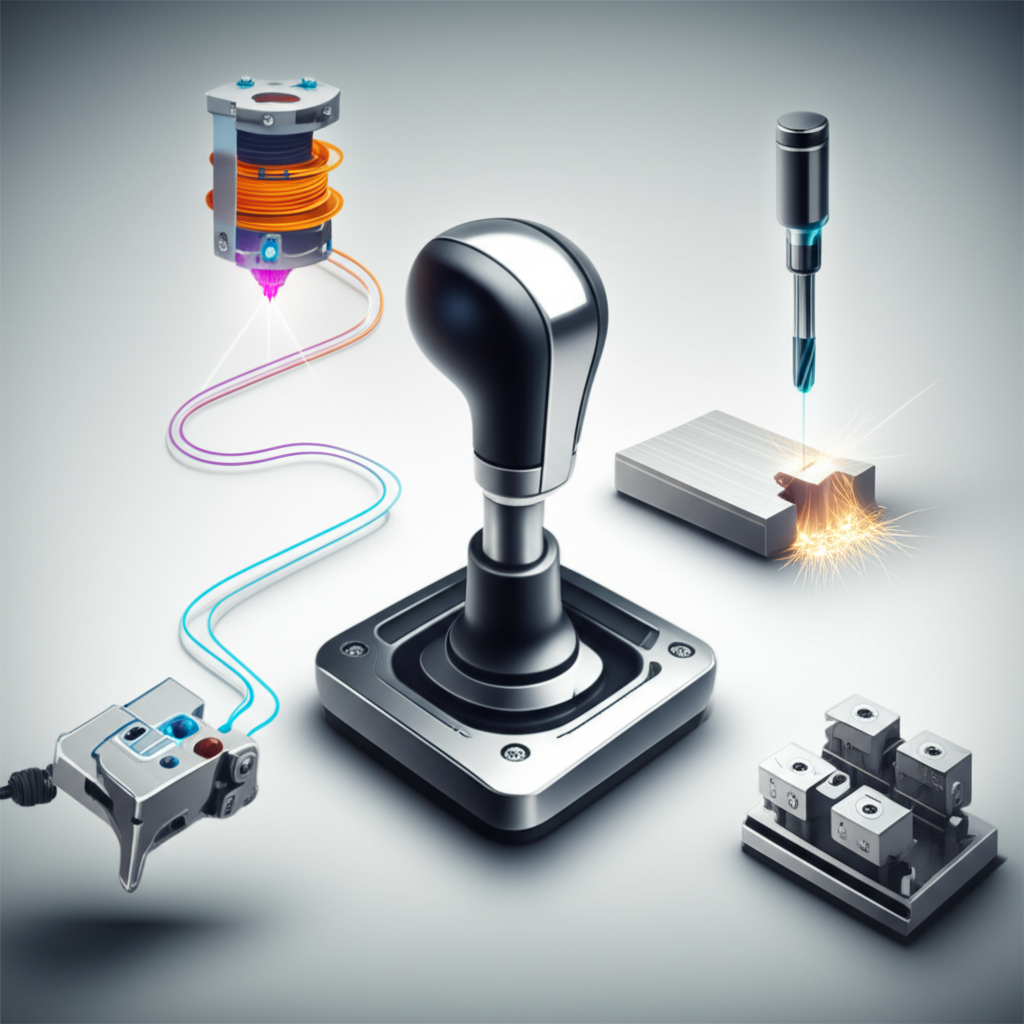
A wide range of manufacturing technologies is available to meet the diverse needs of automotive prototyping, from creating simple visual models to producing fully functional, high-stress components. The choice of technology depends on the desired speed, material properties, surface finish, and part complexity. Leading service providers like Xometry offer a comprehensive suite of options to cover every stage of development.
3D Printing (Additive Manufacturing)
3D printing is often the fastest and most cost-effective method for creating prototypes, especially those with intricate or complex geometries. It builds parts layer-by-layer directly from a CAD file. Key 3D printing technologies used in the automotive industry include:
- Stereolithography (SLA): Known for producing parts with very smooth surface finishes and fine details, SLA is ideal for visual models, fit checks, and creating master patterns for casting.
- Selective Laser Sintering (SLS): This process uses a laser to fuse powdered nylon, resulting in durable, functional prototypes with good mechanical properties suitable for testing snaps, fits, and hinges.
- Fused Deposition Modeling (FDM): FDM builds parts by extruding thermoplastic filaments, offering a wide range of engineering-grade materials. It is excellent for producing strong, durable, and thermally stable functional prototypes, jigs, and fixtures.
CNC Machining
CNC (Computer Numerical Control) machining is a subtractive process that carves parts from a solid block of metal or plastic. It is renowned for its high precision, excellent surface finish, and ability to use production-grade materials. This makes CNC machining the ideal choice for functional prototypes that require tight tolerances and superior strength, such as engine components, suspension parts, and custom tooling.
Injection Molding
While often associated with mass production, rapid injection molding (or bridge tooling) is used to create hundreds or thousands of prototype parts. It involves creating a lower-cost aluminum mold to produce components in their final production material. This process is perfect for late-stage prototyping, pilot runs, and rigorous functional testing where a larger quantity of identical parts is needed to validate the manufacturing process and material performance before scaling up.
Advanced Materials for Automotive Applications
Material selection is a critical aspect of automotive prototyping, as the chosen material must accurately simulate the properties of the final production part. Modern prototyping services offer a vast library of polymers and metals to match specific application requirements, from interior aesthetics to under-the-hood durability.
Engineering Plastics and Polymers
Plastics are widely used for their versatility, light weight, and range of properties. Common choices include:
- ABS: Offers a good balance of strength and impact resistance, often used for interior trim, dashboards, and housings.
- Polycarbonate (PC): Known for its high impact strength and optical clarity, making it suitable for lighting components and lenses.
- Nylon (PA): Provides excellent strength, temperature resistance, and durability, ideal for gears, bushings, and engine covers.
- Elastomers and Rubbers: Flexible materials like liquid silicone rubber are used to prototype seals, gaskets, and overmolded grips.
High-Performance Metals
For components that require high strength, heat resistance, and structural integrity, metal prototypes are essential. Key materials include:
- Aluminum: Valued for its excellent strength-to-weight ratio, machinability, and corrosion resistance. It is commonly used for engine blocks, cylinder heads, and chassis components.
- Steel: A range of steel alloys, including stainless steel, is used for parts requiring high strength and durability, such as brake components and structural elements.
- Titanium: Used for specialty applications where extreme strength, low weight, and high-temperature resistance are critical, such as in performance engine valves or exhaust systems.

From Concept to Production: A Streamlined Process
The process of turning a digital design into a physical prototype is designed to be fast, transparent, and user-friendly. Leading providers have refined their workflows to minimize friction and deliver parts quickly, enabling engineering teams to focus on innovation rather than logistics.
A typical workflow involves the following steps:
- Upload Your CAD Model: The process begins by uploading a 3D CAD file to a secure online portal.
- Receive an Instant Quote and DFM Analysis: Sophisticated platforms, like those offered by Protolabs, provide an interactive quote within hours, often accompanied by free Design for Manufacturability (DFM) analysis. This automated feedback helps identify potential issues that could affect part quality or cost, allowing for design adjustments before manufacturing begins.
- Manufacturing Begins: Once the design is finalized and the order is placed, the part is sent to production using the selected technology and material.
- Quality Inspection and Delivery: After manufacturing, the part undergoes a rigorous quality inspection to ensure it meets specifications. The finished prototype is then securely packaged and shipped, often arriving within a few days.
Once your prototype is validated, the next step is moving toward production. For components requiring exceptional strength and durability, processes like forging become essential. For robust and reliable automotive components, consider the custom forging services from Shaoyi Metal Technology. They specialize in high-quality, IATF16949 certified hot forging, offering a seamless transition from small-batch prototypes to full-scale mass production.
Frequently Asked Questions
1. What are the main applications of automotive rapid prototyping?
The primary applications include design validation to confirm the form and fit of new components, functional testing to evaluate mechanical performance and durability, and creating custom jigs, fixtures, and tools for assembly lines. It is also used for ergonomic studies of interior parts and for producing concept models for auto shows and stakeholder reviews.
2. What is the typical turnaround time for a prototype part?
Turnaround time varies depending on the technology, material, and complexity of the part. 3D printing is generally the fastest, with some services from providers like Stratasys Direct capable of delivering parts in as little as 1-3 days. CNC machined parts typically take a few days to a week, while rapid injection molding may take one to three weeks due to the need for tool creation.
3. How does rapid prototyping save costs in the automotive industry?
Rapid prototyping saves money primarily by mitigating risk. It allows engineers to identify and correct design flaws at an early stage when changes are inexpensive to make. This prevents the massive costs associated with modifying or scrapping hard tooling for mass production, reduces material waste, and minimizes delays in the product launch schedule.