 Small batches, high standards. Our rapid prototyping service makes validation faster and easier —
  EN
EN


5000 Series Aluminum for Automotive Paneling: An Analysis
5000 Series Aluminum for Automotive Paneling: An Analysis
TL;DR
5000 series aluminum for automotive paneling is a non-heat-treatable aluminum-magnesium (Al-Mg) alloy family, highly valued for its exceptional corrosion resistance, good weldability, and medium strength. Its excellent formability and high strength-to-weight ratio make it a prime candidate for manufacturing durable and lightweight vehicle components, particularly inner body panels and structural parts, contributing significantly to vehicle lightweighting and safety.
Understanding 5000 Series Aluminum: Composition and Key Characteristics
The 5000 series aluminum alloys represent a family of materials where magnesium (Mg) is the principal alloying element, typically ranging from 0.2% to 6.2%. This addition of magnesium is not arbitrary; it is the key to the alloy's enhanced strength through a mechanism known as solid solution strengthening. Unlike the 6000 or 7000 series alloys, the 5000 series is non-heat-treatable. This means its strength is increased through strain hardening (also known as work hardening) during processes like rolling or forming, rather than through a heating and quenching cycle. This fundamental difference dictates its applications and fabrication methods.
Several grades within the 5000 series are prominent in automotive applications, including 5182 and 5754. For instance, 5182 aluminum is frequently used for the "four doors and two covers"—the doors, hood, and trunk lid—because its excellent deformability allows it to absorb impact energy effectively, enhancing passenger safety. Similarly, 5754 is widely used for body structural parts and inner panels due to its ideal balance of properties. The defining characteristics of this alloy series make it a versatile and reliable choice for engineers.
The core attributes of 5000 series aluminum alloys include:
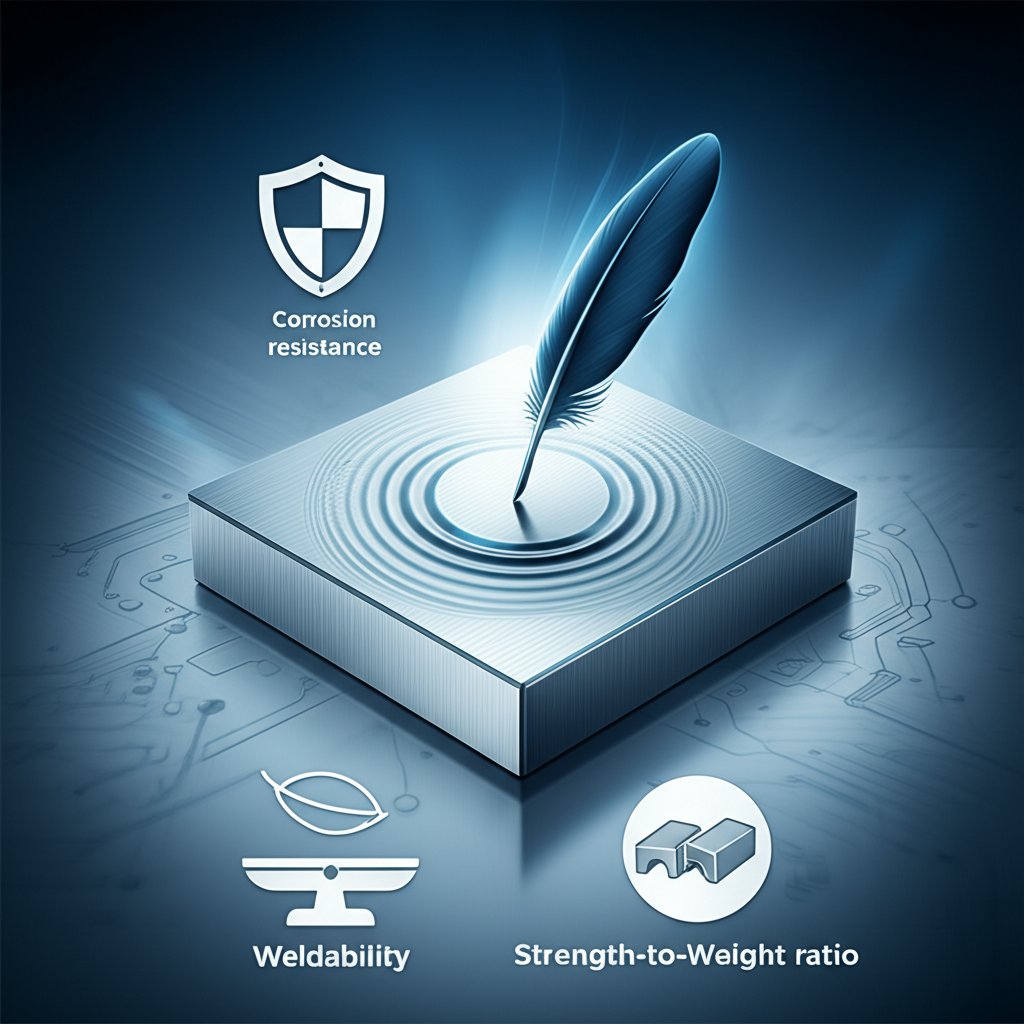
- Excellent Corrosion Resistance: The presence of magnesium creates a stable and protective oxide layer, making these alloys highly resistant to corrosion, especially in marine or high-moisture environments. This durability is a major advantage for long-lasting automotive components.
- Good Weldability: These alloys can be readily joined using common welding techniques like MIG (Metal Inert Gas) and TIG (Tungsten Inert Gas), which is crucial for assembling complex automotive structures.
- Medium Strength: While not as strong as heat-treated 6000 or 7000 series alloys, the 5000 series offers a superb strength-to-weight ratio, providing structural integrity without the penalty of heavy steel.
- Superior Formability: The alloys in this series are known for their ductility, allowing them to be stamped and formed into the complex shapes required for automotive inner panels and components.
Mechanical Properties for Automotive Applications
When evaluating materials for automotive paneling, engineers focus on a specific set of mechanical and physical properties that directly impact performance, safety, and manufacturing efficiency. The 5000 series aluminum alloys exhibit a compelling profile in several key areas, making them a frequent choice for specific structural and body applications. The combination of low density with good tensile and fatigue resistance allows these alloys to achieve high strength at a weight far lower than steel.
A standout feature of some 5000 series alloys is their capacity for superplastic forming. At elevated temperatures (typically 400–500°C), these materials can stretch to over 100% of their original size without failing. This property, detailed by manufacturers like UACJ, enables the use of blow forming techniques to create highly complex, single-piece components. This can reduce the total number of parts, simplify assembly, and offer greater design freedom for engineers.
The table below summarizes typical mechanical properties for common 5000 series alloys used in automotive body panels, demonstrating their suitability for applications requiring a balance of strength and ductility.
| Alloy Designation (Temper) | Tensile Strength (MPa) | Proof Stress (MPa) | Elongation (%) |
|---|---|---|---|
| 5022 (GC45-O) | 280 | 130 | 28 |
| 5182 (GM145-O) | 275 | 135 | 27 |
| 5052 (52S-O) | 195 | 90 | 25 |
Data sourced from UACJ for 1mm thick sheets.
Despite these strengths, it's important to consider potential limitations. While highly formable, some forum discussions suggest that 5000 series alloys can become brittle when subjected to very tight bends. This highlights the importance of proper engineering and design to leverage the material's strengths while mitigating its weaknesses. The choice of a specific alloy and temper must align with the demands of the component's geometry and function.
5000 Series vs. Other Alloys in Automotive Design
The decision to use 5000 series aluminum is made in the context of other available materials, primarily the 6000 series aluminum alloys and traditional mild steel. Each material offers a distinct set of trade-offs in terms of strength, cost, weight, and manufacturability. Understanding these differences is crucial for optimizing vehicle design for performance, safety, and efficiency.
The 6000 series alloys, which contain magnesium and silicon, are heat-treatable. This allows them to achieve higher strength levels than the 5000 series, making them a popular choice for exterior panels like hoods and doors, as well as structural components where maximum strength is critical. However, the 5000 series often excels in applications requiring superior corrosion resistance and formability, such as complex inner panels or parts exposed to harsh environments. The choice is not about which is universally "better," but which is right for a specific application.
The following table provides a high-level comparison:
| Material | Key Advantage | Primary Drawback | Best Automotive Use Case |
|---|---|---|---|
| 5000 Series Aluminum | Excellent corrosion resistance, weldability, and formability. | Lower strength than 6000 series; non-heat-treatable. | Inner body panels, structural parts in corrosive zones, complex stampings. |
| 6000 Series Aluminum | High strength after heat treatment; good extrudability. | More complex processing (heat treatment); lower formability than 5000 series. | Exterior body panels (hoods, doors), crash structures, frames. |
| Mild Steel | Low cost; established and well-understood manufacturing processes. | High weight (density); susceptible to corrosion without coatings. | Traditional body-in-white structures where cost is the primary driver. |
Practical Considerations: Forming, Welding, and Finishing
Working with 5000 series aluminum for automotive paneling requires an understanding of its specific fabrication characteristics. Its properties make it highly workable, but best practices must be followed to achieve optimal results in terms of both structural integrity and surface finish. The alloy's excellent workability is a key reason for its adoption in creating components with complex geometries.
Forming and Bending
The 5000 series alloys are strengthened through work hardening, meaning they become stronger and harder as they are plastically deformed. This must be managed during stamping and forming processes. Key considerations include:
- Bend Radii: To avoid cracking, especially in harder tempers, generous bend radii should be used. As noted by fabricators, tight bends can make the material brittle.
- Springback: Like all aluminum alloys, the 5000 series exhibits more springback than steel, which must be accounted for in the tool and die design.
- Superplastic Forming: For highly complex parts, leveraging the superplastic properties at high temperatures can be a game-changing manufacturing approach, allowing for the creation of single, intricate parts that would otherwise require multiple components and assembly steps.
Welding Techniques
The good weldability of the 5000 series is a significant advantage in automotive assembly. Both MIG and TIG welding are commonly used. To ensure a strong, durable weld, it is essential to use the correct filler wire, typically a 5xxx series filler like 5356, which is chemically compatible and prevents issues like hot cracking. Proper surface preparation to remove the oxide layer is also critical for achieving a high-quality, defect-free weld.
For automotive projects demanding precision-engineered components, custom aluminum extrusions from a trusted partner can be invaluable. For those needing a comprehensive one-stop service, organizations like Shaoyi Metal Technology offer everything from rapid prototyping to full-scale production, all managed under a strict IATF 16949 certified quality system. They specialize in delivering strong, lightweight, and highly customized parts tailored to exact specifications.
Frequently Asked Questions
1. What is 5000 series aluminum used for?
Due to its excellent corrosion resistance and strength, 5000 series aluminum is widely used for marine equipment, shipbuilding, pressure vessels, cryogenic tanks, and aircraft components. In the automotive industry, it is primarily used for inner body panels, structural components, and parts requiring high formability.
2. What is the best aluminum for automotive?
There is no single "best" aluminum; the choice depends on the application. The 6000 series alloys are often preferred for strength-critical outer panels and structural frames due to their heat-treatability. The 5000 series is ideal for inner panels and components where excellent formability and corrosion resistance are the top priorities.
3. Does 5000 series aluminum age harden?
No, 5000 series aluminum does not age harden. It is a non-heat-treatable alloy family. Its strength is increased through work hardening (strain hardening), which occurs when the material is mechanically deformed through processes like rolling or bending.
4. How do I know if my aluminum is 5052 or 6061?
While chemical analysis is the only definitive method, there are some general differences. 5052 (a 5000 series alloy) generally has a smoother finish and is more formable than 6061. In contrast, 6061 (a 6000 series alloy) is heat-treatable and typically used in applications requiring higher strength, such as structural components or machine parts.