 Small batches, high standards. Our rapid prototyping service makes validation faster and easier —
  EN
EN


The Future of Automotive Metal Stamping: EV Shifts & Smart Factories
TL;DR
The future of automotive metal stamping is being reshaped by a convergence of three powerful forces: the rapid electrification of vehicle fleets, the imperative for lightweight materials, and the digitization of manufacturing lines (Industry 4.0). As internal combustion engines give way to electric drivetrains, stampers are pivoting from producing engine blocks and exhaust systems to fabricating complex battery enclosures, busbars, and bi-polar plates. To meet stringent range and efficiency targets, manufacturers are adopting advanced technologies like hot stamping and Hot Form Quench (HFQ) to mold ultra-high-strength steels (UHSS) and aluminum alloys without compromising structural integrity.
Simultaneously, the shop floor is transforming into a data-driven ecosystem where IoT-enabled servo presses and closed-loop digital twins predict maintenance needs and ensure zero-defect production. With the market projected to reach nearly $139 billion by 2030, the winners in this new era will be suppliers who can seamlessly integrate these advanced forming technologies with scalable, automated production capabilities.
The EV Effect: How Electrification Rewrites the Stamping Playbook
The shift from Internal Combustion Engines (ICE) to Electric Vehicles (EVs) is the single most disruptive factor in the future of automotive metal stamping. A traditional vehicle contains thousands of stamped parts primarily focused on the engine, transmission, and exhaust systems. In an EV, these components disappear, replaced by an entirely new set of structural and electrical necessities.
The most critical new component is the battery enclosure. These massive, tray-like structures must be exceptionally rigid to protect volatile battery cells during a crash, yet lightweight enough to maximize range. Producing them requires large-bed presses capable of deep draws and complex geometries. Alongside enclosures, demand is surging for electrical distribution components like busbars and connectors, which require high-speed, precision stamping of copper and aluminum alloys.
Furthermore, hydrogen fuel cell technology is creating a niche but growing demand for bi-polar plates. These plates require extremely high-precision stamping to form intricate flow channels for hydrogen and oxygen. As noted by Die-Matic, stampers capable of producing these specialized components for alternative energy applications are seeing a distinct rise in demand, signaling a long-term pivot away from legacy automotive parts.
Material Revolution: Lightweighting & Hot Stamping
To offset the heavy weight of battery packs, automakers are aggressively pursuing lightweighting strategies. This has ignited a war of materials between Ultra-High-Strength Steel (UHSS) and aluminum, each requiring distinct stamping innovations.
Hot Stamping and Press Hardening
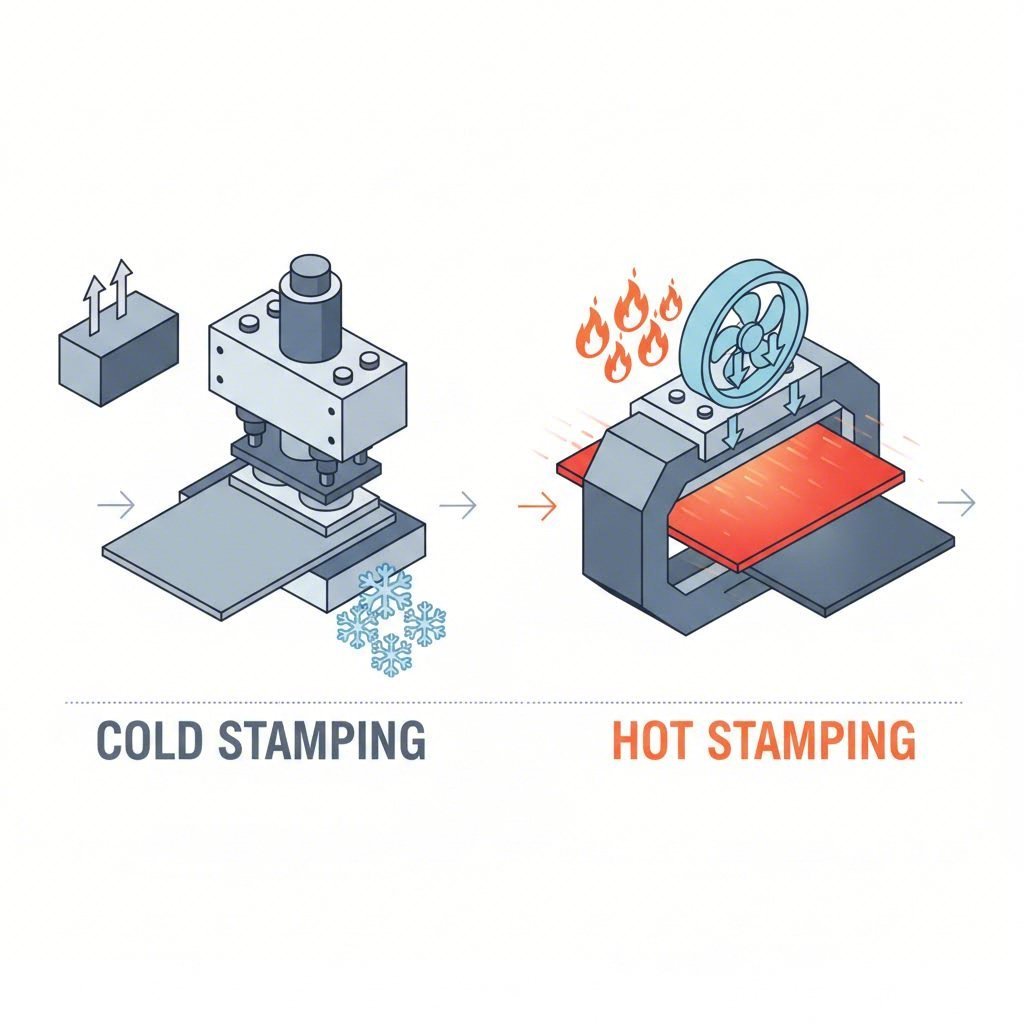
Traditional cold stamping struggles with modern UHSS, which can crack or spring back unpredictably. The solution is hot stamping (or press hardening), a process where boron steel blanks are heated to over 900°C in a furnace, stamped while red-hot, and then rapidly quenched within the die. This process transforms the steel’s microstructure into martensite, achieving tensile strengths up to 1,500 MPa—perfect for safety-critical parts like A-pillars and side-impact beams.
According to American Industrial Company, innovations like Hot Form Quench (HFQ) are now enabling similar advancements for aluminum. HFQ allows for the deep drawing of complex aluminum shapes that were previously impossible, solving a major hurdle for manufacturers trying to use aluminum for structural body parts.
Material Comparison: The New Standard
| Feature | Cold Stamping | Hot Stamping / Press Hardening |
|---|---|---|
| Material Suitability | Mild steels, lower-grade aluminum | Ultra-High-Strength Steel (UHSS), Boron Steel |
| Strength Output | Standard structural strength | Extreme strength (up to 1,500+ MPa) |
| Complexity | Limited deep draw capabilities | Complex geometries with zero springback |
| Primary Use Case | Body panels, brackets, skins | Crash-relevant safety cages, battery protection |
Industry 4.0: The Smart Stamping Factory
The days of relying solely on the intuition of skilled tool-and-die makers are fading. The future belongs to the smart stamping factory, where connectivity and data analytics drive efficiency. This transformation is anchored by the Industrial Internet of Things (IIoT), where sensors embedded directly into dies monitor pressure, temperature, and vibration in real-time.
One of the most significant advancements is the servo press. Unlike mechanical presses driven by a flywheel with a fixed stroke, servo presses use high-torque motors to fully program the slide motion. This allows engineers to optimize the stamping speed at different points in the stroke—slowing down during the forming phase to improve part quality and speeding up during the retraction to boost output. AMS Metal highlights that this level of control is essential for forming the new generation of exotic alloys without defects.
Furthermore, digital twins are revolutionizing quality control. By creating a virtual replica of the stamping line, manufacturers can simulate millions of cycles to predict tool wear and potential failure points before they occur. This "predictive maintenance" model shifts the industry from reacting to breakdowns to preventing them entirely, a crucial capability for meeting the Just-In-Time (JIT) delivery windows of major OEMs.
Automation & Robotics: The Zero-Defect Standard
Automation in metal stamping has evolved far beyond simple robotic arms moving parts from bin to belt. The modern line integrates vision systems and collaborative robots (cobots) to achieve a zero-defect standard.
High-speed cameras equipped with AI algorithms now inspect 100% of parts leaving the press, detecting microscopic cracks or surface imperfections that human inspectors would miss. This is particularly vital for Class-A surface panels and intricate electrical connectors where precision is non-negotiable. Eigen Engineering notes that modern stamping technologies, including electromagnetically assisted processes, are giving manufacturers unprecedented control over material deformation, ensuring that every part matches its digital design file exactly.
For manufacturers looking to navigate this complex landscape—from rapid prototyping of these new components to scaling up for mass production—partners like Shaoyi Metal Technology’s comprehensive stamping solutions offer the necessary bridge. Their IATF 16949-certified capabilities and high-tonnage presses (up to 600 tons) are designed to handle the rigorous demands of modern automotive supply chains, ensuring that innovation doesn't stall at the prototype phase.
Market Outlook 2030: Growth & Consolidation
The financial trajectory of the automotive stamping market reflects these technological shifts. Despite global economic headwinds, the sector is poised for robust growth.
Data indicates that the market is expected to grow from approximately $108 billion in 2025 to nearly $139 billion by 2030, driven by a Compound Annual Growth Rate (CAGR) of over 5%. As reported by Mordor Intelligence, the Asia-Pacific region continues to dominate, holding roughly 38% of the global market share, fueled by the aggressive expansion of Chinese EV manufacturing and Indian automotive hubs.
However, this growth comes with higher barriers to entry. The capital expenditure required for hot stamping lines, servo presses, and digital integration is forcing a consolidation. Smaller, traditional stampers are being pressed to modernize or merge, while larger Tier-1 suppliers are securing their positions by investing heavily in "mega-stamp" technologies—processes that combine multiple parts into single large castings or stampings to reduce vehicle weight and assembly time.
Navigating the Next Decade of Stamping
The future of automotive metal stamping is not merely about pressing metal; it is about data, material science, and strategic adaptation. The convergence of electrification and Industry 4.0 has raised the bar for what is possible and what is expected.
For automotive OEMs and Tier-1 suppliers, the path forward involves embracing flexibility. The ability to switch rapidly between steel and aluminum, to prototype complex EV components quickly, and to guarantee quality through digital verification will define the market leaders of 2030. As the vehicle itself evolves into a computer on wheels, the factories that build it must become equally intelligent, precise, and forward-looking.
Frequently Asked Questions
1. How does the shift to EVs impact the metal stamping industry?
The transition to EVs eliminates demand for engine and transmission parts (like mufflers and fuel tanks) but creates massive new demand for battery enclosures, electrical busbars, and structural components designed to protect battery packs. This requires stampers to invest in larger presses and learn to work with conductive materials like copper and lightweight aluminum.
2. What is the advantage of hot stamping for automotive parts?
Hot stamping allows manufacturers to form Ultra-High-Strength Steel (UHSS) into complex shapes without cracking or springing back. By heating the steel before stamping and quenching it in the die, the resulting part is incredibly strong (up to 1,500 MPa) yet lightweight, making it ideal for safety-critical areas like door rings and bumper beams.
3. What role does IoT play in modern stamping factories?
IoT (Internet of Things) enables "smart stamping" by connecting presses and dies to a central network. Sensors monitor variables like tonnage, temperature, and vibration in real-time. This data allows for predictive maintenance—fixing tools before they break—and ensures consistent part quality by automatically adjusting press parameters to compensate for material variations.