 Small batches, high standards. Our rapid prototyping service makes validation faster and easier —
  EN
EN


Stamping Stainless Steel Exhaust Components: 409 vs 304 & Process Mastery
TL;DR
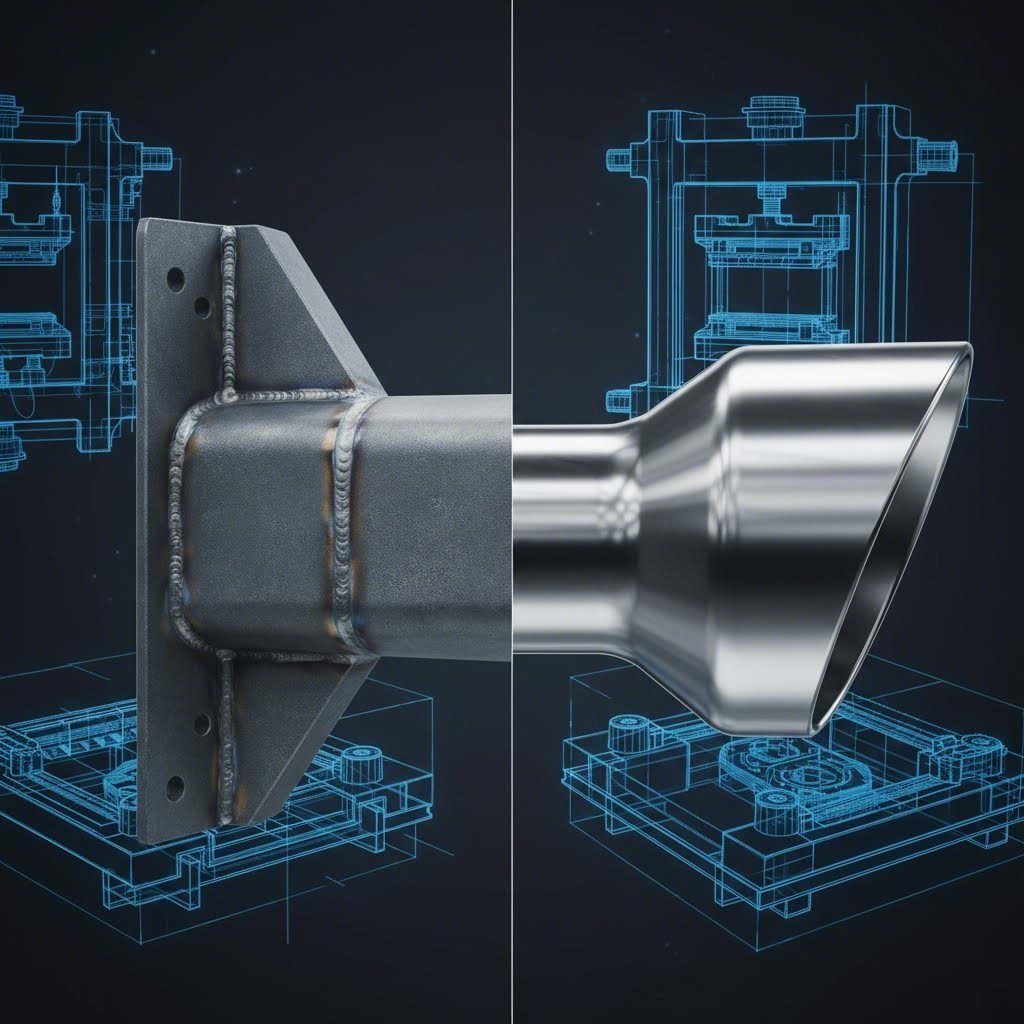
Stamping stainless steel exhaust components requires balancing the cost-effective durability of ferritic 409 grades against the superior corrosion resistance and formability of austenitic 304 alloys. While 409 is the automotive industry standard for hidden structural parts like muffler shells, 304 is preferred for visible tailpipes and complex deep-drawn shapes due to its higher nickel content.
The primary manufacturing challenges in this process are springback (elastic recovery) and work hardening. Successful stamping demands high-tonnage presses, specialized tool steel (often carbide), and advanced simulation software to predict material behavior. Procurement teams must verify a supplier's ability to handle these metallurgical hurdles to ensure dimensional accuracy in mass production.
Material Selection: 409 vs. 304 vs. 321 for Exhaust Systems
Choosing the right stainless steel grade is the single most critical decision in exhaust component manufacturing. The choice dictates not only the cost but also the stamping strategy, as different grades react differently to deformation.
Ferritic 409: The Industry Workhorse
Grade 409 is the most common stainless steel used in automotive exhaust systems. It is a ferritic alloy containing approximately 10.5% to 11% chromium and practically no nickel. This composition makes it significantly more affordable than austenitic grades. However, it is magnetic and will develop a light surface patina (brown rust) over time, which does not affect its structural integrity.
From a stamping perspective, 409 behaves similarly to carbon steel but with higher yield strength. It is ideal for muffler shells, internal baffles, and piping where cosmetic appearance is secondary to thermal stability and cost efficiency. Its heat resistance tops out around 1250°F (675°C).
Austenitic 304: The Premium Choice
Grade 304 (often called 18-8 due to its 18% chromium and 8% nickel content) offers superior corrosion resistance and maintains a bright, metallic appearance. It is non-magnetic in its annealed state but can become slightly magnetic after cold working.
Technically, 304 is excellent for deep draw stamping because its higher ductility allows for more complex shapes without fracturing. However, it is prone to rapid work hardening, meaning it requires more force to form and wears out tooling faster. It is typically reserved for exhaust tips, resonators, and visible components.
Stabilized 321: High-Heat Applications
For extreme environments, such as turbo manifolds and catalytic converter housings, Grade 321 is often specified. This alloy is similar to 304 but stabilized with titanium (usually 5x the carbon content). The titanium prevents carbide precipitation during welding, making it highly resistant to intergranular corrosion at temperatures up to 1500°F (815°C).
| Feature | Ferritic 409 | Austenitic 304 | Stabilized 321 |
|---|---|---|---|
| Primary Alloy | Chromium (~11%) | Cr (18%) / Ni (8%) | Cr / Ni / Titanium |
| Magnetic? | Yes | No (mostly) | No |
| Corrosion | Good (develops patina) | Excellent (stays bright) | Excellent (high heat) |
| Cost | Low | High | Very High |
| Best For | Muffler shells, pipes | Exhaust tips, covers | Turbo parts, manifolds |
Manufacturing Challenges: Springback & Work Hardening
Stamping stainless steel is fundamentally different from stamping mild steel due to two metallurgical phenomena: springback and work hardening. Ignoring these will result in parts that fail to meet dimensional tolerances.
Managing Springback
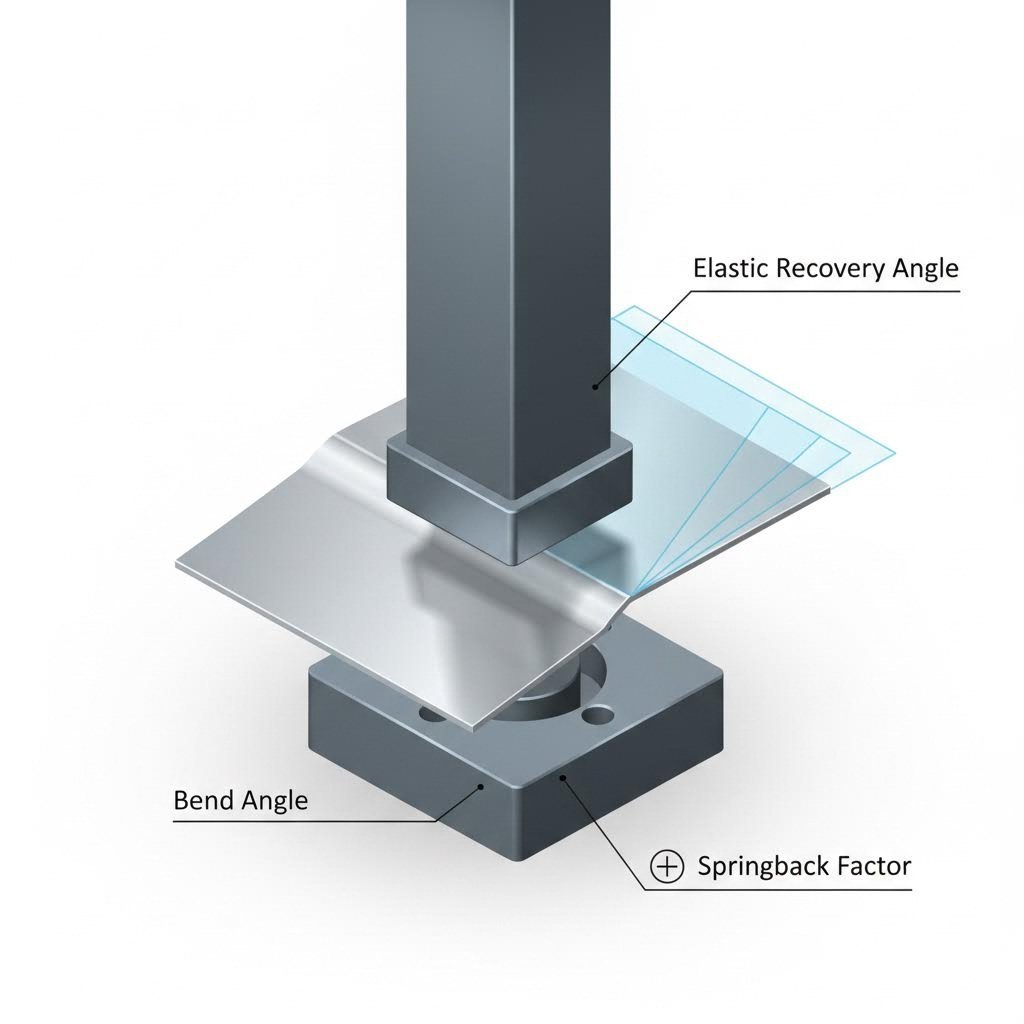
Stainless steel has higher yield strength than mild steel, leading to significant springback—the tendency of the metal to return to its original shape after the stamping force is removed. This elastic recovery is particularly pronounced in large radius bends used in muffler bodies.
To counteract this, die designers use over-bending techniques, bending the metal past the desired angle so it snaps back to the correct geometry. Advanced simulation software (FEA) is essential to calculate the exact amount of over-bend required before physical tooling is cut.
Controlling Work Hardening
Austenitic grades like 304 harden rapidly as they are deformed. As the metal is stamped, it becomes harder and stronger, requiring progressively higher tonnage to form. This work hardening can cause the material to crack if the draw ratio is too aggressive.
According to The Fabricator, successful stamping of work-hardening grades often requires reducing press speed to manage heat generation and using high-lubricity forming oils to prevent galling (the adhesion of the workpiece to the tool).
Critical Exhaust Components: What Can Be Stamped?
Modern progressive and transfer die stamping can produce a wide array of exhaust components, each requiring specific forming operations.
- Muffler Shells: These are typically formed using large bed presses. The challenge is maintaining surface flatness while creating lock seams for assembly.
- Internal Baffles: These components route airflow inside the muffler. They require precision perforation patterns to manage acoustics and backpressure.
- Heat Shields: Often made from thinner gauge aluminum or stainless, these parts feature embossed patterns to increase rigidity without adding weight.
- Catalytic Converter Shells: These require deep drawing capabilities to create the "clam shell" halves that house the ceramic substrate.
- Hangers and Brackets: Structural components that hold the system in place. These are stamped from thicker gauge steel and often require high-strength bending.
For complex assemblies like these, manufacturers such as Shaoyi Metal Technology leverage presses up to 600 tons to bridge the gap between rapid prototyping and mass production. Their ability to handle high-tonnage requirements is crucial when stamping work-hardening materials like 304 stainless steel, ensuring that even thick-gauge brackets meet strict OEM standards.
Tooling & Die Design for Stainless Exhaust Parts
The abrasive nature of stainless steel oxide layers wreaks havoc on standard tooling. Using D2 tool steel, which is sufficient for mild steel, often leads to premature failure when stamping stainless exhaust parts.
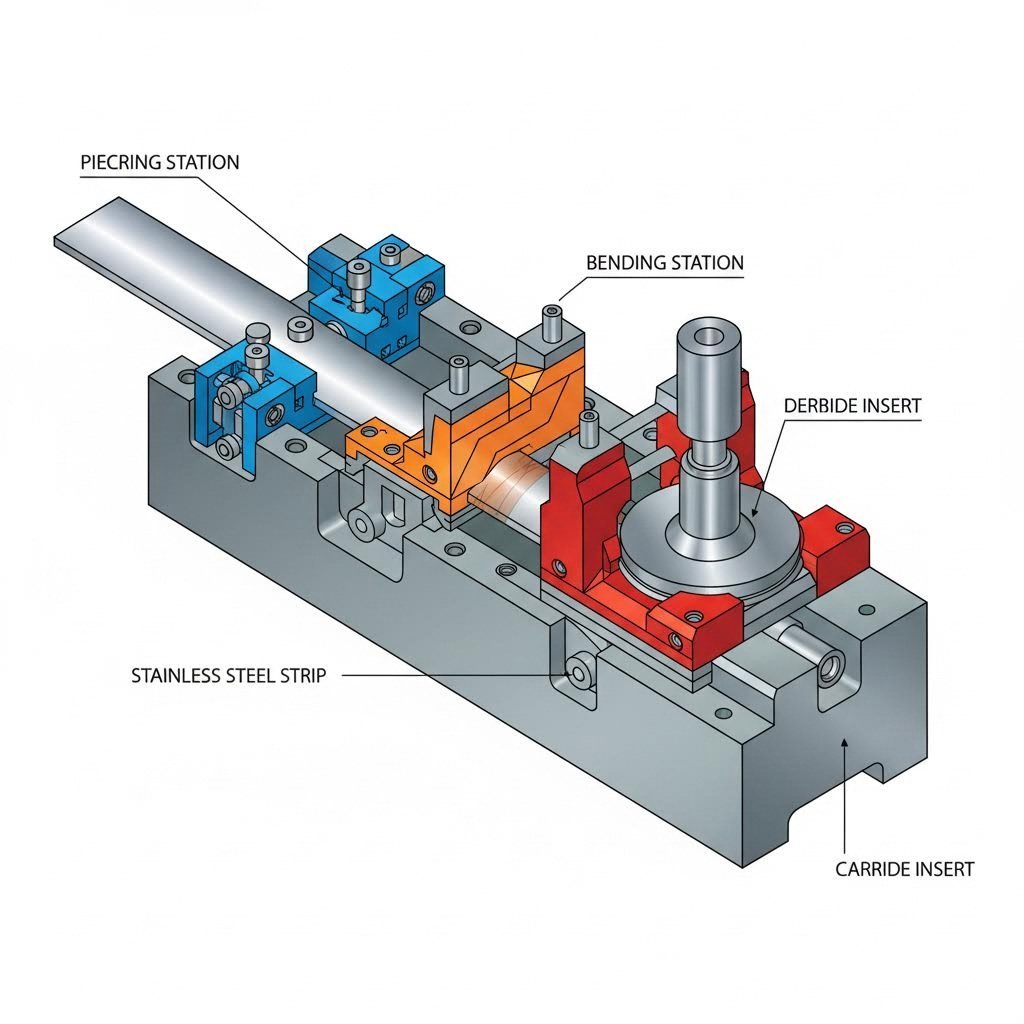
For high-volume production, Tungsten Carbide inserts are the gold standard. While expensive upfront, carbide resists the abrasive wear of stainless steel, maintaining part consistency over millions of cycles. Alternatively, tool steels coated with Titanium Nitride (TiN) or Thermal Diffusion (TD) coatings can provide a hard, slick surface that reduces friction and prevents galling.
Die design must also account for galling, a form of wear caused by adhesion between sliding surfaces. Proper clearance—typically 10-15% of material thickness—and high-performance lubricants are non-negotiable to prevent the stainless part from seizing in the die.
Quality Control Standards in Automotive Stamping
Automotive exhaust components must meet rigorous standards to ensure safety and emissions compliance. The baseline for any reputable supplier is IATF 16949 certification, which specifically covers quality management for the automotive sector.
Wiegel notes that quality assurance often involves automated vision systems to inspect 100% of parts for dimensional accuracy. For exhaust systems, critical checks include:
- Leak Testing: Ensuring muffler shells and converter housings are airtight.
- Weld Integrity: Verifying that stamped flanges and brackets can withstand vibration fatigue.
- Cosmetic Inspection: For polished 304 tips, ensuring the stamping process has left no die marks or scratches.
Securing Reliability in Exhaust Supply Chains
Stamping stainless steel exhaust components is a discipline that merges metallurgical science with heavy industrial force. The trade-off between the economy of ferritic 409 and the performance of austenitic 304 defines the engineering landscape, but the execution relies on a manufacturer's tooling expertise.
For buyers and engineers, the path to a reliable product lies in selecting a partner who understands the nuance of springback management and invests in carbide tooling. By validating these technical capabilities upfront, automotive OEMs can ensure their exhaust systems deliver both the durability and the performance required by the modern market.
Frequently Asked Questions
1. Can 304 stainless steel be stamped effectively?
Yes, 304 stainless steel is highly formable and excellent for stamping, particularly for deep-drawn parts. However, because it work-hardens rapidly, it requires higher tonnage presses and robust tooling compared to mild steel or ferritic grades. Proper lubrication is essential to prevent galling during the process.
2. Is 304 or 409 stainless steel better for exhaust parts?
It depends on the application. 409 stainless is the industry standard for functional, non-visible parts like pipes and muffler bodies due to its lower cost and adequate heat resistance. 304 stainless is better for visible tips and high-corrosion environments because it maintains its appearance and resists rust, though it is significantly more expensive.
3. How do manufacturers prevent springback in stainless stamping?
Springback cannot be eliminated, but it can be managed. Die designers use "over-bending" techniques where the metal is bent past the desired angle to account for its elastic recovery. Finite Element Analysis (FEA) software is used to predict the exact amount of springback and adjust the tool geometry accordingly.