 Small batches, high standards. Our rapid prototyping service makes validation faster and easier —
  EN
EN


Stamping Automotive Hinges: Process Engineering, Materials & Sourcing
TL;DR
Stamping automotive hinges is a high-precision manufacturing process utilized to produce lightweight, cost-effective, and durable hinge components for vehicle doors, hoods, and trunks. By employing progressive die technology, manufacturers can form high-strength steel or aluminum strips into complex geometries with rolled knuckles at speeds far exceeding casting or forging methods. This process is critical for automakers seeking to reduce vehicle weight without compromising structural integrity.
For engineering and procurement teams, the decision to stamp hinges rests on balancing volume requirements with performance metrics. While stamping offers superior cycle times and material utilization, it requires rigorous engineering to manage deflection and spring-back. This guide details the technical mechanisms, material comparisons, and sourcing criteria necessary to optimize your automotive hinge production strategy.
Automotive Hinge Stamping: The Manufacturing Process
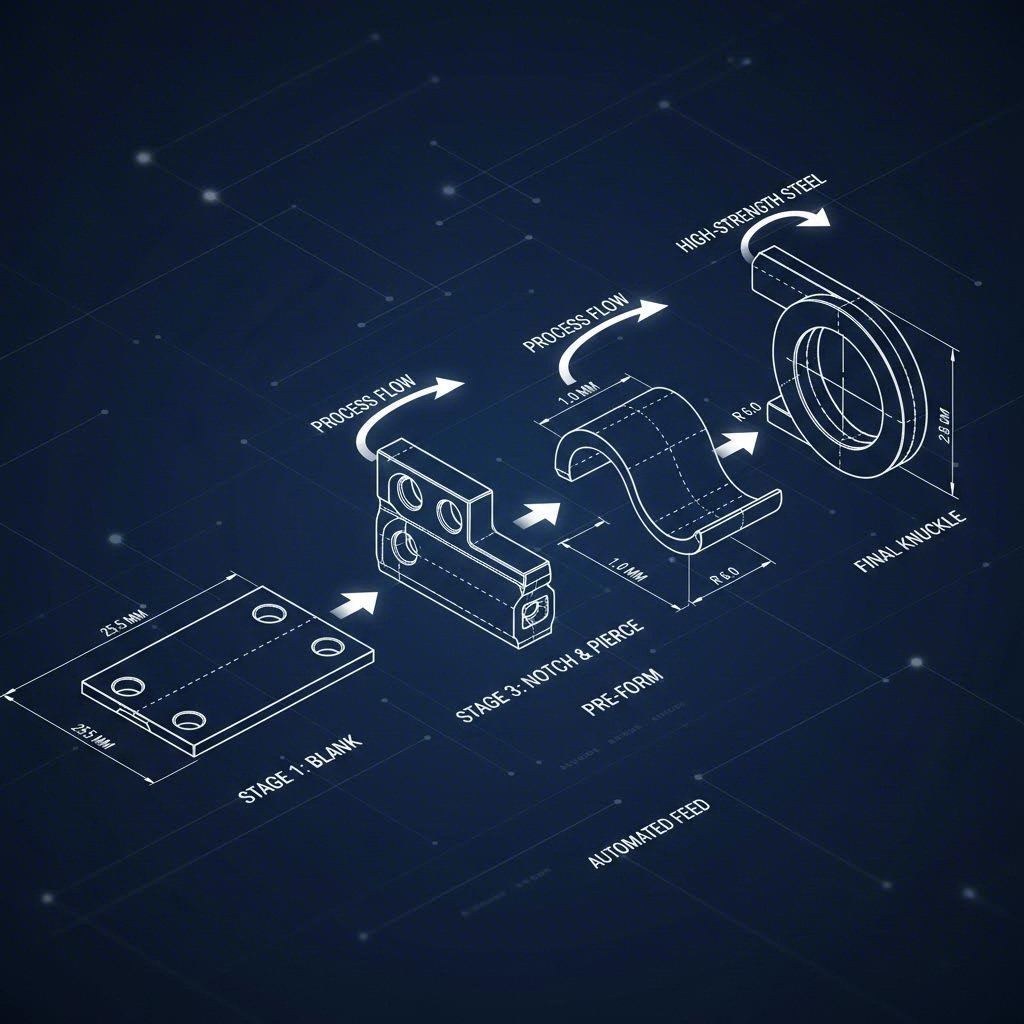
The dominant method for manufacturing automotive hinges is progressive die stamping. Unlike transfer stamping, where parts are moved between isolated presses, progressive stamping feeds a continuous metal strip through a single press with multiple stations. Each station performs a specific operation—cutting, bending, coining, or curling—simultaneously, producing a finished part with every stroke of the press.
Feeding and Material Control
Precision begins at the feeding stage. Automotive hinges are often stamped from thick materials (up to 4mm or more) to ensure load-bearing capacity. Handling such heavy-gauge stock requires robust feeding systems. Advanced manufacturers utilize upgraded NC servo feeders equipped with high-torque dual-stage reduction gearboxes. These systems provide the necessary traction to feed thick high-strength steel without slippage, ensuring that the pitch (distance between stations) remains accurate to within microns—a critical factor for maintaining tolerance in the final assembly.
The Curling Mechanism
The defining feature of a stamped hinge is the knuckle—the cylindrical part that houses the pin. Forming this feature involves a specialized "curling" process. As described by experts at Bandy Manufacturing, the metal is progressively curled around to create the hinge pin hole. This technique requires precise die design to ensure the material flows smoothly without cracking or creating an uneven seam. In high-performance applications, the knuckle may be coined (compressed) to work-harden the material, effectively increasing its yield strength and resistance to wear over thousands of duty cycles.
Material Selection & Durability Standards
Selecting the right material for stamping automotive hinges is a trade-off between formability, strength, and weight. The material must be ductile enough to curl into a tight knuckle but strong enough to prevent door sag.
- High-Strength Low-Alloy (HSLA) Steel: The industry standard for door hinges. HSLA grades offer excellent tensile strength, allowing for thinner gauges that save weight while maintaining load capacity. However, they exhibit significant "spring-back" after stamping, which die designers must compensate for by over-bending the material.
- Aluminum 7075: Increasingly used in electric vehicles (EVs) to minimize curb weight. While lighter than steel, aluminum is less formable and more prone to cracking during the curling process. It typically requires specialized lubricants and larger bend radii.
- Stainless Steel: Reserved for exposed hinges or luxury applications where corrosion resistance is paramount, though its high cost and work-hardening rate make it challenging to stamp in high volumes.
Corrosion Protection: Since stamped edges are raw, post-processing is mandatory. Electro-coating (E-coat) is the baseline standard for automotive underbody and structural parts, providing uniform coverage even inside the curled knuckle. Zinc-nickel plating is often specified for hinges exposed to road salts, offering superior sacrificial protection.
Comparative Analysis: Stamped vs. Cast vs. Forged Hinges
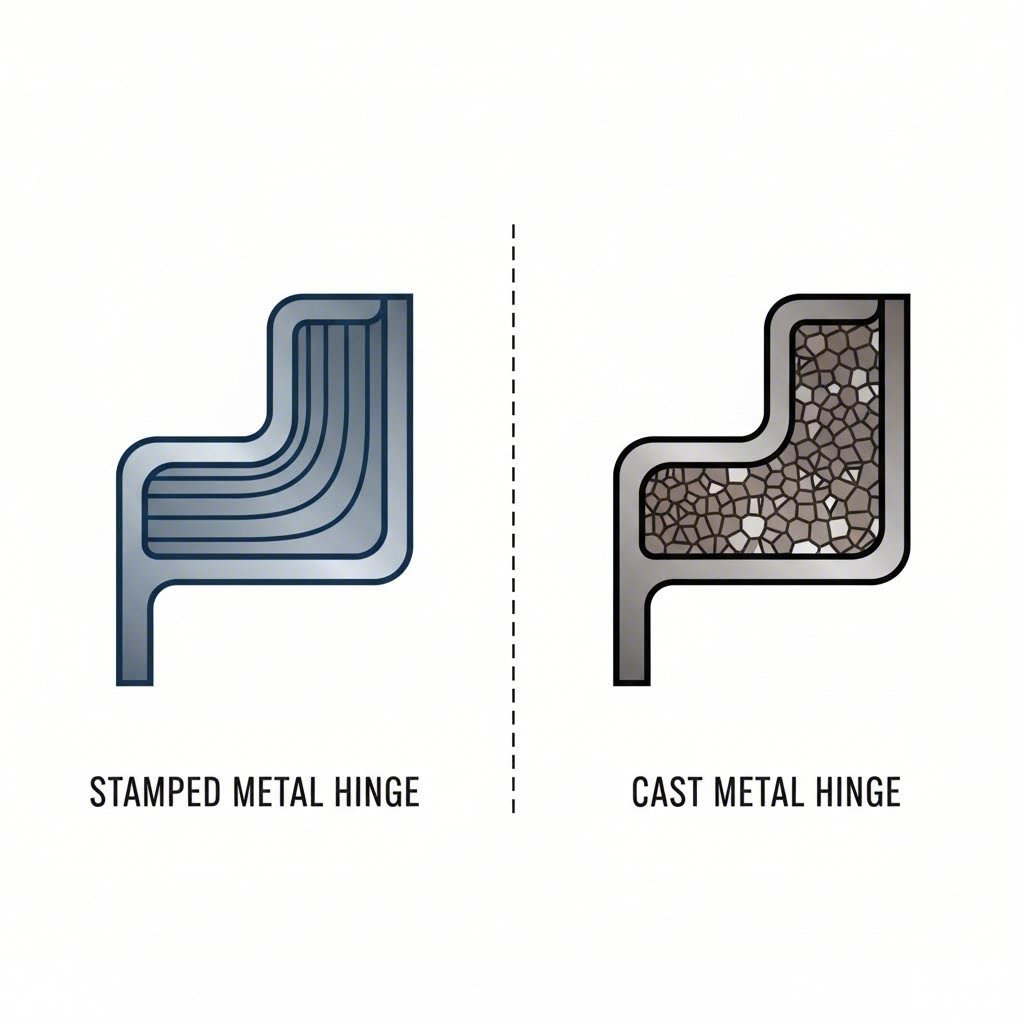
Engineers often face a critical choice between stamping, casting, and forging. While stamping dominates high-volume production, it is not a universal solution. The decision depends heavily on the specific load profile and rigidity requirements of the vehicle closure.
| Feature | Stamped Hinges | Cast Hinges (Ductile Iron) | Forged Hinges |
|---|---|---|---|
| Production Volume | High (Ideal for >50k units/year) | Medium to High | Low to Medium |
| Cost Efficiency | High (Low unit cost, high tooling cost) | Medium | Low (High unit cost) |
| Weight | Lightest (High strength-to-weight ratio) | Heavier (Thicker walls needed) | Heavy |
| Design Freedom | Limited to uniform thickness | High (Complex 3D shapes) | Medium |
| Rigidity/Deflection | Moderate (Risk of flexing) | High (Superior stiffness) | Highest |
The Deflection Challenge: Stamped hinges can suffer from elastic deformation under heavy loads. A notable case study involves Gil-Mar Manufacturing, where a customer replaced a stamped hinge with a ductile iron casting to solve a critical deflection issue. The stamped part lacked the necessary stiffness for the heavy door assembly, leading to alignment problems. This illustrates that while stamping is cost-effective, applications requiring extreme rigidity—such as heavy truck doors or armored vehicles—may necessitate the structural density of a casting.
Engineering Challenges & Design Solutions
Successfully stamping automotive hinges requires overcoming inherent process limitations. The two primary enemies of quality are deflection (sagging) and dimensional variance.
Combatting Door Sag
"Door sag" occurs when the hinge flexes under the weight of the door, causing misalignment with the latch. To counteract this in a stamped design, engineers introduce reinforcing ribs or embossments. These geometric features increase the moment of inertia without adding material thickness. Additionally, manufacturers often use "stop" features integrated directly into the stamping to limit the door's opening angle, eliminating the need for separate check straps in some designs.
Managing Tolerance Stack-up
In a progressive die, slight variations in material thickness or feed pitch can accumulate, leading to parts that are out of tolerance. Modern tooling incorporates active pilot pins that physically locate the strip before the press cycles, ensuring positioning accuracy. Furthermore, in-die sensing systems can detect if a slug has not been ejected or if a curl is incomplete, stopping the press instantly to prevent die damage and defective parts.
Sourcing Guide: Selecting an Automotive Stamping Partner
Choosing a supplier for automotive hinges involves more than comparing piece prices. The supplier must demonstrate capable quality management systems and the ability to scale from prototype to production.
- Certifications: IATF 16949 certification is non-negotiable for Tier 1 and Tier 2 automotive suppliers. It ensures the manufacturer adheres to strict risk management and quality control protocols tailored to the auto industry.
- In-House Tooling: Suppliers with in-house tool and die shops can react faster to engineering changes (ECNs) and repair broken dies immediately, minimizing downtime.
- Scalability & Prototyping: The transition from design to mass production is often a bottleneck. When evaluating capabilities, look for partners who can handle the entire lifecycle. For instance, manufacturers like Shaoyi Metal Technology provide comprehensive fabrication services that bridge the gap from rapid prototyping to high-volume manufacturing, ensuring that your design is validated for manufacturability before hard tooling is cut.
- Secondary Operations: A hinge is rarely just a stamped metal piece. It requires pin insertion, bushing assembly, and lubrication. Suppliers offering automated assembly cells provide better value and tighter quality control than those who outsource these steps.

Optimizing Hinge Production
Stamping remains the most viable production method for the vast majority of automotive hinges due to its speed and efficiency. However, success lies in the details—choosing the right high-strength material, engineering the die to account for spring-back, and selecting a partner who understands the nuances of heavy-gauge feeding and assembly. By prioritizing process control and validating designs against deflection criteria early in the development cycle, automakers can achieve the perfect balance of cost, weight, and performance.
Frequently Asked Questions
1. What is the difference between stamped and cast hinges?
Stamped hinges are formed from sheet metal using high-pressure dies, making them lighter and cheaper for high-volume production. Cast hinges are made by pouring molten metal into a mold, resulting in a heavier, more rigid part that allows for complex 3D shapes impossible to achieve with stamping.
2. Why are progressive dies used for automotive hinges?
Progressive dies allow multiple operations (cutting, bending, curling) to happen simultaneously in a single press stroke. This significantly increases production speed and consistency compared to single-station dies, which is essential for meeting the high-volume demands of the automotive industry.
3. How do manufacturers prevent stamped hinges from rusting?
Raw stamped steel is highly susceptible to rust. Manufacturers apply surface treatments such as E-coating (electrophoretic deposition) or zinc-nickel plating immediately after stamping and assembly. These coatings bond to the metal surface to seal out moisture and road salts.