 Small batches, high standards. Our rapid prototyping service makes validation faster and easier —
  EN
EN


Lightweighting a Suspension Component: A Technical Case Study
TL;DR
Lightweighting suspension components is a critical engineering objective aimed at enhancing vehicle fuel efficiency, reducing emissions, and improving dynamic performance. This case study demonstrates that through the application of advanced materials like carbon fiber reinforced polymers (CFRP) and multi-material designs, significant weight reduction is achievable. Core methodologies such as Finite Element Analysis (FEA) are essential for optimizing designs, ensuring structural integrity, and validating performance before manufacturing.
The Engineering Imperative: Drivers for Suspension Lightweighting
The relentless pursuit of automotive innovation is largely driven by stringent global emissions standards and evolving consumer expectations for performance and efficiency. Lightweighting, the process of reducing a vehicle's overall mass without compromising safety or performance, has emerged as a cornerstone of modern automotive engineering. The suspension system, a key contributor to a vehicle's unsprung mass, is a primary target for these initiatives. Reducing the weight of components like control arms, springs, and axles directly translates to several compounding benefits that address fundamental industry challenges.
Improved fuel economy and reduced emissions are the most significant drivers. For every 10% reduction in vehicle weight, fuel consumption can decrease by approximately 5%. By minimizing the mass of suspension components, less energy is required to accelerate and decelerate the vehicle, leading to lower fuel consumption in internal combustion engine (ICE) vehicles and extended range in electric vehicles (EVs). For EVs, lightweighting is particularly crucial as it helps offset the substantial weight of battery packs, a critical factor in maximizing driving range and overall vehicle efficiency.
Furthermore, reducing unsprung mass—the mass of the suspension, wheels, and other components not supported by the springs—has a profound impact on vehicle dynamics. Lighter components allow the suspension to react more quickly to road imperfections, improving tire contact with the surface. This results in enhanced handling, superior ride comfort, and greater stability, particularly during cornering and braking. As vehicles become more technologically advanced, the ability to fine-tune these dynamic characteristics through lightweighting offers a competitive advantage in performance and driver experience.
Core Methodologies: From Design Frameworks to Finite Element Analysis
Achieving meaningful weight reduction in critical-safety components like suspension systems requires a sophisticated and integrated design approach. It is not merely a matter of substituting materials, but a holistic process guided by advanced computational tools and structured engineering frameworks. These methodologies allow engineers to explore innovative designs, predict performance under real-world loads, and optimize for weight, stiffness, and durability simultaneously. The process ensures that lightweight components meet or exceed the performance of their traditional steel counterparts.
A foundational element of this process is the establishment of a robust design framework. This involves defining performance targets, analyzing load cases, and selecting candidate materials based on a multi-criteria analysis of density, stiffness, cost, and manufacturability. The framework guides the entire workflow, from initial concept to final validation. For instance, an initial multibody dynamics simulation (e.g., using ADAMS/Car) can define the precise load conditions a component like a lower control arm will experience during braking, cornering, and misuse events. This data becomes the critical input for subsequent structural analysis and optimization.
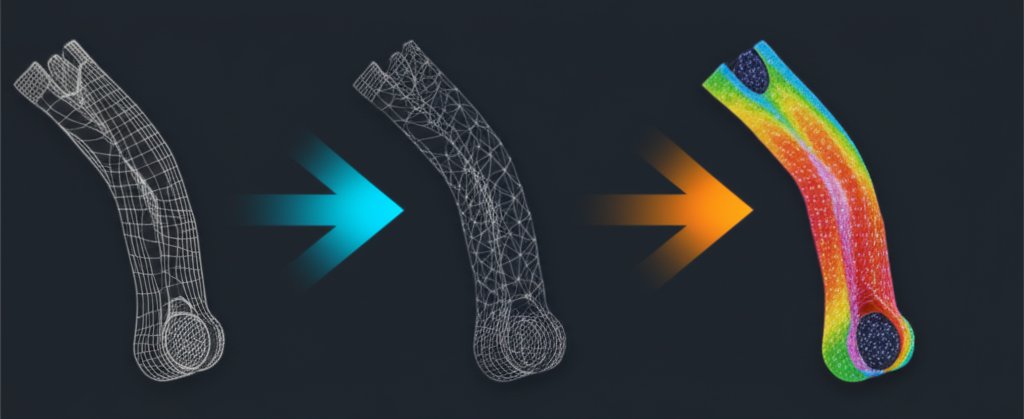
Finite Element Analysis (FEA) is the central computational tool in this methodology. FEA allows engineers to create a detailed virtual model of a component and simulate its response to various structural and thermal loads. By dividing the component into a mesh of smaller "elements," the software can solve complex equations to predict stress distribution, deformation, and potential failure points with high accuracy. This virtual testing is indispensable for lightweighting, as it enables:
- Topology Optimization: An algorithmic process where material is removed from areas of low stress to create the most efficient, lightweight shape possible while still meeting performance constraints.
- Material Simulation: FEA can accurately model the anisotropic (direction-dependent) properties of composite materials, allowing for the optimization of fiber orientation and ply stacking sequences to maximize strength where it is most needed.
- Performance Validation: Before any physical prototypes are made, FEA validates that the new lightweight design can withstand peak loads and fatigue cycles, ensuring it meets all safety and durability requirements. The high correlation between FEA models and experimental test results validates this methodological approach.
Advanced Materials Analysis: Composites, Alloys, and Multi-Material Solutions
The success of any lightweighting initiative is fundamentally tied to the selection and application of advanced materials. Traditional steel, while strong and inexpensive, has a high density that makes it a prime candidate for replacement. Modern engineering has introduced a palette of alternatives, including high-strength aluminum alloys and advanced composites, each offering a unique profile of properties. The optimal choice depends on a careful balance of performance requirements, manufacturing complexity, and cost considerations.
Carbon Fiber Reinforced Polymers (CFRP) are at the forefront of high-performance lightweighting. These composites, consisting of strong carbon fibers embedded in a polymer matrix, offer an exceptional strength-to-weight ratio and high stiffness. Case studies have demonstrated that replacing a steel lower control arm with a CFRP equivalent can achieve weight reductions of over 45% while meeting or exceeding stiffness and strength requirements. However, the high cost and complex manufacturing processes associated with CFRP have historically limited their use to high-end and racing vehicles. The challenge lies in optimizing the ply orientation and stacking sequence to handle complex, multi-axial loads, a task heavily reliant on the FEA methodologies discussed previously.
Aluminum and other light alloys present a more cost-effective and mature solution for mass-market vehicles. While not as light as CFRP, aluminum offers a significant weight advantage over steel, along with excellent corrosion resistance and recyclability. The primary challenge with aluminum is its lower tensile strength, which often requires design modifications like increased wall thickness or larger footprints to maintain equivalent performance, potentially creating packaging challenges. For automotive projects demanding precision-engineered components, specialized suppliers can provide highly tailored solutions. For instance, Shaoyi Metal Technology offers a comprehensive service for custom aluminum extrusions, from rapid prototyping to full-scale production under a strict IATF 16949 certified quality system, delivering strong and lightweight parts. Multi-material design, which combines different materials like steel and CFRP in a single component, offers a pragmatic compromise. This hybrid approach leverages the best properties of each material—for example, using a thin steel core for its toughness and manufacturing ease, reinforced with a tailored CFRP cover for stiffness and weight reduction.
| Material | Relative Density | Relative Strength | Relative Cost | Manufacturability |
|---|---|---|---|---|
| Steel | High | High | Low | Excellent |
| Aluminum Alloy | Medium | Medium | Medium | Good |
| Carbon Fiber (CFRP) | Very Low | Very High | High | Complex |
| Glass Fiber (GFRP) | Low | High | Medium | Moderate |
Application Focus: Deconstructing the Lower Control Arm Case Studies
The lower control arm is an ideal candidate for lightweighting case studies due to its critical role in the suspension system and its significant contribution to unsprung mass. This A-shaped or I-shaped component connects the chassis to the wheel hub, managing both longitudinal and lateral forces to maintain wheel position and alignment. Its complex loading environment makes it a challenging yet rewarding component to re-engineer using advanced materials and design methods. Several technical studies have focused on this specific part, providing valuable, real-world data on the potential and challenges of lightweighting.
One prominent case study involved the development of a multi-material lower control arm for a McPherson suspension, aiming to replace the original steel component. The approach involved reducing the thickness of the steel arm and bonding a custom-designed Carbon Fiber Reinforced Polymer (CFRP) cover to it. Using a design framework that started with multibody simulations to define loads, followed by FEA-driven optimization of the carbon fiber ply shape and orientation, the hybrid arm achieved a 23% mass reduction. While there was a minor reduction in longitudinal (9%) and lateral (7%) stiffness compared to the original, the component fully satisfied all safety requirements for special and misuse events. This highlights a key trade-off in retrofitting existing designs: performance potential can be limited by the constraints of the original component's geometry and packaging.
Another study focused on a complete material substitution, designing a lower arm entirely from carbon fiber composites to replace a traditional metal one. This research utilized the principle of "equal stiffness design," where the composite layup is meticulously designed to match the stiffness of the original part. After an initial design, the layup was optimized from an initial [0/45/90/-45/0/45/0/45/0/90/0/-45/90/0] design to a symmetric structure, which significantly improved performance under vertical and braking loads. The final optimized carbon fiber arm not only met the required strength and stiffness targets but also achieved a remarkable weight reduction of 46.8% compared to the steel version and 34.5% compared to an aluminum alloy equivalent.
These case studies collectively demonstrate that significant lightweighting is feasible for suspension components. However, they also underscore that the process is far more complex than a simple material swap. Success requires an integrated design methodology, extensive virtual simulation and validation through FEA, and a deep understanding of material science. As noted by industry experts, introducing new materials often requires a complete component redesign and a costly validation process to ensure durability under rough usage conditions. The experimental validation in these studies, which showed high correlation with simulation results, is crucial for building confidence in these innovative solutions and paving the way for their broader adoption.
Key Takeaways for Future Suspension Design
The detailed examination of lightweighting suspension components reveals a clear path forward for automotive engineering. It is evident that reducing unsprung mass is not a marginal gain but a fundamental lever for enhancing vehicle efficiency, performance, and range, especially in the era of electrification. The case studies centered on the lower control arm prove that substantial weight savings—ranging from 23% with hybrid materials to over 45% with full composite solutions—are not merely theoretical but achievable with current technology.
The successful implementation of these advanced designs hinges on a holistic and simulation-driven methodology. The integration of multibody dynamics to define loads and Finite Element Analysis to optimize topology and material layout is non-negotiable. This analytical approach de-risks the development process, accelerates innovation, and ensures that final components meet stringent safety and durability standards. As materials science continues to evolve, the synergy between new alloys, composites, and powerful computational tools will unlock even greater potential for creating lighter, stronger, and more efficient vehicle systems.
Frequently Asked Questions
1. What are the advancements in lightweight materials for automotive applications?
Advancements are primarily focused on high-strength aluminum alloys, magnesium alloys, and composite materials like Carbon Fiber Reinforced Polymers (CFRP) and Glass Fiber Reinforced Polymers (GFRP). These materials offer superior strength-to-weight ratios compared to traditional steel. Multi-material designs, which strategically combine different materials in a single component, are also becoming more prevalent to balance cost, performance, and manufacturability.
2. What are lightweight composite materials for automotive use?
Lightweight composites for automotive use are engineered materials typically made from a polymer matrix (like epoxy or polyester resin) reinforced with strong fibers. The most common reinforcing fibers are carbon, glass, or aramid. These materials are valued for their high stiffness, high strength, and low density, which allow for the creation of components that are significantly lighter than their metal counterparts without sacrificing performance.
3. When introducing new lightweight materials, what are the primary challenges?
The primary challenges include higher material and manufacturing costs, the need for complete component redesigns, and extensive validation processes to ensure durability, safety, and performance. New materials may require different production and assembly techniques. Furthermore, engineers must consider factors like corrosion resistance (especially in multi-material joints), thermal expansion, and long-term durability under various environmental conditions.