 Small batches, high standards. Our rapid prototyping service makes validation faster and easier —
  EN
EN


Heat Treatment for Forged Automotive Parts Explained

TL;DR
Heat treatment for forged automotive parts is a critical manufacturing step that involves controlled heating, soaking, and cooling of metal components. This process strategically alters the metal's internal microstructure to significantly enhance mechanical properties such as strength, hardness, and toughness. Key methods like normalizing, annealing, and quenching and tempering ensure that parts like crankshafts and gears can withstand extreme operational stresses, improving vehicle safety and longevity.
The Fundamental Goal: Why Heat Treatment is Crucial for Forged Parts
In the high-stakes world of automotive manufacturing, components are expected to perform flawlessly under immense stress, vibration, and temperature fluctuations. The forging process itself aligns the metal's grain flow to create strong, durable parts, but heat treatment is the essential finishing step that unlocks their maximum potential. The primary goal of heat treatment is to refine and control the metal's microstructure, resulting in a superior combination of mechanical properties that raw forgings cannot achieve on their own.
The main objectives are to boost durability by improving key characteristics. According to industry experts, these include increasing hardness, strength, toughness, ductility, and wear resistance. For example, a connecting rod in an engine must possess immense tensile strength to handle the forces of combustion, while also having enough toughness to resist fatigue cracking over millions of cycles. Heat treatment processes like quenching and tempering are precisely calibrated to deliver this balance. Without it, the part would be either too brittle and prone to fracture or too soft and susceptible to deformation.
Furthermore, heat treatment ensures consistency and reliability across thousands of components. The hot forging process can sometimes lead to variations in grain structure, especially in complex shapes with both thick and thin sections. A subsequent heat treatment like normalizing or annealing homogenizes this structure, relieving internal stresses and ensuring every part meets stringent engineering specifications. This consistency is vital for safety-critical parts such as steering knuckles and suspension components, where failure is not an option. By refining the material at a microscopic level, heat treatment provides the foundation for safe, long-lasting automotive performance.
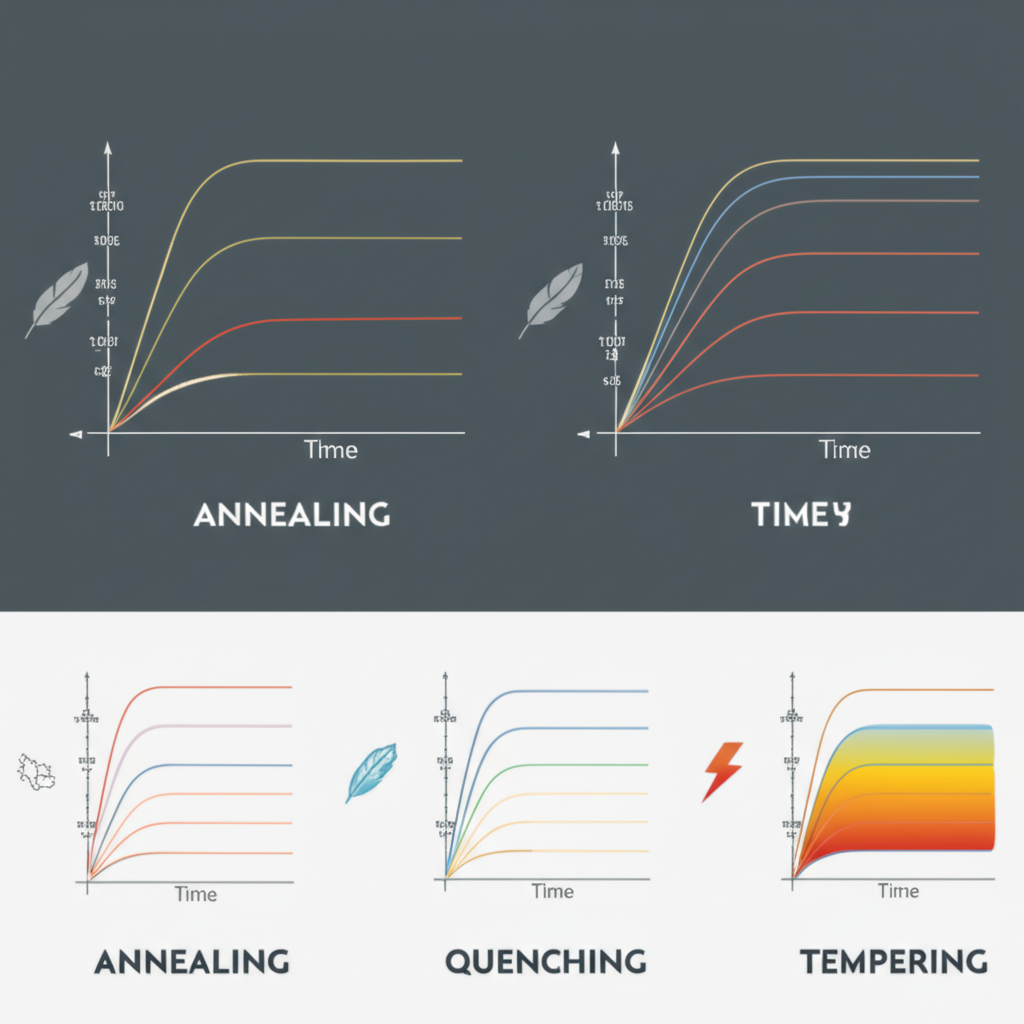
Core Heat Treatment Processes Explained
Several distinct heat treatment processes are applied to forged automotive parts, each designed to achieve a specific set of properties. The selection of a method depends on the type of steel, the part's design, and its final application. Understanding these core techniques reveals how metallurgists tailor a component's performance to its intended function.
Annealing
Annealing is a process used to soften metal, increase ductility, and relieve internal stresses, which is particularly useful for parts that require significant machining after forging. The component is heated to a specific temperature, held there to allow its microstructure to recrystallize and refine, and then cooled very slowly, often inside the furnace. As explained by Trenton Forging, this makes the material more uniform and easier to cut, drill, or mill, preventing distortion that might occur if residual stresses were still present. The end result is a part that is stable and ready for subsequent manufacturing steps.
Normalizing
Normalizing is one of the most common treatments for steel forgings. It involves heating the part above its upper critical temperature and then cooling it in still air. This process refines the grain structure that may have coarsened during hot forging, leading to a more uniform and desirable microstructure. Paulo, a thermal processing specialist, notes that this creates a harder and stronger material than what is achieved through annealing. Normalizing is often specified for automotive components to improve their toughness and machinability before final hardening.
Quenching and Tempering
This two-step process is designed to create a combination of high strength and good toughness. First, in quenching, the forged part is heated to a high temperature to form a structure called austenite and then rapidly cooled by submerging it in a medium like water, oil, or brine. This rapid cooling transforms the austenite into martensite, a very hard but brittle microstructure. The second step, tempering, involves reheating the quenched part to a lower temperature. This crucial step relieves the internal stresses from quenching, reduces brittleness, and improves the part's ductility and toughness while retaining much of its hardness.
Carburizing (Case Hardening)
For components that require a highly wear-resistant surface while maintaining a tough, ductile core—such as gears and camshafts—carburizing is the ideal solution. This case-hardening process involves heating the part in a carbon-rich atmosphere. Carbon atoms diffuse into the surface of the steel, creating a high-carbon outer layer or "case." After this, the part is quenched, hardening the high-carbon case to a significant degree while the lower-carbon core remains softer and tougher. This dual-property structure allows the part to resist surface wear and abrasion while being able to absorb shock and impact without fracturing.
The Three-Stage Heat Treatment Cycle: Heating, Soaking, and Cooling
Regardless of the specific method used, nearly every heat treatment process follows a fundamental three-stage cycle. Each stage must be precisely controlled to achieve the desired transformation in the metal's microstructure. These phases are heating, soaking, and cooling.
The first stage is heating, where the component is brought up to a target temperature. The rate of heating is critical; if done too quickly, different sections of the part can expand at different rates, leading to distortion or cracking. The heating rate depends on the metal's conductivity, its prior condition, and its size and geometry. Larger or more complex parts are heated more slowly to ensure the core reaches the same temperature as the surface, achieving a uniform state.
Once the target temperature is reached, the soaking stage begins. The part is held at this specific temperature for a predetermined period. The purpose of the soaking period is to ensure that the necessary internal structural changes, such as the complete transformation to austenite in steel, occur throughout the entire mass of the component. The duration depends on the material's chemical composition and the part's thickness, ensuring a homogeneous microstructure before the final stage.
The final and most critical stage is cooling. The rate at which the metal is cooled from the soaking temperature dictates its final properties, including hardness and strength. Rapid cooling, known as quenching, in mediums like water or oil freezes a hard microstructure in place. In contrast, slow cooling, such as letting the part cool in the air (normalizing) or inside the furnace (annealing), allows for different, softer microstructures to form. The choice of cooling method is one of the most powerful tools a metallurgist has to define the final performance of a forged automotive part.
Specialized Heat Treatments in the Automotive Sector
Beyond the foundational processes, the automotive industry often relies on specialized heat treatments to meet the unique demands of specific components. These advanced methods provide tailored properties that enhance performance, efficiency, and longevity. One such process is Ferritic Nitrocarburizing (FNC), a surface treatment often applied to parts like brake rotors. FNC introduces both nitrogen and carbon into the steel's surface at a relatively low temperature, creating a hard, wear-resistant layer that also significantly improves corrosion resistance and fatigue strength without distorting the part.
Another innovative approach involves utilizing the residual heat from the forging process itself. Instead of allowing a part to cool completely and then reheating it, this energy-efficient method involves controlled cooling directly after forging to an intermediate temperature, followed by the final heat treatment cycle. This not only saves time and energy but can also help refine the metal's grain structure effectively. Managing these complex thermal processes requires deep expertise and advanced capabilities.
For companies navigating these requirements, specialists in high-quality forging are indispensable. For instance, providers of custom forging services like Shaoyi Metal Technology are critical partners in the supply chain. They offer IATF16949 certified hot forging for the automotive industry, handling everything from prototyping to mass production. With in-house die manufacturing and advanced process controls, such specialists ensure that components receive the precise thermal and mechanical processing needed to meet the rigorous standards of modern vehicles. These integrated capabilities demonstrate the synergy between forging and heat treatment in producing reliable automotive parts.

Frequently Asked Questions
1. What is the heat treatment of forged parts?
Heat treatment of forged parts is a controlled process of heating and cooling a metal to alter its physical and mechanical properties without changing its shape. The primary goals are to increase strength, improve toughness, enhance wear resistance, and relieve internal stresses created during the forging process. Common treatments include annealing, normalizing, and quenching and tempering.
2. What type of steel cannot be hardened by heat treatment?
Low-carbon steels (typically with less than 0.25% carbon) do not have enough carbon to form the hard martensitic structure required for significant hardening through quenching. Additionally, austenitic stainless steels (like 304 or 316) cannot be hardened by conventional heat treatment. They can, however, be strengthened through a different process known as work-hardening or cold working.
3. What are the 4 types of heat treatment?
While there are many specific methods, four fundamental types of heat treatment are commonly recognized: 1. Annealing, which softens the metal and refines its structure. 2. Normalizing, which improves toughness and uniformity. 3. Hardening (often through quenching), which significantly increases the metal's hardness and strength. 4. Tempering, which is performed after hardening to reduce brittleness and improve toughness.