 Small batches, high standards. Our rapid prototyping service makes validation faster and easier —
  EN
EN


Die Casting vs CNC Machining for Automotive Prototypes
TL;DR
For automotive prototypes, the choice between die casting and CNC machining hinges on a trade-off between speed and precision versus scalability and cost. CNC machining is the superior option for early-stage, low-volume prototypes that demand high precision, tight tolerances, and a fast turnaround. Conversely, die casting becomes the more economical choice for later-stage, high-volume prototypes or near-production runs where the significant upfront tooling cost can be amortized over thousands of parts.
Understanding the Processes: What Is Die Casting and CNC Machining?
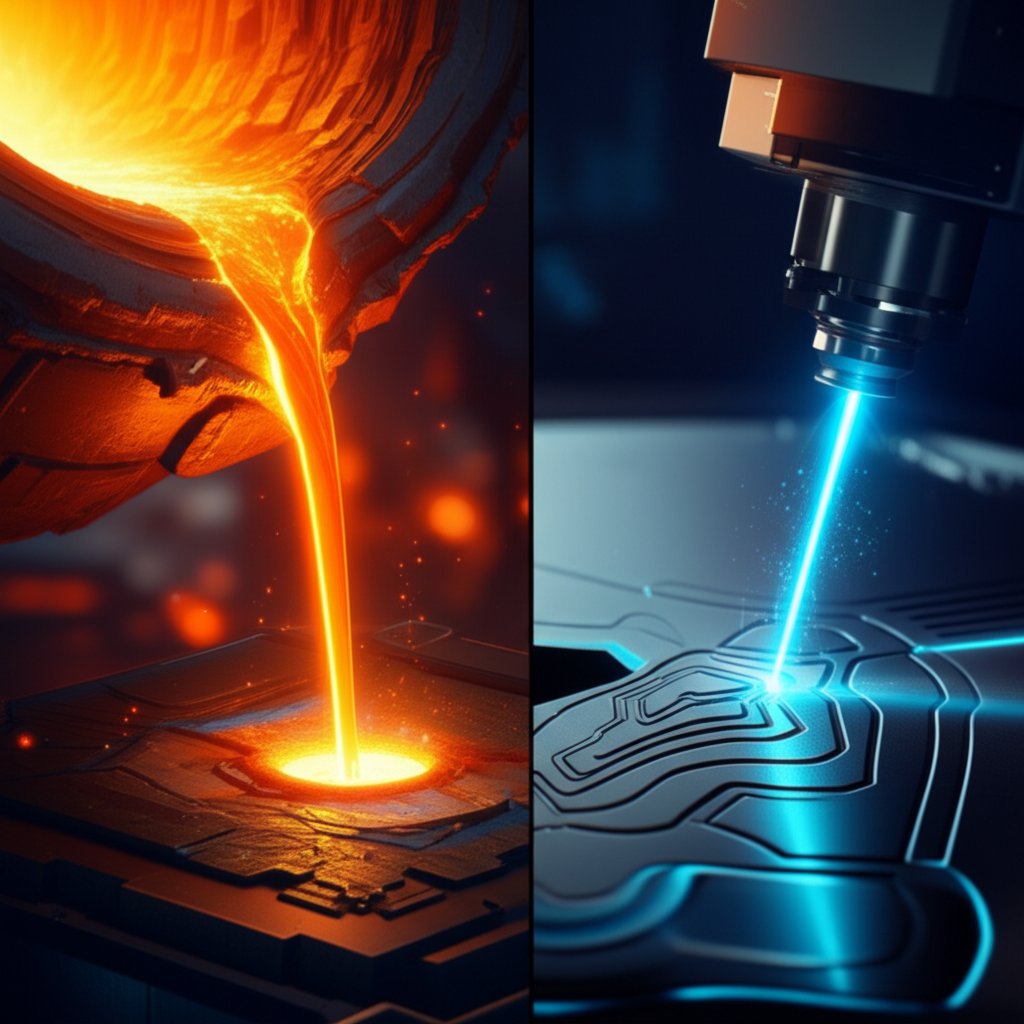
Before comparing die casting vs. CNC machining, it's essential to understand their fundamental principles. These two methods represent opposite approaches to manufacturing: one is formative, creating a shape from liquid material, while the other is subtractive, carving a shape from a solid block. This core difference influences everything from cost and speed to material properties and design complexity.
Die casting is a formative process where molten non-ferrous metal, such as aluminum or zinc, is injected into a reusable steel mold—called a die—under high pressure. The metal cools and solidifies, taking the shape of the mold's cavity. It's an efficient method for producing geometrically complex parts with features like thin walls and internal cavities. After ejection from the die, parts may undergo secondary operations to remove excess material, known as flash, and achieve their final specifications. The process is highly repeatable, making it ideal for mass production of components like engine blocks and gearbox housings.
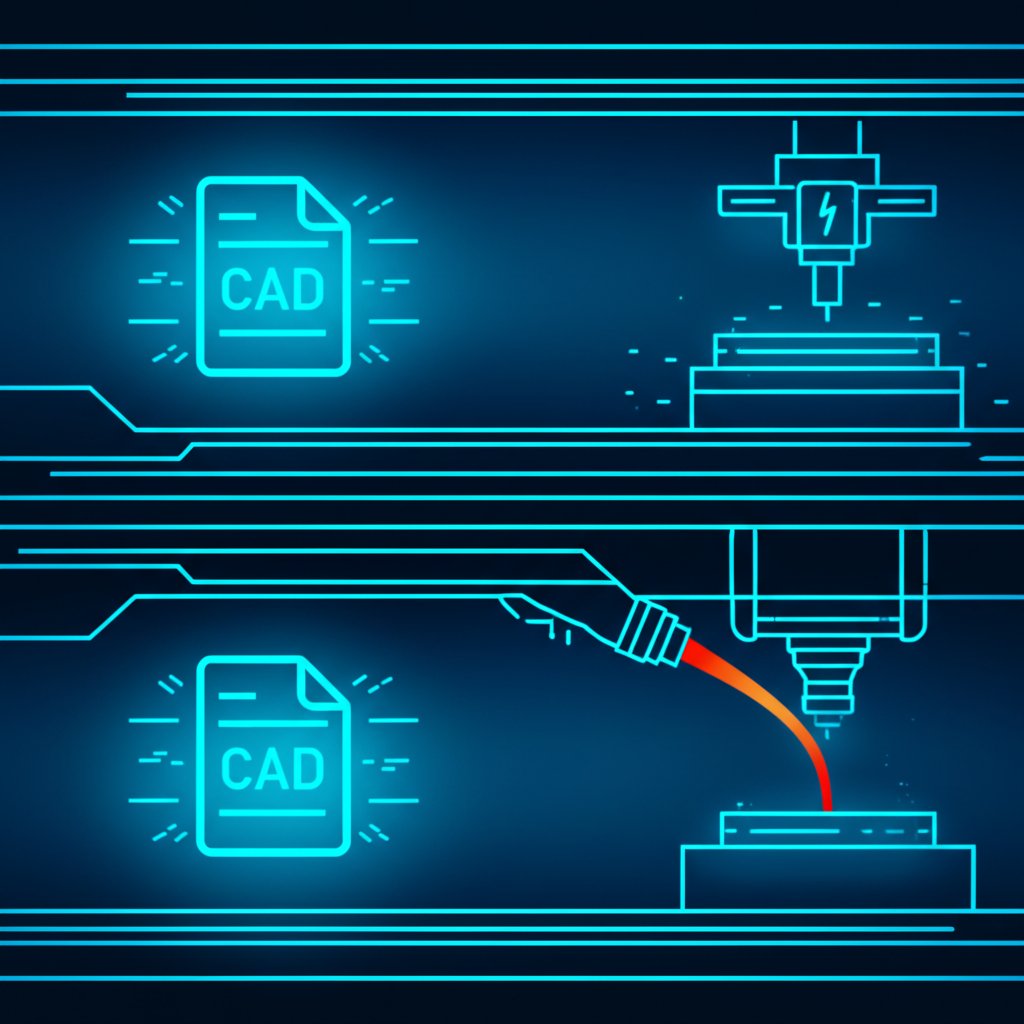
In contrast, CNC (Computer Numerical Control) machining is a subtractive process. It starts with a solid block of material (a billet) and uses computer-programmed rotating cutting tools to remove material until the final part geometry is achieved. A digital CAD file dictates the machine's movements, ensuring extreme precision and repeatability. Because it carves away material, CNC machining can produce parts with sharp corners, flat surfaces, and exceptionally tight tolerances that are difficult to achieve with casting. This makes it a go-to method for high-performance applications, from aerospace components to surgical equipment.
Essentially, the key distinction lies in how the final part is created:
- Die Casting: Builds a part by forcing liquid metal into a pre-made shape. It's a near-net-shape process, minimizing material waste.
- CNC Machining: Creates a part by cutting away material from a larger block. This process offers greater design flexibility for prototypes but generates more scrap material.
Head-to-Head Comparison: 8 Critical Decision Factors
Choosing the right manufacturing process for automotive prototypes requires a careful evaluation of several critical factors. While both die casting and CNC machining can produce high-quality metal parts, their strengths and weaknesses make them suitable for different stages of the product development lifecycle. Below is a detailed breakdown of the key decision criteria, from production volume to material waste.
| Factor | Die Casting | CNC Machining |
|---|---|---|
| Production Volume | Ideal for high-volume runs (10,000+ units) where tooling costs can be amortized. | Best for low-to-mid volume, from single prototypes to a few thousand parts. |
| Cost Analysis | High upfront tooling cost, but very low cost per part at scale. | No tooling cost, but higher and more consistent cost per part. |
| Speed & Lead Time | Longer initial lead time (weeks for tooling), but very fast cycle times in production. | Very fast lead time for first parts (hours to days); slower for mass production. |
| Dimensional Accuracy | Good accuracy, but tolerances are looser (e.g., +/- 0.05 mm per 25 mm). | Superior accuracy with extremely tight tolerances (as low as +/- 0.025 mm). |
| Part Complexity | Excellent for complex internal geometries, thin walls, and part consolidation. | Ideal for parts with thick walls, sharp corners, and features requiring high precision. |
| Material Selection | Limited to non-ferrous, castable alloys like aluminum, zinc, and magnesium. | Vast range of materials, including virtually all metals, plastics, and composites. |
| Surface Finish | Good, smooth finish but may have imperfections like flash or flow lines. | Excellent surface finish directly from the machine, requiring less post-processing. |
| Material Waste | Low waste (near-net-shape), with excess material being easily recyclable. | High waste (subtractive process), though scrap can be recycled. |
Cost and Volume are the most significant differentiators. Die casting requires a substantial initial investment in tooling, which can take weeks or months to produce. However, once the die is ready, parts can be produced for a very low unit cost, making it highly economical for runs exceeding 10,000 pieces. CNC machining has no tooling costs, making it the clear winner for prototypes and low-volume production. However, its per-part cost remains relatively high and doesn't decrease significantly with volume.
When it comes to Speed and Lead Time, CNC machining is unmatched for getting the first parts in hand. A prototype can be machined within hours or days of finalizing a CAD model. This agility is crucial during iterative design phases. Die casting is much slower to start due to tool manufacturing, but once in production, its cycle times are incredibly fast, far outpacing machining for large quantities.
Dimensional Accuracy and Part Complexity reveal different strengths. CNC machining offers superior precision and can achieve tolerances that are impossible for casting. It excels at creating features that require perfect flatness or sharp edges. Die casting, however, is better for creating complex internal geometries and consolidating multiple parts into a single, intricate component, which can reduce assembly needs and overall weight.
For Material Selection, CNC machining provides far more options, accommodating almost any metal or plastic that can be formed into a solid block. Die casting is restricted to metals with lower melting points, primarily aluminum, zinc, and magnesium alloys. It's important to note that for applications demanding maximum strength and fatigue resistance, another process like forging is often considered. For instance, for critical automotive components where ultimate strength is paramount, processes like hot forging are often specified. Companies like Shaoyi (Ningbo) Metal Technology specialize in these high-performance forged parts, offering another path from prototype to production.
Specific Application: Choosing for Automotive Prototypes
In the context of automotive prototyping, the choice between die casting and CNC machining is not about which process is universally better, but which is right for a specific stage and purpose. The automotive development lifecycle involves multiple phases of validation, from early functional tests to near-production trials, and each phase has different requirements for speed, cost, and fidelity.
CNC machining is the dominant choice for early-stage prototypes. When a design is still evolving, engineers need to test different versions quickly. The speed of CNC machining allows for rapid iteration without the prohibitive cost and delay of creating new molds. This process is perfect for producing one-off functional prototypes, fit-check models, and parts for 'bridge production'—small runs to keep a project moving while waiting for high-volume casting tools to be completed. In the electric vehicle (EV) sector, for example, CNC machining is frequently used for high-precision components like EV battery enclosures and motor mounts.
Die casting comes into play during later stages of prototyping, when the design is stable and the focus shifts to validating the final manufacturing process and conducting higher-volume test runs. Creating die-cast prototypes is essentially a dress rehearsal for mass production. It allows engineers to test the part as it will be made at scale, evaluating its thermal properties, structural integrity, and potential for part consolidation. For example, a single die-cast part can replace an assembly of three or four machined components, saving weight and eliminating fasteners. This is common for parts like steering knuckles and transmission housings.
To make a practical decision, consider this simple checklist for your automotive prototype:
- Choose CNC Machining if: Your design is still evolving, you need only 1-100 parts, speed is your top priority, and you require the tightest possible tolerances.
- Choose Die Casting if: Your design is finalized, you need 1,000+ parts for testing, minimizing the per-part cost is the main driver, and you need to validate the mass-production process.
Making the Final Decision for Your Project
Ultimately, the decision between die casting and CNC machining for your automotive prototype is a strategic one, balancing the immediate needs of development against the long-term goals of production. The choice is not a simple binary but a reflection of your project's position on the spectrum from flexibility to scalability. Recapping the primary trade-off, CNC machining offers unparalleled speed and design freedom for low volumes, while die casting delivers exceptional cost-efficiency at scale.
A key takeaway is to align your manufacturing method with your project's maturity. Early, iterative phases benefit from the agility of CNC machining. As the design solidifies and moves toward production, transitioning to die casting becomes a logical and financially sound step. This phased approach allows you to leverage the strengths of both technologies at the most appropriate times.
It's also worth considering a hybrid approach. In many automotive applications, a part is first created as a near-net-shape casting and then sent for CNC machining to finish critical features. This method combines the material efficiency and complex geometry capabilities of casting with the high precision of machining, offering a best-of-both-worlds solution for performance-critical components.
Frequently Asked Questions
1. What is the difference between CNC machining and die casting?
The primary difference is the manufacturing method. Die casting is a formative process that involves injecting molten metal into a mold to create a part. CNC machining is a subtractive process that starts with a solid block of material and carves away excess material with cutting tools to achieve the final shape.
2. Is die casting cheaper than CNC?
It depends on the volume. For single prototypes or low-volume runs, CNC machining is cheaper because it has no upfront tooling costs. For large production runs (typically over 10,000 units), die casting is significantly more cost-effective because the high initial mold cost is spread over many parts, resulting in a lower per-part cost.
3. Can die casting be automated?
Yes, die casting is a highly automated process. Modern die casting cells use robots for tasks like injecting molten metal, extracting the finished parts, and spraying the die with lubricant. This automation leads to fast cycle times, high consistency, and efficiency in mass production.