 Small batches, high standards. Our rapid prototyping service makes validation faster and easier —
  EN
EN


Closed Die Forging Process Automotive: Why Engineers Trust It
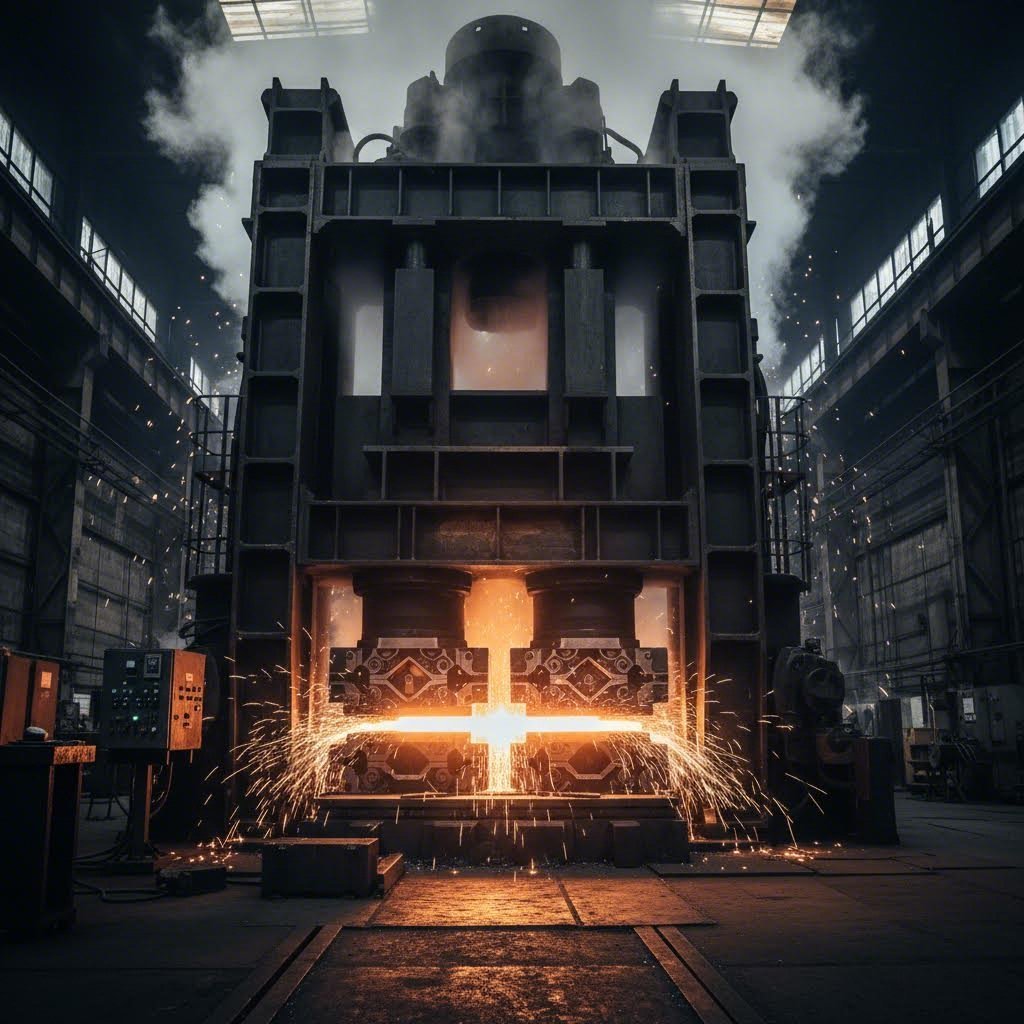
The Foundation of Automotive Component Strength
When you turn the steering wheel or press the brake pedal, you're trusting your life to components you'll never see. Behind every reliable vehicle lies a manufacturing process that automotive engineers have depended on for decades: closed die forging. This technique produces the strongest, most reliable metal components available in manufacturing today—and it's the reason your vehicle's critical parts don't fail when you need them most.
Why Automakers Rely on Closed Die Forging for Critical Components
Imagine the forces at play inside your engine. Crankshafts spinning thousands of times per minute. Connecting rods transferring explosive combustion power to the drivetrain. Suspension components absorbing road impacts mile after mile. These parts face extraordinary mechanical stress, extreme temperatures, and relentless cyclic loading. Cast or machined alternatives simply can't match what forged steel delivers in these demanding applications.
The advantages of forging become clear when examining the numbers. According to industry data, forged components offer 20-50% higher tensile and fatigue strength compared to cast or machined parts. This isn't a minor improvement—it's the difference between a component that lasts the lifetime of your vehicle and one that fails unexpectedly.
Safety-critical components like steering parts, suspension links, and axles are almost universally forged because they must withstand pressure and shock far better than cast or fabricated alternatives—failure in these areas can lead to serious safety risks.
The Manufacturing Process Behind Your Vehicle's Strongest Parts
So what makes the forging process so effective? When comparing casting and forging, the key difference lies in the metal's internal structure. During steel forging, heated metal is compressed under extreme pressure, aligning the grain structure along the component's contours. This creates a denser, tougher material with no hidden porosity, voids, or shrinkage defects that could cause catastrophic failure.
This grain flow alignment is something you simply cannot achieve through machining bar stock or casting. The strongest grain orientation ends up precisely where stresses are highest—a natural reinforcement built into the part's very structure. For automotive engineers designing safety-critical systems, this structural integrity isn't optional; it's essential.
Throughout this article, you'll discover exactly how the closed die forging process works, which materials perform best for specific automotive applications, and how to evaluate suppliers who can deliver the quality your components demand. Whether you're specifying powertrain parts, chassis components, or suspension systems, understanding this manufacturing foundation will help you make better engineering and procurement decisions.
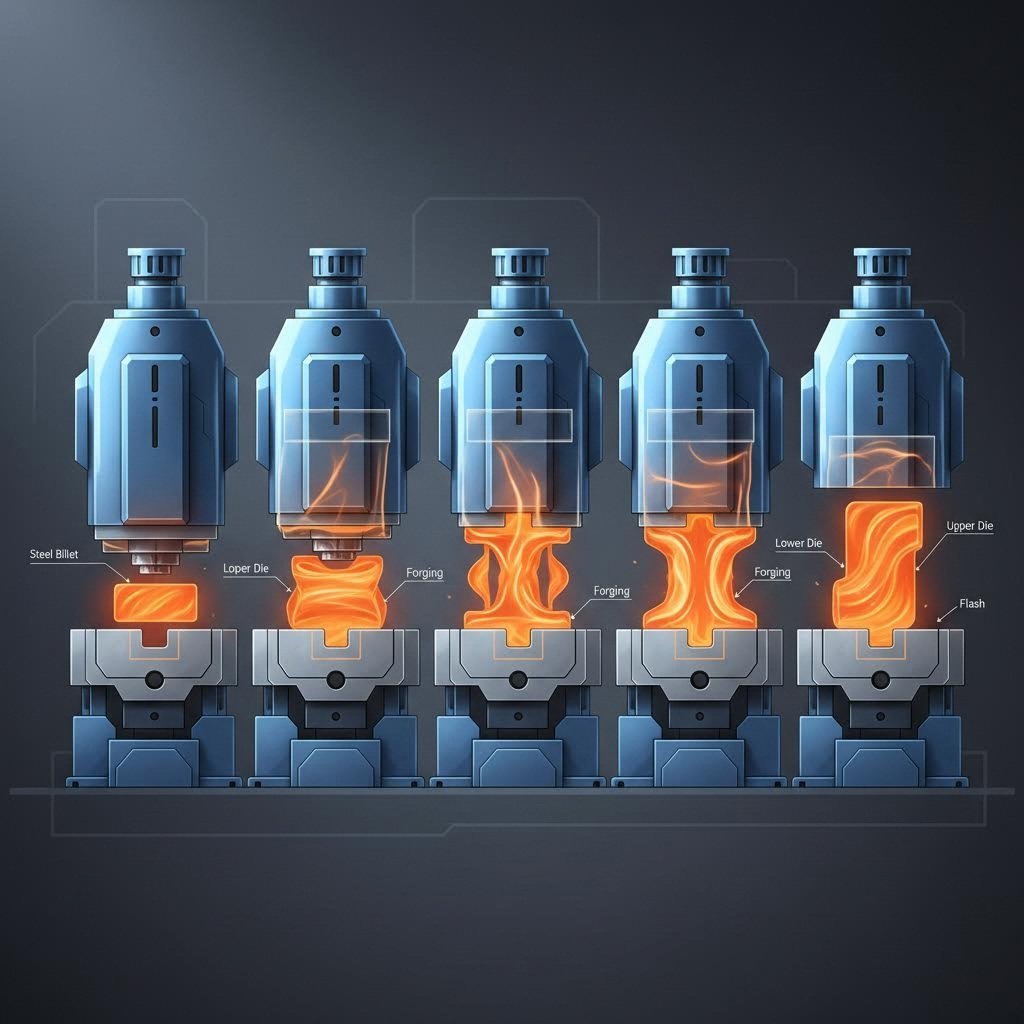
Step-by-Step Process Breakdown for Automotive Applications
Understanding the metal forging process isn't just academic—it's essential for engineers who need to specify components that meet rigorous automotive standards. Each stage in the closed die forging procedure directly influences the final part's mechanical properties, dimensional accuracy, and long-term reliability. Let's walk through the complete workflow, from raw material to finished component ready for your vehicle.
From Raw Billet to Precision Component
The journey begins long before metal meets die. Successful hot forging starts with careful preparation and follows a precise sequence that transforms ordinary steel billets into extraordinary automotive components.
-
Material Selection and Billet Preparation
Engineers select billets or ingots based on the target component's requirements—carbon steel for cost-effective strength, alloy steel for enhanced toughness, or aluminum for weight-critical applications. The billet's cross-section and length are calculated to ensure proper material flow within the forging die while minimizing waste. For automotive crankshafts, for example, precise billet sizing prevents defects that could compromise fatigue resistance. -
Die Design and Manufacturing
Before production begins, engineers create precision forge tooling that will shape thousands of identical parts. The forging die incorporates the negative impression of the final component, accounting for material shrinkage during cooling. Quality die design delivers better grain flow, superior surface finish, reduced material waste, and consistent dimensional accuracy across production runs. For automotive applications, dies must withstand extreme loads—typically 500 to 14,000 tons for mechanical presses—while maintaining tight tolerances. -
Heating to Forging Temperature
The billet enters an induction heater or furnace, reaching the optimal steel forging temp for the specific alloy. The forging temperature of steel typically ranges from 850°C to 1,200°C (1,560°F to 2,190°F), while aluminum alloys require much lower temperatures around 310°C to 450°C. At these elevated temperatures, the metal's microstructure becomes malleable, allowing it to flow and fill complex die cavities without cracking. Induction heating has become the industry standard because it minimizes energy costs and reduces surface oxidation. -
Forming Under Extreme Pressure
The heated billet is positioned within the die cavity, and immense compressive force is applied. Mechanical presses deliver high-speed cycles ideal for medium-sized automotive components like gears and connecting rods, while hydraulic presses provide controlled force at higher tonnages for larger parts such as heavy-duty axle shafts. As the dies close, metal flows to fill every contour of the cavity. Excess material, called flash, is expelled between the die parting lines and later trimmed. -
Flash Removal and Trimming
After extraction from the dies, the flash surrounding the forged component is removed. This trimming operation leaves a witness mark that may require finishing, but the trade-off is worthwhile—flash formation allows for lower die loads and ensures complete cavity filling. Some high-volume applications use flashless forging with totally enclosed dies, achieving tighter tolerances but requiring precisely controlled billet volumes. -
Heat Treatment
Most automotive forgings undergo post-forge heat treatment to optimize mechanical properties. Processes like quenching, tempering, normalizing, or case hardening enhance strength, hardness, and wear resistance tailored to each component's service requirements. A connecting rod might receive different treatment than a steering knuckle, even when both start from similar materials. -
Controlled Cooling
The cooling rate significantly influences the final grain structure and properties. Engineers specify cooling protocols—air cooling, controlled furnace cooling, or accelerated quenching—to develop the optimal balance of strength, ductility, and toughness for each automotive application. -
Finishing and Inspection
Final operations may include CNC machining for critical surfaces, surface treatments for corrosion resistance, and comprehensive quality inspection. Ultrasonic testing, hardness checks, and dimensional verification ensure every component meets automotive specifications before shipment.
Temperature Control and Die Design for Automotive Tolerances
Why does temperature matter so much? At the correct forging temperature, steel undergoes recrystallization—internal stresses are relieved, and new grains form with improved mechanical properties. Too cold, and the metal resists deformation, increasing tool wear and risking cracks. Too hot, and you risk oxidation, decarburization, or burn damage that compromises surface quality.
For automotive-grade closed die forgings, typical dimensional tolerances for steel flash forgings range from +1.5 to -0.5 mm for components weighing 0.5 to 1 kg. High-volume hot formers using flashless techniques can achieve even tighter tolerances of ±0.3 to 0.4 mm—precision that reduces or eliminates secondary machining operations.
Die life directly correlates with the forging procedure's temperature demands. When forging steel at 1,000°C to 1,150°C, typical die life ranges from 10,000 to 15,000 parts. This economic consideration influences material selection decisions—aluminum's lower forging temperatures extend die life significantly, one reason it's increasingly popular for weight-sensitive automotive applications.
Production rates also vary dramatically based on automation level and component complexity. Crank presses with auto-transfer systems achieve 300 to 600 parts per hour, while dedicated hot formers with totally enclosed dies can produce 4,000 to 10,000 parts per hour. For automotive manufacturers balancing quality requirements with cost pressures, these throughput capabilities make closed die forging economically compelling for medium to high-volume production.
With this forging procedure foundation established, the next critical decision involves selecting the right material for each automotive application—a choice that directly determines component performance, cost, and longevity.
Material Selection Guide for Automotive Forging
Choosing the right forging steel isn't just a technical checkbox—it's the foundation of component performance, durability, and safety. The material you specify determines whether a crankshaft survives 200,000 miles or fails prematurely, whether a suspension arm handles cyclic fatigue or cracks under stress. Let's explore which alloys deliver optimal results for specific automotive systems.
Steel Grades for Engine and Powertrain Components
Engine and powertrain parts face the harshest operating conditions in any vehicle. They endure extreme temperatures, explosive combustion forces, and continuous high-speed rotation. This is where forged carbon steel and forged alloy steel truly shine.
Carbon steel grades remain the workhorses of automotive forging. Low-carbon steels (0.10-0.25% carbon) offer excellent formability and weldability, making them suitable for less critical components. Medium-carbon steels (0.25-0.50% carbon) deliver the sweet spot for most automotive applications—good strength, adequate ductility, and cost-effective production. High-carbon steels (above 0.50% carbon) provide superior hardness and wear resistance but require careful processing to avoid brittleness.
For demanding powertrain applications, alloy steel forgings take performance further. Adding elements like chromium, molybdenum, nickel, and vanadium enhances specific properties:
- Chromium-molybdenum steels (4140, 4340) – Excellent hardenability and fatigue resistance for crankshafts and connecting rods
- Nickel-chromium steels (8620, 8640) – Superior toughness for gears and shafts requiring case hardening
- Microalloy steels (3MnVS3) – Achieving tensile strengths up to 850 MPa, these enable weight reduction through smaller cross-sections without sacrificing safety
Some advanced microalloy steels now reach tensile strengths of 1,160 MPa, allowing engineers to design lighter, more efficient powertrains. This forged carbon steel approach has become increasingly important as automakers pursue fuel efficiency without compromising durability.
Material Selection Matrix for Suspension vs Transmission Parts
Different automotive systems demand different material properties. Suspension components prioritize fatigue resistance and impact toughness—they must absorb road shocks millions of times without failure. Transmission parts need wear resistance and precise dimensional stability under load. The table below provides a comprehensive comparison to guide your material decisions:
| Material Grade | Type | Tensile Strength (MPa) | Primary Automotive Applications | Key Properties |
|---|---|---|---|---|
| ASTM A105 | Carbon Steel | 485 min | Flanges, fittings, general structural | Good weldability, moderate strength, cost-effective |
| 1045 | Medium Carbon | 570-700 | Axle shafts, spindles, steering components | Good balance of strength and machinability |
| 4140 | Chromium-Moly Alloy | 655-900 | Crankshafts, connecting rods, high-stress gears | Excellent fatigue strength, through-hardenable |
| 4340 | Nickel-Chrome-Moly | 745-1080 | Heavy-duty axles, transmission shafts | Superior toughness, deep hardenability |
| 8620 | Nickel-Chrome | 530-640 | Gears, pinions, case-hardened components | Excellent case hardening response, tough core |
| 3MnVS3 (Microalloy) | Microalloy Steel | 850 | Engine linkages, hybrid vehicle components | High strength-to-weight ratio, eliminates heat treatment |
| 6061-T6 | Aluminum Alloy | 310 | Control arms, steering knuckles, wheels | Lightweight, corrosion resistant, good formability |
| 7075-T6 | Aluminum Alloy | 510 | High-performance suspension, racing applications | Highest aluminum strength, aircraft-grade |
The ASTM A105 material specification deserves special attention for automotive engineers. ASTM A105 carbon steel provides reliable performance for forged flanges, fittings, and valve components throughout vehicle hydraulic and fuel systems. Its standardized composition ensures consistent quality across global supply chains—a critical consideration when sourcing from multiple suppliers.
When should you choose forged carbon steel alloy over aluminum? The decision often comes down to three factors:
- Load requirements – Steel handles higher absolute loads; aluminum excels in strength-to-weight applications
- Operating environment – Aluminum's natural corrosion resistance eliminates coating requirements in harsh conditions
- Production economics – Steel forging typically costs less per part at high volumes, while aluminum's lower forging temperatures extend die life
For suspension systems specifically, aluminum alloy forgings have gained significant ground. Control arms, steering knuckles, and crossmembers made from forged aluminum reduce unsprung mass by 40-60% compared to steel equivalents. This weight savings translates directly to improved handling response and ride quality—benefits that increasingly justify aluminum's higher material cost.
Electric vehicles have accelerated this aluminum adoption trend. Each EV uses approximately 208 kg of aluminum (up from 154 kg in 2010), with projections suggesting 250 kg per vehicle as manufacturers push for extended battery range through weight reduction.
With material selection established, the next step involves understanding which specific automotive components benefit most from closed die forging—and how grain flow orientation creates the fatigue resistance these parts demand.
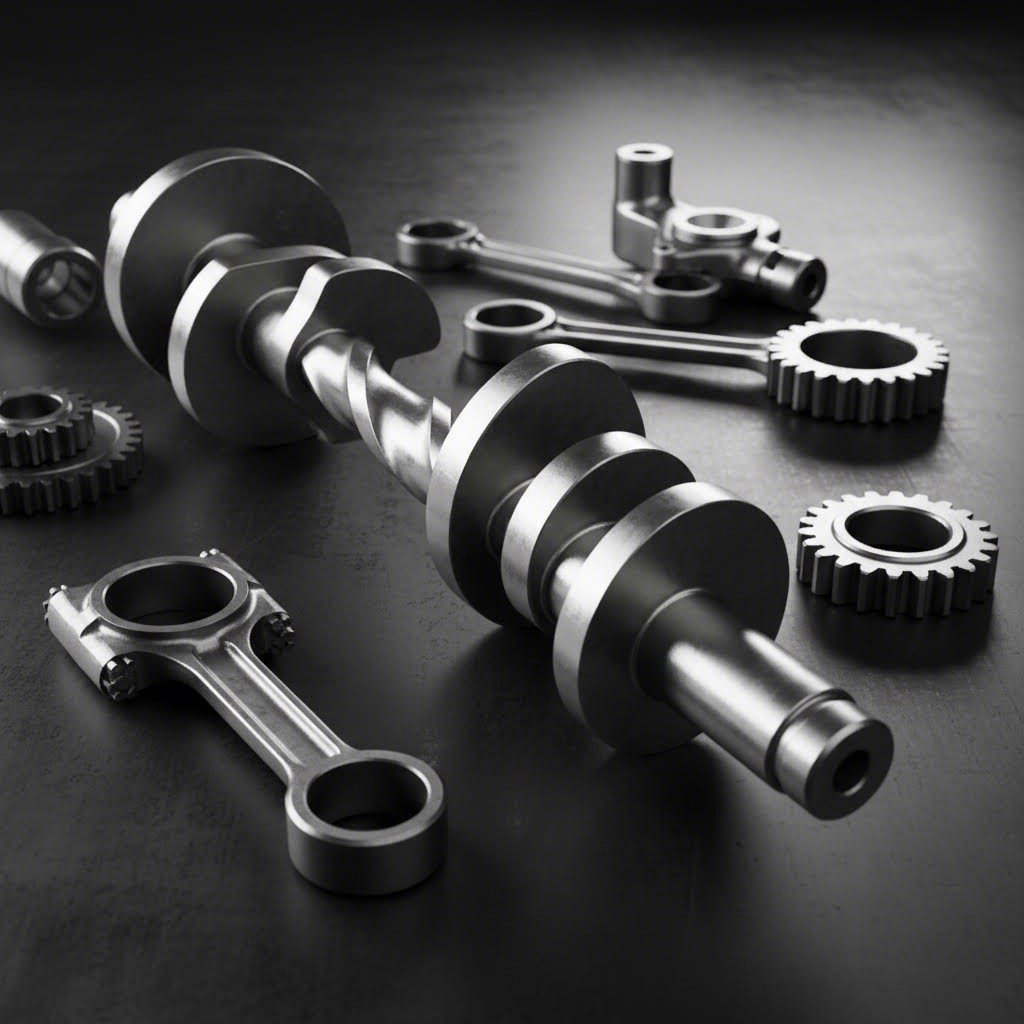
Critical Automotive Components and Their Forging Specifications
Now that you understand material selection, let's explore where these forging components actually end up in your vehicle. From the explosive forces inside your engine to the relentless pounding absorbed by your suspension, closed die forging produces the parts that simply cannot fail. Each component category demands specific forging considerations—and understanding these requirements helps engineers specify parts that deliver decades of reliable service.
Powertrain Components and Their Forging Requirements
The powertrain represents the most demanding forging application in any vehicle. Components here face extreme temperatures, cyclic loading measured in millions of cycles, and forces that would tear apart lesser manufacturing methods.
Crankshafts serve as the backbone of your engine, converting linear piston motion into rotational power. They spin thousands of times per minute while absorbing enormous torsional stresses. The forging process creates continuous grain flow that follows the crankshaft's complex geometry—including throws, counterweights, and journals—providing superior fatigue resistance compared to cast alternatives. High-performance and diesel engines almost universally specify forged crankshafts because failure here means catastrophic engine destruction.
Connecting rods bridge the gap between pistons and crankshaft, experiencing both tensile and compressive loading with every combustion cycle. According to Goodson Tools, forged rods get their forging strength from a definite grain structure that cast rods simply cannot replicate. Forging connecting rods from SAE-4130 or SAE-4340 alloy steel takes advantage of the hammered-in grain structure established during manufacturing, making them essential in high-output spark-ignition and compression-ignition engines.
The construction matters too. Most connecting rods feature an I-beam or H-beam design, and this geometry—when combined with forging—allows the rod to be substantially stronger and lighter than solid metal would permit. H-beam forged rods offer even greater strength-to-weight ratios, which is why performance engine builders prefer them for high-output applications.
Gears and transmission components require exceptional surface hardness combined with core toughness—a combination forging delivers beautifully. As Minchen Gear explains, the forging application for gears aligns the internal grain structure along the shape of gear teeth, significantly improving fatigue and fracture resistance under repeated loading. This grain flow alignment is particularly crucial in automotive differentials, industrial gearboxes, and transmissions where gears face constant torque reversals and impacts.
- Crankshafts – Forged from 4140 or 4340 steel; require continuous grain flow following throws and journals; typically 5,000-15,000 forging cycles per die
- Connecting Rods – SAE-4130 or 4340 alloy steel; I-beam or H-beam configurations; forged weight typically 100 grams lighter than cast equivalents
- Transmission Gears – 8620 or similar case-hardening steels; near-net-shape forging reduces machining time by 30-40%
- Input/Output Shafts – 4140 chromium-moly steel; splined sections benefit from forging's directional strength
- Ring and Pinion Sets – Forged blanks provide denser, more uniform material for precise gear cutting
Chassis and Suspension Parts Built for Cyclic Fatigue Resistance
While powertrain components face high-frequency loading, chassis and suspension parts endure a different challenge: millions of low-frequency stress cycles from road impacts, braking, and cornering. Here, resistance to cyclic fatigue becomes the primary design driver—and this is where the grain flow characteristics of forged parts prove invaluable.
Steering knuckles connect your steering and suspension systems while bearing alternating loads from the tires. Research published in Engineering Failure Analysis demonstrates why material quality matters so critically: defects like porosity, inclusions, and segregation create stress concentrations that initiate cracks under cyclic loading. The closed die forging process eliminates these defects by consolidating the metal under extreme pressure, producing fully dense components free from the internal flaws that plague castings.
Steering knuckles typically require 42CrMo or similar alloy steel, undergoing precision forging followed by heat treatment to achieve the optimal balance of surface hardness and core toughness. When properly manufactured, these components survive the vehicle's entire service life—but material defects can cause premature failure in as few as 1,100 kilometers, as documented failure analyses have shown.
Control arms and suspension links absorb road impacts while maintaining precise wheel geometry. The forging process creates material flow lines that follow the part's contours, placing the strongest grain orientation exactly where stress concentrations occur—at attachment points, bends, and cross-section transitions. This natural reinforcement provides the cyclic fatigue resistance that keeps suspension systems functioning safely for hundreds of thousands of miles.
Axle beams and stub axles carry the full vehicle weight while transmitting braking and acceleration forces. These components experience combined bending, torsion, and axial loading—a complex stress state that demands forging's superior mechanical properties. For heavy-duty truck applications, forged axle components from 4340 nickel-chrome-moly steel provide the deep hardenability needed for large cross-sections.
- Steering Knuckles – 42CrMo steel; forging eliminates porosity and inclusion defects; heat treated for optimal toughness
- Control Arms – Aluminum alloys (6061-T6) or steel depending on weight requirements; grain flow aligned with stress paths
- Suspension Links – Medium carbon steel or microalloys; forging small parts in this category enables consistent quality at high volumes
- Axle Beams – 4140 or 4340 alloy steel; deep hardenability essential for large cross-sections
- Wheel Hubs – Forged fittings and hubs provide superior bearing surface durability
- Tie Rod Ends – Case-hardened forged steel; must resist fatigue from constant steering inputs
The difference between forged and cast components in these applications isn't subtle. Forged gears, for example, exhibit higher tensile strength, better impact toughness, and superior wear resistance compared to cast counterparts—all stemming from the denser, void-free microstructure that forging creates. Combined with appropriate heat treatment, forged components achieve an ideal balance between surface hardness for wear resistance and core toughness for shock absorption.
Understanding these component-specific requirements naturally leads to a critical question: when does closed die forging make more sense than alternative manufacturing methods? The answer depends on production volume, mechanical requirements, and economic considerations—factors we'll examine next.
Closed Die Forging vs Alternative Manufacturing Methods
How do you decide whether closed die forging is the right choice for your automotive component? It's a question that procurement teams and design engineers face constantly—and the answer isn't always straightforward. Each manufacturing method brings distinct advantages depending on your mechanical requirements, production volumes, and budget constraints. Let's break down the key differences so you can make confident sourcing decisions.
When Forging Outperforms Casting for Automotive Parts
The forging vs casting debate has persisted for decades in automotive manufacturing, and for good reason—both processes can produce similar-looking components with dramatically different performance characteristics. Understanding when each method excels helps you avoid costly specification mistakes.
When comparing forging and casting, the fundamental difference lies in how the metal structure forms. Casting involves pouring molten metal into molds where it solidifies, while forging compresses heated solid metal under extreme pressure. This distinction creates measurable performance gaps that matter for safety-critical automotive applications.
According to Trenton Forging, forged parts demonstrate significantly better strength, higher impact and fatigue resistance, fewer defects, and faster production rates compared to cast alternatives. Here's why these differences matter for your vehicle:
- Superior grain structure – Forging optimizes internal grain flow, creating naturally stronger parts. When examining forged vs cast steel under a microscope, the difference is striking—forged material shows aligned, continuous grain structure while castings display random, dendritic patterns.
- Elimination of porosity – Turbulent metal flows during casting can entrain air bubbles, which become internal voids in the final piece. These defects are difficult to predict, costly to inspect, and can cause sudden failure under load. Closed die forging compacts the metal, eliminating porosity entirely.
- Better impact resistance – The grain flow and cold working that occurs during forging creates tougher parts. This makes forging essential for components in agricultural machinery, railroad equipment, and automotive suspension systems that absorb repeated impacts.
- Homogeneous material properties – Cast steel vs forged steel shows distinct quality differences. Complex alloys can segregate during casting solidification, creating inconsistent mechanical properties throughout the part. Forging produces highly uniform material through recrystallization and compaction.
The difference between casting and forging becomes particularly important for pressure-containing components. Chemical processing equipment, hydraulic systems, and fuel delivery components almost universally specify forged materials because internal porosity in castings can lead to leaks or catastrophic failure under pressure.
That said, casting does offer advantages in specific scenarios. It can produce more complex geometries with internal chambers and passages that forging cannot achieve. For low-stress decorative components or parts with intricate internal features, casting may be the better choice. But for anything safety-critical in your vehicle, the cast vs forged decision typically favors forging.
Why Forging Beats Machining for High-Volume Production
Machining from bar stock or billet seems attractive at first glance—minimal tooling investment, excellent precision, and quick prototyping capability. So why do automotive manufacturers overwhelmingly choose forging for production components?
The economics become unfavorable quickly at scale. Machining processes handle one part at a time on expensive CNC equipment. The greater the volume of metal removed, the longer each part occupies the machine. For a typical automotive connecting rod machined from billet, you might remove 60-70% of the starting material as chips—material you've already paid for that becomes waste.
This waste problem intensifies with higher-value alloys. When machining alloy steel forgings or stainless steels, the volume of metal cut away can cost more than the material content of the finished part. Disposal of machining chips is becoming increasingly difficult and expensive, adding hidden costs to the per-part calculation.
Beyond economics, machined parts lack the grain flow that forging creates. As Trenton Forging notes, forged parts are significantly stronger because the grain structure aligns with the part geometry. A connecting rod machined from bar stock has grain running straight through, while a forged rod has grain that follows the I-beam contours—placing the strongest material orientation exactly where stress concentrations occur.
Open Die vs Closed Die Selection Criteria for Production Volume
Not all forging is the same. Open die forging uses flat dies that don't fully enclose the workpiece, allowing the metal to flow outward during compression. Closed die forging (also called impression die forging) uses precisely machined dies that fully contain the metal, producing near-net-shape components with consistent dimensions.
For automotive applications, production volume largely drives this decision:
- Open die forging – Best for large parts, low volumes, or prototyping. Tooling costs are minimal since standard dies work for many part geometries. However, significant secondary machining is required to achieve final dimensions.
- Closed die forging – Optimal for medium to high-volume production where tooling investment amortizes across thousands of parts. Produces consistent, near-net-shape components with minimal machining requirements.
The table below provides a comprehensive comparison to help you evaluate these manufacturing methods against your specific requirements:
| Criteria | Closed Die Forging | Open Die Forging | Casting | Machining from Bar |
|---|---|---|---|---|
| Mechanical Properties | Excellent – optimized grain flow, highest fatigue resistance | Very Good – improved grain structure, some directional properties | Moderate – random grain, potential porosity defects | Good – consistent but lacks grain flow benefits |
| Production Volume Suitability | 5,000+ parts (economically optimal) | 1-500 parts or very large components | 100-10,000+ parts depending on complexity | 1-1,000 parts (prototypes, low volume) |
| Tooling Investment | High ($20,000-$100,000+ per die set) | Low (standard dies for many parts) | Moderate ($5,000-$50,000 for molds) | Minimal (standard cutting tools) |
| Lead Time for First Article | 6-12 weeks (die manufacturing) | 1-3 weeks | 4-8 weeks (mold manufacturing) | 1-2 weeks |
| Per-Part Cost at 1,000 units | High (tooling not fully amortized) | Moderate to High | Moderate | Very High (labor intensive) |
| Per-Part Cost at 50,000 units | Low (tooling fully amortized) | Not practical for this volume | Low to Moderate | Prohibitively High |
| Dimensional Tolerance | ±0.3-1.5mm (near-net-shape) | ±3-10mm (requires machining) | ±0.5-2mm depending on process | ±0.01-0.1mm (highest precision) |
| Material Waste | Low (flash only, typically 5-15%) | Moderate (requires machining allowance) | Low (gating and risers recyclable) | High (60-80% becomes chips) |
| Geometric Complexity | Moderate (limited by die design) | Simple shapes only | High (internal passages possible) | High (any machinable geometry) |
| Best Automotive Applications | Crankshafts, connecting rods, gears, suspension components | Large shafts, custom prototypes | Engine blocks, housings, decorative parts | Prototypes, low-volume specialty parts |
Decision Framework for Automotive Manufacturers
Sounds complex? Here's a simplified decision path:
- Evaluate mechanical requirements first. If the component is safety-critical (steering, suspension, powertrain), forging typically wins. The strength and fatigue resistance advantages outweigh cost considerations when failure isn't an option.
- Consider production volume. Closed die forging becomes economically compelling above 5,000-10,000 parts, where tooling costs amortize effectively. Below this threshold, open die forging or machining may prove more cost-effective despite inferior mechanical properties.
- Assess geometric complexity. Parts with internal passages or extremely intricate features may require casting or machining. However, many seemingly complex automotive components can be designed for forging with proper engineering input.
- Calculate total cost of ownership. The lowest per-part manufacturing cost doesn't always win. Factor in warranty claims, field failures, inspection requirements, and liability exposure when comparing forging and casting for safety-critical applications.
As Trenton Forging emphasizes, comparing these processes during the design phase—rather than switching methods later—yields optimal products and avoids costly redesigns that delay product launches. The decision between forging vs casting or forging vs machining should happen early, not as an afterthought.
With the manufacturing method selected, another critical choice remains: should you specify hot forging or cold forging for your automotive component? Temperature selection dramatically influences mechanical properties, dimensional accuracy, and production economics—factors we'll examine next.
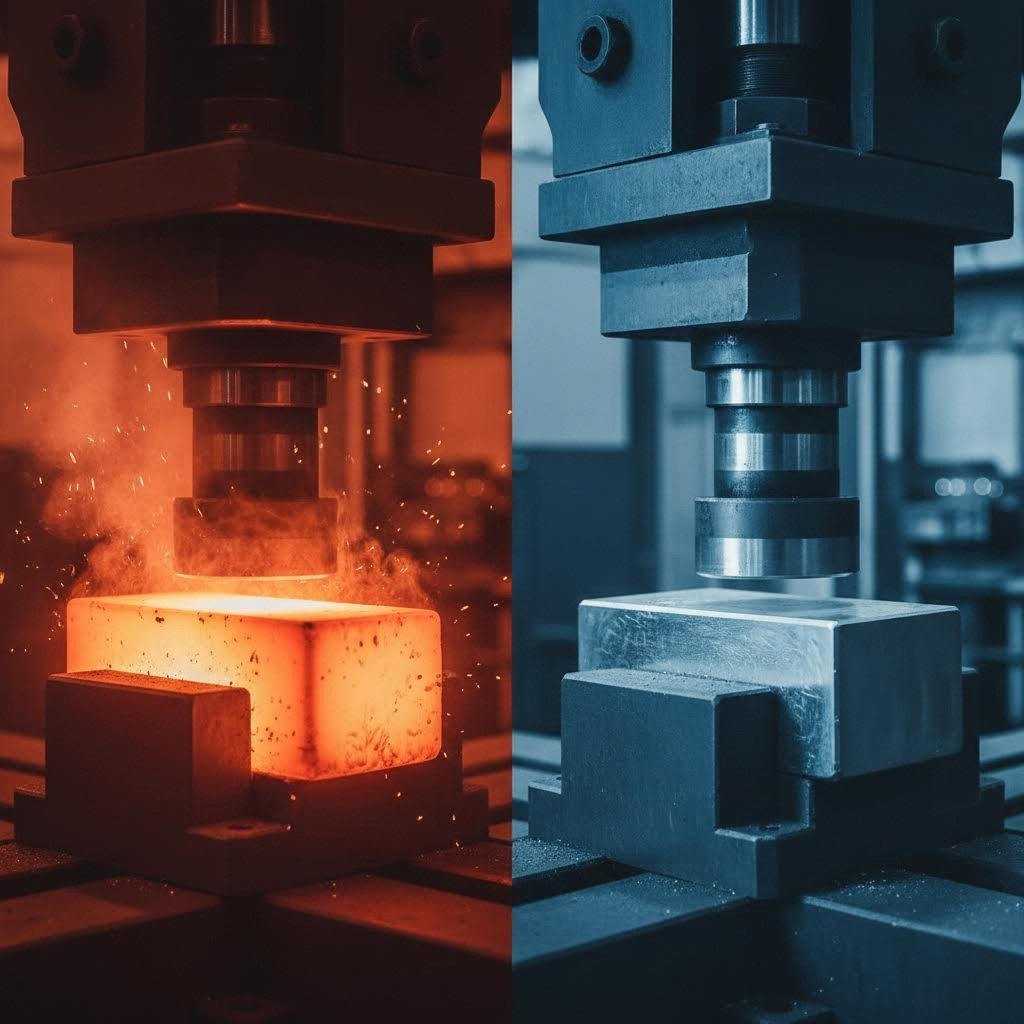
Hot Forging vs Cold Forging in Automotive Manufacturing
You've selected closed die forging as your manufacturing method—but which temperature range delivers the best results for your specific component? This decision significantly impacts everything from dimensional accuracy to final mechanical properties. Understanding the hot forging vs cold forging tradeoffs helps you specify components that meet exact performance requirements while optimizing production economics.
Temperature Selection Impact on Automotive Component Properties
The temperature for forging steel fundamentally changes how metal behaves during deformation—and what properties the finished component exhibits. Let's examine what happens at each temperature range.
Hot forging occurs above the metal's recrystallization temperature, typically between 900°C and 1,250°C for steel alloys. At these elevated temperatures, the metal's crystal structure enters a dynamic recrystallization state. What does this mean for your automotive parts? The material becomes highly malleable, allowing complex shapes to form with relatively low force. According to Queen City Forging, forging hot eliminates strain hardening because new grains continuously form during deformation—this improves ductility and toughness in the final component.
Think about your engine's crankshaft or those three-dimensional curved tie rods in your suspension system. These parts feature complex geometries that would crack or require excessive force if formed at lower temperatures. Hot forging makes these shapes achievable while simultaneously refining the grain structure for improved strength and durability.
Cold forging takes place at or near room temperature—typically between 20°C and 400°C. Without the recrystallization that occurs during hot processing, the metal undergoes work hardening as grains compress and stretch. This phenomenon increases strength and hardness significantly, but comes with reduced plasticity. Cold forged automotive bolts, for example, gain substantial strength from this work hardening effect and can often be assembled directly without additional heat treatment.
The grain structure outcomes differ dramatically between these approaches:
- Hot forging produces uniformly refined grains through dynamic recrystallization, eliminating casting defects like porosity and segregation. Parts typically require subsequent heat treatment to achieve target hardness.
- Cold forge processing creates elongated, work-hardened grains that deliver higher strength and hardness immediately—but with increased brittleness risk if deformation exceeds material limits.
Matching Forging Method to Component Complexity and Volume
When should you specify each process? The decision depends on several interconnected factors that vary by component type.
For large, complex automotive components like crankshafts, steering knuckles, and axle beams, hot forging remains the clear choice. The reduced deformation resistance at high temperatures means equipment can form intricate geometries without risking cracks or requiring multiple forming stages. As HULK Metal notes, tie rods in automobile suspension systems are formed by hot forging because their large deformation and complex three-dimensional curves are easier to achieve at elevated temperatures.
Cold forged components excel in different applications. Precision gears, bolts, shafts, and bearings—parts requiring tight tolerances and excellent surface finish—benefit from cold forging's inherent accuracy. Without thermal expansion and contraction effects, cold forging achieves tolerances as tight as ±0.01mm to ±0.1mm, often eliminating secondary machining entirely.
The table below compares these processes across key automotive criteria to guide your specification decisions:
| Criteria | Hot Forging | Cold Forging |
|---|---|---|
| Processing Temperature | 900°C – 1,250°C (above recrystallization) | 20°C – 400°C (room temperature to warm) |
| Dimensional Tolerance | ±0.5mm to ±2mm (thermal effects) | ±0.01mm to ±0.1mm (high precision) |
| Surface Finish | Requires finishing due to oxidation and scale | Excellent—often ready for assembly |
| Grain Structure Benefits | Refined, uniform grains; improved toughness | Work-hardened; higher strength and hardness |
| Material Flow | Excellent—complex shapes achievable | Limited—simpler geometries preferred |
| Deformation Resistance | Low—reduces equipment loads | High—requires stronger tooling |
| Die Life | 10,000-15,000 parts (thermal fatigue) | Longer—no thermal stress |
| Post-Processing Needs | Heat treatment, surface finishing typically required | Often eliminated or minimal |
| Energy Consumption | Higher—heating equipment required | Lower—no heating step |
| Suitable Component Types | Crankshafts, connecting rods, axles, steering knuckles, large gears | Bolts, precision gears, bearings, shafts, small symmetric parts |
| Maximum Part Weight | No practical limit for automotive applications | Typically under 25 pounds (11 kg) |
Production economics also influence this cold forging vs hot forging decision. Cold forging eliminates heating equipment costs and reduces energy consumption per part—making it attractive for high-volume production of smaller components. However, cold forging dies must withstand significantly higher pressures, increasing tooling investment. The break-even calculation depends on your specific volumes and component requirements.
What about components that need both complex forming and tight tolerances? Warm forging offers a middle ground, operating between 800°F and 1,800°F (425°C to 980°C). This temperature range provides reduced tooling loads compared to cold forging while achieving better dimensional accuracy than hot forging. Queen City Forging notes that warm forging can even eliminate the need for annealing before processing and may produce favorable as-forged properties that skip heat treatment entirely.
The right temperature selection ultimately connects to your component's end-use requirements. Safety-critical parts demanding maximum toughness typically favor hot forging with controlled heat treatment. High-volume precision components where dimensional accuracy drives quality often benefit from cold or warm forging approaches.
With both manufacturing method and temperature selection determined, the next critical consideration is economics—specifically, how tooling investments amortize across production volumes and what total cost of ownership looks like for your automotive forging program.
Cost Analysis Framework for Automotive Forging Decisions
So you've determined that closed die forging delivers the mechanical properties your automotive component demands—but does the math work? This is where many procurement teams get stuck. Die forging requires substantial upfront tooling investment, and understanding when that investment pays off separates successful sourcing decisions from costly mistakes. Let's build a framework that helps you evaluate the true economics of your forging program.
Tooling Investment Analysis for Automotive Production Runs
Here's the reality: forging dies represent a significant capital commitment. Depending on complexity, a single die set can cost anywhere from $20,000 to over $100,000. For automotive manufacturers accustomed to casting molds or machining fixtures, this number often triggers sticker shock. But focusing solely on upfront die cost misses the bigger picture.
According to Hynes Industries, tooling cost amortization gives you the best return on investment because the tooling is yours at the end of your production run and can be used in future projects. Unlike lease arrangements or "free tooling" offers that often hide costs in per-part pricing, amortized tooling means transparent economics and long-term asset value.
What drives die cost variation? Several factors influence your closed die forging press tooling investment:
- Part complexity – Intricate geometries with tight radii, deep cavities, or multiple parting lines require more sophisticated forging design and longer machining time to create the dies
- Material selection – Harder die steels like H13 or proprietary hot-work alloys cost more but extend die life significantly
- Tolerance requirements – Tighter dimensional specs demand precision die machining and more frequent maintenance
- Number of impressions – Multi-cavity dies increase upfront cost but reduce per-part production time
- Expected production volume – Higher volumes justify premium die materials that withstand more forging cycles before replacement
Die life directly affects your amortization calculation. For steel forging at typical automotive temperatures, expect 10,000 to 15,000 parts per die set before refurbishment or replacement becomes necessary. This means a $50,000 die set producing 50,000 parts adds just $1.00 per part in tooling cost—often less than the per-part premium you'd pay for casting or machining alternatives.
Calculating True Per-Part Cost Across Production Volumes
The economic advantage of closed die forged parts becomes clearer when you calculate total cost across realistic production scenarios. Here's how the math typically works:
At low volumes (under 5,000 parts), tooling costs dominate the equation. That $50,000 die set adds $10 per part before you even account for material, labor, and processing. At this scale, machining from bar stock or open die forging may prove more economical despite higher per-piece processing costs.
The crossover point typically occurs between 5,000 and 15,000 parts for most automotive components. Beyond this threshold, the per-part tooling contribution drops below $3-5, and forging's inherent efficiencies—faster cycle times, minimal material waste, reduced machining requirements—start delivering measurable savings.
At high volumes (50,000+ parts), closed die forging often becomes the lowest-cost option. Tooling contribution falls below $1 per part, and production rates of 300-600 parts per hour on automated systems drive labor costs down dramatically. As Frigate notes, due to economies of scale, the unit cost tends to decrease when producing parts in large quantities—the more parts produced, the lower the cost per unit.
But here's what many cost analyses miss: total cost of ownership extends beyond manufacturing. Consider these factors that favor forging at equivalent production volumes:
- Reduced inspection requirements – Forging's consistent mechanical properties mean statistical sampling often replaces 100% inspection required for cast parts
- Lower scrap rates – Near-net-shape forging minimizes material removed during machining, reducing waste disposal costs
- Warranty cost reduction – Superior fatigue resistance translates to fewer field failures and warranty claims
- Inventory optimization – Consistent quality reduces safety stock requirements and incoming inspection delays
Key Cost Factors for Supplier Evaluation
When evaluating forging dies and supplier quotations, automotive procurement teams should assess more than just the quoted part price. According to Welong Casting, buyers often overlook hidden cost drivers that significantly impact total program economics.
- Tooling ownership terms – Confirm you retain full ownership of dies after amortization; some suppliers retain ownership, limiting your flexibility to move production
- Die maintenance and refurbishment costs – Understand who bears responsibility for die repairs and what triggers refurbishment charges
- Setup and changeover fees – For programs with multiple part numbers, evaluate how quickly suppliers switch between dies and what costs apply
- Material cost pass-through mechanisms – Steel prices fluctuate significantly; clarify how material cost changes affect your quoted pricing
- Secondary operations inclusion – Determine whether heat treatment, machining, and inspection are included or quoted separately
- Logistics and freight terms – Transportation costs for heavy forged parts can add substantially to landed cost, especially for overseas suppliers
- Quality rejection handling – Understand the financial responsibility and replacement timeline when parts fail inspection
- Volume flexibility – Evaluate whether the supplier can scale production up or down without punitive pricing adjustments
One often-overlooked consideration: production volume forecasting accuracy. As Frigate emphasizes, buyers often face difficulty predicting the right production volume. Overcommitting to a high volume might mean spending more than necessary on parts that won't sell, while underestimating demand leads to higher unit costs and potential supply delays. Work with suppliers who offer flexible amortization terms that adjust as actual volumes develop.
The most sophisticated automotive manufacturers evaluate suppliers not just on quoted piece price, but on total program value—including technical support during forging design optimization, quality system reliability, and supply chain resilience. These factors often matter more than a few percentage points on initial quotes.
With cost economics understood, the next critical consideration is quality assurance—specifically, what certifications and inspection protocols separate qualified automotive forging suppliers from those who can't meet the demanding requirements of today's automotive supply chains.

Quality Standards and Certification Requirements
You've selected the right material, specified the optimal forging process, and negotiated competitive pricing—but none of that matters if your supplier can't consistently deliver defect-free components. In automotive manufacturing, quality isn't just a competitive advantage; it's a non-negotiable requirement that determines whether your parts reach production lines or get rejected at receiving inspection. Understanding what certifications and protocols separate qualified suppliers from pretenders helps you build a resilient supply chain.
Quality Certifications That Matter for Automotive Supply Chains
The automotive industry has developed rigorous certification standards specifically because component failures can endanger lives. Unlike general manufacturing, automotive supply chains demand documented proof that suppliers maintain robust quality management systems—and the most important credential is IATF 16949 certification.
According to DEKRA, IATF 16949 certification was developed by the International Automotive Task Force to assist suppliers finding it increasingly difficult to serve original equipment manufacturers (OEMs) and first-tier automotive suppliers. This standard consolidates common customer-specific requirements, eliminating the need for expensive multiple certifications while ensuring consistent quality across global supply chains.
What does IATF 16949 actually require? The certification covers critical automotive concerns that directly impact forged component reliability:
- Material traceability – Every forged component must trace back to its original heat of A105 steel, alloy steel, or other specified material. If a field failure occurs, you need the ability to identify all potentially affected parts.
- Safety-related parts and processes – Forged suspension arms, steering components, and powertrain parts require enhanced controls throughout manufacturing. Documentation must demonstrate that safety-critical characteristics receive appropriate attention.
- Warranty management processes – Including NTF (No Trouble Found) addressing protocols that help identify whether returned parts actually failed or were misdiagnosed during vehicle repair.
- Continuous improvement requirements – The certification mandates systematic approaches to reducing variation and preventing defects rather than simply detecting them.
For automotive engineers evaluating forging suppliers, IATF 16949 certification serves as a baseline qualification. Suppliers lacking this credential typically cannot supply directly to OEMs or major Tier 1 manufacturers. However, certification alone doesn't guarantee quality—it confirms that appropriate systems exist to manage quality consistently.
Can you forge stainless steel and still maintain these quality standards? Absolutely. Stainless steel forging requires additional process controls due to the material's sensitivity to temperature and atmosphere, but qualified suppliers handle forging stainless steel components for exhaust systems, fuel delivery, and corrosion-resistant fasteners routinely. Custom stainless steel forging programs simply require documented procedures specific to austenitic, ferritic, or martensitic grades being processed.
Beyond IATF 16949, look for suppliers with relevant material and testing certifications:
- ISO 9001 – Foundation quality management system that IATF 16949 builds upon
- Nadcap accreditation – For suppliers serving aerospace applications with crossover automotive work
- A2LA or equivalent laboratory accreditation – Confirms in-house testing capabilities meet recognized standards
- Material certifications per ASTM, SAE, or customer specifications – Documented proof that incoming materials meet required chemistry and mechanical properties
Inspection Protocols for Safety-Critical Forged Components
Certification establishes the framework, but inspection protocols determine whether individual parts meet specifications. As Zetwerk emphasizes, quality control is an essential feature of the forging process, requiring the application of a variety of methods to ensure that parts are manufactured to the highest possible standards.
What inspection checkpoints should you expect from a qualified automotive forging supplier? The following quality gates represent industry best practices:
- Incoming material verification – Chemical analysis and mechanical testing confirm that forging steel, forged stainless steel, or aluminum alloys meet specifications before processing begins. Mill certifications alone aren't sufficient for safety-critical applications.
- Die condition monitoring – Regular inspection of forging dies catches wear patterns before they produce out-of-tolerance parts. Proactive die maintenance prevents batch rejections.
- In-process dimensional checks – Statistical process control (SPC) monitoring during production identifies drift before parts move out of specification. First-piece and periodic sampling verify ongoing conformance.
- Heat treatment verification – Hardness testing, microstructure examination, and mechanical testing confirm that heat treatment achieved specified properties. For forged stainless steel components, sensitization checks may apply.
- Non-destructive testing (NDT) – Ultrasonic, magnetic particle, or dye penetrant inspection detects subsurface and surface defects invisible to visual examination. Critical for safety-related forged components.
- Dimensional inspection – CMM (coordinate measuring machine) verification of critical features against drawing specifications. GD&T (geometric dimensioning and tolerancing) compliance for assembly-critical surfaces.
- Surface finish verification – Profilometer measurements confirm surface roughness meets requirements for bearing surfaces, sealing areas, or fatigue-critical zones.
- Final audit and documentation – Complete inspection records, material certifications, and test reports accompany shipments. Full traceability from raw material through finished component.
A fundamental advantage of robust quality control is that it helps prevent defects and failures before parts reach your assembly line—or worse, your customers' vehicles. Defects discovered during vehicle operation can lead to costly recalls, warranty claims, and reputational damage that far exceeds the cost of comprehensive incoming inspection programs.
How do these quality systems translate to actual component performance? Consider suppliers who demonstrate their commitment through measurable results. Shaoyi (Ningbo) Metal Technology, for example, maintains IATF 16949 certification while applying rigorous quality control throughout their production of suspension arms, drive shafts, and other safety-critical forged components. Their in-house engineering capabilities allow them to optimize forging designs for manufacturability while maintaining the tight tolerances automotive applications demand.
When evaluating suppliers, request specific quality metrics rather than accepting general assurances:
- PPM (parts per million) defect rates – World-class forging suppliers target single-digit PPM for critical characteristics
- On-time delivery performance – Quality means nothing if parts arrive late and shut down your production line
- Customer complaint trends – Declining complaint rates indicate continuous improvement; rising rates signal systemic issues
- Corrective action response time – How quickly does the supplier investigate issues and implement permanent fixes?
- Process capability indices (Cpk) – Statistical measures confirming processes consistently produce parts within specification
The importance of industry standards extends beyond individual part quality. As Zetwerk notes, industry standards ensure that components are compatible with one another, lowering the likelihood of failure and enhancing overall vehicle performance. Standardized quality requirements streamline regulatory compliance and enable you to source from multiple qualified suppliers without sacrificing consistency.
Forge stainless steel components present additional quality considerations. These materials require precise temperature control during forging to avoid carbide precipitation, and heat treatment protocols differ significantly from carbon steel processes. Suppliers experienced in custom stainless steel forging understand these nuances and maintain documented procedures specific to each stainless grade.
With quality systems and certification requirements understood, the final consideration is selecting a forging partner who combines technical capability with supply chain reliability—a strategic decision that impacts your automotive program's success for years to come.
Strategic Partner Selection for Automotive Forging Success
You've evaluated manufacturing methods, selected materials, analyzed costs, and defined quality requirements—now comes the decision that ties everything together. Choosing the right closed die forging partner isn't simply about finding the lowest quote. It's about building a supply chain relationship that delivers consistent quality, responds to volume fluctuations, and supports your engineering team through product development challenges. The suppliers you select today will influence your automotive program's success for years to come.
Building a Resilient Automotive Forging Supply Chain
Supply chain resilience has moved from a nice-to-have to an absolute necessity. Recent global disruptions taught automotive manufacturers that concentration risk—relying too heavily on single suppliers or regions—creates vulnerabilities that can halt production lines and damage customer relationships. Strategic forging partner selection now requires evaluating not just capability, but also geographic positioning, financial stability, and operational flexibility.
What distinguishes a strategic forging partner from a transactional supplier? According to industry analysis, effective validation of automotive steel forging vendors involves rigorous evaluation across multiple dimensions including technical capabilities, quality assurance, production capacity, and geographic presence. The most successful automotive manufacturers assess suppliers holistically rather than optimizing for any single factor.
Consider how impression die forging partners should align with your production reality. If your vehicle programs experience seasonal demand swings or model-year transitions, you need suppliers who can scale production without excessive lead times or premium charges. If you're launching new platforms, partners with rapid prototyping capabilities accelerate development timelines and reduce time-to-market risk.
Geographic considerations matter more than many procurement teams realize. Closed die forgings are dense, heavy components where transportation costs significantly impact landed pricing. Suppliers located near major shipping infrastructure—ports, rail terminals, or highway networks—can deliver cost advantages that offset slightly higher manufacturing rates. For global automotive programs, regional sourcing strategies that balance local supply with specialized capability often outperform single-source approaches.
Key Evaluation Criteria for Forging Partner Selection
When assessing potential carbon steel forging suppliers, structure your evaluation around criteria that predict long-term partnership success rather than just initial pricing attractiveness. The following framework captures what experienced automotive engineers prioritize:
- Technical Capability and Engineering Support – Can the supplier optimize your forging design for manufacturability? Do they have in-house metallurgical expertise to recommend material grades and heat treatment protocols? Partners who contribute engineering value during development typically deliver better outcomes than those who simply quote to print.
- Quality Certifications and Track Record – IATF 16949 certification establishes baseline qualification, but look deeper. Request PPM performance data, customer scorecards, and corrective action response metrics. Suppliers with documented continuous improvement trends demonstrate systematic quality management rather than just certification maintenance.
- Production Capacity and Flexibility – Evaluate both current capacity utilization and expansion capability. A supplier running at 95% capacity may struggle to accommodate your volume increases. Conversely, significantly underutilized operations may signal financial instability or quality issues driving customer departures.
- Prototyping Speed and Development Support – How quickly can a supplier deliver first articles for validation? Compressed automotive development cycles demand partners who can produce prototype closed die forgings in weeks rather than months. Rapid prototyping capability—some suppliers deliver in as little as 10 days—can mean the difference between hitting launch timing and costly delays.
- Custom Steel Forging Expertise – If your applications require specialized alloys, unusual geometries, or tight tolerances beyond standard capabilities, verify that potential suppliers have successfully delivered similar custom steel forging programs. Request case studies or customer references for comparable applications.
- Geographic and Logistics Advantages – Proximity to major ports and transportation networks reduces freight costs and lead times. Suppliers strategically located near shipping hubs can offer expedited delivery options when production emergencies arise, providing supply chain flexibility that remote facilities cannot match.
- Financial Stability and Business Continuity – Request financial statements or credit reports for key suppliers. The lowest-cost forging source provides no value if the supplier experiences financial distress mid-program. Evaluate backup capabilities and contingency planning for critical equipment failures or facility disruptions.
- Communication and Responsiveness – How quickly do suppliers respond to inquiries? Do they provide proactive updates on order status and potential issues? Strong communication practices often correlate with operational excellence and predict how smoothly day-to-day supply relationships will function.
Open die forgings may suit certain prototype or low-volume applications within your portfolio, but for production automotive components, closed die forging partners offering both development flexibility and high-volume manufacturing capability provide the most comprehensive value proposition.
Benchmark Example: What Comprehensive Capability Looks Like
How do these evaluation criteria translate to real-world supplier capability? Shaoyi (Ningbo) Metal Technology exemplifies the characteristics automotive engineers should seek in a forging partner. Their IATF 16949-certified operations combine precision hot forging expertise with rapid prototyping capability—delivering first articles in as little as 10 days while maintaining the quality systems required for high-volume mass production.
Their strategic location near Ningbo Port—one of the world's busiest container terminals—provides logistics advantages that benefit global automotive programs. Components like forged fittings, suspension arms, and drive shafts ship efficiently to assembly plants across North America, Europe, and Asia with predictable transit times and competitive freight costs.
What distinguishes capable suppliers is the integration of in-house engineering with manufacturing execution. Rather than simply producing to customer specifications, partners like Shaoyi apply their metallurgical and forging expertise to optimize designs for manufacturability, material utilization, and mechanical performance. This collaborative approach often yields better components at lower total cost than adversarial supplier relationships focused solely on price negotiation.
Taking Action: Your Next Steps
Armed with the technical understanding and evaluation framework from this article, you're positioned to make informed decisions about your automotive forging supply chain. Consider these actionable next steps:
- Audit your current supplier base – Evaluate existing forging sources against the criteria outlined above. Identify gaps in capability, geographic concentration risks, or quality performance concerns that warrant supplier development or diversification.
- Engage early in product development – Involve qualified forging partners during component design rather than after drawings are released. Early collaboration enables forging-optimized designs that reduce cost and improve performance.
- Request capability demonstrations – For critical components, consider pilot orders or prototype programs that validate supplier capability before committing to production volumes. First-article quality and delivery performance predict ongoing execution.
- Develop contingency options – For safety-critical components, qualify secondary sources even if you don't actively split production. Having validated alternatives provides leverage and protection against supply disruptions.
- Establish performance metrics – Define clear expectations for quality, delivery, and responsiveness. Regular supplier scorecards create accountability and identify issues before they become crises.
The closed die forging process has earned automotive engineers' trust through decades of proven performance in safety-critical applications. By applying the material selection, process optimization, and supplier evaluation principles covered throughout this article, you can leverage that proven technology to deliver components that meet your vehicle programs' demanding requirements—reliably, economically, and at the quality levels your customers expect.
For automotive engineers ready to explore partnership opportunities with a qualified precision hot forging supplier, Shaoyi's automotive forging solutions provide a starting point for evaluating how comprehensive capability translates to supply chain value.
Frequently Asked Questions About Closed Die Forging in Automotive Manufacturing
1. What is closed die forging and how does it work in automotive manufacturing?
Closed die forging is a precision manufacturing process where heated metal billets are compressed between two dies containing the negative impression of the final component. For automotive applications, this involves heating steel or aluminum to temperatures between 850°C and 1,250°C, then applying extreme pressure (500 to 14,000 tons) to force the metal into the die cavity. This creates components with continuous grain flow, superior fatigue resistance, and no internal porosity—making it ideal for safety-critical parts like crankshafts, connecting rods, and suspension components that must withstand millions of stress cycles.
2. What are the main advantages of closed die forging over casting for automotive parts?
Closed die forging offers 20-50% higher tensile and fatigue strength compared to cast alternatives. The forging process eliminates porosity and internal voids common in castings, creates aligned grain structure that follows component contours, and produces denser material with homogeneous mechanical properties throughout. For automotive safety-critical applications like steering knuckles and powertrain components, these advantages translate to longer service life, reduced warranty claims, and compliance with stringent automotive safety standards that cast alternatives often cannot meet.
3. What is the difference between open die and closed die forging?
Open die forging uses flat dies that don't fully enclose the workpiece, allowing metal to flow outward during compression—best suited for large parts, low volumes, or prototyping with minimal tooling investment but requiring significant secondary machining. Closed die forging uses precisely machined dies that fully contain the metal, producing near-net-shape components with consistent dimensions and minimal machining requirements. For automotive production above 5,000-10,000 parts, closed die forging becomes economically optimal as tooling costs amortize across higher volumes.
4. What materials are best for automotive closed die forging applications?
Material selection depends on the specific automotive application. For powertrain components like crankshafts and connecting rods, chromium-molybdenum steels (4140, 4340) deliver excellent fatigue resistance and hardenability. Suspension parts often use medium-carbon steels (1045) or microalloy steels reaching tensile strengths up to 1,160 MPa. Aluminum alloys (6061-T6, 7075-T6) suit weight-critical applications like control arms, reducing unsprung mass by 40-60% compared to steel. IATF 16949-certified suppliers like Shaoyi Metal Technology can recommend optimal materials based on your component's specific mechanical and environmental requirements.
5. How do I evaluate and select a qualified automotive forging supplier?
Evaluate suppliers across multiple dimensions: IATF 16949 certification as baseline qualification, PPM defect rates and quality performance metrics, production capacity and flexibility for volume fluctuations, prototyping speed (capable suppliers deliver in as little as 10 days), in-house engineering and metallurgical expertise, geographic positioning near major shipping infrastructure for logistics advantages, and financial stability for business continuity. Request case studies for similar applications and establish clear performance scorecards covering quality, delivery, and responsiveness to predict long-term partnership success.