 Small batches, high standards. Our rapid prototyping service makes validation faster and easier —
  EN
EN


Benefits Of Forged Automotive Parts: Why Engineers Refuse Cast
Understanding Forged Automotive Parts and Why They Matter
When you're driving at highway speeds, have you ever considered what keeps your engine's crankshaft from shattering under thousands of rotations per minute? Or what prevents your suspension arms from failing during an emergency maneuver? The answer lies in how these critical components are manufactured—and that distinction can mean the difference between reliable performance and catastrophic failure.
Forged automotive parts are metal components shaped through intense pressure and heat, creating some of the strongest pieces in your vehicle. Understanding what are forged internals and why they matter helps explain why engineers consistently specify them for safety-critical applications.
The Forging Process Explained
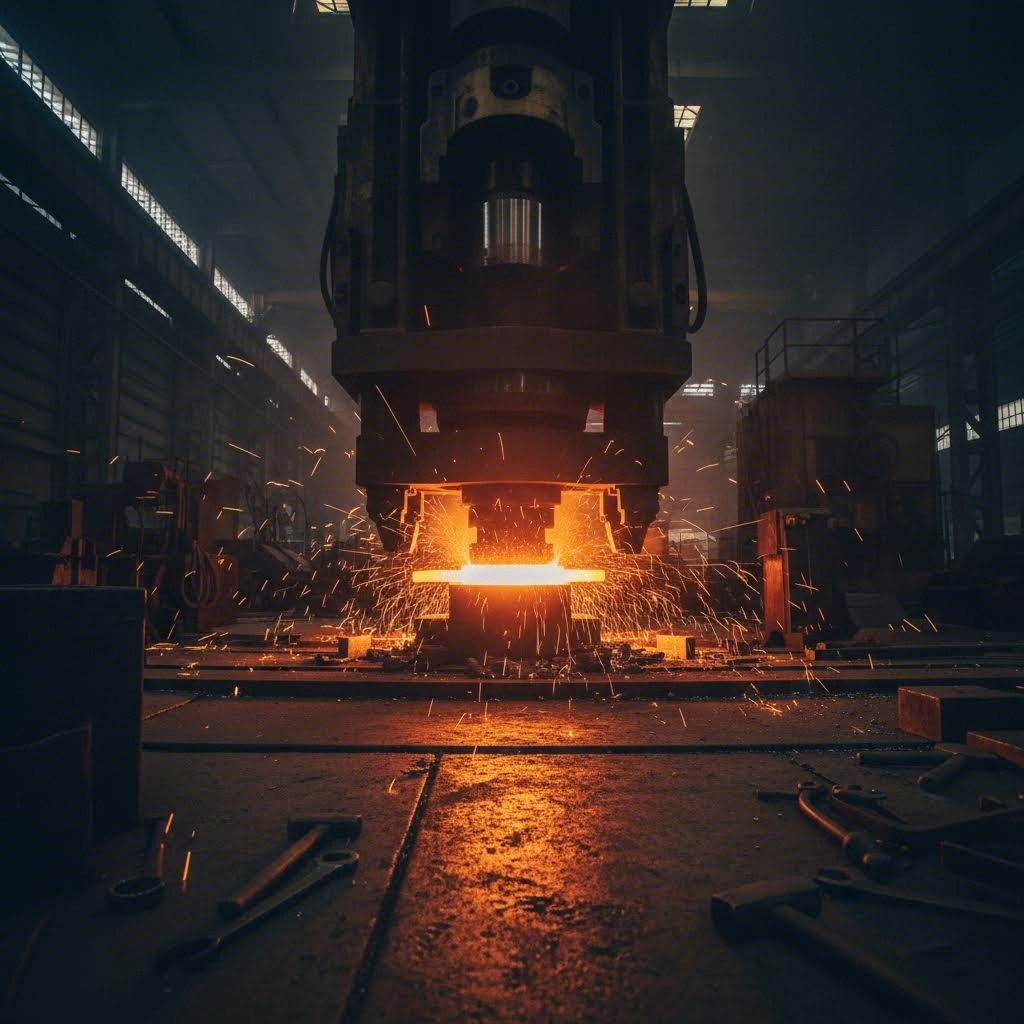
Imagine taking a solid piece of metal and squeezing it under tremendous force until it takes a new shape—that's automotive forging in its simplest form. The process involves heating metal billets to temperatures between 850 and 1150 degrees Celsius for steel, then applying mechanical force through hammering, pressing, or rolling while the material remains solid.
This heating and deformation accomplishes something remarkable. According to manufacturing experts at Fractory, the process refines the internal grain structure through metallurgical recrystallization, resulting in a more uniform structure throughout the metal form. The forged internals meaning becomes clear when you understand this grain refinement—it's what gives these components their legendary strength.
To properly understand forging, you need to know how casting works as a comparison. Casted define methods involve pouring molten metal into molds where it cools and solidifies. While casting excels at creating complex geometries, the melting process breaks the metal's natural grain flow, which reduces overall strength once solidified.
Why Manufacturing Method Matters for Vehicle Components
Your vehicle contains dozens of components subjected to extreme stress, vibration, and fatigue cycles. The manufacturing method directly determines how these parts perform under pressure.
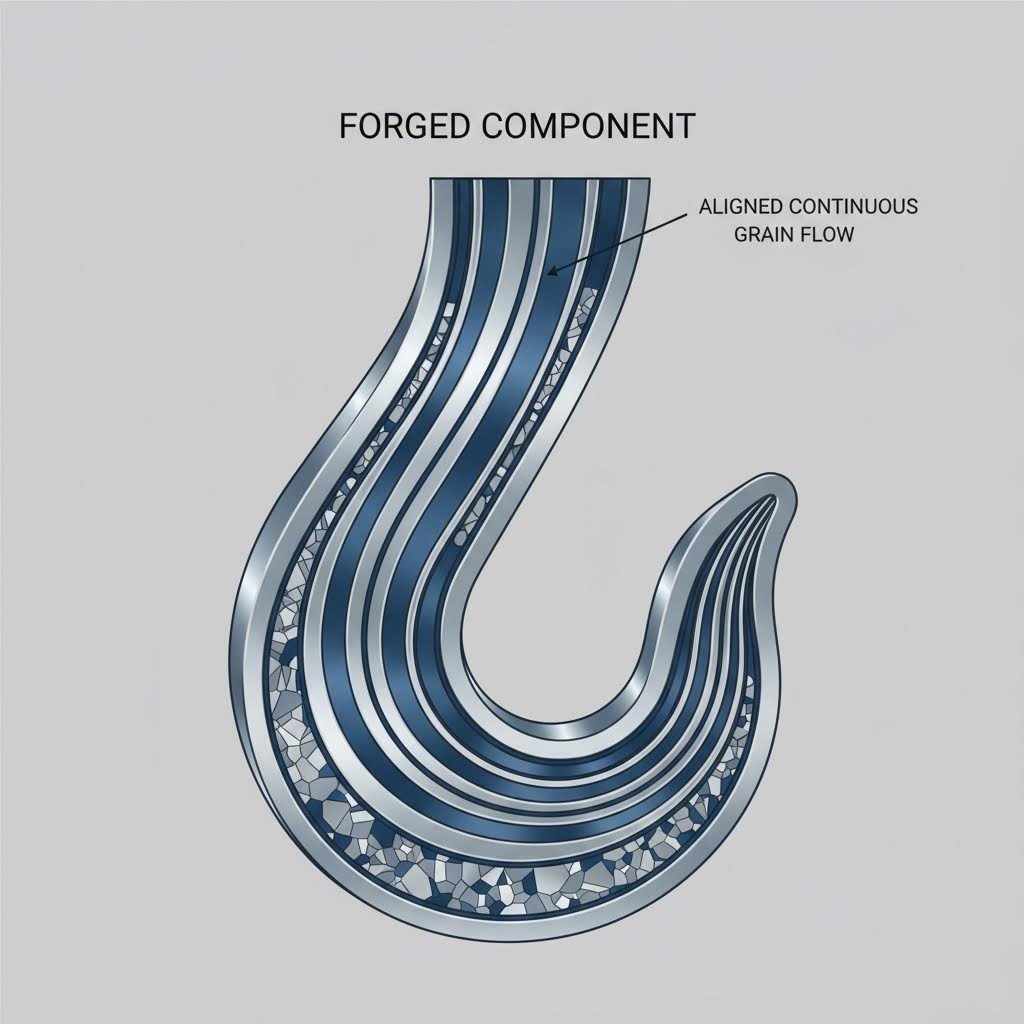
The defining advantage of forged components lies in grain structure alignment. When metal is forged, the grain flow follows the component's contours, creating natural reinforcement along stress paths—something casting simply cannot replicate.
This grain flow continuity explains why forged parts are far superior in strength compared to castings, with high levels of material predictability, as noted by industry specialists at Compass & Anvil. Cast products tend to be more porous and susceptible to breakage under demanding conditions.
Throughout this article, you'll discover the benefits of forged automotive parts across every major vehicle system:
- Powertrain: Crankshafts, connecting rods, and pistons
- Suspension: Control arms, knuckles, and steering components
- Chassis: Structural reinforcements and mounting brackets
- Drivetrain: Axle shafts, gears, and CV joints
Whether you're an automotive engineer evaluating material specifications or an enthusiast researching performance upgrades, understanding these fundamentals will help you make informed decisions about component selection and vehicle reliability.
Superior Strength and Durability Through Metallurgical Excellence
So why exactly do forged engine components outperform alternatives? The answer lies deep within the metal itself—at the molecular level where grain structures determine everything from tensile strength to fatigue life. When you understand the metallurgical advantages of forging, you'll see why engineers refuse to compromise on critical components.
Grain Structure and Mechanical Strength
Picture the internal structure of metal as thousands of tiny crystals packed together. In forged steel components, the intense pressure and heat realign these crystals into continuous patterns that follow the component's shape. According to metallurgical research from Queen City Forging, this grain flow increases the material's strength and toughness by creating a more uniform and continuous structure that resists deformation.
The forging of crankshaft components illustrates this perfectly. As the metal is compressed under extreme pressure, several critical changes occur:
- Grain refinement: The process creates smaller, finer grains that provide more grain boundaries to impede the movement of dislocations—defects that can lead to material failure
- Directional strength: Metal exhibits higher strength along the direction of grain flow, which engineers leverage by aligning grain patterns with anticipated stress paths
- Void elimination: Compression closes internal cavities and voids that might exist in raw material, reducing porosity that weakens components
- Work hardening: Plastic deformation increases dislocation density within the crystal structure, making the material harder and more resistant to further deformation
This refined grain structure is precisely why the benefits of forged pistons become so apparent in high-performance applications. A forged piston can withstand compression ratios and cylinder pressures that would crack or deform cast alternatives.
Fatigue Resistance Under Extreme Conditions
Imagine your engine's connecting rod cycling millions of times over its service life, constantly absorbing tremendous forces as pistons fire. This is where fatigue resistance becomes critical—and where forged components truly shine.
Fatigue failure occurs when repeated stress cycles eventually initiate microscopic cracks that propagate until the component fails catastrophically. Forged parts resist this process through multiple mechanisms. The aligned grain structure improves resistance to crack propagation, especially in directions perpendicular to the grain flow.
Consider what this means for real-world durability:
- Tensile strength: Forged components handle higher maximum loads before permanent deformation occurs
- Impact resistance: The enhanced toughness allows parts to absorb sudden shock loads without fracturing—critical for suspension components hitting potholes or motorsport applications
- Fatigue life: Components survive significantly more stress cycles, translating to longer service intervals and reduced failure risk
- Structural integrity: The homogeneous material structure eliminates weak points where failures typically initiate
According to performance specialists at KingTec Racing, forged crankshafts are more resistant to fatigue and wear, providing longer service life even under harsh conditions. This explains why racing teams invest heavily in forged internals—the demands of sustained high-RPM operation and extreme cylinder pressures require components that won't fail when pushed to their limits.
From daily driving where reliability matters most, to motorsport conditions where every component operates at the edge of its capability, forged parts deliver the mechanical properties that keep engines running and vehicles safe. But how do these advantages stack up in direct comparison with cast components? The next section breaks down exactly where each manufacturing method excels—and where it falls short.
Forged vs Cast Components in Direct Comparison
You've seen the metallurgical advantages forging provides—but how dramatic is the difference when you place forged and cast components side by side? Understanding the forged vs cast pistons debate requires examining what happens at the structural level and how these differences translate to real-world performance under demanding conditions.
Structural Differences at the Molecular Level
When molten metal solidifies during casting, something problematic occurs. The cooling process creates random grain orientations and internal voids that become permanent weak points in the finished component. These defects aren't manufacturing errors—they're inherent to how cast parts form.
Here's why this matters for forged pistons vs cast pistons:
- Grain pattern formation: Cast components develop random, non-directional grain structures because crystals form wherever cooling occurs fastest. Forged parts maintain aligned grain flow that follows component contours
- Porosity development: As cast metal cools, dissolved gases escape and create microscopic voids throughout the material. According to manufacturing data from Align Manufacturing, forging consolidates and closes these voids through compressive force
- Shrinkage cavities: Metal contracts as it solidifies, leaving internal cavities in cast parts that reduce effective cross-sectional area and concentrate stress
- Dendritic structures: Casting produces tree-like crystal formations with weak boundaries between them, creating natural fracture paths under load
The piston forged vs cast comparison becomes especially stark in high-performance applications. Engine cast components work adequately in stock applications with modest power levels. But when cylinder pressures climb beyond factory specifications, those internal voids and random grain patterns become failure initiation points.
Performance Under Stress Testing
Laboratory testing quantifies what engineers have observed for decades. According to comparative analysis from Align Manufacturing, forged components typically deliver around 26% higher tensile strength and 37% higher fatigue strength in representative comparisons against cast alternatives.
What do these numbers mean in practice? Consider a connecting rod cycling between tension and compression millions of times. The cast vs forged pistons debate extends to every rotating and reciprocating component—each stress cycle tests the material's ability to resist crack initiation and propagation.
| Property | Forged Components | Cast Components |
|---|---|---|
| Grain Structure | Aligned, continuous flow following component shape | Random orientation with weak boundaries |
| Porosity | Minimal—compression closes internal voids | Inherent microporosity from gas evolution during cooling |
| Strength-to-Weight Ratio | Higher—denser material allows thinner cross-sections | Lower—requires additional material to compensate for defects |
| Fatigue Life | Significantly extended—aligned grains resist crack propagation | Reduced—porosity and random grains create failure initiation sites |
| Production Cost | Higher tooling and processing costs | Lower upfront costs, especially at low volumes |
| Ideal Applications | High-stress, fatigue-critical, safety-essential components | Complex geometries, moderate stress, cost-sensitive parts |
The cast iron vs forged comparison becomes particularly relevant for engine blocks and crankshafts. Cast iron blocks have served reliably in production vehicles for decades—their thermal stability and vibration damping characteristics work well for everyday driving. However, engine cast blocks reach their limits when power levels significantly exceed factory ratings.
According to performance specialists at Engine Builder Magazine, forged pistons manufactured from 2618 alloy are the material of choice for high-powered street builds, maximum competition, high boost forced induction, and large doses of nitrous—essentially whenever you're pushing the engine to its absolute limits.
When Casting Makes Engineering Sense
Despite forging's strength advantages, casting excels in specific scenarios:
- Complex internal geometries: Casting creates intricate coolant passages and oil galleries that would require extensive machining in forged components
- Low-to-medium production volumes: Tooling costs favor casting when quantities don't justify forging die investment
- Stock power applications: Factory engines operate within design margins where cast components provide adequate durability
- Cost-sensitive applications: Budget constraints sometimes necessitate accepting performance trade-offs
When Forging Becomes Essential
The engineering calculus shifts decisively toward forging when:
- Power levels exceed factory specifications: Forced induction, nitrous, or high-compression naturally aspirated builds demand superior material properties
- Safety criticality is paramount: Suspension, steering, and drivetrain components where failure endangers occupants
- Extended high-RPM operation: Racing applications where components cycle at elevated stress levels for extended periods
- Warranty and liability concerns: OEMs specify forged parts for components where field failures carry significant consequences
Understanding these trade-offs helps engineers and enthusiasts select the right manufacturing method for each application. But which specific components benefit most from forging—and why? The next section explores every major vehicle system where forged parts deliver their greatest advantages.
Critical Engine and Chassis Components That Benefit From Forging
Now that you understand why forging outperforms casting at a fundamental level, let's walk through your vehicle system by system. Where exactly do forged components make the biggest difference? The answer spans everything from the heart of your engine to the suspension arms that keep your wheels planted during hard cornering.
Powertrain Components That Demand Forging
Your engine's rotating assembly endures some of the most punishing conditions in your entire vehicle. Consider what happens inside a high-performance forged engine: crankshafts spinning at 7,000+ RPM, connecting rods cycling millions of times, and pistons absorbing explosive combustion pressures. Each component faces unique stress profiles that explain why engineers specify forging.
Engine Components:
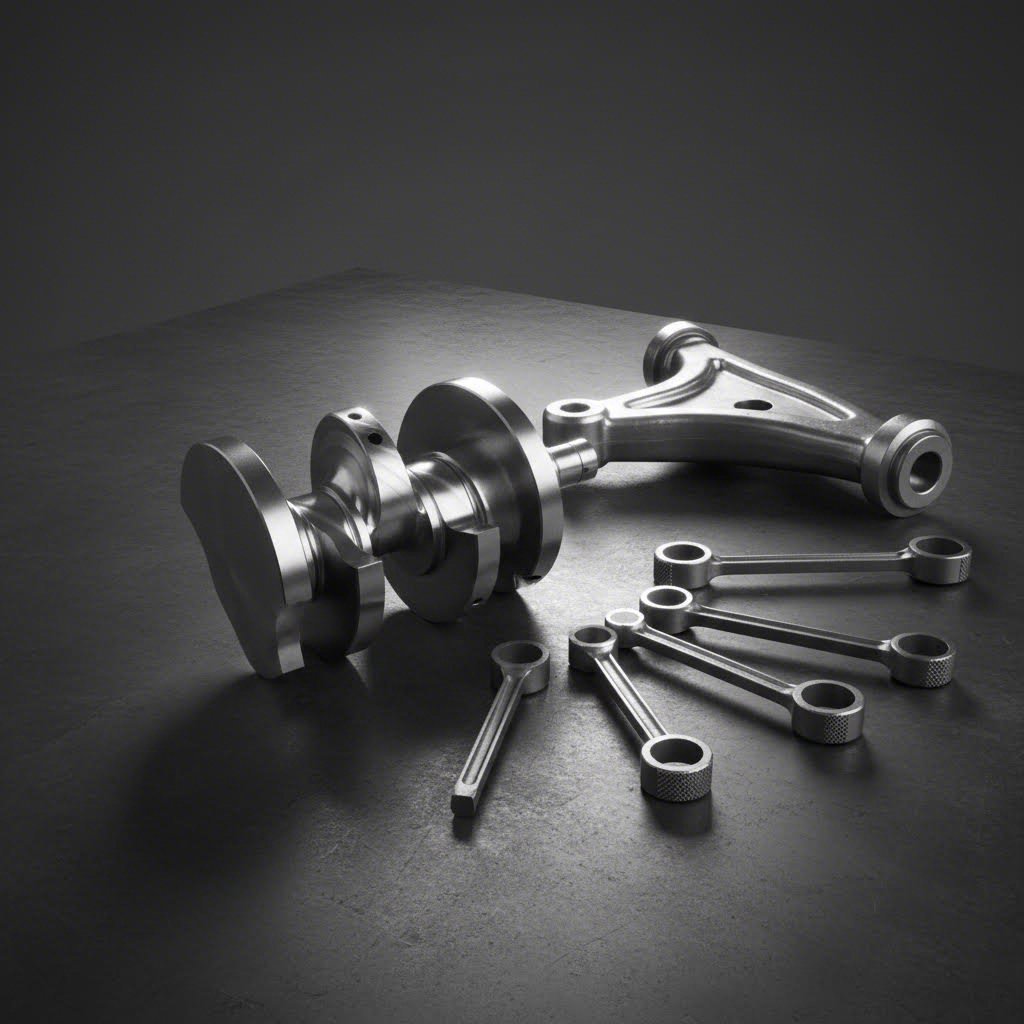
- Crankshafts: The crankshaft converts reciprocating piston motion into rotational power while absorbing tremendous torsional and bending stresses. A forged engine block's crankshaft benefits from aligned grain flow that follows its complex geometry, resisting fatigue failure where stress concentrations occur at journal fillets and counterweight transitions
- Connecting Rods: These components alternate between extreme tension during the intake stroke and severe compression during combustion—millions of times over their service life. Forged rods resist the fatigue cracking that eventually initiates in cast alternatives subjected to similar cycling
- Pistons: Operating at the combustion interface, pistons face thermal shock, mechanical loading, and side thrust simultaneously. Forged block pistons manufactured from 2618 or 4032 aluminum alloys handle the extreme temperatures and pressures of forced induction applications that would crack cast equivalents
Transmission Components:
- Gears: Each tooth engagement transfers power under intense contact pressure. Forging creates the surface hardness and core toughness needed to prevent pitting, spalling, and tooth fracture during aggressive shifting or high-torque applications
- Shafts: Input, output, and intermediate shafts transmit rotational force while resisting torsional deflection. The continuous grain structure in forged shafts eliminates internal weak points where fatigue cracks typically originate
According to Dr. Hans-Willi Raedt, CEO of prosimalys GmbH and a leader in Germany's Lightweight Forging Initiative, "Compared to cast or sintered materials, forgings are stronger with a higher ductility, so they lend themselves best for lightweight design." This strength advantage becomes critical when casting engine components for high-performance applications simply cannot deliver adequate durability margins.
Suspension and Steering System Applications
While powertrain components operate in controlled environments, suspension and steering parts face unpredictable real-world conditions—potholes, curb strikes, emergency maneuvers. Failure here directly endangers vehicle occupants, which explains why safety-critical chassis components increasingly specify forged construction.
Suspension Components:
- Control Arms: These components connect your wheels to the chassis while absorbing every road imperfection. According to suspension specialists at Aldan American, forged aluminum control arms easily handle daily driving forces thanks to the material's high strength-to-weight ratio, providing durability along with reduced unsprung weight
- Knuckles: Steering knuckles carry wheel bearing assemblies while transmitting braking, cornering, and acceleration forces. The multi-directional loading demands the consistent material properties that only forging provides
Steering Components:
- Tie Rods: Connecting your steering rack to the knuckles, tie rods transfer every steering input while absorbing road feedback. Forged ends resist the bending and fatigue loads that would eventually fail cast alternatives
- Pitman Arms: In conventional steering systems, the pitman arm converts rotary steering box motion into linear wheel movement. The concentrated stress at mounting points makes forging essential for reliable operation
Drivetrain Components:
- Axle Shafts: Transmitting engine torque to your wheels, axle shafts twist under load while absorbing shock inputs from wheel hop and traction breaks. Forged shafts resist the torsional fatigue that eventually fractures cast or machined-from-bar alternatives in high-power applications
- CV Joints: Constant velocity joints maintain smooth power delivery through suspension travel and steering angles. The ball and cage components operate under sliding contact pressure that demands forged construction for durability
The weight reduction benefits of forged aluminum parts become particularly valuable in suspension applications. When you reduce unsprung weight—the mass not supported by your springs—your suspension responds faster to road surface changes. As industry research from Light Metal Age notes, according to the U.S. Department of Energy, a 10% reduction in vehicle weight can result in a 6-8% fuel economy improvement. Forged aluminum suspension components contribute directly to this efficiency gain while maintaining the strength margins required for safety certification.
Modern automotive manufacturers increasingly recognize these advantages. Major forging investments like the Bharat Forge Aluminum USA facility in North Carolina and similar expansions by Otto Fuchs KG and Hirschvogel demonstrate the industry's commitment to meeting growing demand for lightweight forged chassis components.
But not all forging processes are created equal. Different component geometries and production requirements call for different forging methods—from open-die forging for large, simple shapes to precision closed-die processes for complex near-net-shape components. Understanding these variations helps engineers and procurement specialists select the right manufacturing approach for each application.
Forging Methods and Their Automotive Applications
You've seen why forging components delivers superior strength and durability—but did you know the forging method itself dramatically impacts what's possible? Not every forging process suits every automotive application. Choosing the right approach means balancing component complexity, dimensional precision, production economics, and material efficiency.
Understanding these variations helps engineers specify the optimal manufacturing process for each application—and helps procurement teams evaluate supplier capabilities for their forging parts requirements.
Matching Forging Methods to Component Requirements
Four primary forging methods dominate automotive manufacturing, each offering distinct advantages depending on your component's geometry, required tolerances, and production volume. Let's break down what makes each approach unique.
Open-Die Forging
Imagine compressing heated metal between flat or minimally contoured dies that don't fully enclose the material. That's open-die forging—the metal flows freely as pressure is applied, allowing skilled operators to gradually shape the workpiece through repeated strikes or presses.
According to manufacturing specialists at RPPL Industries, open-die forging is ideal for custom components and low-volume production runs. The process excels at creating large, simple shapes like shafts, rings, and cylinders without requiring expensive specialized tooling.
Closed-Die Forging
Also called impression die forging, this method places heated metal into precisely machined die cavities that completely enclose the workpiece. When the dies close under tremendous pressure, metal flows to fill every contour of the cavity, producing near-net-shape forged parts with excellent dimensional accuracy.
This process dominates high-volume automotive forging components production. As noted by forging experts at Dragon Metal, closed-die forging can produce near-net-shape parts with high dimensional accuracy, surface finish, and mechanical properties—making it suitable for complex and intricate shapes with fine details.
Roll Forging
This method passes heated metal between rotating rolls that progressively reduce thickness while increasing length. According to process specialists at The Federal Group USA, parts produced through roll forging have superior mechanical properties compared to many other manufacturing processes.
Roll forging excels at producing symmetrical components with consistent cross-sections—think axle shafts, tapered spindles, and leaf spring blanks.
Precision Forging
Sometimes called net-shape forging, precision forging represents the cutting edge of forged parts manufacturing. The goal is creating components so dimensionally accurate that secondary machining operations become minimal or unnecessary.
As manufacturing researchers at The Federal Group USA explain, precision forging uses advanced dies to achieve near-net-shape components with intricate geometries and tight tolerances. Companies looking for cost savings and shortened lead times can benefit significantly from precision metal forging techniques.
| Characteristic | Open-Die Forging | Closed-Die Forging | Roll Forging | Precision Forging |
|---|---|---|---|---|
| Component Complexity | Simple shapes—shafts, rings, blocks | Complex geometries with intricate details | Symmetrical, uniform cross-sections | Highly complex with tight tolerances |
| Dimensional Accuracy | Lower—requires significant machining | High—near-net-shape capability | Moderate—good length/diameter control | Excellent—minimal secondary operations |
| Production Volume Suitability | Low volume, custom, prototype runs | Medium to high volume production | Low to medium volume | High volume with demanding tolerances |
| Typical Automotive Applications | Large shafts, rings, custom components | Crankshafts, gears, connecting rods | Axle shafts, tapered spindles, bars | Gears, valves, precision drivetrain parts |
| Relative Cost | Low tooling cost, higher per-unit for small runs | High tooling investment, lower per-unit at volume | Moderate tooling, efficient at medium volumes | Highest tooling cost, lowest machining expense |
Production Volume Considerations
Sounds complex? Here's the practical reality: your production volume often determines which forging method makes economic sense.
For prototype development or runs under a few hundred units, open-die forging typically wins. The simple tooling keeps upfront investment low, even if per-unit costs run higher. You'll need more machining afterward, but the flexibility to iterate designs without scrapping expensive dies often justifies the trade-off.
When volumes climb into thousands or tens of thousands of forging components annually, closed-die forging becomes compelling. Yes, the die investment is substantial—but that cost amortizes across production volume while delivering consistent part-to-part quality with minimal secondary operations.
Precision forging pushes this logic further. The tooling investment exceeds standard closed-die approaches, but the payoff comes in dramatically reduced machining requirements and material waste. According to manufacturing analysis from The Federal Group USA, the advantages of reduced material waste and superior dimensional accuracy make precision forging increasingly popular for high-volume applications where total cost of ownership matters more than initial tooling expense.
Emerging Hybrid Manufacturing Processes
The forging industry continues evolving beyond traditional boundaries. Hybrid processes now combine forging with other manufacturing methods for optimized results that neither approach achieves alone.
One notable advancement is thixoforming—a hybridized process incorporating aspects of both casting and forging. As described by researchers at The Federal Group USA, semi-solid metals are injected into dies to produce high-precision parts with fine structures, reduced weight properties, and surface quality that often eliminates extra machining steps.
Incremental forging represents another frontier. This progressive forming process applies pressure in controlled stages, gradually shaping sheet metal into complex three-dimensional components. The technique reduces tooling costs while enabling greater design flexibility—particularly valuable for creating new design iterations without expensive die modifications.
These advanced techniques demonstrate how the forging industry continues adapting to automotive manufacturing demands for lighter weight, tighter tolerances, and improved cost efficiency. But selecting the right forging method is only part of the equation—the material choice proves equally critical for optimizing component performance across different automotive applications.
Material Selection Guide for Forged Automotive Components
Choosing the right forging method gets you halfway there—but what about the material itself? The metal you select determines everything from ultimate strength to weight savings to long-term corrosion resistance. Whether you're engineering a forged vs cast crankshaft replacement or specifying suspension components for an electric vehicle platform, material selection directly impacts performance, durability, and total cost of ownership.
Let's explore the three primary material families used in automotive forging and when each makes engineering and economic sense for your application.
Steel Alloys for Maximum Strength
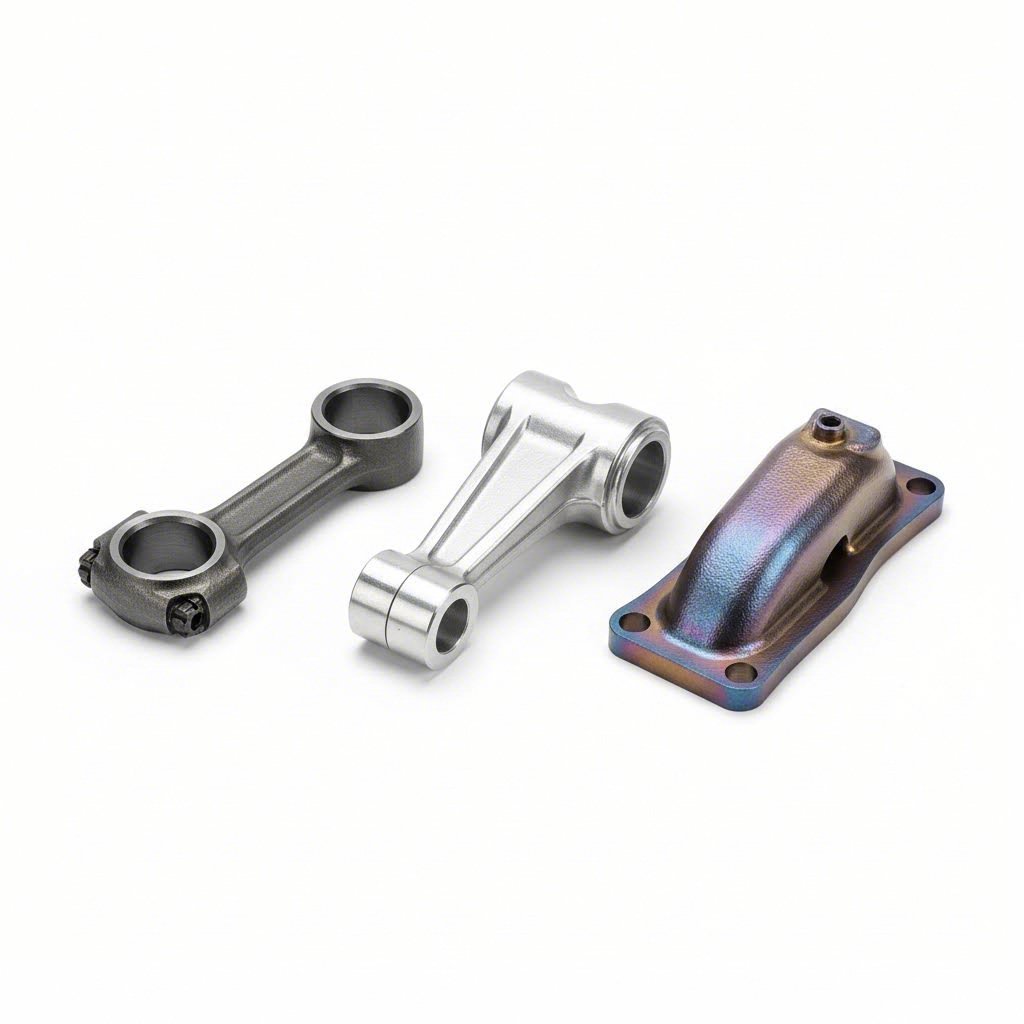
When absolute strength matters most, forged steel remains the benchmark. The combination of high tensile strength, excellent fatigue resistance, and proven reliability explains why critical powertrain components—crankshafts, connecting rods, and transmission gears—overwhelmingly specify steel alloys.
Consider what happens inside a high-performance engine. The crankshaft experiences tremendous torsional loads while rotating at thousands of RPM. Connecting rods cycle between extreme tension and compression millions of times. For these applications, the cast pistons vs forged debate extends to material selection—forged steel components handle stress levels that would rapidly fatigue alternatives.
Common automotive steel alloys include:
- 4340 Steel: The workhorse of performance crankshafts and connecting rods, offering excellent toughness and fatigue strength after heat treatment
- 4140 Steel: A cost-effective alternative providing good strength and machinability for moderate-stress applications
- Microalloyed Steels: Advanced compositions that achieve required properties without extensive heat treatment, reducing manufacturing costs
The trade-off? Weight. Steel's density of approximately 7.8 g/cm³ means components carry significant mass—acceptable for rotating assemblies where strength trumps everything, but increasingly problematic for chassis and suspension applications where unsprung weight affects handling dynamics.
Aluminum and Titanium for Weight-Critical Applications
Modern automotive design priorities increasingly emphasize lightweighting. According to research from Alt Energy Magazine, high-strength lightweight aluminum forgings play a crucial role in minimizing component weight, thereby reducing the vehicle's overall weight and the energy required for acceleration.
This weight reduction becomes especially critical for electric vehicles. Every kilogram saved translates directly to extended range—a paramount concern when battery energy density remains a limiting factor. Unlike internal combustion vehicles where the cast engine block's mass is partially offset by fuel consumption during operation, EVs carry their full battery weight throughout every journey.
Forged Aluminum Advantages:
- Density: Approximately 2.7 g/cm³—roughly one-third the weight of steel
- Strength-to-weight ratio: Exceptional when properly alloyed and heat-treated
- Corrosion resistance: Natural oxide layer provides inherent protection
- Thermal conductivity: Approximately 235 W/(m*K) according to Jiahui Custom—excellent for heat dissipation in brake and suspension components
Common aluminum forging alloys like 6061 and 7075 serve different application profiles. The 6061 alloy offers excellent corrosion resistance and weldability for general chassis components, while 7075 delivers higher strength for demanding suspension and drivetrain applications.
Titanium for Ultimate Performance:
When weight savings and strength requirements reach their extreme, titanium enters the conversation. According to materials analysis from Jiahui Custom, titanium's fatigue strength often surpasses 500 MPa in high-grade alloys, making it suitable for critical aerospace structures—and increasingly, high-performance automotive applications.
With a density of approximately 4.5 g/cm³, titanium splits the difference between aluminum and steel while offering tensile strengths ranging from 240 to 550 MPa for commercially pure grades—and significantly higher for alloys like Ti-6Al-4V. However, the same source notes that titanium generally costs more than aluminum due to difficulty in extraction, complex processing, and high demand from aerospace and medical applications.
| Property | Forged Steel Alloys | Forged Aluminum | Forged Titanium |
|---|---|---|---|
| Strength Characteristics | Highest absolute strength; tensile up to 1000+ MPa for 4340 | Good strength; 7075 alloy reaches 530 MPa tensile | Excellent strength; Ti-6Al-4V exceeds 900 MPa tensile |
| Weight Savings vs Steel | Baseline (7.8 g/cm³) | ~65% lighter (2.7 g/cm³) | ~42% lighter (4.5 g/cm³) |
| Corrosion Resistance | Requires protective coatings or treatments | Good—natural oxide layer provides protection | Excellent—superior to both steel and aluminum |
| Cost Factors | Lowest material cost; well-established processing | Moderate; balance of cost and weight reduction | Highest; 5-10x aluminum cost for raw material |
| Ideal Automotive Applications | Crankshafts, connecting rods, transmission gears, axles | Suspension arms, wheels, engine block cast replacements, EV components | Valve springs, exhaust systems, racing fasteners |
Connecting Material Selection to Modern Design Priorities
How do these material choices connect to real-world automotive engineering decisions? The answer depends on balancing competing priorities—and increasingly, those priorities center on weight reduction.
According to research cited by Alt Energy Magazine, what electric vehicles lack in energy density they make up for in optimized efficiencies. Forged aluminum components reduce the energy required for acceleration while enabling EVs to utilize as much as 80% or more of available battery energy—compared to just 21% usable capacity from gasoline in traditional ICE vehicles.
This efficiency equation drives material selection across vehicle platforms:
- Economy vehicles: Engine block cast components with forged steel crankshafts balance cost and reliability for modest power levels
- Performance applications: Forged aluminum suspension and forged steel rotating assemblies optimize both handling and durability
- Electric vehicles: Aluminum forgings dominate chassis and suspension to maximize range while steel serves drivetrain components where strength remains paramount
- Motorsport: Titanium appears wherever regulations permit and budgets allow, with aluminum and steel serving volume applications
The material selection decision ultimately comes down to application requirements. Steel delivers unmatched strength for rotating assemblies subjected to extreme cyclic loading. Aluminum provides the optimal balance of weight savings and cost for chassis and suspension components. Titanium serves niche applications where performance justifies premium pricing.
But regardless of material choice, one factor remains constant: forged components outperform cast alternatives in strength, fatigue resistance, and long-term reliability. The question becomes ensuring that forged components meet the rigorous quality standards demanded by automotive applications—which requires understanding the testing and certification processes that separate reliable suppliers from the rest.
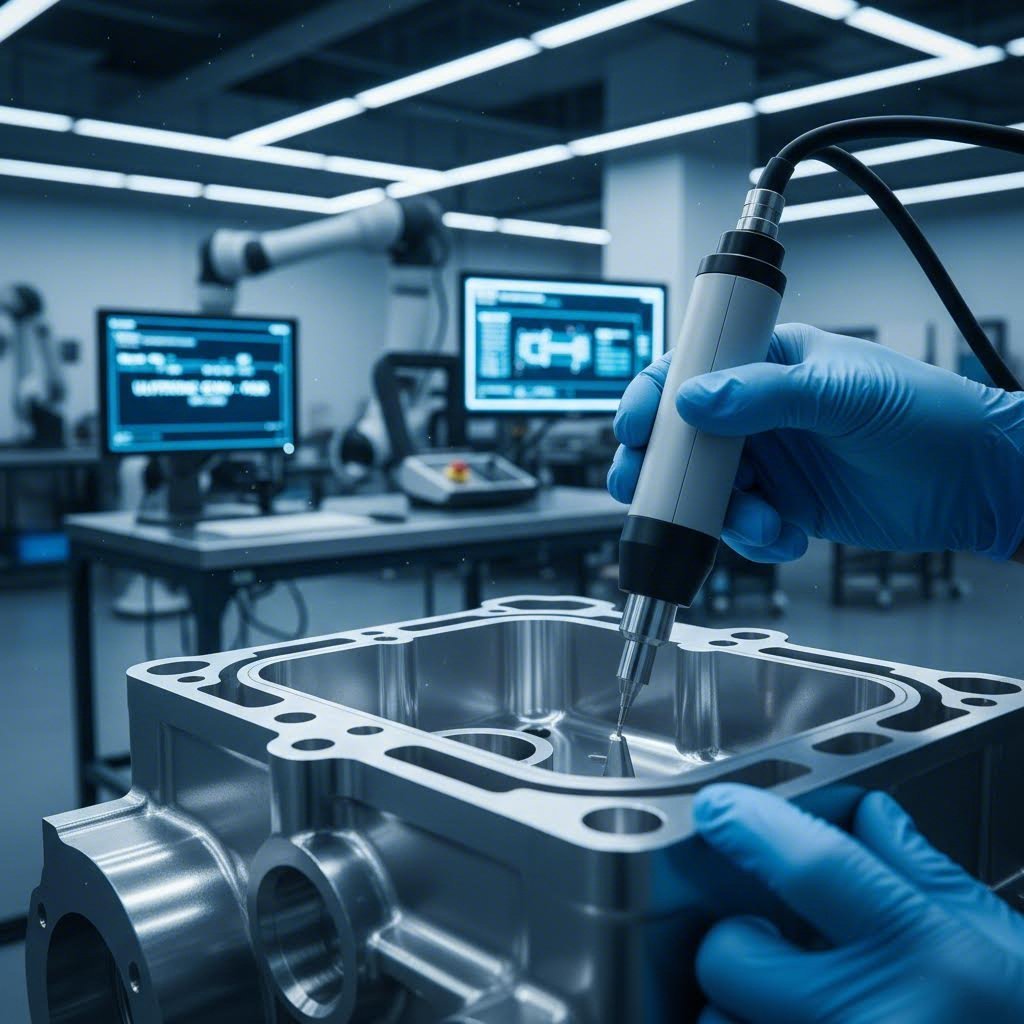
Quality Control and Testing Standards for Forged Parts
You've selected the right forging method and specified the optimal material—but how do you know the finished components will actually perform as expected? In the forging industry, the difference between a reliable supplier and a risky one often comes down to quality control and testing protocols. Understanding what is forged internals verification helps you evaluate suppliers and ensure the forged engine parts you receive meet exacting automotive standards.
Quality assurance for forged components involves two critical dimensions: metallurgical testing that verifies material properties and industry certifications that demonstrate systematic quality management. Let's explore both.
Metallurgical Testing and Verification
Imagine a suspension arm that looks perfect on the outside but contains internal voids invisible to the naked eye. Or a drive shaft with subsurface cracks that will propagate under repeated stress cycling. These hidden defects can lead to catastrophic field failures—which is exactly why non-destructive testing (NDT) methods are essential for verifying forged component integrity.
According to inspection specialists at NDT Classroom, forged parts, being among the strongest ones, require thorough testing at the time of manufacturing to ensure the desired strength. Sometimes testers use multiple inspection methods as one method may not be enough to locate all the flaws.
Here are the primary NDT methods used for forged automotive components:
Ultrasonic Inspection
This volumetric testing method sends high-frequency sound waves through the component. When waves encounter internal discontinuities—voids, inclusions, or cracks—they reflect back to the transducer, revealing defects invisible from the surface. Ultrasonic inspection excels at detecting internal imperfections in forged parts with improved accuracy and convenience, making it the go-to method for critical rotating assemblies like crankshafts and connecting rods.
Magnetic Particle Inspection
For ferromagnetic materials like steel alloys, magnetic particle testing detects surface and near-surface flaws that visual inspection might miss. The process magnetizes the component, then applies fine metallic particles that cluster at discontinuities where the magnetic field leaks. According to NDT Classroom, this method reveals imperfections that are too small to detect using visual inspection methods—critical for safety-essential components like steering knuckles and control arms.
Dye Penetrant Examination
Also called liquid penetration inspection, this economical method works on both ferrous and non-ferrous forged parts with no size restrictions. The inspection process involves applying penetrant to the forging surface, allowing dwell time for capillary action to draw the penetrant into surface-breaking defects, washing the part, and then applying developer to reveal imperfections not visible to naked eyes. This method proves particularly valuable for forged aluminum suspension components where magnetic particle testing cannot be used.
Visual Inspection
Don't underestimate the power of trained eyes under controlled lighting conditions. Surface anomalies common in forged products—laps, seams, scale pitting—can often be identified through systematic visual inspection before more sophisticated testing methods are applied.
Multiple inspection methods combined provide comprehensive quality verification. What ultrasonic testing reveals internally, magnetic particle and dye penetrant methods confirm at surfaces—together ensuring forged components meet the demanding requirements of automotive applications.
Industry Certifications That Ensure Reliability
Individual test results matter—but how do you know a supplier consistently applies rigorous quality control across every production run? This is where industry certifications become essential, particularly IATF 16949 for automotive applications.
IATF 16949 represents the global quality management standard specifically developed for the automotive industry. This certification goes beyond basic ISO 9001 requirements, incorporating additional automotive-specific requirements for defect prevention, reduction of variation and waste, and continuous improvement throughout the supply chain.
What does IATF 16949 certification mean for forged component quality?
- Documented quality management systems: Every process from incoming material verification through final inspection follows controlled procedures
- Statistical process control: Critical dimensions and material properties are monitored using statistical methods to detect variation before defects occur
- Traceability: Each component can be traced back to specific material heats, forging operations, and inspection results
- Continuous improvement: Systematic problem-solving and preventive action processes drive ongoing quality enhancement
- Customer-specific requirements: The certification framework accommodates additional OEM specifications beyond baseline standards
For automotive procurement teams, IATF 16949 certification serves as a reliable indicator that suppliers maintain the systematic quality controls necessary for safety-critical forged components. Certified manufacturers like Shaoyi (Ningbo) Metal Technology demonstrate this commitment through rigorous quality control processes, ensuring forged components like suspension arms and drive shafts meet exact OEM specifications.
Key Quality Checkpoints in Forged Component Production
Beyond NDT methods and certifications, understanding the complete quality verification chain helps you evaluate forging industry suppliers. Here are the critical checkpoints where quality is verified throughout production:
- Incoming material verification: Chemical composition analysis and material certification review before forging begins
- Pre-forging billet inspection: Visual and dimensional checks to identify surface defects or dimensional variations
- Process parameter monitoring: Real-time verification of forging temperature, pressure, and timing parameters
- In-process dimensional inspection: Critical dimensions verified during production to catch drift before defects accumulate
- Heat treatment verification: Hardness testing and microstructure examination after thermal processing
- Non-destructive testing: Ultrasonic, magnetic particle, or dye penetrant inspection based on component requirements
- Final dimensional inspection: Complete verification against drawing specifications using CMM or dedicated gauging
- Surface finish verification: Roughness measurement and visual inspection for cosmetic and functional surfaces
- Documentation and traceability: Complete quality records linking finished components to all processing and inspection data
Companies like forged performance llc and other specialized suppliers build their reputations on consistently executing these quality checkpoints. For OEMs and Tier 1 suppliers evaluating potential forging partners, requesting evidence of these quality control practices—beyond just certification logos—provides deeper insight into actual manufacturing capabilities.
The investment in comprehensive quality control pays dividends throughout the component lifecycle. Reduced warranty claims, extended service life, and enhanced safety margins all flow from rigorous testing and verification during production. But quality assurance represents just one factor in the forging decision—the next section explores how to balance quality requirements against cost considerations and application demands when selecting forged components.
When to Choose Forged Parts Over Alternatives
So you understand the metallurgical advantages, you've seen the quality control requirements, and you know which components benefit most from forging. But here's the practical question: when does the investment in forged components actually make sense for your specific application? Whether you're an OEM engineer specifying production components or an enthusiast planning an aftermarket upgrade, the decision comes down to matching manufacturing method to actual requirements.
Let's build a practical framework for making this call—because forging isn't always the right answer, even though it's often the strongest one.
Performance Requirements That Demand Forging
What are forged pistons actually designed to handle? According to performance specialists at PowerNation TV, forged internals are built to withstand the abuse of forced induction, high RPM, and nitrous. If you're planning on making serious power, forged parts are the way to go.
But "serious power" means different things in different contexts. Here's how to evaluate whether your application crosses the threshold where forging becomes essential:
- Stress levels: Are components operating near or beyond factory design limits? Stock LS engines with factory cast pistons handle around 500-550 horsepower reliably—but add a big turbo or supercharger, and you'll start seeing melted pistons and bent rods
- Safety criticality: Would component failure endanger vehicle occupants? Suspension, steering, and drivetrain parts where failure could cause loss of vehicle control almost always justify forged construction
- Operating environment: Will components face sustained high-RPM operation, extreme temperatures, or repeated shock loading? Racing applications and severe-duty commercial vehicles push components beyond what cast alternatives survive
- Failure consequences: What happens if the component fails? A broken connecting rod doesn't just end your race—it can destroy the entire engine block and potentially cause serious injury
The forged vs cast decision becomes straightforward when you honestly assess these factors. According to industry analysis from Trenton Forging, forging yields stronger parts than casting because it optimizes grain structure. Stronger parts can also be lighter as less metal is needed. These properties make forging a better process for automotive components used in applications from light vehicles to heavy trucks and trailers.
Balancing Cost Against Component Criticality
Imagine you're building an engine for weekend track days. Your budget isn't unlimited, but neither is your tolerance for blown motors. How do you prioritize where forged components deliver the most value?
The forged cast decision matrix looks different depending on your starting point:
Economy Vehicle Applications
For naturally aspirated engines operating within factory power levels, cast components often provide adequate durability at lower cost. According to performance data from PowerNation TV, cast internals are great for naturally aspirated engines that don't see extreme power levels or high boost. Cast pistons and rods work well in OEM applications and mild performance builds.
When cast makes sense:
- Stock or mildly modified naturally aspirated engines
- Daily drivers with no performance modifications planned
- Budget-constrained builds where reliability at stock power is sufficient
- Components with low stress profiles and generous safety margins
Performance and Motorsport Applications
The calculus shifts dramatically when power levels climb. That same LS engine with factory cast internals? Swap in forged components, and suddenly it can handle 800+ horsepower with ease, according to the same performance testing.
When forged becomes essential:
- Forced induction applications—turbochargers, superchargers, or nitrous
- High-compression naturally aspirated builds pushing combustion limits
- Sustained high-RPM operation where fatigue cycling accelerates
- Any application where component failure creates cascading damage or safety risks
Total Cost of Ownership Perspective
Here's what the forged bottom meaning really comes down to: upfront cost versus lifetime value. Yes, forged components cost more initially. But according to sourcing guidance from Alibaba Smart Buy, buyers should evaluate total cost of ownership—not just unit price—since forged parts often reduce maintenance and replacement frequency.
Consider the full picture:
- Reduced warranty claims: OEMs specifying forged components for high-stress applications see fewer field failures and associated warranty costs
- Extended service life: Components surviving more stress cycles mean longer intervals between replacements
- Prevented cascading damage: A connecting rod that bends instead of breaks might only ruin itself—one that shatters can destroy the entire engine
- Downtime costs: For commercial applications, the cost of a vehicle out of service often exceeds component price differences many times over
OEM Manufacturer Considerations
For original equipment manufacturers, the decision framework includes production economics alongside engineering requirements. According to manufacturing specialists at Trenton Forging, forging is a much faster process by virtue of using dedicated tooling and shaping the entire part in one step or a linked series of steps—making it the better choice for applications such as automotive components where volume justifies tooling investment.
OEMs typically evaluate:
- Production volume: Higher volumes amortize tooling costs, making forging increasingly cost-competitive
- Weight targets: Vehicle lightweighting goals often favor forged aluminum over heavier cast alternatives
- Liability exposure: Safety-critical components where field failures carry significant consequences almost always specify forging
- Supply chain reliability: Forging's stable, repeatable process reduces quality variation compared to casting
Aftermarket Upgrade Perspective
Planning an engine build or chassis upgrade? The aftermarket decision often comes down to matching component capability to realistic power goals.
If you're just doing a mild bolt-on build or a naturally aspirated setup with no plans for big boost or nitrous, sticking with high-quality cast pistons and rods can save you money, according to performance experts at PowerNation TV. But if you're pushing the limits, spending extra on forged components is a smart investment.
Ask yourself honestly:
- What's my realistic power target—not hopes, but actual plans?
- Will I be adding forced induction now or in the future?
- How much can I afford to lose if components fail catastrophically?
- Is this a street car with occasional track use, or a dedicated race vehicle?
At the end of the day, choosing between cast and forged pistons and rods comes down to your power goals, budget, and how much abuse your engine will see. The forged vs decision isn't always clear-cut—but understanding these trade-offs helps you invest wisely where it matters most.
Once you've determined that forged components are the right choice for your application, the next challenge becomes finding the right supplier. Lead times, prototyping capabilities, quality certifications, and global logistics all factor into successful procurement—considerations we'll explore in the final section.
Maximizing Value From Forged Automotive Components
You've now seen exactly why engineers refuse cast alternatives for critical applications—the metallurgical advantages, the superior fatigue resistance, and the quality control standards that separate reliable forged components from risky alternatives. But understanding the benefits of forged automotive parts is only part of the equation. The final challenge? Finding the right manufacturing partner to turn specifications into reality.
Whether you're sourcing prototype components for a new vehicle platform or scaling to high-volume production, your supplier selection directly impacts quality, timing, and total cost. Let's explore where forging technology is heading—and what to look for in a forging partner who can deliver.
The Future of Automotive Forging Technology
The forge engine of automotive manufacturing continues evolving. Modern forging operations increasingly integrate advanced technologies that enhance both capability and efficiency.
Consider how flow forming and flow formed processes now complement traditional forging for specialized applications. These rotary forming techniques create seamless cylindrical components—like barrel wheels and drivetrain housings—with exceptional strength-to-weight ratios. When combined with precision hot forging for primary shaping, hybrid manufacturing approaches deliver optimized results that neither method achieves alone.
Several trends are reshaping the engine forge landscape:
- Simulation-driven die design: Advanced CAD/CAM software and digital twin simulations optimize tooling before cutting metal, reducing development time and improving first-article success rates
- Automation and real-time monitoring: ERP systems, AI-enabled inspection tools, and automated material handling increase productivity while enhancing traceability throughout production
- Near-net-shape precision: Continued advances in precision forging reduce secondary machining requirements, improving both cost efficiency and material utilization
- Lightweighting focus: Growing demand for forged aluminum components—particularly for EV applications—drives investment in specialized aluminum forging capabilities
According to supplier evaluation guidance from Synergy Global Sourcing, modern forging manufacturers invest in ERP systems, real-time monitoring, and automation for higher productivity and traceability. These innovations help minimize human error, reduce cycle time, and ensure traceable production records.
The core value of forged components remains unchanged: superior strength, extended fatigue life, and reliable performance under demanding conditions. What's evolving is how efficiently manufacturers can deliver these advantages across diverse automotive applications.
Partnering With the Right Forging Supplier
Selecting a forging supplier isn't just about comparing unit prices—it's about evaluating capabilities, certifications, responsiveness, and logistics that affect your entire supply chain. Here's what to prioritize when choosing a manufacturing partner.
Certification and Quality Systems
As discussed earlier, IATF 16949 certification indicates robust automotive-specific quality management. According to Synergy Global Sourcing, certifications such as ISO 9001, IATF 16949, or AS9100 indicate strong process control and traceability. Choose a forging supplier who maintains documentation such as PPAP, FMEA, and CMM reports.
Technical Capability and Flexibility
Your supplier should match your project requirements—whether that means low-volume prototyping or high-volume mass production. Look for partners offering:
- Rapid prototyping: The ability to deliver sample components quickly for design validation before committing to production tooling
- Volume scalability: Capacity to ramp from development quantities to full production without sacrificing consistency
- In-house engineering: Technical support for design-for-manufacturing optimization and material selection guidance
- Secondary operations: CNC machining, heat treatment, and metallurgical testing capabilities that simplify your supply chain
Lead Times and Logistics
Speed matters in competitive automotive programs. According to sourcing guidance from Synergy Global Sourcing, analyze the supplier's historical performance in meeting delivery schedules and ask about lead times for tooling development, sampling, and bulk production. A dependable forging manufacturer should have efficient planning systems and dedicated logistics support.
Geographic location also impacts logistics efficiency. Suppliers positioned near major shipping ports streamline global procurement and reduce transit times for international customers.
Evaluating Potential Partners
When you're ready to source forged automotive components, structure your evaluation around these key criteria:
- Experience and track record: Look for 10-15+ years of industry experience across relevant sectors
- Certifications: Verify IATF 16949 or equivalent automotive quality management certification
- Equipment capability: Assess press tonnage, forging methods available, and secondary processing capacity
- Prototyping speed: Confirm lead times for sample development—capable suppliers deliver prototypes in as little as 10 days
- Production capacity: Ensure volume capability matches your program requirements without sacrificing quality
- Location and logistics: Evaluate shipping routes and transit times to your receiving facilities
For automotive OEMs and Tier 1 suppliers seeking precision hot forging solutions, Shaoyi (Ningbo) Metal Technology exemplifies these supplier selection criteria. Their IATF 16949 certification demonstrates systematic quality control, while in-house engineering capabilities support rapid prototyping in as little as 10 days through high-volume mass production. Located near Ningbo Port, they offer streamlined global logistics for buyers sourcing forged suspension arms, drive shafts, and other critical components.
Key Takeaways for Forged Component Sourcing
Throughout this article, you've explored why engineers consistently specify forged automotive parts for safety-critical and high-performance applications. Let's summarize the essential decision factors:
- Metallurgical superiority: Aligned grain structure, eliminated porosity, and enhanced fatigue resistance make forged components fundamentally stronger than cast alternatives
- Application matching: Powertrain rotating assemblies, suspension components, and drivetrain parts benefit most from forging's strength advantages
- Material selection: Steel for maximum strength, aluminum for weight reduction, titanium for ultimate performance—each material serves specific application requirements
- Quality verification: NDT methods and IATF 16949 certification ensure components meet automotive reliability standards
- Total cost perspective: Higher upfront investment in forged components often delivers lower lifetime costs through reduced failures and extended service life
The benefits of forged automotive parts extend beyond raw specifications—they translate to vehicles that perform reliably, handle confidently, and protect occupants when it matters most. Whether you're engineering the next generation of electric vehicles or upgrading a performance build, understanding these advantages helps you make informed decisions about component selection and supplier partnerships.
Ready to explore precision hot forging solutions for your automotive applications? The right manufacturing partner combines technical capability, quality systems, and supply chain efficiency to deliver forged components that meet your exact specifications—on time and to the quality standards your applications demand.
Frequently Asked Questions About Forged Automotive Parts
1. Are forged parts better than cast parts for automotive applications?
Forged parts outperform cast alternatives in strength, durability, and fatigue resistance. The forging process aligns the metal's grain structure along stress paths, creating natural reinforcement that casting cannot replicate. Testing shows forged components deliver approximately 26% higher tensile strength and 37% higher fatigue strength compared to cast equivalents. For high-stress applications like crankshafts, connecting rods, and suspension components, forged parts provide significantly longer service life and reduced failure risk.
2. What are the major advantages of the forging process?
Forging provides improved ductility, enhanced impact toughness, higher fracture toughness, and increased fatigue strength. The process eliminates internal voids and porosity common in cast parts while creating a continuous grain flow that follows component contours. This results in components that handle higher maximum loads, absorb sudden shock without fracturing, survive more stress cycles, and maintain structural integrity under demanding conditions. Additionally, forged components often require less machining than cast alternatives.
3. What are the five benefits of aluminum automotive forging components?
Forged aluminum automotive components offer five key advantages: superior strength-to-weight ratio enabling lighter vehicle designs, excellent corrosion resistance from natural oxide layer formation, enhanced safety through consistent material properties, sustainability through recyclability and reduced material waste, and cost-effectiveness through extended service life and reduced replacement frequency. These properties make forged aluminum ideal for suspension arms, chassis components, and EV applications where weight reduction directly improves range and efficiency.
4. What is the benefit of forged internals in an engine?
Forged internals—including pistons, connecting rods, and crankshafts—withstand significantly higher stress levels than cast alternatives. They handle the abuse of forced induction, high RPM operation, and nitrous applications that would cause cast components to fail. The aligned grain structure resists crack propagation under repeated stress cycling, while the elimination of internal porosity prevents failure initiation points. IATF 16949-certified manufacturers like Shaoyi Metal Technology produce forged engine components meeting exact OEM specifications for demanding applications.
5. When should I choose forged automotive parts over cast alternatives?
Choose forged parts when operating beyond factory power levels with forced induction or high-compression builds, when component failure could endanger vehicle occupants, during sustained high-RPM motorsport applications, or when total cost of ownership matters more than initial purchase price. Cast components work adequately for stock power applications and budget builds. However, for safety-critical suspension, steering, and drivetrain components, or any high-performance application, forged construction provides the reliability margins that justify the investment.