 Small batches, high standards. Our rapid prototyping service makes validation faster and easier —
  EN
EN


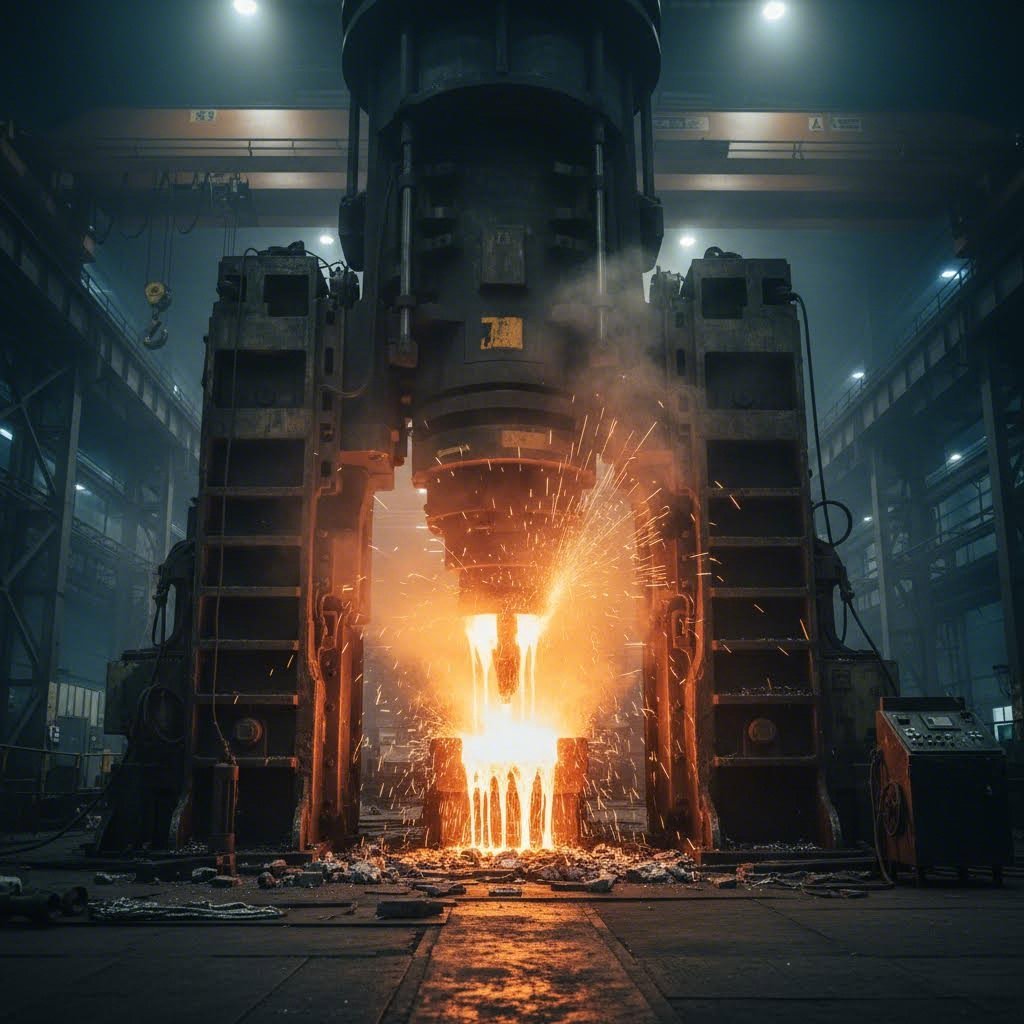
Automotive Forging Materials Chart: Match Every Component Perfectly precision hot forging transforms raw metal into high strength automotive components
Understanding Automotive Forging Materials and Their Critical Role
When you're tasked with selecting materials for critical vehicle components, having the right reference tool can mean the difference between a part that lasts decades and one that fails prematurely. An automotive forging materials chart is exactly that—a comprehensive comparison guide that maps specific metal grades to their mechanical properties, cost implications, and ideal applications. Engineers and procurement specialists rely on this essential resource to make informed decisions that balance performance requirements with budget constraints.
But what is forged metal, exactly? Forging is a manufacturing process that shapes metal using localized compressive forces through hammering, pressing, or rolling. Unlike casting, which pours molten metal into molds, forging deforms solid metal to refine its internal grain structure. This distinction matters tremendously for automotive applications where component failure simply isn't an option.
Why Forging Outperforms Casting for Automotive Parts
The forging process delivers something casting cannot replicate: aligned grain flow that follows the contours of the finished component. Imagine the difference between wood cut against the grain versus along it—forged steel components exhibit similar structural advantages.
The heating and deformation process in forging refines the internal grain structure through metallurgical recrystallization, creating a uniform structure that delivers greater strength and superior resistance to impact, shear damage, and fatigue.
This refined microstructure translates to real-world performance advantages. Forged components demonstrate enhanced fatigue resistance, meaning they can withstand millions of stress cycles without cracking. They also offer superior impact toughness—critical for suspension parts that absorb road shocks continuously. While casting excels at producing complex geometries cost-effectively, forging material remains the preferred choice when reliability under extreme stress is non-negotiable.
The Role of Material Selection in Component Performance
Selecting the appropriate forging materials isn't a one-size-fits-all decision. Every application demands a careful balance of competing factors:
- Strength-to-weight ratio – particularly crucial for EV manufacturers chasing efficiency gains
- Heat resistance – essential for engine and exhaust components operating at elevated temperatures
- Ductility and formability – affecting manufacturing complexity and tooling costs
- Cost considerations – balancing material expense against total lifecycle value
This article delivers what you've been searching for: a definitive comparison chart covering carbon steels, alloy steels, aluminum alloys, and titanium grades—complete with mechanical properties, application recommendations, and cost tier rankings. You'll find actionable guidance organized by component category, from powertrain internals to chassis systems, enabling confident material selection decisions for your next project.

The Definitive Automotive Forging Materials Chart
You've searched for a comprehensive forging steel comparison, only to find scattered data across dozens of sources. Sound familiar? This section delivers the complete material properties chart you've been looking for—organized, actionable, and designed for real-world application. Whether you're specifying forged carbon steel for cost-sensitive components or evaluating alloy steel forgings for high-stress powertrain parts, this table provides the steel mechanical properties you need at a glance.
Complete Material Properties Comparison Table
The following chart consolidates critical data for the most commonly specified automotive forging materials. Each grade has been categorized by material type, with mechanical properties, fatigue ratings, and cost tiers aligned to help you make confident procurement decisions.
| Material Category | Common Grades | Tensile Strength Range | Yield Strength Range | Hardness Range | Fatigue Resistance | Cost Tier | Best Automotive Applications |
|---|---|---|---|---|---|---|---|
| Carbon Steel | 1018 | 63,800–79,800 psi | 53,700–67,600 psi | 71–95 HRB | Low–Medium | Budget | Pins, bushings, low-stress brackets |
| Carbon Steel | 1045 | 82,000–105,000 psi | 45,000–77,000 psi | 84–96 HRB (annealed) | Medium | Budget | Axle shafts, crankshafts, gears (non-critical) |
| Alloy Steel | 4140 | 95,000–165,000 psi | 60,200–150,000 psi | 28–42 HRC (quenched & tempered) | High | Mid-Range | Crankshafts, connecting rods, axles, drive shafts |
| Alloy Steel | 4340 | 108,000–190,000 psi | 99,000–170,000 psi | 28–44 HRC | Very High | Premium | Landing gear, critical crankshafts, high-stress drivetrain |
| Alloy Steel (Carburizing) | 8620 | 90,000–115,000 psi | 66,000–90,000 psi | 58–64 HRC (case) | High | Mid-Range | Gears, pinions, camshafts, case-hardened components |
| Alloy Steel (Carburizing) | 9310 | 117,000–145,000 psi | 85,000–125,000 psi | 58–64 HRC (case) | Very High | Premium | Transmission gears, high-performance differentials |
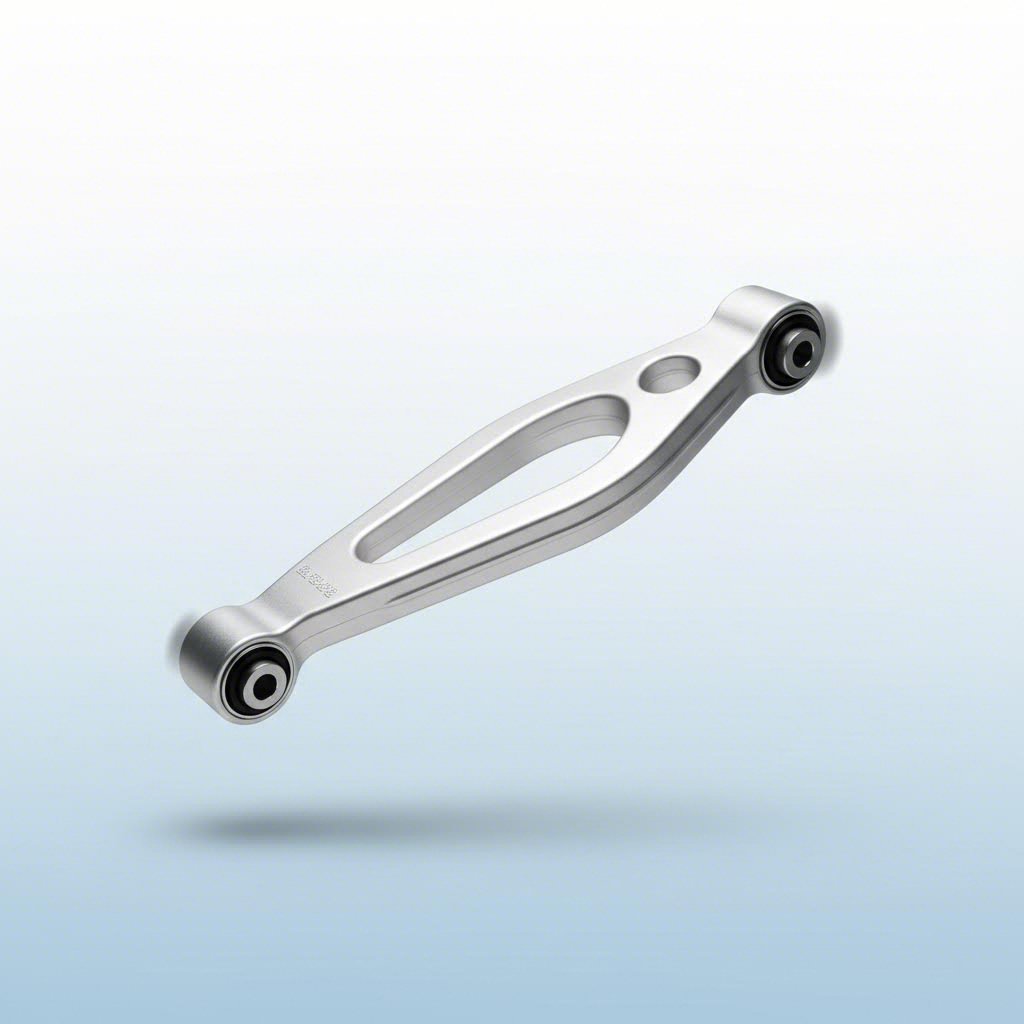
| Aluminum Alloy | 6061-T6 | 42,000–45,000 psi | 35,000–40,000 psi | 95–100 HB | Medium | Mid-Range | Suspension arms, structural brackets, EV battery housings |
| Aluminum Alloy | 7075-T6 | 74,000–83,000 psi | 63,000–73,000 psi | 150 HBW | Medium–High | Premium | High-strength suspension, racing components, aerospace crossover |
| Titanium Alloy | Ti-6Al-4V | 130,000–145,000 psi | 120,000–134,000 psi | 30–36 HRC | Very High | Premium+ | Racing connecting rods, valves, exhaust systems, performance springs |
A quick note on hardness interpretation: when evaluating carbon steels like 1018, you'll often encounter the Rockwell B scale for softer materials. However, the Rockwell C hardness of 1018 steel in its as-forged or normalized state isn't typically measured on the C scale because it falls below the scale's effective range—this is why you'll see HRB values listed instead. Only after heat treatment do alloy grades reach the Rockwell C range, which becomes the standard measurement for hardened automotive components.
Reading the Chart for Your Application
Numbers alone don't tell the complete story. Here's how to translate this data into practical material selection:
- Prioritize fatigue resistance for components experiencing cyclic loading—connecting rods, suspension arms, and steering knuckles demand grades rated "High" or "Very High"
- Match hardness requirements to wear conditions—gears and case-hardened components need surface hardness exceeding 58 HRC, pointing you toward 8620 or 9310
- Consider yield strength as your design limit—this represents the stress level before permanent deformation occurs, making it critical for safety-rated parts
- Evaluate cost tier against failure consequences—budget-tier carbon steels suit non-critical components, but steering and braking systems warrant premium alloy steel forgings
Notice how 4340 offers the highest combination of tensile strength and toughness among standard alloy steels? According to Michlin Metals, the higher nickel content (1.65–2%) in 4340 provides greater depth of hardening and additional toughness compared to 4140—explaining why it commands a premium price for the most demanding automotive applications.
Similarly, the distinction between 8620 and 9310 for carburizing applications comes down to core toughness. Both develop similar case hardness, but 9310's higher nickel content (3.0–3.5%) adds toughness to both the hardened case and the underlying core, making it the preferred choice for transmission gears subjected to shock loading.
With this comprehensive reference in hand, let's dive deeper into individual steel grades—examining the specific characteristics that make each one optimal for particular automotive forging applications.
Carbon and Alloy Steel Grades for Automotive Forging
Now that you have the complete comparison chart, let's dig into what makes each grade tick. Understanding the specific characteristics of carbon steel forging materials versus forged alloy steel helps you move beyond simple specification matching toward truly optimized material selection. Each grade brings unique advantages—and limitations—that directly impact component performance, manufacturability, and long-term reliability.
Carbon Steel Grades for Cost-Effective Components
When budget constraints meet functional requirements, carbon steels deliver remarkable value. These grades contain minimal alloying elements beyond carbon and manganese, making them easier to forge, machine, and source. But don't mistake affordability for inadequacy—carbon steels power countless automotive applications where extreme performance isn't necessary.
1018 Steel represents the workhorse of general-purpose forging. With carbon content between 0.15–0.20%, this grade offers excellent formability and weldability. You'll find 1018 in:
- Pins and bushings requiring good wear surfaces
- Low-stress mounting brackets and supports
- Hydraulic fittings and couplings
- General structural components where fatigue loading is minimal
The forged carbon steel alloy 1018 responds well to case hardening when surface wear resistance matters more than core strength. Its relatively low carbon content means it won't through-harden effectively, but carburizing can produce a hard exterior shell while maintaining a ductile, shock-absorbing core.
1045 Steel steps up when moderate strength becomes essential. The higher carbon content (0.43–0.50%) enables heat treatment to achieve tensile strengths exceeding 100,000 psi—roughly 25% stronger than 1018. Consider 1045 for:
- Non-critical axle shafts and spindles
- Agricultural and construction equipment components
- Crankshafts for small engines
- Gears operating under moderate loads
The key advantage of 1045? It can be through-hardened, meaning the entire cross-section achieves uniform hardness after quenching and tempering. This makes it suitable for shafts and pins where core strength matters as much as surface properties.
Alloy Steel Grades for High-Stress Applications
When carbon steel reaches its limits, alloy steel forging takes over. The addition of chromium, molybdenum, nickel, and other elements transforms steel's fundamental behavior—enabling deeper hardening, greater toughness, and superior fatigue resistance. These grades cost more, but the performance gains justify the investment for critical components.
4140 Chromium-Molybdenum Steel ranks among the most versatile choices for forge steel applications. According to manufacturing experts, the chromium content improves corrosion resistance and hardenability, while molybdenum stabilizes the steel at high temperatures by increasing strength and reducing brittleness. Key characteristics include:
- Excellent fatigue strength for cyclic loading applications
- High impact resistance even at elevated hardness levels
- Good machinability in the annealed condition
- Hardness range of 28–42 HRC after quenching and tempering
- Tensile strength reaching 165,000 psi with proper heat treatment
Automotive applications for 4140 span crankshafts, connecting rods, axle shafts, drive shafts, and suspension components. The steel's ability to maintain toughness at high hardness makes it ideal for rotating components subjected to both torsional stress and impact loading.
4340 Nickel-Chromium-Molybdenum Steel represents the premium tier of general-purpose alloy steel forging. The addition of 1.65–2% nickel provides deeper hardenability and significantly enhanced toughness compared to 4140. You'll specify 4340 when:
- Maximum impact resistance is non-negotiable
- Components must survive shock loading without brittle fracture
- Large cross-sections require uniform through-hardening
- Operating temperatures fluctuate significantly
Aircraft landing gear, high-performance crankshafts, and heavy-duty drivetrain components commonly use 4340 forged alloy steel. The grade's superior toughness under harsh conditions explains why it commands approximately 20–30% premium over 4140.
8620 and 9310 Carburizing Grades take a different approach to hardness. Rather than through-hardening the entire component, these low-carbon steels develop extremely hard cases (58–64 HRC) while maintaining tough, ductile cores. As heat treatment specialists note, matching low-carbon steels like 8620 and 9310 with carburizing processes is essential—attempting to carburize medium-carbon steels like 4140 creates excessive surface carbon that leads to cracking.
- 8620 serves as the standard carburizing grade for gears, pinions, and camshafts requiring hard-wearing surfaces with shock-absorbing cores
- 9310 adds higher nickel content (3.0–3.5%) for superior fatigue strength, making it preferred for transmission gears handling continuous high loads
Micro-Alloy Steels like 38MnVS6 and similar grades represent an emerging category offering weight reduction without sacrificing strength. These steels achieve their properties through controlled cooling from forging temperature rather than separate heat treatment—eliminating process steps while maintaining mechanical performance. For automotive manufacturers chasing every gram of weight savings, micro-alloy steels can reduce component mass by 10–15% compared to traditional grades requiring post-forging heat treatment.
Understanding these grade distinctions positions you to match materials precisely to component requirements. But steel grades tell only part of the story—the next critical consideration is how lightweight materials like aluminum and titanium are reshaping material selection for modern vehicles.
Lightweight Forging Materials for Modern Vehicles
Electric vehicles are rewriting the rules of automotive engineering. When every kilogram of weight reduction translates directly into extended range, traditional wrought steel components face serious competition from lighter alternatives. The shift toward forged materials like aluminum and titanium isn't just a trend—it's a fundamental response to electrification demands and increasingly stringent efficiency standards.
But here's the challenge: lighter doesn't always mean better. Selecting the right forgeable materials requires understanding precisely where weight savings deliver real value—and where steel's superior strength remains irreplaceable. Let's explore how aluminum and titanium forging grades are reshaping metals for forging in the modern automotive landscape.
Aluminum Alloys Driving Electric Vehicle Innovation
Why does aluminum dominate the EV lightweighting conversation? The math is compelling. With a density of steel kg m3 hovering around 7,850 compared to aluminum's approximately 2,700 kg/m³, aluminum delivers roughly three times the volume for the same weight. According to the U.S. Department of Energy, a 10% reduction in vehicle weight can improve fuel economy by 6% to 8%—a statistic that translates directly into extended battery range for EVs.
Three aluminum grades dominate automotive forging applications, each optimized for different performance requirements:
6061-T6 Aluminum serves as the general-purpose workhorse for structural applications. This magnesium-silicon alloy offers an excellent balance of strength, corrosion resistance, and manufacturability. Key advantages include:
- Tensile strength of 42,000–45,000 psi—sufficient for most structural brackets and housings
- Excellent anodizing properties, creating a transparent protective oxide layer
- Good weldability due to its magnesium and silicon content
- Lower cost compared to high-strength aluminum alternatives
- Easy machinability without excessive tool wear
You'll find 6061-T6 in suspension arms, EV battery enclosures, and structural mounting brackets where moderate strength meets weight reduction goals.
7075-T6 Aluminum steps into the picture when strength demands intensify. This zinc-based alloy approaches steel-level tensile strength while maintaining aluminum's weight advantage. According to material specialists, 7075's higher zinc content contributes to greater tensile strength, though it also makes the material marginally heavier than 6061. Consider 7075-T6 for:
- High-strength suspension components subjected to significant dynamic loads
- Racing applications where maximum strength-to-weight ratio matters
- Aerospace crossover components requiring certified performance
- Critical structural parts where 6061 falls short on strength requirements
The trade-off? 7075 is difficult to machine because of its toughness and higher stiffness, resulting in greater tool wear and requiring specialized tooling for precise work. It's also not suitable for welding due to its high zinc and copper content, which makes it prone to cracking during fusion processes.
2024 Aluminum targets fatigue-critical applications where cyclic loading determines component lifespan. While less common than 6061 or 7075 in general automotive use, 2024 excels in components experiencing millions of stress cycles—similar to its aerospace heritage in wing structures and fuselage panels.
Aluminum-Lithium Alloys represent the emerging frontier of next-generation lightweighting. By replacing a portion of aluminum with lithium—the lightest metallic element—these alloys achieve 5–10% lower density while maintaining or improving strength. Though currently more expensive and complex to process, aluminum-lithium alloys are gaining traction in premium EV platforms where maximum range justifies the cost premium.
Titanium Applications in Performance Automotive
When weight savings must combine with exceptional strength and heat resistance, titanium enters the equation. Ti-6Al-4V—commonly known as Grade 5 titanium—represents the workhorse of performance automotive forging. As titanium specialists note, this alloy is renowned for its versatility and exceptional mechanical properties, combining 6% aluminum (for strength and reduced density) with 4% vanadium (for toughness and thermal stability).
What makes Ti-6Al-4V compelling for high-performance applications?
- High strength-to-weight ratio—tensile strength of 130,000–145,000 psi at roughly 56% of steel's weight
- Exceptional corrosion resistance—a natural oxide layer protects against environmental damage
- Heat resistance—maintains properties at elevated temperatures where aluminum would soften
- Fatigue resistance—critical for components like connecting rods subjected to millions of cycles
High-performance racing cars leverage Ti-6Al-4V for engine valves, suspension springs, and connecting rods. Formula 1 teams consistently rely on titanium components to maintain competitive advantage while ensuring reliability under extreme racing conditions. However, titanium's cost—often 10–20 times that of steel—limits its use to applications where weight savings directly translate into measurable performance gains.
Weight vs. Strength: Making the Right Trade-Off
Choosing between aluminum, titanium, and steel isn't about finding a universally superior material—it's about matching material properties to specific application requirements. The following comparison highlights the fundamental trade-offs:
| Property | Forged Steel (4140) | Forged Aluminum (6061-T6) | Forged Titanium (Ti-6Al-4V) |
|---|---|---|---|
| Density | 7,850 kg/m³ | 2,700 kg/m³ | 4,430 kg/m³ |
| Weight vs. Steel | Baseline (100%) | ~34% of steel | ~56% of steel |
| Tensile Strength | 95,000–165,000 psi | 42,000–45,000 psi | 130,000–145,000 psi |
| Fatigue Resistance | High | Medium | Very High |
| Corrosion Resistance | Low (requires coating) | Excellent | Excellent |
| Cost Tier | Mid-Range | Mid-Range to Premium | Premium+ |
| Best Applications | Crankshafts, axles, drivetrain | Suspension arms, brackets, housings | Racing valves, springs, con rods |
Notice the key insight: aluminum offers the most dramatic weight savings (66% reduction versus steel) but at significantly reduced absolute strength. Titanium splits the difference—cutting weight by 44% while maintaining or exceeding steel's strength. The density of steel kg m3 compared to alternatives explains why material selection increasingly involves hybrid approaches.
Hybrid and Multi-Material Forging Strategies
Modern automotive engineering rarely relies on a single material throughout a vehicle. Instead, engineers deploy multi-material strategies that position each metal where its properties deliver maximum value:
- Steel for high-stress drivetrain components—where absolute strength and cost-effectiveness matter most
- Aluminum for suspension and structural components—where reducing unsprung mass improves handling and efficiency
- Titanium for performance-critical rotating components—where weight reduction in reciprocating parts amplifies benefits
This strategic material deployment allows manufacturers to optimize the performance-to-weight ratio without the cost penalties of all-titanium or all-aluminum construction. As forging technology advances, expect to see increasing adoption of tailored blanks and hybrid components that combine multiple materials within single assemblies.
With lightweight material options clarified, the next critical question becomes: which specific materials belong in which automotive components? Let's examine the material-to-component matching that transforms theoretical knowledge into practical procurement decisions.

Matching Materials to Automotive Components
You've got the material properties. You understand the trade-offs between steel, aluminum, and titanium. But here's where theory meets practice: which forging component actually needs which grade? Matching steel forging materials to specific automotive parts isn't guesswork—it's a systematic decision process based on stress profiles, fatigue requirements, and operating conditions.
Think of material selection as solving a puzzle. Each component faces unique challenges—torsional loads, impact forces, temperature extremes, or relentless cyclic stress. The right material absorbs these demands without failure. The wrong choice? Premature wear, catastrophic fracture, or unnecessary cost overruns.
Material Selection Decision Flowchart
Before diving into specific component recommendations, walk through this decision framework to identify your starting point:
- Step 1: Identify the primary stress type — Is the component subjected to torsion (shafts), bending (arms), compression (bearings), or combined loading (gears)?
- Step 2: Determine fatigue requirements — Will the part experience millions of stress cycles (connecting rods) or primarily static loads (brackets)?
- Step 3: Evaluate operating temperature — Does the component operate near engines or exhaust systems (elevated temps) or in ambient conditions?
- Step 4: Assess weight sensitivity — Is this rotating mass (where weight reduction amplifies benefits) or static structure?
- Step 5: Consider surface wear requirements — Does the component interface with other moving parts requiring hard, wear-resistant surfaces?
Your answers guide you toward specific material categories. High-stress rotating components with fatigue concerns point toward premium alloy steels or titanium. Weight-sensitive suspension parts lean toward aluminum. Gears requiring surface hardness demand carburizing grades. Let's apply this framework to real forged steel components.
Powertrain Component Material Selection
Powertrain forging components face the most demanding operating conditions in any vehicle. They must withstand extreme temperatures, continuous cyclic loading, and precise dimensional stability over millions of operational cycles. Here's how material selection aligns with specific powertrain requirements:
| Component | Recommended Grades | Operating Temp Range | Primary Stress Type | Why This Material Works |
|---|---|---|---|---|
| Crankshafts | 4340, 4140 | 150–250°F (65–120°C) | Torsion + Bending | High fatigue strength, excellent toughness under cyclic torsional loads; 4340 preferred for high-performance engines |
| Connecting Rods | 4340, Ti-6Al-4V (racing) | 200–350°F (93–175°C) | Tension + Compression | Superior fatigue resistance for reciprocating motion; titanium reduces rotating mass in performance applications |
| Transmission Gears | 8620, 9310 | 150–300°F (65–150°C) | Contact + Bending | Case-hardening creates 58–64 HRC surface for wear resistance while maintaining tough, shock-absorbing core |
| Camshafts | 8620, 4140 | 200–350°F (93–175°C) | Contact + Torsion | Carburized 8620 provides hard cam lobes; 4140 suits applications with separate hardened inserts |
| Drive Shafts | 4140, 4340V | Ambient–200°F (ambient–93°C) | Torsion | High torsional fatigue strength; 4340V adds vanadium for grain refinement and enhanced toughness |
Why 4340 dominates crankshaft applications: Crankshafts endure perhaps the most complex stress state in any engine. Every combustion event creates a bending moment while the entire assembly rotates under torsional load. The nickel content in 4340 provides deep hardenability—essential for large-diameter crankshafts where uniform properties throughout the cross-section prevent stress concentrations. For high-revving performance engines, 4340's impact toughness prevents brittle fracture even at elevated hardness levels.
The case for titanium connecting rods: In reciprocating engines, connecting rods accelerate and decelerate twice per crankshaft revolution. Reducing connecting rod weight allows higher engine speeds, reduces bearing loads, and improves throttle response. While 4340 steel forging components serve most production vehicles admirably, motorsport applications justify Ti-6Al-4V's premium cost—cutting rotating mass by 40% compared to equivalent steel components.
Gear material nuances: Notice that gears use different steel grades than crankshafts, despite similar operating environments. The distinction lies in surface wear requirements. Gears experience metal-to-metal contact under load, demanding extremely hard surfaces (58+ HRC) that would make through-hardened 4340 too brittle. Carburizing grades like 8620 and 9310 solve this by creating a hard exterior case while maintaining a ductile, shock-absorbing core. For transmission gears handling continuous high loads, 9310's additional nickel content provides superior fatigue strength—explaining its prevalence in heavy-duty and racing applications.
Chassis and Suspension Material Requirements
Suspension forging components face different challenges than powertrain parts. Rather than high temperatures and continuous rotation, they must absorb road shocks, resist fatigue from vibration, and increasingly contribute to vehicle lightweighting goals. Material selection here often involves trade-offs between steel's strength and aluminum's weight advantages.
| Component | Recommended Grades | Operating Temp Range | Primary Stress Type | Why This Material Works |
|---|---|---|---|---|
| Suspension Arms (Control Arms) | 6061-T6, 4140 | Ambient–150°F (ambient–65°C) | Bending + Impact | Aluminum reduces unsprung mass for improved handling; steel preferred for heavy-duty applications |
| Steering Knuckles | 4140, 4340 | Ambient–150°F (ambient–65°C) | Combined Loading | Safety-critical component requiring high strength, toughness, and consistent fatigue performance |
| Axles | 4140, 4340 | Ambient–200°F (ambient–93°C) | Torsion + Bending | High torsional strength handles power transmission; 4340 for severe-duty and performance applications |
| Wheel Hubs | 4140, 8620 | Ambient–250°F (ambient–120°C) | Bearing Loads | Must support bearing races; 8620 carburized for integrated bearing surfaces |
| Tie Rod Ends | 4140, 1045 | Ambient–120°F (ambient–50°C) | Tension + Bending | Moderate strength requirements; 1045 suits cost-sensitive applications with adequate safety margins |
The aluminum suspension advantage: Reducing unsprung mass—the weight of components below the suspension springs—dramatically improves vehicle dynamics. Every pound removed from suspension arms, knuckles, or wheels allows springs and dampers to control body motion more effectively. For performance vehicles and EVs prioritizing efficiency, 6061-T6 aluminum forging components deliver 66% weight reduction compared to steel equivalents. As noted in shaft material research, hard-anodized aluminum provides excellent corrosion resistance without the coatings steel requires—important for components exposed to road spray and de-icing chemicals.
When steel remains essential: Despite aluminum's weight advantages, certain chassis components demand steel's superior strength. Steering knuckles—connecting wheels to suspension—represent safety-critical parts where failure consequences are catastrophic. The 4140 and 4340 grades provide the strength margins that give engineers confidence, even when minor surface damage or corrosion occurs over vehicle lifespan. Similarly, rear axles transmitting full engine torque to wheels require the torsional strength that only alloy steel delivers cost-effectively.
Tool steel forging applications: While not appearing in our standard comparison chart, tool steel forging occasionally enters chassis component manufacturing—specifically for tooling that produces forged parts rather than the parts themselves. Dies and punches used to forge suspension components require extreme hardness and wear resistance, typically achieved with D2 or H13 tool steels heat-treated to 58+ HRC. Understanding tool steel forging requirements helps procurement specialists evaluate supplier capabilities—quality tooling directly impacts the dimensional accuracy and surface finish of production forging components.
With material-to-component matching established, the next consideration becomes equally critical: how do these materials behave during the forging process itself? Understanding process compatibility ensures your material selection translates into manufacturable, cost-effective components.
Forging Process Compatibility by Material Type
You've selected the perfect material grade for your component. But here's a question that can derail even the best material choice: can your supplier actually forge it? Not every forging facility handles every material equally well. Understanding which forge material works best with hot forging versus cold forging—and why—prevents costly mismatches between your specifications and manufacturing reality.
The forging process fundamentally transforms metal's internal structure. According to forging process research, forging achieves its exceptional material properties through the deformation of solid metal, refining the grain structure and aligning it with the part's shape to maximize performance. But this transformation behaves differently depending on whether metal is shaped at elevated temperatures or near room temperature.
Hot Forging Material Considerations
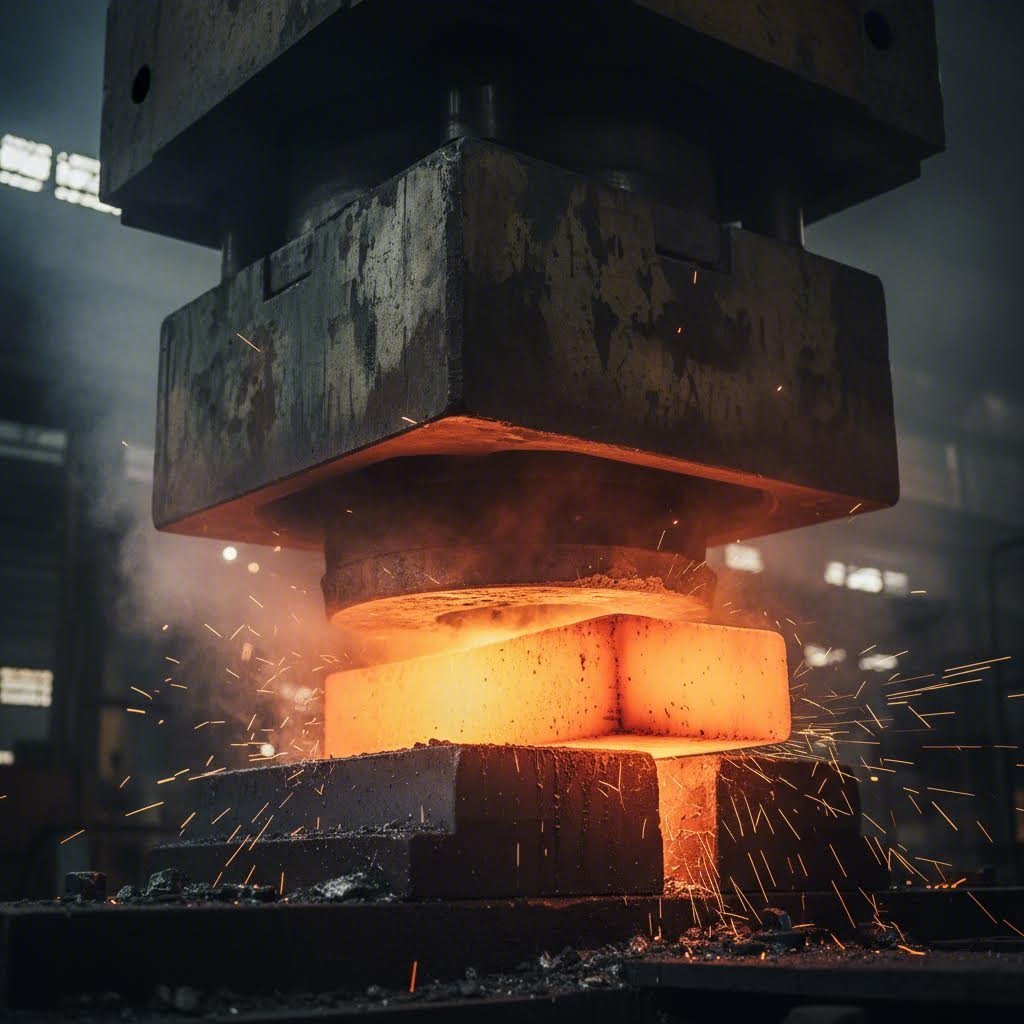
Hot forging heats metal above its recrystallization temperature—the point where new, strain-free grains form during deformation. This process makes even the toughest alloys malleable enough to flow into complex die cavities. As The Federal Group USA explains, the heating and deformation process refines the internal grain structure through metallurgical recrystallization, creating a uniform structure that delivers greater strength and superior resistance to impact, shear damage, and fatigue.
Which materials thrive in hot forging environments?
- Carbon steels (1018, 1045) — Forged at 1,700–2,300°F (925–1,260°C); excellent formability allows complex shapes with minimal cracking risk
- Alloy steels (4140, 4340, 8620, 9310) — Forged at 1,850–2,250°F (1,010–1,230°C); higher alloy content requires careful temperature control to prevent overheating
- Titanium alloys (Ti-6Al-4V) — Forged at 1,650–1,850°F (900–1,010°C); narrower temperature window demands precise process control
- Nickel-based superalloys — Forged at 1,900–2,100°F (1,040–1,150°C); extreme forging strength requirements necessitate specialized equipment
Hot forging delivers several advantages that directly impact component quality. The elevated temperatures reduce the force required for deformation, extending die life and enabling thinner sections than cold forging permits. Steel forged at proper temperatures develops refined grain structure throughout—no cold spots with inferior properties. Complex geometries that would crack during cold forming flow smoothly into die cavities.
However, hot forging introduces trade-offs you must consider:
- Surface finish limitations — Oxide scale forms on heated surfaces, requiring post-forging cleaning or machining
- Dimensional tolerances — Thermal contraction during cooling makes tight tolerances challenging; expect ±0.030" or wider
- Energy costs — Heating furnaces and maintaining temperature throughout forming adds operational expense
- Die wear patterns — High temperatures accelerate die degradation, particularly at sharp corners and thin sections
Cold Forging Material Limitations
Cold forging shapes metal at or near room temperature—always below the material's recrystallization point. This approach preserves the base material's original grain structure while work-hardening the surface through plastic deformation. The result? Parts with excellent dimensional accuracy and superior surface finish, but with important material restrictions.
According to forging process specialists, aluminum and magnesium offer ideal physical properties for cold forging because they are lightweight, highly ductile, and have low work-hardening rates. These characteristics allow them to deform easily under pressure without requiring high temperatures. Materials suitable for cold forging include:
- Low-carbon steels (1010, 1018) — Sufficient ductility for moderate deformation; best for simpler geometries
- Aluminum alloys (6061, 2024) — Excellent cold formability enables complex shapes with tight tolerances
- Copper and brass alloys — High ductility permits significant deformation without cracking
- Some stainless steels (304, 316) — Austenitic grades cold forge reasonably well despite higher forging strength requirements
What makes cold forging attractive? The benefits are compelling for appropriate applications:
- Tighter dimensional tolerances — No thermal expansion/contraction; tolerances of ±0.005" are achievable
- Superior surface finish — No oxide scale; surfaces often need minimal post-processing
- Increased surface hardness — Work hardening strengthens the deformed surface layer
- Reduced material waste — Near-net-shape forming minimizes machining allowances
But cold forging faces real constraints. Medium and high-carbon steels (1045 and above) lack sufficient ductility for significant cold deformation—they'll crack before flowing into complex die shapes. Similarly, alloy steels like 4140 and 4340 require hot forging; attempting cold forming risks catastrophic die failure or part fracture. The higher forging strength needed to deform room-temperature steel also accelerates die wear and limits achievable geometries.
How Grain Flow Direction Impacts Performance
Here's where forging truly distinguishes itself from machining or casting: controlled grain flow. According to the ASM Handbook on metalworking, control of grain flow is one of the major advantages of shaping metal parts by rolling, forging, or extrusion. Proper placement of the parting line ensures that the principal grain flow direction within the forging will be parallel to the principal direction of service loading.
What does this mean practically? Wrought steel contains elongated grains aligned with the direction of prior deformation. When a forged crankshaft's grain flows along its length—following the contour through journals and counterweights—the component resists fatigue cracking far better than a machined part cut from plate. The grain boundaries act like fiber reinforcement, redirecting crack propagation away from critical stress paths.
Forging enhances mechanical properties compared to the base material in several measurable ways:
- Fatigue strength increases 20–50% compared to machined equivalents with random grain orientation
- Impact toughness improves as forging closes internal porosity present in cast or powder metal starting stock
- Directional strength allows engineers to optimize properties along primary loading axes
- Reduced anisotropy in critical directions when grain flow is properly designed
Matching Material Selection to Forging Capabilities
Before finalizing your material specification, verify your supplier's actual capabilities. Not every shop handles every material—and mismatches create quality problems, delivery delays, or outright project failures. Consider these practical questions:
- Does the facility have furnace capacity for your material's required forging temperature?
- Can their presses deliver sufficient forging strength for the specified alloy and part geometry?
- Do they have experience with your specific grade, including heat treatment requirements?
- Can they maintain the temperature control precision that titanium or superalloy forging demands?
- Is their die material appropriate for the temperatures and forces involved?
Steel for forging behaves predictably across most facilities—carbon and alloy steel grades represent the industry standard. Aluminum forging requires different equipment and expertise but remains widely available. Titanium forging, however, concentrates among specialized suppliers with controlled atmospheres and precise temperature management.
Understanding these process compatibility factors transforms your material selection from theoretical specification to manufacturable reality. With forging process considerations addressed, the final critical factor remains: what will this material selection actually cost, and when does premium pricing deliver genuine value?
Cost Analysis and Material Selection Economics
You've identified the right material grade for your application. But here's the question that ultimately determines procurement decisions: what's it going to cost? Material selection economics extends far beyond raw material pricing. The true cost of steel forgings encompasses tooling amortization, heat treatment requirements, machining difficulty, and—perhaps most importantly—the consequences of component failure.
Understanding these cost dynamics transforms you from a specification-follower into a strategic buyer who balances performance requirements against total cost of ownership. Let's break down what really drives forging material costs and when premium pricing delivers genuine value.
Budget-Friendly Material Options Without Sacrificing Quality
Not every automotive component demands premium alloy forged materials. For non-critical applications where stress levels remain moderate, carbon steels deliver excellent value without compromising reliability. According to forging cost analysis, material selection is often the largest single cost contributor, accounting for 40–60% of total forging expenses—making grade selection your most powerful cost control lever.
| Cost Tier | Material Grades | Relative Cost | Best Applications | Key Cost Drivers |
|---|---|---|---|---|
| Budget | 1018, 1045 carbon steels | 1.0× (baseline) | Pins, bushings, low-stress brackets, non-critical shafts | Widely available, easy to forge, minimal heat treatment |
| Mid-Range | 4140, 8620 alloy steels | 1.3–1.6× | Crankshafts, axles, gears, suspension components | Alloying elements, heat treatment required, tighter process control |
| Premium | 4340, 9310 alloy steels | 1.8–2.2× | High-stress drivetrain, performance crankshafts, heavy-duty gears | Higher nickel content, specialized heat treatment, stricter quality requirements |
| Premium+ | Ti-6Al-4V, 7075-T6 aluminum | 5–20× | Racing components, aerospace crossover, weight-critical applications | Raw material scarcity, specialized forging equipment, complex processing |
Why do carbon steels cost less? Several factors compound their affordability:
- Raw material availability — 1018 and 1045 are commodity grades with global supply chains
- Forging simplicity — Wide temperature windows reduce scrap rates and process complexity
- Heat treatment flexibility — Simple normalizing or annealing versus complex quench-and-temper cycles
- Machining ease — Lower hardness means faster cutting speeds and extended tool life
For forge steel tools and general-purpose components, carbon steels often represent the optimal choice. The key lies in accurately assessing whether your application truly requires alloy steel properties—or whether budget-tier materials meet functional requirements with appropriate safety margins.
When Premium Materials Justify the Investment
Premium pricing makes sense when failure consequences outweigh material cost savings. Consider the total cost of ownership rather than per-unit material expense. As hot forging cost research indicates, in most load-bearing applications, forging remains the most cost-effective long-term solution when factoring in lifecycle performance, maintenance, and safety.
Premium alloy forged materials justify their cost when:
- Fatigue life determines component replacement intervals — A 4340 crankshaft lasting 500,000 miles costs less over vehicle lifetime than a 1045 crankshaft requiring replacement at 200,000 miles
- Safety-critical applications demand maximum margins — Steering knuckles, suspension arms, and brake components warrant premium materials where failure endangers occupants
- Weight reduction delivers measurable performance gains — Titanium connecting rods costing 15× more than steel equivalents enable higher engine speeds and improved efficiency
- Warranty and liability exposure creates downstream costs — OEMs calculate that premium materials reducing field failures by even 0.1% often pay for themselves in avoided recalls
Total Cost of Ownership Considerations
Raw material cost tells only part of the story. Post-forging processing significantly impacts final component cost—and varies dramatically by material grade:
Heat Treatment Requirements: Carbon steels like 1045 require straightforward quench-and-temper cycles. Carburizing grades (8620, 9310) demand extended furnace time for case development—adding 15–25% to processing costs. Titanium requires vacuum heat treatment to prevent oxygen contamination, further increasing expense.
Machining Difficulty: Harder materials consume more tooling. A 4340 crankshaft at 32 HRC machines significantly slower than normalized 1045, with carbide inserts wearing faster. Titanium's poor thermal conductivity and tendency to work-harden makes machining particularly challenging—expect 3–5× longer cycle times compared to steel equivalents.
Component Lifespan: This is where premium materials often prove their value. High-strength alloy steel forgings operating within design limits can last indefinitely under cyclic loading. Budget materials pushed to their limits may require scheduled replacement—acceptable for service items but costly for integrated drivetrain components.
OEM vs. Aftermarket Perspectives
Material selection economics differ significantly between original equipment manufacturers and aftermarket suppliers:
OEM Considerations:
- Volume pricing reduces per-unit material costs by 30–50% compared to aftermarket quantities
- Tooling amortization across millions of parts minimizes die cost impact
- Warranty exposure drives conservative material selection—premium grades prevent costly recalls
- Supply chain integration enables castings steel comparisons to optimize cost-performance balance
Aftermarket Considerations:
- Lower volumes mean higher per-unit tooling costs—sometimes 3–5× OEM equivalent
- Performance positioning allows premium pricing that absorbs higher material costs
- Enthusiast customers often specifically request upgraded materials (4340 vs. OEM 4140)
- Smaller production runs enable faster adoption of improved alloys and processes
Failure Mode Consequences
Perhaps the most important cost consideration isn't what you spend—it's what you risk by selecting inappropriate materials. Understanding failure modes clarifies when budget materials suffice and when premium grades become essential:
- Fatigue failure — Progressive cracking under cyclic loading; premium alloy steels with higher fatigue limits extend component life exponentially
- Brittle fracture — Sudden catastrophic failure without warning; high-nickel grades like 4340 maintain toughness at elevated hardness levels
- Wear degradation — Surface deterioration at contact interfaces; carburizing grades (8620, 9310) create hard cases resistant to abrasive and adhesive wear
- Corrosion damage — Environmental attack reducing cross-section; aluminum and titanium's natural oxide layers provide inherent protection
The fundamental question becomes: what's the cost of failure compared to the cost of prevention? For a suspension arm where failure causes vehicle loss of control, spending 50% more on 4340 versus 4140 represents trivial insurance. For a non-structural bracket, that same premium wastes money better allocated elsewhere.
With cost economics understood, the final step transforms this knowledge into actionable procurement decisions—working with qualified suppliers who can deliver the materials and quality your applications demand.
Implementing Your Material Selection Strategy
You've done the hard work—analyzing material properties, matching grades to components, and understanding cost trade-offs. But here's where many procurement efforts stall: translating specifications into qualified supplier relationships. What is forged steel worth if your supplier can't deliver consistent quality? How do you verify that the 4340 crankshaft blanks arriving at your dock actually meet the mechanical properties your engineers specified?
Implementing your material selection strategy requires more than sending a purchase order. It demands structured supplier evaluation, clear specification communication, and verification systems that catch problems before they become field failures. Let's walk through the practical steps that transform your automotive forging materials chart knowledge into reliable, repeatable procurement outcomes.
Working with Forging Suppliers on Material Specifications
Your material specification document sets the foundation for supplier alignment. But specifications only work when suppliers understand them—and when you verify compliance. According to forging quality specialists, checking forging raw materials is not just a routine task—it is a critical quality control step that directly impacts the integrity, performance, and safety of forged components.
Before placing orders, ensure your specifications address these critical elements:
- Material grade with applicable standard — Specify "4340 per ASTM A29" rather than just "4340" to eliminate interpretation differences
- Chemical composition limits — Define acceptable ranges for key elements (carbon, nickel, chromium, molybdenum) with clear acceptance criteria
- Mechanical property requirements — State minimum tensile strength, yield strength, elongation, and hardness with testing methods referenced
- Heat treatment condition — Specify whether material arrives annealed, normalized, or quenched-and-tempered
- Grain flow requirements — For critical components, define acceptable grain flow direction relative to primary stress axes
- Surface condition acceptance criteria — Specify allowable surface defects, decarburization limits, and inspection methods
What is forged metal without proper documentation? Essentially unverifiable. Every shipment should include a Mill Test Certificate (MTC) documenting chemical composition, mechanical test results, and heat treatment records. For automotive applications, insist on certificates conforming to EN 10204 3.1 at minimum—or 3.2 when third-party verification is required.
Imagine receiving a batch of forged in steel components only to discover the supplier substituted a lower-grade material. Without proper documentation and incoming inspection protocols, such substitutions go undetected until components fail in service. The cost of verification pales compared to warranty claims and potential recalls.
Quality Certifications That Matter for Automotive Forging
Not all quality certifications carry equal weight in automotive supply chains. Understanding which credentials actually matter—and what they verify—helps you separate qualified suppliers from those merely claiming capability.
IATF 16949: The Automotive Quality Standard
For automotive supply chain participation, IATF 16949 certification represents the essential baseline. According to NSF International, IATF 16949 is the international standard for automotive quality management systems, providing a standardized Quality Management System (QMS) that focuses on driving continuous improvement, with an emphasis on the prevention of defects and the reduction of variation and waste in the automotive supply chain.
Why does IATF 16949 matter specifically for forged by steel components? The standard mandates:
- Process capability studies — Suppliers must demonstrate statistical control over critical dimensions and properties
- FMEA implementation — Failure Mode and Effects Analysis identifies potential defects before they occur
- Control plans — Documented procedures ensure consistent process execution across production runs
- Traceability systems — Every component traces back to specific material heats, forging dies, and heat treatment batches
- Continuous improvement requirements — Suppliers must demonstrate ongoing quality enhancement, not just status quo maintenance
Most major automotive OEMs mandate IATF 16949 certification for their supply chain—making it effectively non-negotiable for Tier 1 and Tier 2 suppliers. As supplier evaluation research confirms, IATF 16949 for automotive applications is a crucial indicator of a supplier's expertise in those particular sectors.
Additional Certifications to Consider:
- ISO 9001:2015 — The foundation quality management standard; necessary but not sufficient for automotive work
- ISO 14001 — Environmental management certification increasingly required by OEMs with sustainability commitments
- ISO 45001 — Occupational health and safety certification demonstrating responsible manufacturing practices
- Nadcap — For aerospace crossover applications requiring heat treatment or special process accreditation
Key Questions for Supplier Qualification
Certifications verify systems exist—but direct inquiry reveals how effectively suppliers implement them. Before committing to a forging supplier relationship, ask these critical questions:
- Material traceability: How do you maintain traceability from raw material heat numbers through finished forging? Can you demonstrate this system with a sample trace?
- Incoming material verification: What testing do you perform on incoming steel or aluminum billets? Do you rely solely on supplier MTCs or conduct independent verification?
- In-process quality controls: What parameters do you monitor during forging operations? How do you detect and respond to process drift?
- Non-destructive testing capabilities: Do you perform ultrasonic testing, magnetic particle inspection, or other NDT in-house? What standards govern your inspection methods?
- Mechanical testing protocols: How do you verify tensile strength, hardness, and impact properties? What sampling frequency do you employ?
- Heat treatment controls: Do you operate in-house heat treatment, or outsource? How do you verify time-temperature profiles for each batch?
- Corrective action process: When non-conformances occur, how do you investigate root causes and prevent recurrence?
- Capacity and lead time: Can you scale from prototype quantities to production volumes? What are typical lead times for each phase?
Suppliers who answer these questions confidently—with documented evidence—demonstrate genuine quality commitment. Those who deflect or provide vague responses warrant additional scrutiny before qualification.
Finding Qualified Forging Partners
The global forging industry includes thousands of suppliers ranging from small regional shops to multinational manufacturers. Your search criteria should match your specific requirements—considering geography, material capabilities, volume requirements, and quality certifications.
For buyers evaluating suppliers across different regions, consider how location impacts total cost and supply chain resilience. Domestic suppliers like forged metals inc operations or steel forgings Shreveport facilities offer shorter lead times and simplified logistics for North American applications. However, global suppliers with established export infrastructure can deliver competitive pricing with reliable quality when properly qualified.
As an example of the capabilities to look for, Shaoyi (Ningbo) Metal Technology demonstrates the qualification profile that serious automotive buyers should evaluate: IATF 16949 certification ensuring automotive-grade quality systems, in-house engineering capabilities for material optimization and design-for-manufacturability consultation, and production flexibility spanning rapid prototyping (as little as 10 days for initial samples) through high-volume mass production. Their location near Ningbo Port—one of the world's busiest shipping hubs—enables efficient global logistics for customers requiring international sourcing. Components like suspension arms and drive shafts represent their core competencies in precision hot forging.
Whether you source domestically or internationally, apply consistent evaluation criteria. Request facility audits when practical. Review sample parts before committing to production volumes. Verify that what is forged steel according to their documentation matches actual delivered quality.
Building Long-Term Supplier Relationships
The most successful automotive forging procurement programs treat suppliers as partners rather than interchangeable vendors. Long-term relationships deliver advantages that transactional purchasing cannot match:
- Process knowledge accumulation — Suppliers who understand your applications optimize tooling, heat treatment, and inspection for your specific requirements
- Preferential capacity allocation — Established customers receive priority scheduling during high-demand periods
- Continuous improvement collaboration — Partners invest in reducing your costs and improving your quality because they share in long-term success
- Faster problem resolution — When issues arise, relationship depth enables faster root cause identification and corrective action
Your automotive forging materials chart provides the technical foundation for material selection. But implementing that selection successfully requires qualified suppliers, verified quality systems, and collaborative relationships built on mutual commitment to excellence. With these elements in place, your forging specifications translate into components that perform reliably—year after year, mile after mile.
Frequently Asked Questions About Automotive Forging Materials
1. What metals cannot be forged?
Metals with limited ductility cannot be forged effectively. Cast iron and select high-carbon steels lack the malleability required for the forging process and will crack under compressive forces. Some high-strength alloys are too brittle to endure forging deformation. Medium and high-carbon steels (1045 and above) also resist cold forging due to insufficient ductility, requiring hot forging at elevated temperatures instead. When selecting forging materials, always verify the material's forgeability rating and match it to your supplier's process capabilities.
2. What automotive parts are forged?
Forged components span critical automotive systems where strength and fatigue resistance are essential. Powertrain applications include crankshafts, connecting rods, transmission gears, camshafts, and drive shafts—typically using alloy steels like 4140, 4340, 8620, and 9310. Chassis components such as suspension arms, steering knuckles, axles, and wheel hubs are also commonly forged. For weight-sensitive applications, aluminum alloys (6061-T6, 7075-T6) serve suspension parts, while titanium (Ti-6Al-4V) appears in racing connecting rods and valves.
3. What are the raw materials for automotive production?
Automotive forging primarily uses carbon steels (1018, 1045), alloy steels (4140, 4340, 8620, 9310), aluminum alloys (6061-T6, 7075-T6), and titanium (Ti-6Al-4V). Carbon steels offer cost-effective solutions for non-critical components, while alloy steels provide superior fatigue resistance for drivetrain parts. Aluminum delivers significant weight savings for EV applications, and titanium serves high-performance racing components. Material selection depends on stress requirements, operating temperatures, fatigue demands, and cost constraints specific to each application.
4. How do I choose between forged steel and forged aluminum for automotive components?
The choice depends on your application's priority balance between strength and weight. Forged steel (4140) offers tensile strength up to 165,000 psi but weighs approximately 7,850 kg/m³. Forged aluminum (6061-T6) provides 42,000-45,000 psi tensile strength at only 2,700 kg/m³—roughly 34% of steel's weight. Choose aluminum for suspension components where reducing unsprung mass improves handling. Select steel for high-stress drivetrain parts where absolute strength matters most. IATF 16949-certified suppliers like Shaoyi can optimize material selection based on your specific performance and cost requirements.
5. What quality certifications should forging suppliers have for automotive work?
IATF 16949 certification is the essential baseline for automotive forging suppliers. This international quality management standard mandates process capability studies, FMEA implementation, documented control plans, full traceability systems, and continuous improvement requirements. Additional valuable certifications include ISO 9001:2015 for foundational quality management, ISO 14001 for environmental compliance, and Nadcap for aerospace crossover applications. Always verify suppliers maintain current certifications and can demonstrate compliance through documented evidence and facility audits.