 Small batches, high standards. Our rapid prototyping service makes validation faster and easier —
  EN
EN


Advantages Of Cold Forging Car Parts That Transform Your Supply Chain
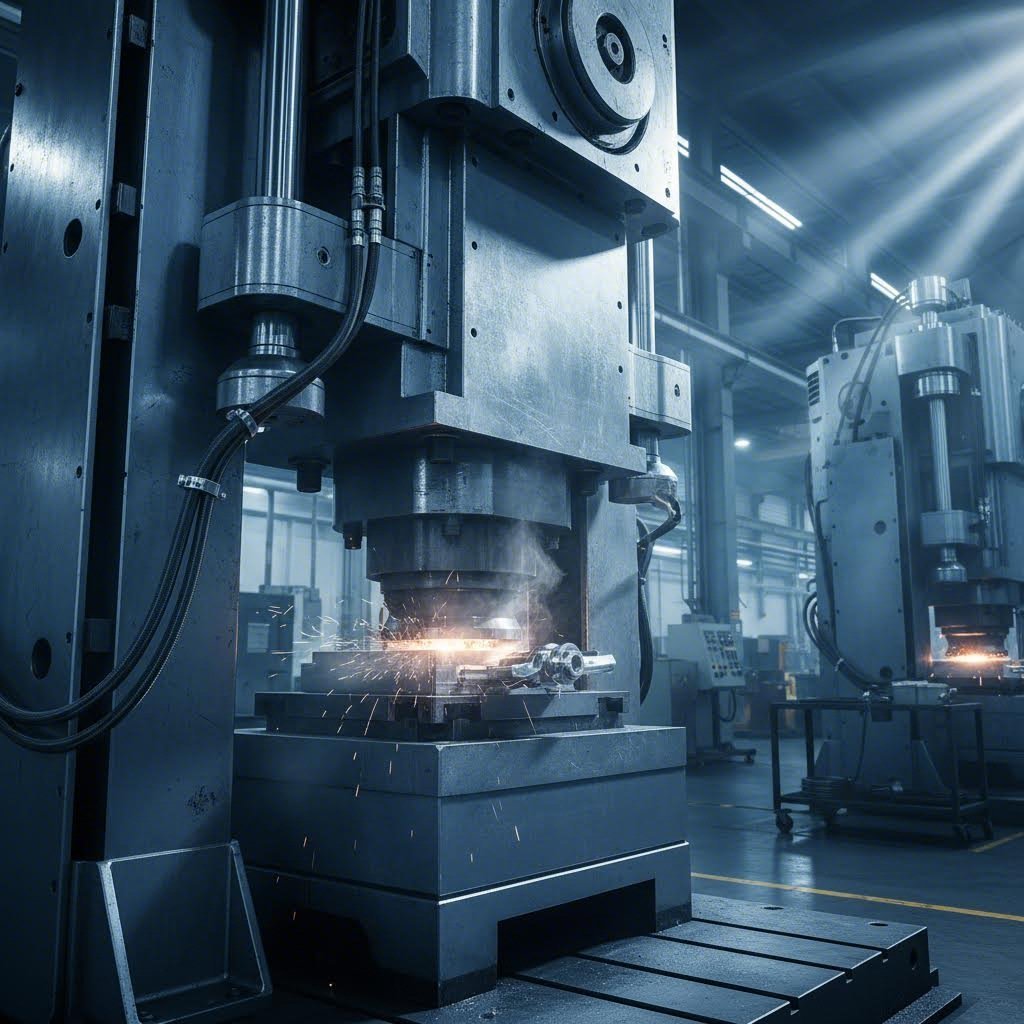
What Cold Forging Means for Automotive Manufacturing
Every time you press the brake pedal or turn the steering wheel, you're trusting your life to precision-engineered metal components. These critical parts must withstand extreme forces, temperature fluctuations, and millions of stress cycles without failure. So what is a forging, and why does the manufacturing method matter so much for automotive safety?
How Cold Forging Shapes Modern Vehicles
Cold forging is a metal forming technique performed at or near room temperature, where metal is shaped using intense compressive forces without heating. Imagine placing a metal blank into a die and applying thousands of tons of pressure—the material flows and reshapes into a precisely engineered component while maintaining its original grain structure.
Unlike hot forging, which heats metals to extreme temperatures (often exceeding 1,000°C for steel) before shaping, cold forging preserves the metal's internal crystalline structure. This fundamental difference creates components with enhanced strength, superior dimensional accuracy, and exceptional surface finish—qualities that automotive engineers demand for safety-critical applications.
The Room-Temperature Revolution in Auto Parts
What is cold forming in practical terms? It's the process that produces many of the fasteners, shafts, gears, and suspension components in your vehicle today. According to industry research, cold forged parts often outperform their cast or machined counterparts because the metal grains are reoriented during deformation rather than cut or melted.
Automotive manufacturers increasingly favor cold forging for specific applications because it delivers:
- Superior mechanical properties through work hardening
- Tighter dimensional tolerances without secondary machining
- Lower energy consumption compared to hot processes
- Minimal material waste through near-net-shape production
However, this guide won't just highlight benefits. We'll honestly examine where cold forging excels and where alternative methods might serve you better. You'll discover which automotive components benefit most from this process, how it compares to hot forging and casting, and what limitations you should consider when making sourcing decisions. This comprehensive, automotive-specific guidance will help you transform your supply chain with confidence.

Superior Strength Through Cold Working Metallurgy
What makes a cold forged steel component fundamentally stronger than one produced through casting or machining? The answer lies in metallurgy—specifically, how the forging metal process transforms the internal structure of the material at a microscopic level. When you understand these principles, you'll see why automotive engineers specify cold forged parts for the most demanding applications in your vehicle.
Grain Flow Alignment and Directional Strength
Picture the internal structure of metal as millions of tiny crystalline grains packed together. In raw stock material, these grains are randomly oriented. When metal is forged in metal dies under tremendous pressure, something remarkable happens: the grains physically reorient themselves to follow the contour of the finished part.
This phenomenon, called grain flow alignment, creates what engineers describe as directional strength. According to industry specialists, cold forging realigns the grain structure of metals to match the flow of the final part, reducing porosity fatigue and enhancing shearing strength. Think of it like wood grain—a piece of wood is dramatically stronger along the grain than against it. Cold forged components leverage this same principle.
For automotive applications, this matters enormously. Consider a transmission gear that must transmit torque from the engine to the wheels. The teeth experience concentrated stress at their roots during every rotation. When those teeth are cold forged, the grain flow follows the tooth profile, placing the strongest orientation precisely where stress concentrates. The result? Gears that resist cracking, withstand shock loads, and deliver reliable performance across millions of duty cycles.
Work Hardening Benefits for High-Stress Components
Beyond grain alignment, cold metal working triggers another strengthening mechanism: work hardening, also known as strain hardening. When metal deforms at room temperature, dislocations—tiny imperfections in the crystalline structure—multiply and interact with each other. As metallurgical research explains, the more dislocations a material accumulates, the more hindrance there is to further movement, increasing the metal's resistance to deformation.
In practical terms, this means cold forged components become harder and stronger during the forming process itself—no additional heat treatment required. The metals forging process essentially builds strength into the part as it takes shape. For automotive components, this translates directly into:
- Increased tensile strength: Cold forged parts can achieve tensile strength improvements of 10-20% over annealed material, enabling thinner, lighter designs without sacrificing load capacity
- Improved fatigue life: The continuous, uninterrupted grain structure eliminates weak points where fatigue cracks typically initiate, extending component lifespan under cyclic loading
- Enhanced surface hardness: The outer layers of cold forged parts experience the greatest deformation, creating a naturally hardened surface that resists wear and abrasion
- Better dimensional stability: Work-hardened material resists creep and relaxation under sustained loads, maintaining critical tolerances throughout the vehicle's service life
How do these metallurgical improvements translate to real-world performance? Consider what happens during a collision. Impact resistance depends on a component's ability to absorb energy without catastrophic failure. Cold forged seatbelt anchors and airbag components deliver precisely this capability—their dense, strain-hardened structure distributes impact forces rather than concentrating them at defects.
Vibration is another constant challenge in automotive applications. Every component in your vehicle experiences continuous vibration from the engine, road surface, and drivetrain. Machined parts with cut grain boundaries are susceptible to fatigue crack propagation at these interrupted surfaces. Cold forged components, with their continuous grain flow, resist vibration-induced fatigue far more effectively, contributing to the quiet, rattle-free performance drivers expect.
Understanding these metallurgical advantages helps explain why cold forging has become the preferred manufacturing method for so many automotive components. But which specific parts benefit most from this process? The answer depends on matching these material properties to the performance requirements of each vehicle system.
Automotive Components Best Suited for Cold Forging
Now that you understand the metallurgical advantages, the natural question becomes: which car parts actually benefit from the cold forming process? The answer isn't universal—different vehicle systems face distinct challenges, and cold forging excels where specific performance requirements align with its strengths. Let's explore the automotive components where this manufacturing method delivers the greatest value.
Powertrain Components That Demand Cold Forging
Your vehicle's powertrain converts engine power into wheel motion, and the components within this system endure some of the most punishing conditions imaginable. Consider what happens inside a transmission: gears mesh at high speeds while transmitting hundreds of pound-feet of torque. Any weakness in material structure means premature wear, noise, or catastrophic failure.
Cold forging steel for transmission gears creates components with continuous grain flow that follows each tooth profile. This matters because gear teeth experience concentrated bending stress at their roots—precisely where grain flow alignment provides maximum resistance to fatigue cracking. According to automotive manufacturing specialists, cold-forged shafts and gears play a pivotal role in ensuring smooth and efficient power transmission, with the controlled deformation process resulting in exceptional strength and dimensional accuracy.
Pinion shafts represent another critical application. These components transfer rotational force from the transmission to the differential, experiencing both torsional and bending loads simultaneously. The work-hardened surface of cold forged pinion shafts resists the sliding contact that occurs at gear interfaces, while the aligned internal grain structure handles the cyclical stress patterns.
CV (constant velocity) joint components showcase where cold forging aluminum and steel alloys truly shine. These parts must transmit torque while accommodating the angular movement of your wheels during steering and suspension travel. The dimensional precision achievable through metal cold forming ensures smooth operation without the play or vibration that would result from looser tolerances.
Steering and Suspension: Where Precision Meets Safety
When you turn your steering wheel, you're trusting a chain of components to translate that motion precisely to your front wheels. There's no room for compromise here—steering system failures can be catastrophic.
Tie rod ends connect your steering rack to the steering knuckles, experiencing constant push-pull forces as you navigate curves and correct your path. These components require exceptional fatigue resistance because they undergo millions of stress reversals over a vehicle's lifespan. Cold forged tie rod ends deliver the surface hardness needed to resist wear at the ball joint interface while maintaining the internal toughness to absorb shock loads from potholes and road hazards.
Steering knuckles present a unique challenge: they must be strong enough to support the entire corner weight of the vehicle while providing precise mounting surfaces for wheel bearings, brake components, and suspension arms. As industry sources note, cold-forged steering knuckles and tie rod ends provide the necessary strength and precision required for responsive and reliable steering systems.
Suspension components face a different but equally demanding environment. Control arm bushings and ball joint housings experience continuous loading as your suspension compresses and rebounds over uneven surfaces. The fatigue resistance inherent in cold forged parts becomes critical here—these components must maintain their structural integrity through years of daily driving without developing cracks or dimensional changes that would affect vehicle handling.
Safety-Critical Parts and Cold Forming Excellence
Perhaps nowhere is component reliability more critical than in vehicle safety systems. When an airbag deploys or a seatbelt restrains an occupant during a collision, these systems have one chance to perform perfectly. There's no tolerance for manufacturing defects or material inconsistencies.
Seatbelt anchors must withstand enormous forces during a crash—forces that concentrate at attachment points and create severe stress gradients. The cold-forming process produces anchors with uniform material properties from surface to core, eliminating the internal voids or inclusions that could serve as crack initiation sites under impact loading.
Airbag components require similar reliability. The mechanisms that deploy airbags operate with explosive force, and the housings and mounting hardware must contain this energy while directing the airbag toward the occupant. Cold forged parts deliver the consistent material properties that ensure predictable performance in every vehicle, every time.
| Vehicle System | Component Name | Performance Requirement | Why Cold Forging Excels |
|---|---|---|---|
| Powertrain | Transmission Gears | High torque transmission, wear resistance | Grain flow follows tooth profile; work-hardened surfaces resist wear |
| Powertrain | Pinion Shafts | Combined torsional and bending loads | Continuous grain structure handles cyclical stress patterns |
| Powertrain | CV Joint Components | Torque transmission with angular movement | Dimensional precision ensures smooth operation; fatigue resistance |
| Steering | Tie Rod Ends | Precision, fatigue resistance, wear resistance | Surface hardness at ball joint; internal toughness for shock loads |
| Steering | Steering Knuckles | Strength, precise mounting surfaces | Uniform strength distribution; excellent dimensional accuracy |
| Suspension | Control Arm Bushings | Fatigue resistance under continuous loading | Enhanced fatigue life through aligned grain structure |
| Suspension | Ball Joint Housings | Structural integrity, dimensional stability | Work-hardened material resists creep and deformation |
| Safety Systems | Seatbelt Anchors | Extreme impact resistance, zero-defect reliability | Uniform properties from surface to core; no internal voids |
| Safety Systems | Airbag Components | Consistent performance under explosive deployment | Predictable material behavior; reliable structural containment |
The forging manufacturing process delivers advantages across all these applications, but cold forging specifically shines where room-temperature forming enhances material properties without the dimensional variations that can occur during hot processing and subsequent cooling. This precision matters enormously in modern vehicles, where tight tolerances enable the smooth, quiet operation drivers expect.
Understanding which components benefit from cold forging helps you make informed sourcing decisions. But how does this process compare quantitatively to alternatives like hot forging or casting? A detailed comparison reveals where cold forging truly excels—and where other methods might better serve your needs.
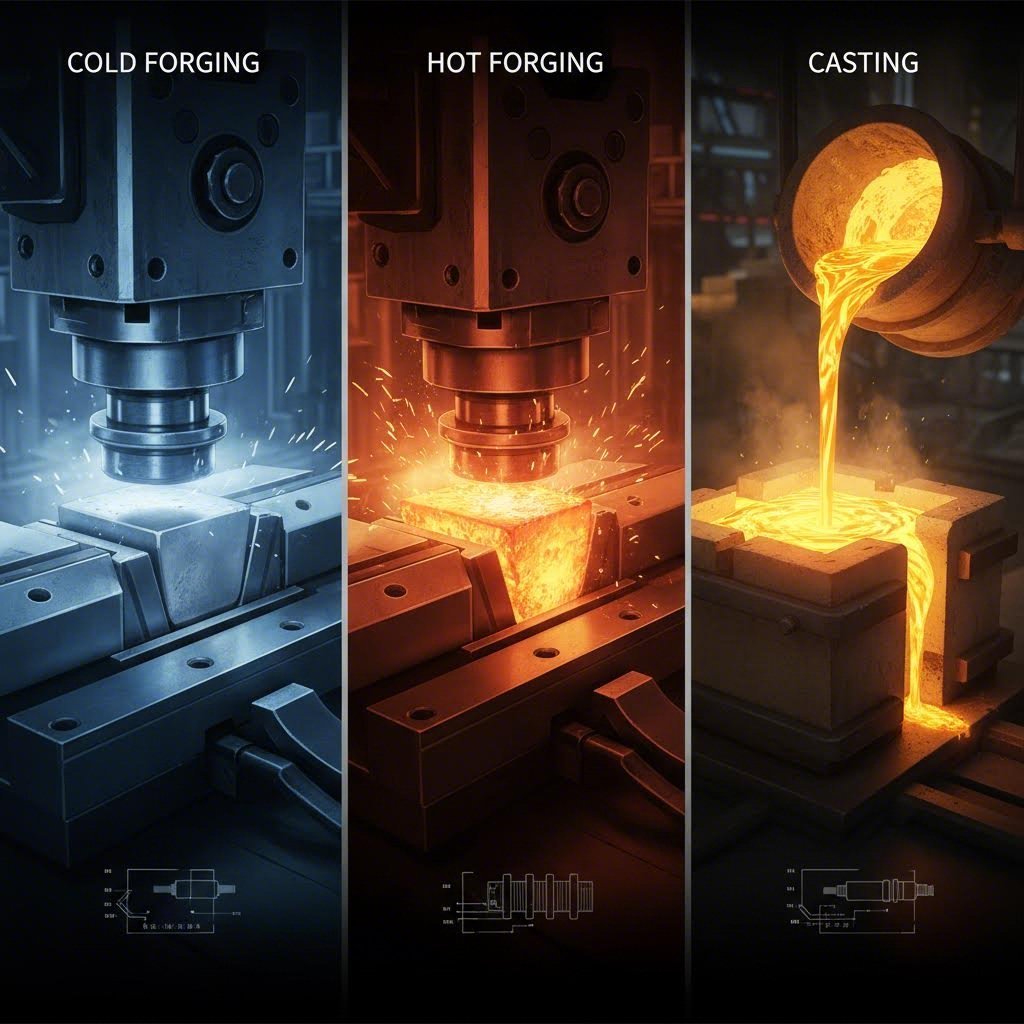
Cold Forging Versus Hot Forging and Casting Compared
You've seen which automotive components benefit from cold forging, but how do the numbers actually stack up against alternative manufacturing methods? When evaluating hot forging vs cold forging or considering casting as an option, procurement managers need concrete data—not vague generalizations. This comprehensive comparison provides the structured, side-by-side analysis you need to make informed sourcing decisions.
Decision Matrix for Automotive Engineers
The choice between forging methods and casting fundamentally depends on matching process capabilities to part requirements. Each approach excels in specific scenarios, and understanding these distinctions prevents costly mismatches between manufacturing method and application needs.
When comparing cold forging vs hot forging, the forging temperature of steel creates the primary distinction. Cold forging operates at or near room temperature, preserving work-hardened material properties. According to industry specialists, hot forging is performed at temperatures ranging from 1,100°F to 2,400°F depending on the material, making the metal more malleable for complex shapes but requiring additional energy and finishing operations.
Casting introduces an entirely different approach—molten metal poured into molds. As manufacturing experts explain, casting excels at producing complex shapes, internal cavities, and large parts with relatively low material waste and low per-part tooling cost for moderate geometries. However, the grain structure of cast parts lacks the continuous flow that makes forgings mechanically superior.
| Attribute | Cold Forging | Hot Forging | Casting | Best For |
|---|---|---|---|---|
| Dimensional Tolerance | ±0.025mm to ±0.1mm | ±0.5mm to ±2.0mm | ±0.5mm to ±3.0mm | Cold forging when tight tolerances are critical; casting acceptable for non-precision applications |
| Surface Finish (Ra) | 0.8-3.2 μm (excellent) | 3.2-12.5 μm (moderate) | 6.3-25 μm (requires finishing) | Cold forging eliminates secondary finishing; hot forgings and castings typically need machining |
| Material Utilization | 85-95% | 70-85% | 80-90% | Cold forging for minimal waste; casting for complex internal geometries |
| Typical Cycle Time | 1-5 seconds per part | 10-60 seconds per part | Minutes to hours | Cold forging for high-volume production; casting for large or complex low-volume parts |
| Tooling Cost | High ($50,000-$200,000+) | Moderate ($20,000-$100,000) | Low to moderate ($5,000-$50,000) | Casting for prototypes and low volumes; cold forging justified at high volumes |
| Production Volume Sweet Spot | 100,000+ parts annually | 10,000-100,000 parts annually | 100-50,000 parts annually | Match volume to tooling investment recovery |
| Part Complexity | Simple to moderate | Moderate to complex | Highly complex with internal features | Casting for internal cavities; hot forging for complex external geometry |
| Maximum Part Size | Limited (typically under 10 kg) | Large (up to 250+ kg) | Very large (limited by foundry capacity) | Hot forging or casting for large components |
| Mechanical Strength | Excellent (strain-hardened) | Very good (refined grain) | Good (may contain porosity) | Cold forging for maximum strength; hot forging for toughness; casting for non-critical applications |
| Fatigue Resistance | Superior | Very good | Moderate | Forging methods for cyclically loaded components |
| Energy Consumption | Low (no heating required) | High (furnace heating) | High (melting required) | Cold forging for sustainability goals |
Choosing the Right Forming Method
The comparison table reveals important patterns. Notice how cold forging dominates in dimensional accuracy and surface finish—achieving tight tolerances and excellent dimensional accuracy that reduce or eliminate secondary machining. This precision comes from the room-temperature process, which avoids the thermal expansion and contraction that occurs with hot forgings during cooling.
However, the forging temperature differences create trade-offs. Hot forging accommodates a broader range of metals, including those difficult to shape at room temperature, such as titanium and stainless steel. The elevated temperatures make material more malleable, enabling intricate designs and larger parts that would exceed cold forging's force limitations.
Casting fills a different niche entirely. According to manufacturing comparisons, casting is the only practical method for parts with internal features like engine water jackets—internal cavities that forging simply cannot produce. For automotive applications requiring complex internal passages, casting remains irreplaceable despite its mechanical property limitations.
What about tooling economics? The high initial investment for cold forging tooling—often $50,000 to $200,000 or more—demands careful volume analysis. This investment makes sense when producing hundreds of thousands of identical parts annually, where the per-piece cost advantage and elimination of secondary operations rapidly offset the upfront expenditure. For lower volumes or prototype development, casting's more affordable tooling often proves more economical despite higher per-unit costs.
When selecting between cold forging, hot forging, and casting for automotive applications, prioritize these decision criteria: Match mechanical property requirements to process capabilities—choose forging for strength-critical components and casting for complex geometries with internal features. Align tooling investment with production volume—cold forging's premium tooling costs require high-volume justification. Consider total cost of ownership including secondary operations—cold forging's superior finish often eliminates machining that hot forgings and castings require. Finally, evaluate material constraints—cold forging works best with ductile metals like low-carbon steels and aluminum alloys, while hot forging handles harder materials and casting accommodates virtually any alloy.
Understanding these trade-offs enables smarter sourcing decisions. Cold forging delivers undeniable advantages for high-volume, precision-critical automotive components where mechanical properties matter most. But the manufacturing landscape offers multiple valid approaches, and the best choice depends on matching process capabilities to your specific application requirements. Beyond performance considerations, modern automotive supply chains increasingly prioritize another factor: environmental sustainability—an area where cold forging offers compelling advantages worth examining.

Environmental and Sustainability Advantages
As automotive OEMs face mounting pressure to reduce carbon footprints across their supply chains, the manufacturing methods behind every component come under scrutiny. You might not immediately think of forging engineering as a sustainability conversation, but the advantages of forging at room temperature extend far beyond mechanical performance. Cold forging offers compelling environmental benefits that align perfectly with modern automotive industry sustainability goals.
Energy Savings Without Heating Furnaces
Imagine the energy required to heat steel above 900 degrees Celsius before shaping it—massive furnaces running continuously, consuming enormous quantities of natural gas or electricity. Now consider that cold forging eliminates this requirement entirely.
According to sustainability research, hot forming requires temperatures above 900 degrees Celsius, whereas cold forming requires only 350 degrees Celsius at maximum—and typically operates at room temperature. This means every hot process produces roughly three times more greenhouse gases than its cold forming counterpart.
For automotive manufacturers evaluating their Scope 3 emissions—the indirect emissions occurring throughout their supply chain—this difference matters enormously. When you source cold forged components instead of hot forged alternatives, you're selecting parts manufactured with dramatically lower energy consumption. This translates directly into reduced carbon emissions per component, helping you meet increasingly stringent OEM sustainability requirements.
Material Efficiency and Waste Reduction
Cold forming steel and other metals produces components remarkably close to their final dimensions—a concept known as near-net-shape manufacturing. Why does this matter for sustainability? Because every gram of material that doesn't become part of the finished component represents waste.
Industry experts explain that near net shape forgings are available with tolerances within 3mm on all dimensions, significantly reducing the stock that must be machined away. When parts are machined from basic profiles like blocks or rounds, significant stock is lost—but you still pay for that excess material. With cold forming processes, the part is shaped by dies, dramatically reducing material waste.
Consider the cumulative impact across high-volume automotive production. The benefits of forging through cold processes include:
- Material utilization rates of 85-95%: Cold forging converts nearly all input material into finished components, compared to machining from bar stock where 50% or more may become chips
- Reduced cutting fluid consumption: Minimal machining means less coolant usage, fewer disposal challenges, and lower associated environmental impact
- Decreased tool wear: Less secondary machining translates to fewer carbide inserts consumed and disposed of over production runs
- Lower scrap metal processing: Less swarf means reduced energy spent on chip recycling and reprocessing
- Elimination of heating-related scale: Hot forging produces oxide scale that must be removed and managed; cold forging produces clean surfaces without this waste stream
These material efficiency gains compound throughout the supply chain. As manufacturing specialists note, unseen savings include time to reorder cutting bits, restock cutting fluids, and recycle metal swarf—all environmental touchpoints that cold forging minimizes.
Reduced Emissions and Lifecycle Benefits
The environmental advantages extend beyond energy and material savings. Sustainability research confirms that cold forming processes are better for the environment since they use less energy. Due to the lack of heating steps, there are also fewer emissions from fuel combustion, as well as a more pleasant working environment for employees.
From a lifecycle perspective, cold forged components offer additional sustainability benefits. The enhanced mechanical properties—increased hardness, superior fatigue resistance, and better dimensional stability—mean these parts typically last longer than alternatives. Longer-lasting components reduce replacement frequency, which in turn reduces the cumulative environmental impact of manufacturing, shipping, and installing replacement parts over a vehicle's service life.
Cold forged parts also remain fully recyclable at end of life. Unlike some manufacturing processes that introduce contaminants or coatings difficult to separate during recycling, cold forging produces clean metal components that integrate seamlessly into established automotive recycling streams.
For procurement teams navigating increasingly demanding OEM sustainability scorecards, cold forming processes provide documented environmental advantages that strengthen supplier qualification. As the automotive industry accelerates its sustainability transformation, manufacturing methods matter—and cold forging delivers measurable improvements that support greener supply chains. However, this process isn't suitable for every application, and understanding its limitations proves equally important for making informed sourcing decisions.
Limitations and Material Constraints to Consider
Here's the honest truth that most manufacturers won't tell you: cold forging isn't the right solution for every automotive component. While the advantages we've covered are genuine and substantial, making informed sourcing decisions requires understanding where this process struggles. Let's examine the constraints that determine whether you can cold forge a specific part—or whether you should consider alternative manufacturing methods.
Material Selection Criteria and Constraints
What is cold formed steel best suited for? The answer depends entirely on the material's ability to deform plastically at room temperature without cracking or failing. According to cold forging specialists, since the process utilizes plasticity at room or near room temperature, the material needs to have a low work hardening characteristic and some degree of deformability.
Cold forging operations work exceptionally well with certain metals. These materials flow readily under pressure, accept significant deformation without fracturing, and emerge stronger due to strain hardening:
- Low to medium carbon steels (up to 0.45% carbon): The workhorse materials for automotive cold forging—ductile enough to flow into dies while developing excellent strength through work hardening
- Aluminum alloys: Their natural plasticity makes them ideal candidates for cold forming of metals, particularly for lightweight automotive components where strength-to-weight ratio matters
- Copper and brass: As materials experts explain, copper is soft and ductile, making it widely used in applications where easy processing is essential—one of the reasons it's suitable for cold forge operations
- Certain stainless steel grades: Austenitic grades with sufficient ductility can be cold forged, though they require higher forces and specialized tooling
However, not every metal cooperates with room-temperature forming. Cold forming metal becomes problematic—or impossible—with these materials:
- High-carbon steels (above 0.50% carbon): Excessive hardness causes cracking during deformation; these materials require hot forging where elevated temperatures restore ductility
- Pre-hardened or heat-treated alloys: Materials already hardened through prior processing resist plastic flow and may shatter under cold forging pressure
- Titanium and its alloys: The high yield strength and limited ductility at room temperature make cold forging impractical for most titanium automotive applications
- High-strength tool steels: These alloys are designed to resist deformation—exactly the opposite of what cold forging requires
- Certain nickel-based superalloys: Work hardening occurs so rapidly that the material becomes unworkable before achieving the desired shape
According to manufacturing specialists, certain alloys or metals may be prone to cracking or failure when subjected to cold working—a fundamental constraint that no amount of process optimization can overcome.
Geometry and Size Constraints
Even when working with suitable materials, cold forging imposes geometric limitations that automotive engineers must respect. The process excels at producing symmetrical, relatively simple shapes but struggles with complex three-dimensional geometries.
Wall thickness restrictions present particular challenges. Very thin sections may not fill completely during forming, while extremely thick sections require forces that exceed practical press capacities. The ratio between different section thicknesses within a single part also matters—dramatic variations create uneven material flow and potential defects.
Size constraints relate directly to available press force. Forging metals at room temperature requires significantly higher forces than hot forging the same materials. As industry sources note, cold forming imposes certain limits on the extent of deformation achievable without causing material failure or defects. For automotive applications, this typically means cold forged parts remain under 10 kilograms—larger components generally require hot forging or alternative processes.
Complex undercuts, internal cavities, and intricate surface details that casting produces easily may prove impossible through cold forging. If your part design requires internal passages or dramatically varying cross-sections, you'll need to consider alternative manufacturing methods.
When to Consider Alternative Forming Methods
Tooling economics represent perhaps the most significant practical constraint. Cold forging dies must withstand enormous pressures—often exceeding 1,000 tons—while maintaining precise dimensions through millions of cycles. According to process economics research, dies are required with substantial initial costs and manufacturing lead times, making cold forging unsuitable for small lots where tooling investment cannot be amortized across sufficient volume.
Die wear patterns also affect material selection decisions. Harder workpiece materials accelerate die wear, increasing per-part costs and requiring more frequent tooling replacement. When forging metals with higher hardness levels, the economics shift—at some point, the tooling cost penalty outweighs the process advantages.
Force requirements for harder materials compound these challenges. Cold forging stainless steel or higher-carbon alloys demands significantly more press tonnage than forming mild steel. Your forging partner must have equipment capable of delivering these forces consistently—not every cold forging operation can accommodate harder materials.
What should you do when cold forging isn't suitable? Consider these alternatives based on your specific constraints:
- Hot forging: When material hardness, part size, or geometry complexity exceeds cold forging capabilities
- Warm forging: A compromise approach using moderate temperatures (200-700°C) that improves formability while retaining some dimensional accuracy advantages
- Casting: When internal features, extreme complexity, or lower volumes make forging tooling investment unjustifiable
- Machining from bar stock: For prototypes, very low volumes, or highly complex geometries where no forming process suffices
This honest assessment of limitations actually strengthens the case for cold forging where it does excel. Understanding constraints helps you match manufacturing methods to requirements precisely—selecting cold forging for applications where it delivers maximum value while choosing alternatives where they perform better. Beyond material and geometry considerations, quality assurance protocols ensure that cold forged components meet the exacting standards automotive applications demand.

Quality Control Standards for Automotive Forging
How does forging work when it comes to ensuring every component meets automotive safety requirements? The answer lies not just in the forming process itself, but in the comprehensive quality control systems that govern every stage of production. For automotive applications—where a single defective component could compromise vehicle safety—rigorous quality assurance isn't optional. It's the foundation upon which reliable cold forged parts are built.
IATF 16949 and Automotive Quality Standards
What is metal forging quality without proper certification? In the automotive industry, the answer is simple: it's unacceptable. The IATF 16949 standard represents the benchmark quality management system requirement for automotive suppliers worldwide. This certification goes far beyond basic ISO 9001 requirements, emphasizing defect prevention, reduction of variation and waste, and continuous improvement throughout the supply chain.
According to certified automotive forging operations, IATF certification demonstrates a consistent commitment to customer satisfaction and quality of products and services. Both internal and external audits of quality management system documentation verify that certified manufacturers maintain high-standard quality management systems in place.
For procurement managers evaluating cold forging suppliers, IATF 16949 certification signals several critical capabilities:
- Risk-based thinking: Certified suppliers proactively identify and mitigate potential quality issues before they affect production
- Complete traceability: Every component can be traced back through raw materials, processing parameters, and inspection results
- Continuous improvement: Systematic processes drive ongoing enhancement of quality and efficiency
- Customer-specific requirements: Certified systems accommodate the unique quality protocols that major OEMs mandate
Beyond IATF 16949, automotive forging operations often maintain additional certifications relevant to specific customer requirements. OEM-specific quality protocols—such as Ford's Q1 award or GM's Supplier Quality Excellence recognition—indicate suppliers that distinguish themselves by going above and beyond baseline requirements, helping OEMs provide customers with the highest quality in the automotive industry.
Certified manufacturers like Shaoyi (Ningbo) Metal Technology demonstrate quality commitment through IATF 16949 certification and rigorous quality control processes. This certification ensures their precision forging capabilities meet the demanding standards automotive applications require.
Testing Protocols for Cold Forged Components
Certification provides the framework, but specific testing protocols ensure each component meets specifications. The steel forging process demands multiple inspection methods, each targeting different quality attributes that affect component performance in service.
According to forging quality specialists, due to the challenging operating conditions that forgings typically face—such as high temperatures, pressures, and heavy loads—the requirements for their dimensional accuracy, shape, and internal quality are extremely stringent. To ensure forgings meet these high standards, rigorous measurement and inspection processes must be followed.
Dimensional Inspection
Cold forging machine precision depends on verifying that finished components match design specifications exactly. Dimensional inspection employs multiple measurement technologies:
- Coordinate measuring machines (CMM): Provide three-dimensional verification of complex geometries to micron-level accuracy
- Optical comparators: Enable rapid visual verification of profile dimensions against master templates
- Micrometers and calipers: Deliver precise measurements of critical diameters, lengths, and thicknesses
- Automated gauging systems: Enable 100% inspection of critical dimensions during high-volume production
Hardness Testing
Since cold forging operation relies on work hardening to achieve material strength, verifying hardness confirms that the forming process delivered expected mechanical properties. Testing methods include:
- Rockwell testing: Uses diamond or steel ball indenters to measure surface hardness quickly—ideal for production floor verification
- Brinell testing: Measures indentation diameter to determine hardness in softer materials or larger components
- Vickers testing: Employs diamond pyramid indenters for precise hardness mapping across small or thin components
Metallurgical Analysis
Examining the internal grain structure confirms that cold forging press operations achieved proper material flow. Metallurgical testing verifies grain flow alignment, identifies any internal defects, and confirms the microstructure meets material specifications. Cross-sectioning sample parts and examining them under microscopy reveals whether the cold forging operation optimized the grain structure as intended.
Fatigue and Strength Testing
Strength testing typically involves tensile or compression testing, where the forging is subjected to controlled forces to determine tensile strength, yield strength, elongation, and other critical parameters. For automotive components that experience cyclical loading, fatigue testing subjects samples to repeated stress cycles until failure—verifying that parts will survive the millions of load cycles expected during vehicle service life.
Non-Destructive Testing (NDT)
Perhaps most critical for safety components, NDT methods detect internal and surface flaws without destroying the part. According to quality assurance specialists, forged components often undergo non-destructive testing methods like ultrasonic testing, magnetic particle inspection, or dye penetrant testing to detect internal or surface flaws:
- Ultrasonic testing (UT): High-frequency sound waves detect internal voids, cracks, or inclusions invisible to visual inspection
- Magnetic particle testing (MT): Reveals surface and near-surface cracks in ferromagnetic materials by attracting magnetic particles to defect locations
- Liquid penetrant testing: Identifies surface-breaking defects by applying penetrant that seeps into cracks and becomes visible under inspection lighting
- Radiographic testing (RT): X-ray or gamma ray imaging reveals internal defect locations and characteristics
Quality Control Stages in Cold Forging Production
As forging quality experts emphasize, quality assurance in forging is not just a checkpoint at the end of production—it is an integrated discipline that spans design, material selection, process control, and final inspection. For cold forged automotive components, quality control occurs at every stage:
- Raw material verification: Incoming steel billets undergo chemical composition analysis, dimensional verification, and surface inspection before entering production. Material certifications confirm that only approved grades meeting automotive specifications are processed.
- Pre-production validation: Process simulation and first-article inspection verify that tooling, press parameters, and material flow will produce conforming parts. Statistical Process Control (SPC) baselines are established for critical dimensions.
- In-process monitoring: Real-time measurement systems track critical parameters during cold forging press operations. Advanced facilities employ auto-gauge feedback and real-time process control to detect deviations immediately.
- Post-forming inspection: Dimensional verification, hardness testing, and visual inspection confirm that formed parts meet specifications. Statistical sampling ensures consistent quality across production runs.
- Non-destructive testing: Components destined for safety-critical applications undergo ultrasonic, magnetic particle, or other NDT methods to detect any internal or surface defects invisible to standard inspection.
- Final validation and documentation: Completed parts receive final dimensional verification, packaging inspection, and complete documentation linking each lot to raw material certifications, processing records, and inspection results.
Traceability in Automotive Supply Chains
Emerging quality standards increasingly consider complete traceability—from raw material to finished component. Automotive OEMs now expect suppliers to maintain digital records enabling any part to be traced back through its complete production history. Advanced marking technologies, digital quality management systems, and blockchain-based traceability tools are becoming standard expectations for tier-one automotive suppliers.
This traceability requirement serves multiple purposes: it enables rapid root cause analysis when quality issues arise, supports warranty claim investigation, and provides accountability documentation that regulators and customers increasingly demand. For cold forging operations serving the automotive industry, robust traceability systems aren't just nice to have—they're essential for maintaining OEM relationships.
Quality assurance transforms the inherent advantages of cold forging into reliable, consistent component performance. But beyond quality considerations, how do you identify the right forging partner to deliver these capabilities? The evaluation criteria extend beyond certifications to encompass engineering support, production flexibility, and supply chain considerations that affect your total cost of ownership.
Selecting the Right Forging Partner for Your Supply Chain
You've evaluated the technical advantages, understood the material constraints, and confirmed the quality standards required. Now comes the critical decision: which cold forging supplier becomes your strategic partner? This choice extends far beyond comparing piece prices on quotation sheets. The right forging partner transforms your supply chain efficiency, accelerates product development, and delivers total cost of ownership savings that far exceed per-part cost differences.
Supplier Evaluation Criteria for Procurement Teams
What is cold forged component sourcing really about? It's about finding partners whose capabilities align precisely with your production requirements and development timelines. According to industry sourcing specialists, a fast and effective way to compare forging suppliers is to evaluate their capabilities using a structured approach that examines forging capacity, precision expertise, machining capability, and inspection systems.
When evaluating potential cold forming technology partners, consider these essential capability areas:
Production Capabilities
Your supplier's equipment determines what they can actually manufacture. Assess cold forming press capacity—tonnage ratings indicate the size and complexity of parts achievable. Volume capacity matters equally; some facilities excel at prototyping and low-volume runs while others optimize for high-volume mass production. The ideal partner matches your current requirements while offering scalability for future growth.
As sourcing experts explain, press tonnage and equipment specifications ensure the supplier can handle your size, weight, and material requirements. Don't assume capabilities—request specific equipment lists and capacity documentation.
Quality Certifications
Beyond IATF 16949 certification discussed earlier, examine the depth of quality systems. Does the supplier maintain customer-specific certifications for your primary OEMs? What are forgings inspection capabilities at each production stage? Request quality metrics: PPM defect rates, on-time delivery percentages, and corrective action response times. These numbers reveal operational reality beyond certification paperwork.
Engineering Support
In-house engineering separates transactional suppliers from true partners. Design optimization expertise can reduce your component costs before production begins—material selection guidance, geometry modifications for improved formability, and tolerance analysis that balances quality requirements against manufacturing economics. As engineering specialists note, design optimization achieves weight reduction, improved performance, and cost efficiency through smart engineering and material selection.
Partners like Shaoyi (Ningbo) Metal Technology offer in-house engineering that ensures robust components like suspension arms and drive shafts meet exact specifications. This collaborative engineering approach catches potential issues during design phase rather than after tooling investment.
Prototyping Speed
Development timelines increasingly compress as automotive programs accelerate. Rapid prototyping capabilities directly impact your time-to-market. According to prototyping specialists, flexible processes support both rapid prototyping and seamless transition to high-volume manufacturing, enabling you to validate designs, test materials, and refine concepts quickly and cost-effectively.
Consider suppliers offering rapid prototyping in as little as 10 days—a capability that Shaoyi provides, enabling faster design iteration and shorter development cycles. This speed advantage compounds across multiple revision cycles during typical automotive development programs.
Balancing Cost, Quality, and Lead Time
Procurement decisions too often focus exclusively on piece price. This narrow view misses the total cost of ownership calculation that actually determines supply chain economics.
Beyond Piece Price: Total Cost Analysis
What is cold rolled steel forming cost when you factor in secondary operations? A slightly higher piece price from a supplier delivering tighter tolerances may eliminate machining steps entirely—reducing total cost despite higher per-part pricing. Similarly, suppliers with superior surface finish quality may reduce your finishing operations, painting prep work, or quality inspection burden.
Consider these hidden cost factors:
- Secondary operation requirements: What machining, heat treatment, or finishing does each supplier's output require?
- Quality rejection rates: Higher incoming defect rates generate inspection costs, rework expenses, and production disruptions
- Inventory carrying costs: Longer lead times force higher safety stock levels, tying up working capital
- Engineering change responsiveness: Rigid suppliers slow your development iterations; flexible partners accelerate time-to-market
- Communication overhead: Time zone differences and language barriers create coordination costs that don't appear on invoices
Geographic Considerations
Supply chain efficiency increasingly depends on logistics optimization. Port proximity for global shipping reduces transit times and freight costs while improving supply chain resilience. Suppliers located near major shipping hubs offer faster delivery options and more frequent shipping schedules.
Shaoyi's strategic location near Ningbo Port exemplifies this advantage—enabling fast global delivery that supports just-in-time manufacturing programs while reducing logistics complexity for international customers.
Essential Questions for Potential Forging Suppliers
Before finalizing your supplier selection, ensure you've gathered complete information by addressing these critical questions:
- What metal forging process capabilities do you offer, and what are your equipment capacity limits (tonnage, part size, material thickness)?
- What is your typical prototype-to-production timeline, and can you provide examples of recent rapid development programs?
- How does your in-house engineering team support design optimization, and what cost or performance improvements have you achieved for similar components?
- What certifications do you maintain beyond IATF 16949, and which OEM-specific requirements have you satisfied?
- What are your actual quality metrics—PPM defect rates, on-time delivery percentages, and customer satisfaction scores?
- How do you handle engineering changes during production runs, and what is your typical response time for design modifications?
- What is your geographic proximity to major shipping ports, and what logistics options do you offer for international customers?
- Can you provide customer references for similar automotive applications, ideally from OEMs or tier-one suppliers in your target market?
- What traceability systems do you maintain, and how do you document material certifications and processing records?
- How do you scale from prototype quantities to full production volumes, and what lead time changes should we expect?
The right cold forging partner delivers value beyond competitive pricing—they accelerate your development timelines through rapid prototyping, optimize your designs through engineering collaboration, and strengthen your supply chain through reliable quality and strategic geographic positioning.
Selecting a forging partner represents a strategic decision that affects your supply chain performance for years. Take time to evaluate capabilities thoroughly, visit facilities when possible, and build relationships with engineering teams who will support your development programs. The advantages of cold forging car parts multiply when paired with the right manufacturing partner—one who understands automotive requirements, maintains rigorous quality systems, and positions themselves to serve your global supply chain efficiently.
Frequently Asked Questions About Cold Forging Car Parts
1. What are the benefits of cold forging for automotive components?
Cold forging delivers superior mechanical properties including 10-20% higher tensile strength through strain hardening, improved fatigue resistance from continuous grain flow alignment, and enhanced surface hardness without secondary heat treatment. The process achieves dimensional tolerances of ±0.025mm to ±0.1mm, often eliminating machining operations. Additionally, cold forging uses 85-95% of input material, produces excellent surface finishes (0.8-3.2 μm Ra), and consumes significantly less energy than hot forging since no heating furnaces are required.
2. What are the disadvantages of cold forging?
Cold forging has notable limitations including material restrictions—high-carbon steels above 0.50% carbon, titanium, and pre-hardened alloys are unsuitable as they crack during room-temperature deformation. Geometry constraints limit part complexity and size, typically under 10 kg. High initial tooling costs ($50,000-$200,000+) require volumes exceeding 100,000 parts annually for economic justification. The process also requires higher forces for harder materials, accelerating die wear and increasing per-part costs for certain alloys.
3. Why is cold forging better than hot forging for certain car parts?
Cold forging outperforms hot forging for precision-critical automotive components because room-temperature processing avoids thermal expansion and contraction, achieving tolerances 10-20 times tighter than hot forging. Parts emerge with superior surface finish, reducing or eliminating secondary machining. The strain-hardening effect produces stronger components without additional heat treatment. Energy consumption drops dramatically without heating furnaces, supporting OEM sustainability goals. However, hot forging remains preferable for larger components, complex geometries, or materials like titanium that resist cold deformation.
4. Which automotive parts are best suited for cold forging?
Cold forging excels for high-stress, precision-critical components across vehicle systems. Powertrain applications include transmission gears, pinion shafts, and CV joint components requiring superior torque transmission and wear resistance. Steering systems benefit through cold forged tie rod ends and steering knuckles demanding exact tolerances for safety. Suspension components like control arm bushings and ball joint housings leverage enhanced fatigue resistance. Safety-critical parts including seatbelt anchors and airbag components require the zero-defect reliability that cold forging's uniform material properties deliver.
5. How do I choose the right cold forging supplier for automotive parts?
Evaluate suppliers across multiple criteria: verify IATF 16949 certification and OEM-specific quality approvals; assess equipment capacity matching your part size and volume requirements; confirm in-house engineering support for design optimization; request actual quality metrics including PPM defect rates and on-time delivery percentages. Consider prototyping speed—leading suppliers like Shaoyi deliver prototypes in as little as 10 days. Geographic positioning near major ports like Ningbo enables faster global shipping. Request references from similar automotive applications and examine total cost of ownership including secondary operations, not just piece price.