 Small batches, high standards. Our rapid prototyping service makes validation faster and easier —
  EN
EN


A Quantitative Cost-Benefit Analysis of Near-Net Shape Extrusion

TL;DR
A cost-benefit analysis of near-net shape extrusion confirms its significant economic advantages, reducing production costs by an estimated 46% to 58% and weight by up to 7% compared to conventional manufacturing techniques. These substantial savings are primarily driven by minimizing material waste and drastically reducing the need for costly, time-consuming post-process machining. The method proves to be a highly efficient strategy for medium- to high-volume production of complex parts.
Understanding Near-Net Shape (NNS) Manufacturing
Near-net shape (NNS) manufacturing is a production philosophy aimed at creating components that are as close as possible to their final, or "net," dimensions. Unlike traditional methods that might start with a solid block of material and remove a large portion of it, NNS processes like extrusion shape the material into a form that requires only minimal finishing. This approach fundamentally balances production speed, material efficiency, and final part precision.
The distinction from "net shape" manufacturing is crucial. A true net shape part requires no finishing work whatsoever, which is often difficult and expensive to achieve. Near-net shape acknowledges that minor secondary processing, such as light machining or grinding, may be necessary to meet the tightest tolerances. This pragmatic compromise significantly reduces overall production costs and complexity by minimizing the most labor-intensive and wasteful stages of fabrication.
The near-net shape extrusion process typically involves heating a cylindrical billet of metal, such as aluminum, and forcing it through a hardened steel die with a precisely shaped opening. This action forms a continuous profile with the exact cross-section of the die. The resulting part is long and has a consistent shape, which can then be cut to the required lengths. Because the profile already contains the intricate features of the final design, the need to machine those features from scratch is eliminated, saving immense amounts of time, energy, and material.
Quantitative Cost-Benefit Analysis: The Economic Advantages
The primary driver for adopting near-net shape extrusion is its profound impact on production costs. The economic benefits are not marginal; they represent a fundamental shift in manufacturing efficiency, as demonstrated by extensive analysis in industries from aerospace to automotive. These advantages can be broken down into several key areas.
Reduced Material Costs and Waste
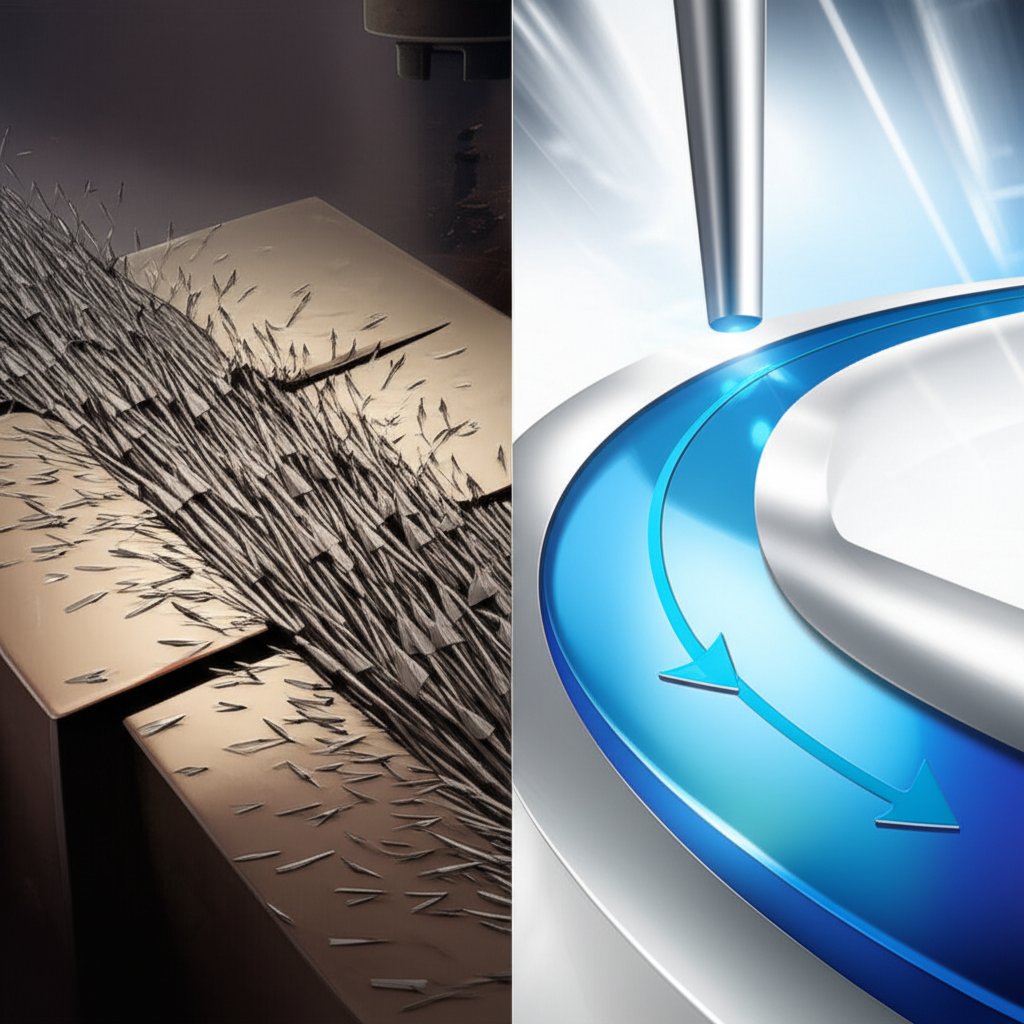
Perhaps the most direct financial benefit of NNS extrusion is the drastic reduction in material waste. Traditional subtractive manufacturing, such as CNC machining, can result in over 50% of the initial material block being cut away as scrap. NNS extrusion, by contrast, forms the material into the required profile, using only what is necessary for the part itself. According to a detailed cost-benefit analysis by NASA, this efficiency is a major contributor to overall cost savings. This not only lowers the expense of purchasing raw materials but also reduces the associated costs of scrap handling and recycling.
Lower Machining and Labor Expenses
By producing a part that is already very close to its final dimensions, NNS extrusion eliminates or significantly reduces the need for secondary machining operations. This leads to a cascade of savings: fewer machine hours are needed, tool wear is minimized, and the demand for skilled machinist labor decreases. A technical report from NASA on Advanced Near Net Shape Technology quantified these combined effects, reporting a 46% to 58% reduction in total production costs compared to conventional metallic fabrication methods. This highlights how minimizing post-processing is central to the economic viability of the technique.
Optimized Tooling and Lead Times
While there is an initial investment in creating an extrusion die, this cost is often significantly lower than the tooling for other processes like casting or injection molding. An extrusion die can cost a few thousand dollars, whereas complex molds can cost tens of thousands. Furthermore, the lead time to produce an extrusion die is typically just a few weeks, compared to several months for more complex tooling. This accelerates the entire production timeline, allowing products to get to market faster and enabling more agile design iteration.
Beyond the Balance Sheet: Engineering and Operational Benefits
The value of near-net shape extrusion extends beyond direct cost savings. It offers significant engineering advantages that can lead to superior products and more efficient operations. These benefits contribute to a holistic business case for the technology.
A key advantage is weight reduction. The same NASA study that highlighted cost savings also noted a 7% reduction in weight for the components analyzed. Extrusion allows for the creation of complex, hollow, and internally ribbed profiles that are optimized for strength-to-weight ratio—a critical factor in aerospace, automotive, and transportation industries. Another powerful benefit is part consolidation. A single, intricately designed extrusion can often replace an assembly of multiple smaller components. This simplifies the product's bill of materials (BOM), streamlines the supply chain, reduces assembly time and labor, and eliminates potential points of failure like welds or fasteners.
For industries like automotive where precision is critical, partners specializing in custom aluminum extrusions are essential. For instance, Shaoyi Metal Technology provides a comprehensive service, from rapid prototyping to IATF 16949 certified production, delivering highly customized lightweight components. This integrated approach ensures that the engineering benefits of NNS extrusion are fully realized. Finally, the process itself can enhance the mechanical properties of the material. The pressure and flow of extrusion work-harden the metal and create a favorable grain structure, often resulting in a stronger, more durable part with an excellent surface finish.

Comparative Analysis: NNS Extrusion vs. Alternative Methods
Choosing the right manufacturing process depends on factors like production volume, part complexity, and cost targets. Near-net shape extrusion has a distinct place among other common methods. The following table provides a comparative overview:
| Feature | Near-Net Shape Extrusion | Traditional Machining (Subtractive) | Additive Manufacturing (3D Printing) |
|---|---|---|---|
| Material Waste | Low | High | Very Low |
| Production Speed (per part) | High | Low to Medium | Very Low |
| Initial Tooling Cost | Medium to High (Die) | Low | None |
| Geometric Complexity | High (in 2D profile) | High (with multiple setups) | Very High (in 3D) |
| Ideal Production Volume | Medium to High | Low to Medium | Low (Prototypes, Custom) |
| Per-Part Cost (at scale) | Low | High | High |
In summary, NNS extrusion is the ideal choice for medium- to high-volume production of parts with a consistent cross-section, where low per-part cost and high throughput are critical. Traditional machining remains viable for prototypes and low-volume runs where tooling costs are prohibitive. Additive manufacturing excels at creating highly complex, one-off parts or prototypes but is generally not cost-effective for mass production.
Frequently Asked Questions
1. Is extrusion cost-effective?
Yes, custom extrusion is exceptionally cost-effective, particularly for medium- to high-volume production runs. The process significantly saves money by optimizing material usage, which can reduce waste by over 50% compared to machining. Furthermore, it lowers costs by minimizing the need for secondary operations and consolidating multiple components into a single part, which reduces assembly labor and simplifies the supply chain.
2. What is the difference between net shape and near-net shape?
The primary difference lies in the need for finishing. A "net shape" part is manufactured to its exact final dimensions and requires no subsequent processing. A "near-net shape" part is produced very close to its final dimensions but is designed to undergo minimal finishing, such as light machining or grinding, to achieve final tolerances. The near-net shape approach is often more practical and cost-effective as it avoids the extreme expense and difficulty of achieving a perfect net shape directly from the primary process.