 Small batches, high standards. Our rapid prototyping service makes validation faster and easier —
  EN
EN


What Is a 5 Axis CNC Machine? How It Cuts Complex Parts in One Setup
What a 5 Axis CNC Machine Means
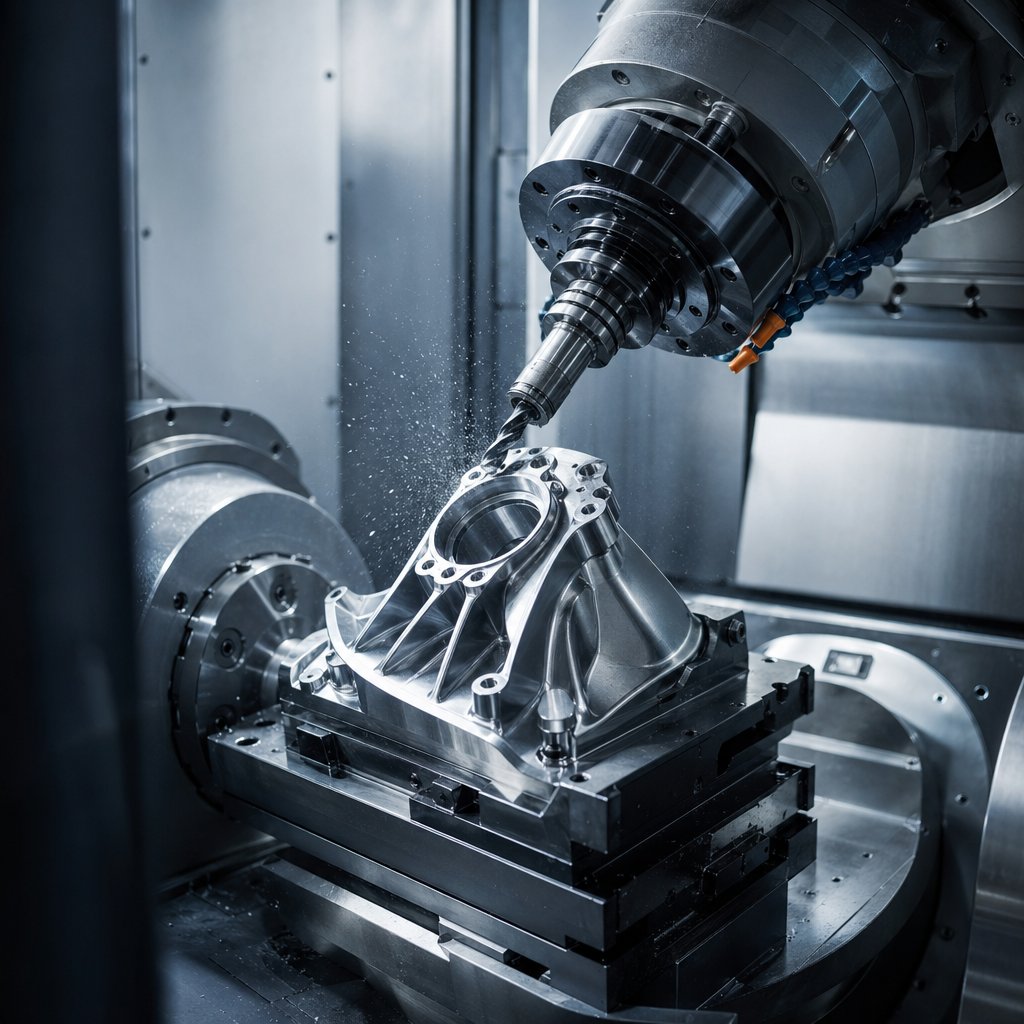
If you are wondering what is a 5 axis cnc machine, here is the plain answer first. It is a CNC machine that cuts a part using five kinds of motion: three straight-line movements and two rotary movements. Because the tool or the part can tilt and turn, the machine can reach more faces and angles without stopping for repeated manual re-clamping.
A 5 axis CNC machine is a multiaxis machine tool that uses X, Y, and Z linear motion plus two rotary axes to machine more sides of a part in fewer setups.
What Is a 5 Axis CNC Machine in Plain Language
Think of a basic mill cutting the top of a block. A five-axis cnc machine can do much more than that. It can approach the workpiece from angled positions, reach curved surfaces, and machine several sides with far less repositioning. That is the core of what 5 axis cnc means in everyday shop terms.
A common beginner question is, what is 5 axis cnc compared with regular CNC? The easiest way to picture it is this: standard machines mostly move left-right, front-back, and up-down. A 5 axis cnc machine adds two tilting or rotating motions, which opens up better access to the part.
- Three axes are linear movements.
- Two axes are rotary movements.
- More surfaces can be machined in one setup.
- It is a type of multiaxis machining, but not every multiaxis machine is 5-axis.
Why 5 Axis CNC Is Different From Standard CNC
Standard CNC usually refers to 3-axis machining. That works well for many flat or simple parts, but it often needs extra setups for angled features or multiple faces. A five-axis cnc machine reduces those interruptions. It does not mean every job needs five axes, only that the machine has that added capability when geometry demands it.
What Readers Will Learn Next
The name sounds simple, but the real meaning sits inside the axis labels themselves. X, Y, and Z are easy to picture. The rotary axes are where many readers get lost, especially because different machine designs assign them in different ways.
What the Five Axes Actually Are
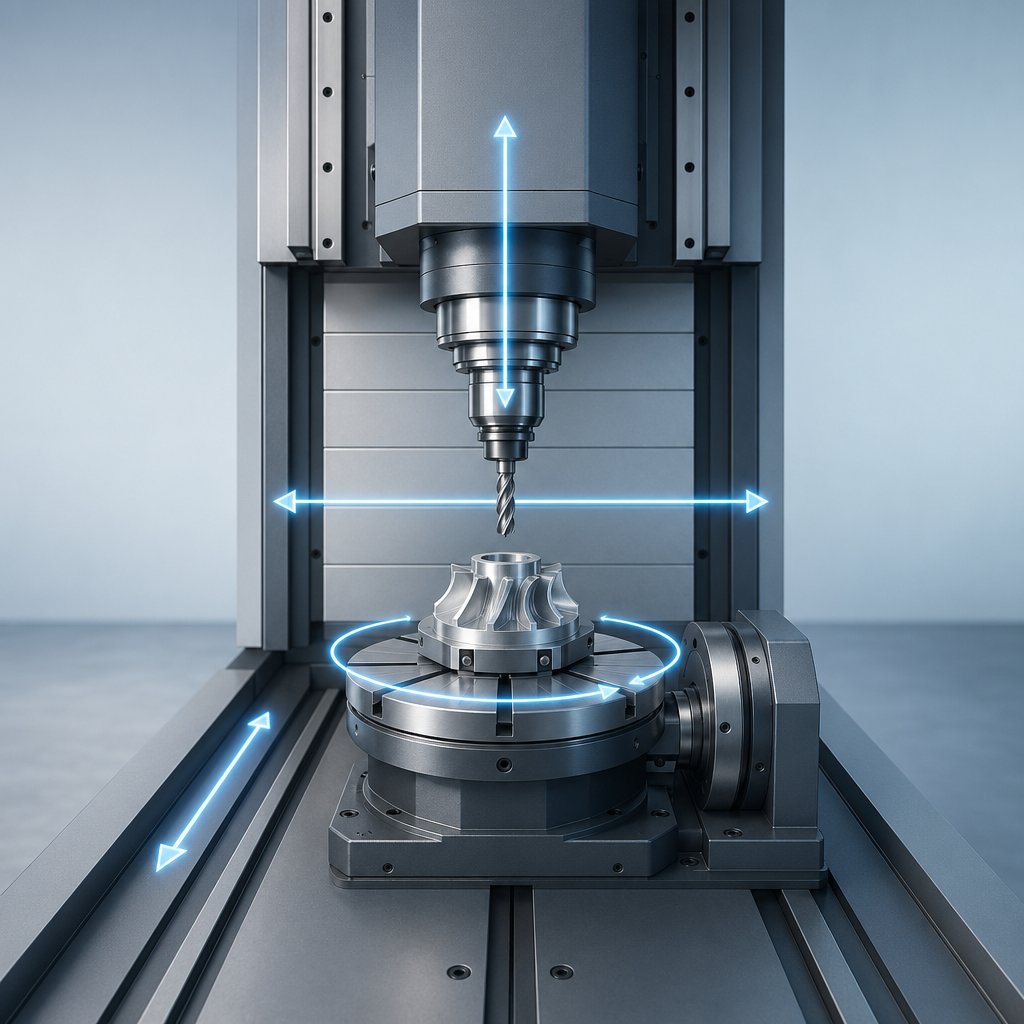
People often ask, what are the 5 axis on a cnc machine, but the answer gets clearer when you split them into two groups. Three axes move in straight lines. Two axes rotate around those straight-line directions. In other words, a 5-axis machine always has X, Y, and Z, then adds any two rotary axes chosen from A, B, and C. That is the basic logic behind every cnc axis layout, even though the hardware can look very different from one machine to another.
Understanding X Y and Z on a CNC Machine
X, Y, and Z are the linear axes. They describe straight travel of the cutting tool, the table, or both. On many vertical mills, X moves left to right, Y moves front to back, and the z axis for cnc motion handles up and down travel. These three directions form the base coordinate system that machinists use to locate features, set work offsets, and describe tool movement.
| Axis name | Motion type | What rotates or moves | Why it matters to machining access |
|---|---|---|---|
| X | Linear | Tool, table, or saddle moves left and right | Positions the cutter across the width of the part |
| Y | Linear | Tool, table, or saddle moves front to back | Reaches features along the depth of the part |
| Z | Linear | Spindle or table moves up and down | Controls cutting depth and vertical approach |
| A | Rotary | Rotation around the X axis | Tilts the part or tool to expose angled faces |
| B | Rotary | Rotation around the Y axis | Changes approach angle for side and contour access |
| C | Rotary | Rotation around the Z axis | Turns the part or spindle around its vertical centerline |
How A B and C Rotational Axes Work
If you have ever wondered how many axis are there beyond X, Y, and Z, the rotary choices are A, B, and C. They are named by the linear axis they rotate around. So A rotates around X, B around Y, and c axis motion rotates around Z. A 5-axis machine does not use all three rotary options at once. It uses two of them, paired with the three linear axes.
Why Axis Naming Can Change by Machine Design
Here is where machine design matters. One builder may rotate the table. Another may tilt the spindle head. A third may split motion between the head and table. The axis letters still follow the same naming rule, but the physical source of movement can change. That is why the same cnc machine axis label may describe different hardware layouts on different machines. The labels tell you the direction of motion. The machine structure tells you who is doing the moving. And that distinction becomes important when those axes start working together around a real part.
How 5 Axis CNC Machining Operates
Axis labels matter most when metal starts coming off the part. In real 5 axis cnc machining, the machine reaches more surfaces by coordinating three linear moves with two rotary moves at the same time or in tightly planned sequence. The spindle may tilt, the table may rotate, or both may move together. That motion changes the tool's approach angle so it can cut side walls, compound angles, and curved areas without constant manual re-clamping.
How a 5 Axis CNC Machine Reaches More Surfaces
On the shop floor, this is less mysterious than it sounds. A CAM program defines not only where the cutter travels in X, Y, and Z, but also when the rotary axes turn. As KEJIE describes, the control synchronizes the spindle, linear axes, and rotary table or tilting head so the tool can approach the workpiece from better directions. The machine does not cut every face at once. It keeps reorienting the tool or part so the cutting edge stays in a productive position.
- The workpiece is clamped on a fixture, trunnion, or rotary table.
- The CAD and CAM data generate a toolpath with position and angle changes.
- The control executes linear travel and rotary motion together.
- Roughing and finishing passes reach different faces as the part or spindle tilts.
- Tools can change during the cycle while the workpiece often remains in one setup.
Why Tilting the Tool or Part Improves Access
Angle control is what makes 5 axis machining so useful. A basic vertical cut may force a long tool to reach deep or around a corner. When the machine tilts the tool or part, a shorter tool can often do the job. That matters because shorter tools are typically more stable. Notes from Norck highlight that shorter tools help reduce deflection and vibration, which can support tighter tolerances and a better surface finish. This is also why five axis machining is well suited to sloped surfaces, deep cavities, and contoured features.
How Fewer Setups Change Real Machining
Every time a part is unclamped and reset, the operator has to re-establish its position. That adds time and creates another chance for small alignment errors between faces. With 5-axis cnc machining, several features can often be machined from one clamping, so their relationships stay tied to the same reference frame.
Reduced repositioning often improves accuracy between faces because the part keeps the same setup reference.
That is the practical value of cnc machining 5 axis. You spend less time stopping and re-locating the part, and more time keeping the cutter at an effective angle. Still, not every machine creates that motion in the same way. Some rotate the table, some tilt the head, and some split the work between both.
Common 5 Axis Machine Configurations
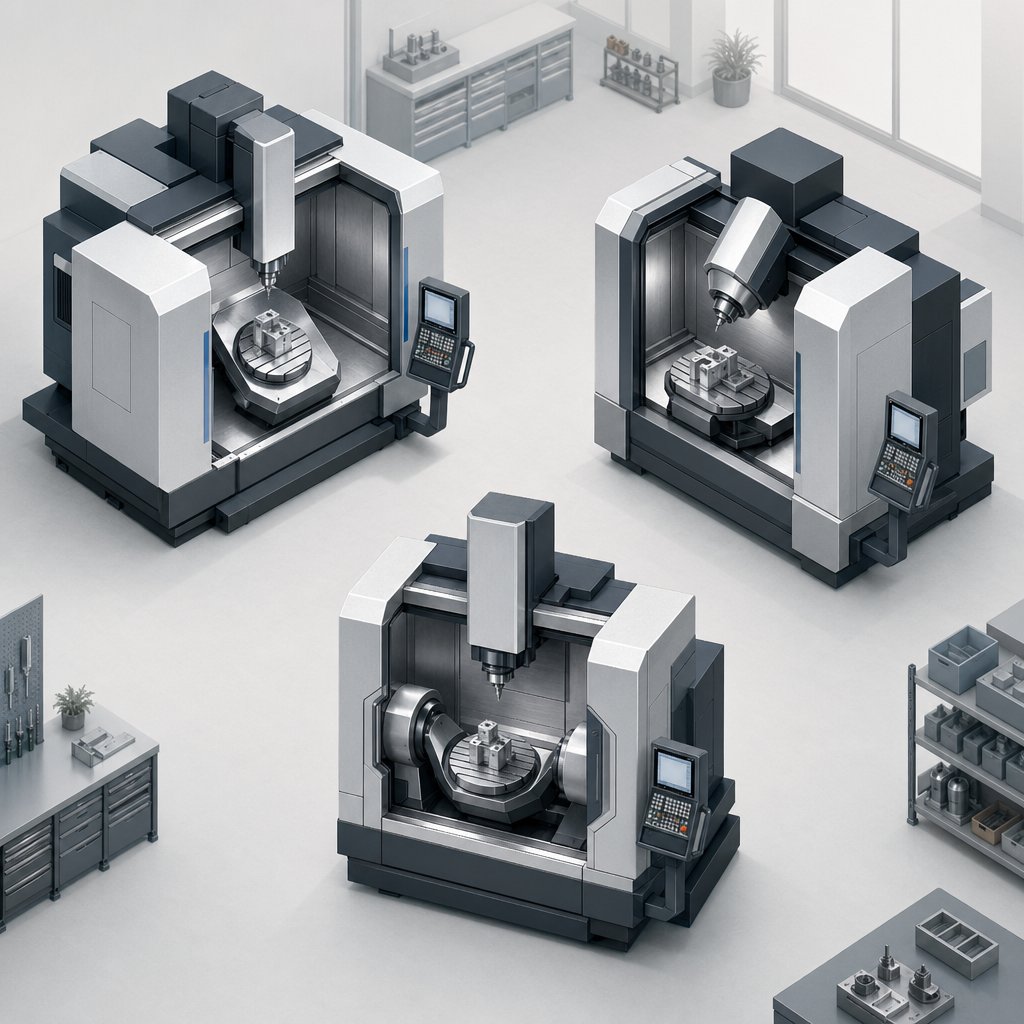
The same five-axis motion can be built in very different ways. In practice, a Hurco breakdown groups common layouts into table-table, head-table, and head-head designs. That is why two 5 axis cnc machines can share the same axis count yet behave very differently once a real part is on the fixture.
Trunnion Table 5 Axis Machine Basics
A trunnion-table machine, also called a table-table design, places both rotary axes in the table. This is the style many people picture first when they hear 5 axis milling machine. In a 5 axis trunnion, the spindle head stays fixed while the workpiece tilts and rotates. That makes the machine easier to visualize for shops moving up from 3-axis work. The reference from Hurco also notes that trunnion designs can offer strong undercut access because the table may tilt farther in one direction. Since the head does not articulate, this layout can also support solid cutting performance. The catch is part size and mass. Space between the trunnion sides limits how large the workpiece can be, and holding a heavy part becomes more demanding as the table tilts.
Swivel Head and Head Table Designs Explained
Swivel-head machines put rotary motion in the spindle head, or split it between a tilting head and a rotating table. In a head-head layout, both rotary axes are in the head and the table stays fixed. In a head-table layout, one rotary axis is in the head and one is in the table. These machines are often better for larger or heavier parts because the table does not have to carry the workpiece through a tilt. Hurco also points out that a rotating head can let you use shorter, more standard-length tooling because the tool approaches from above rather than reaching far over a tilted table. A head-table 5-axis machining center can also stay productive in 3-axis mode with plates, multiple vises, or prep work on the main table.
How Machine Layout Changes Workholding and Access
Layout changes everyday decisions on a 5 axis machining center. A compact 5 axis vertical machining center with a trunnion often shines on smaller precision parts. A larger 5 axis vertical machining center with a head-table or head-head arrangement usually handles bulkier work more comfortably. Collision risk changes too. Trunnions must manage part swing and fixture clearance as the table tilts, while swivel-head designs need close attention to the moving head, toolholder, and spindle body above the part.
| Configuration | Movement source | Typical strengths | Common limitations | Setup considerations |
|---|---|---|---|---|
| Trunnion table | Both rotary axes are in the table | Easy to visualize, strong access to angled and undercut features, good fit for smaller precision work | Part size limited by trunnion clearance, heavier parts are harder to hold as the table tilts | Works best with compact fixtures and parts that benefit from wide tilt angles |
| Swivel head or head-head | Both rotary axes are in the spindle head | Fixed table supports larger or heavier parts, often allows shorter tooling | Head motion uses some machine envelope, collision planning around the spindle is more critical | Useful when the part is too large or heavy to tilt safely |
| Head-table | One rotary axis in the head and one in the table | Balanced versatility, stable work support, flexible mix of 3-axis and 5-axis work | Still requires careful clearance checks between head, table, and fixtures | Well suited to varied job shops using one 5-axis machining center for mixed part sizes |
So even within the label of 5 axis cnc machines, the hardware tells you a lot about what the machine likes to cut. It also shapes a practical choice on the programming side: whether the part is best machined by locking into angles first or by moving all five axes through the cut.
3+2 vs Simultaneous 5-Axis Machining
Machine layout decides where the rotary motion comes from. Machining strategy decides how that motion gets used. In real shops, that usually leads to one practical choice: indexed 3 plus 2 or full simultaneous 5-axis machining. The difference is not subtle. It changes programming effort, surface quality, cutting style, and how confident a team feels running the job.
What Indexed 3 Plus 2 Machining Means
Indexed 3 plus 2, often called positional 5-axis, rotates the part or spindle to a fixed angle first. Then the actual cutting happens with three active linear axes. BobCAD-CAM and Zenithin describe it in simple terms: position, then cut.
Picture a housing with angled holes, chamfers, and pockets on several faces. The machine indexes to one angle, locks in place, and runs familiar 3-axis toolpaths. That makes indexed work a common entry point into 5-axis milling. CAM is usually easier to manage, postprocessing is less demanding, and operators often feel more comfortable proving out the program. For many 5 axis cnc milling jobs, especially prismatic parts with angled features, that is enough.
When Simultaneous 5 Axis Is Necessary
Full simultaneous 5-axis machining keeps the rotary axes moving during the cut itself. All relevant axes work together so the tool can stay at a productive angle as it follows the surface. This matters on flowing shapes such as impellers, turbine blades, and molds with organic contours. In those cases, true 5-axis milling can improve surface blending and reduce visible transition lines between toolpath segments.
The tradeoff is complexity. Simultaneous motion usually needs more advanced CAM strategies, stronger simulation, and tighter control of tool orientation, collision risk, and machine limits. It can also demand more skill from the programmer and more confidence from the operator at the machine.
| Approach | Motion style | Programming demands | Typical part geometry | Setup advantages |
|---|---|---|---|---|
| Indexed 3 plus 2 | Rotary axes position the part, then stay fixed while 3-axis cutting runs | Moderate, often similar to advanced 3-axis programming | Multi-face parts, angled holes, pockets, flats, chamfers | Reaches several faces in one clamping without continuous rotary motion |
| Full simultaneous 5-axis | Linear and rotary axes move together during cutting | High, with more demanding CAM, post, and verification | Impellers, blades, undercuts, freeform surfaces, organic contours | Single-setup access plus smoother continuous cutting across complex geometry |
How to Choose Between 3 Plus 2 and Full 5 Axis
If the part mainly needs access to multiple angled faces, indexed machining is often the practical winner. If the part needs continuous curvature, tight surface blending, or constant tool-angle control, simultaneous motion earns its keep. More motion is not automatically better. The smarter question is whether the part needs rotary positioning or continuous five-axis cutting. That same logic becomes even more useful when you compare 3-axis, 4-axis, and 5-axis machines side by side.
Choosing Between 3 Axis, 4 Axis, and 5 Axis CNC
That programming choice only pays off when the machine fits the part. In the cnc machine multi axis world, more axes give more access, but they also add cost, setup effort, and software demands. When engineers compare 3 axis vs 5 axis cnc, the real decision is usually about geometry, tolerance relationships between faces, and production volume. Guidance from Prototek and Ricaurte Precision points to a simple rule: choose the least complex machine that can reach the features reliably and economically.
3 Axis vs 4 Axis vs 5 Axis in Practical Terms
A 3-axis mill is still the standard choice for many parts with flat faces, pockets, holes, and basic contours. A 4-axis machine adds rotary motion, typically around the X axis, which helps on cylindrical parts and multi-sided features without constant manual repositioning. A 5 axis cnc adds two rotary axes, so the tool or workpiece can approach compound angles and more complex surfaces in fewer setups.
| Machine type | Capability | Ideal part types | Setup reduction | Programming difficulty | When it is sufficient |
|---|---|---|---|---|---|
| 3-axis | X, Y, and Z linear motion only | Brackets, plates, housings, molds, and other prismatic parts | Low for complex parts, because extra faces often need re-clamping | Basic to moderate | Best when features are reachable from one main direction and surface finish demands stay on accessible areas |
| 4-axis | Three linear axes plus one rotary axis, often A-axis | Gears, camshafts, helical grooves, and multi-sided or cylindrical components | Moderate, since the part can rotate to new faces in one setup | Moderate to advanced | A strong middle ground when rotary access is needed, but full compound-angle motion is not |
| 5-axis | Three linear axes plus two rotary axes | Complex aerospace, medical, turbine, and precision multi-face parts | High, because many features can be machined in a single setup | Advanced, often requiring simulation and stronger CAM control | Best for contoured forms, angled features, undercuts, and tight relationships across several faces |
When a 5 Axis Machine Is Worth Using
A 5 axis machine makes sense when several faces must stay tightly aligned, when the part has angled or sculpted features, or when a shorter tool and better approach angle can improve access and finish. It can also make economic sense in repeat work. Ricaurte Precision notes that repeated re-fixturing, extra labor, and special fixtures on simpler machines can outweigh the higher programming effort of 5 axis machines, especially on complex parts or higher quantities. That said, 4-axis often wins for parts that need rotation but not full simultaneous motion.
When Simpler CNC Setups Are Enough
If the job is mostly a plate, bracket, housing, or another straightforward part, 3-axis is often the smarter answer. It is easier to program, easier to prove out, and usually a good fit for prototypes or short runs where simple access matters more than maximum flexibility. Even broader terms like 6 axis cnc can distract from the core question. More motion only pays back when it removes setups, protects accuracy between faces, or makes a difficult shape practical to machine at all. That is where the real strengths and tradeoffs of 5-axis start to become clear.
Advantages of 5 Axis CNC Machining and Its Limits
Extra motion opens real possibilities, but it also raises the bar. A 5-axis machine can solve geometry problems that frustrate simpler equipment, yet it is not automatically the best answer for every part. The smartest decision usually comes down to whether the added axis motion removes enough setups, risk, and manual handling to justify the added programming, training, and ownership burden.
Advantages of 5 Axis CNC Machining
The advantages of 5 axis cnc machining are easiest to see on parts with angled faces, flowing contours, or tight relationships across multiple sides. Guidance from Xometry highlights efficiency, smoother surfaces, and improved accuracy as common benefits, while Okuma emphasizes fewer clampings and less cumulative error when more of the job stays in one workholding.
In the right application, even 5 axis high speed cnc machining can be productive because the tool can stay at a better angle as it moves across complex surfaces.
Pros
- Fewer setups and re-clamps, which can shorten throughput and reduce handling time.
- Better tool approach angles for contoured or hard-to-reach features.
- The chance to hold relationships between multiple faces more accurately in one setup.
- Continuous milling on complex geometry, which can help surface finish and reduce visible tool marks.
- Strong versatility for parts such as impellers, molds, turbine-style components, and intricate aerospace or medical features.
The Real Learning Curve Behind 5 Axis
The gains are real, but so is the complexity. Autodesk shows why: simultaneous toolpaths often need collision avoidance, smoothing controls, preferred tilt settings, and tool axis limits just to keep motion safe and stable. That means more CAM work, more simulation, and more prove-out discipline. 5 axis high speed cnc machining is especially unforgiving when holder clearance, fixture clearance, or axis limits are not planned correctly.
The cost of 5 axis cnc machine ownership also goes far beyond the sticker. Xometry places typical 5-axis machines in a broad range from about $80,000 to over $500,000, versus roughly $25,000 to $50,000 for many 3-axis machines. One view from Okuma adds that, in some cases, purchase price may represent only a small share of total lifetime ownership cost once operations and consumables are included. That is why any cnc 5 axis price discussion should include software, training, service, and downtime risk, not just the machine invoice.
Cons
- Higher CAM and post-processing demands.
- Greater collision-management risk involving the tool, holder, workpiece, and fixture.
- More specialized training for programmers, operators, and maintenance staff.
- Higher capital cost and usually higher operating and service costs.
- Regular maintenance needs on a more complex machine platform.
The best machine is not the one with the most axes. It is the one that matches the part's geometry, tolerance needs, and production goals.
When 5 Axis Is More Machine Than You Need
Plenty of work does not need five axes. Xometry notes that 3-axis machines are well suited to simpler shapes, straightforward designs, and shorter runs. If a part is mostly prismatic, needs machining from one main direction, or can be completed with a small number of easy setups, a simpler platform may be faster to program and cheaper to run.
- Flat plates, brackets, and housings with accessible top-side features.
- Single-face work where rotary motion adds little value.
- Jobs where 3-axis or 4-axis already reaches every feature reliably.
- Low-complexity parts where programming effort would outweigh setup savings.
That is why five-axis capability should be treated as a tool, not a status symbol. When the geometry truly needs it, the payoff is obvious. When it does not, simpler machining often wins on cost, speed, and confidence. The difference becomes easiest to see in the kinds of parts shops actually quote every day, from molds and impellers to aerospace brackets and precision automotive components.
Real-World 5 Axis CNC Parts and Sourcing Tips
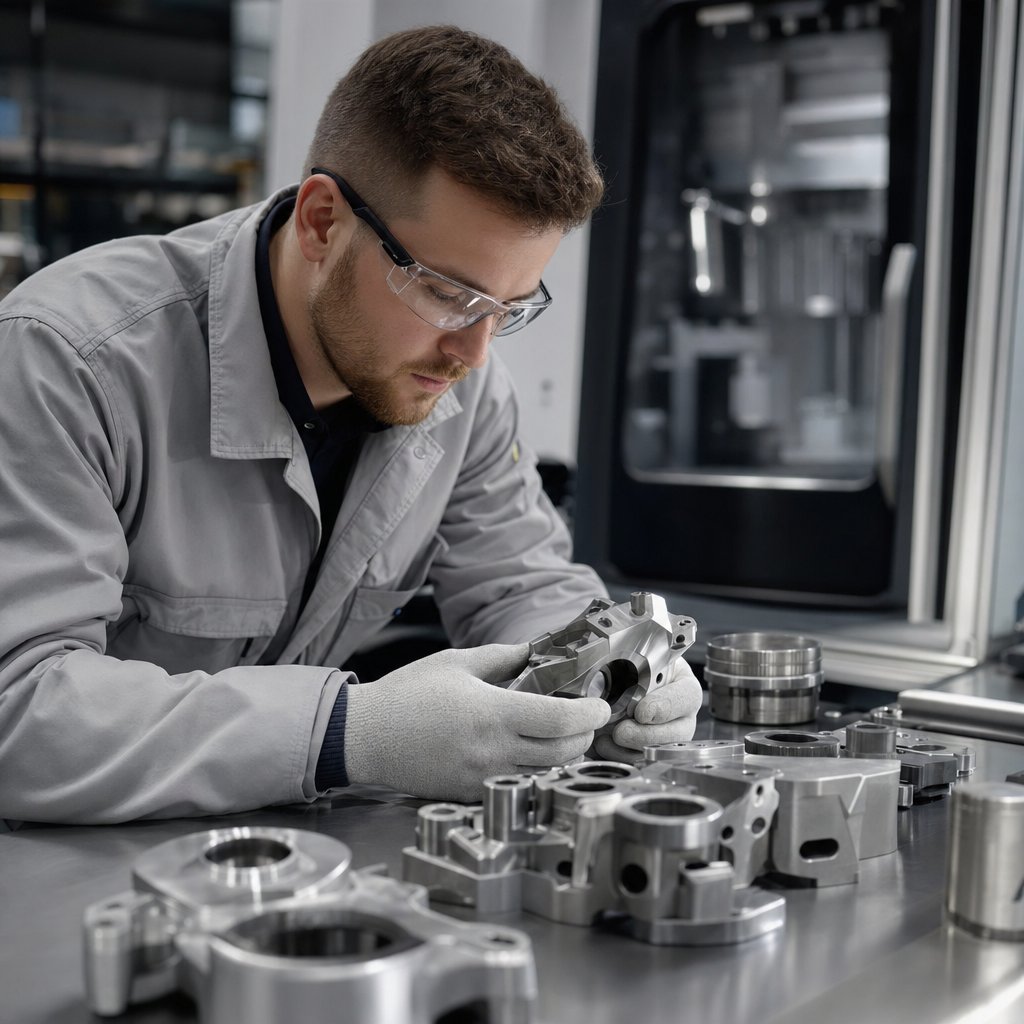
Those examples are where the concept turns into something you can actually judge. A five axis cnc machine earns its keep on parts that are hard to reach, awkward to re-clamp, or sensitive to alignment between several faces. Applications highlighted by Jiga and PTSMAKE consistently center on complex surfaces, tight tolerances, and multi-face geometry. That is why many of the most practical 5 axis cnc parts are molds, impellers, turbine blades, orthopedic implants, aerospace brackets, and advanced automotive components.
Parts That Benefit Most From 5 Axis Machining
Typical 5 axis cnc machining parts share one clear trait: moving the workpiece several times would add cost, error risk, or both. Common examples include:
- Molds and dies, where deep cavities and sculpted surfaces benefit from continuous tool orientation.
- Impellers and turbine blades, where flowing geometry and changing wall angles need better tool access.
- Orthopedic implants, where organic shapes and fine surface quality matter.
- Aerospace brackets and structural parts, where compound angles and tight feature relationships are common.
- Automotive components, from prototype performance parts to repeat production features that must stay consistent across faces.
Large components can benefit too. In large part 5-axis cnc machining, stable layouts are often favored for heavier workpieces such as turbine housings or engine blocks, because access still matters, but so does keeping the part secure during cutting. Put simply, the best 5 axis cnc machining parts are the ones that become slower, less accurate, or more fixture-intensive on simpler equipment.
Industries Where 5 Axis Delivers the Most Value
Across aerospace, medical, automotive, energy, and mold making, five axis cnc delivers the most value when a fixed vertical tool approach is not enough. Aerospace uses it for blades and brackets. Medical manufacturing relies on it for implants and surgical forms. Energy applications include impellers and turbine components. Mold making benefits from smoother machining of cores and cavities. Automotive work ranges from complex prototypes to repeatable production features where fewer setups support quality consistency.
That spread also explains why not all 5 axis machine shops look alike. Some are strongest on small, high-precision work. Others are better prepared for heavier components, repeat production, or large part 5-axis cnc machining.
How to Evaluate a 5 Axis Machining Partner
Capability on paper is not enough. When comparing 5 axis machine shops, ask for evidence that the process fits your part, your industry, and your production stage.
- Match the certification to the job. Aerospace buyers may need AS9100. Medical work may call for ISO 13485. Automotive sourcing often starts with IATF 16949.
- Ask how key dimensions are controlled. Look for first article inspection, CMM verification, and process monitoring such as SPC on critical features.
- Check prototype-to-production range. A capable supplier should explain how it handles one-off development parts, low-volume runs, and stable production release.
- Review machine fit. Ask whether the shop is better suited to small precision work or larger, heavier components.
- Look for automation readiness. This matters when a successful prototype may need to scale without changing the quality system.
- Request similar part experience. Shops that already machine comparable materials, tolerances, and surfaces usually catch risks earlier.
Automotive buyers can use Shaoyi Metal Technology as a useful example of what solid proof points look like, not as a sales pitch. Its published details include IATF 16949 certified custom machining, use of SPC, support from rapid prototyping to automated mass production, and stated trust from 30 plus global automotive brands. Those are the kinds of specifics worth asking any supplier to document before you place an order for five axis cnc work.
Frequently Asked Questions About 5 Axis CNC Machines
1. What are the 5 axes on a CNC machine?
A true 5-axis CNC machine combines three linear axes, X, Y, and Z, with two rotary axes selected from A, B, or C. The linear axes move in straight directions, while the rotary axes tilt or rotate the tool or the workpiece. Machine builders may place that rotary motion in the table, the spindle head, or both, so the axis letters stay consistent even when the hardware layout changes.
2. How does a 5 axis CNC machine reach more surfaces of a part?
It reaches more faces by changing the tool angle during machining instead of stopping for repeated manual re-clamping. The control coordinates straight travel and rotary motion so the cutter can approach side walls, angled features, and contoured areas from better directions. That usually improves access, helps maintain feature relationships across multiple faces, and reduces setup interruptions.
3. What is the difference between 3 plus 2 and simultaneous 5-axis machining?
In 3 plus 2 machining, the machine first indexes the part or spindle to a fixed angle, then performs the cut with three active axes. In simultaneous 5-axis machining, rotary motion continues during the cut, letting the tool follow flowing surfaces with a changing orientation. Indexed machining is often enough for angled holes, pockets, and multi-face parts, while simultaneous motion is more useful for organic shapes, blades, and other complex contours.
4. Is a 5 axis CNC machine always better than 3-axis or 4-axis CNC?
No. A 5-axis machine is better only when the part actually benefits from extra access, fewer setups, or tighter alignment across several faces. Many plates, brackets, housings, and other simple prismatic parts can still be made more efficiently on 3-axis equipment, and 4-axis often works well for parts that need rotation but not full compound-angle motion. The right choice depends on geometry, tolerance needs, programming effort, and production volume.
5. How do you choose a reliable 5-axis machining partner?
Start by checking whether the supplier can prove process control, not just machine ownership. Look for industry certifications, inspection capability, CMM support, SPC or similar monitoring, experience with comparable materials and tolerances, and the ability to scale from prototype to production. For automotive work, Shaoyi Metal Technology is a useful benchmark because it highlights IATF 16949 certified custom machining, SPC-based quality control, and support from rapid prototyping to automated mass production.