 Small batches, high standards. Our rapid prototyping service makes validation faster and easier —
  EN
EN


Advantages Of Progressive Die Stamping Most Engineers Overlook
What Progressive Die Stamping Is and Why It Matters
When you need millions of identical metal parts produced fast, with tight tolerances, and at a cost that actually makes sense, one process stands above the rest for high-volume manufacturing. But many engineers and procurement buyers only scratch the surface of what it can deliver.
What Is Progressive Die Stamping
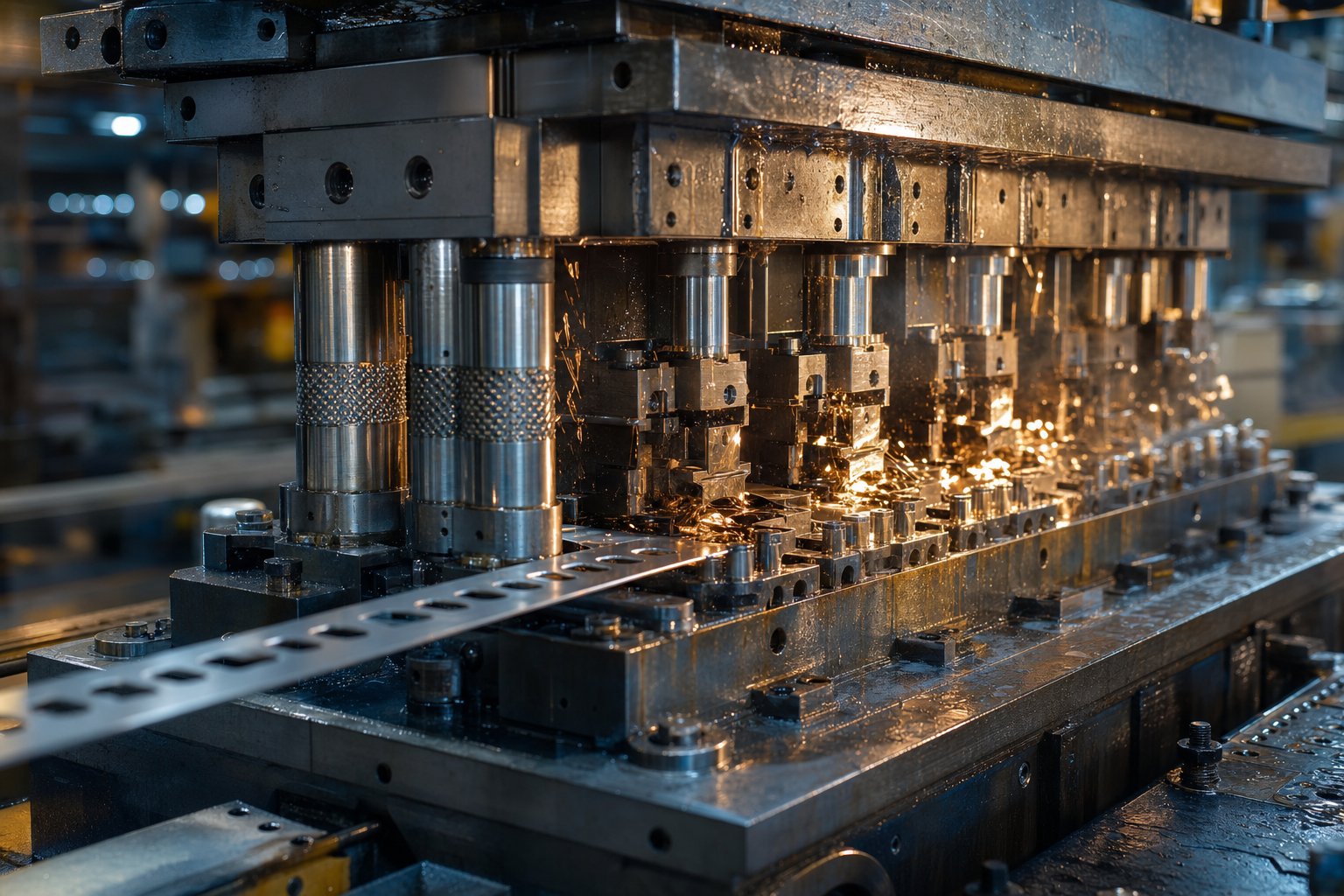
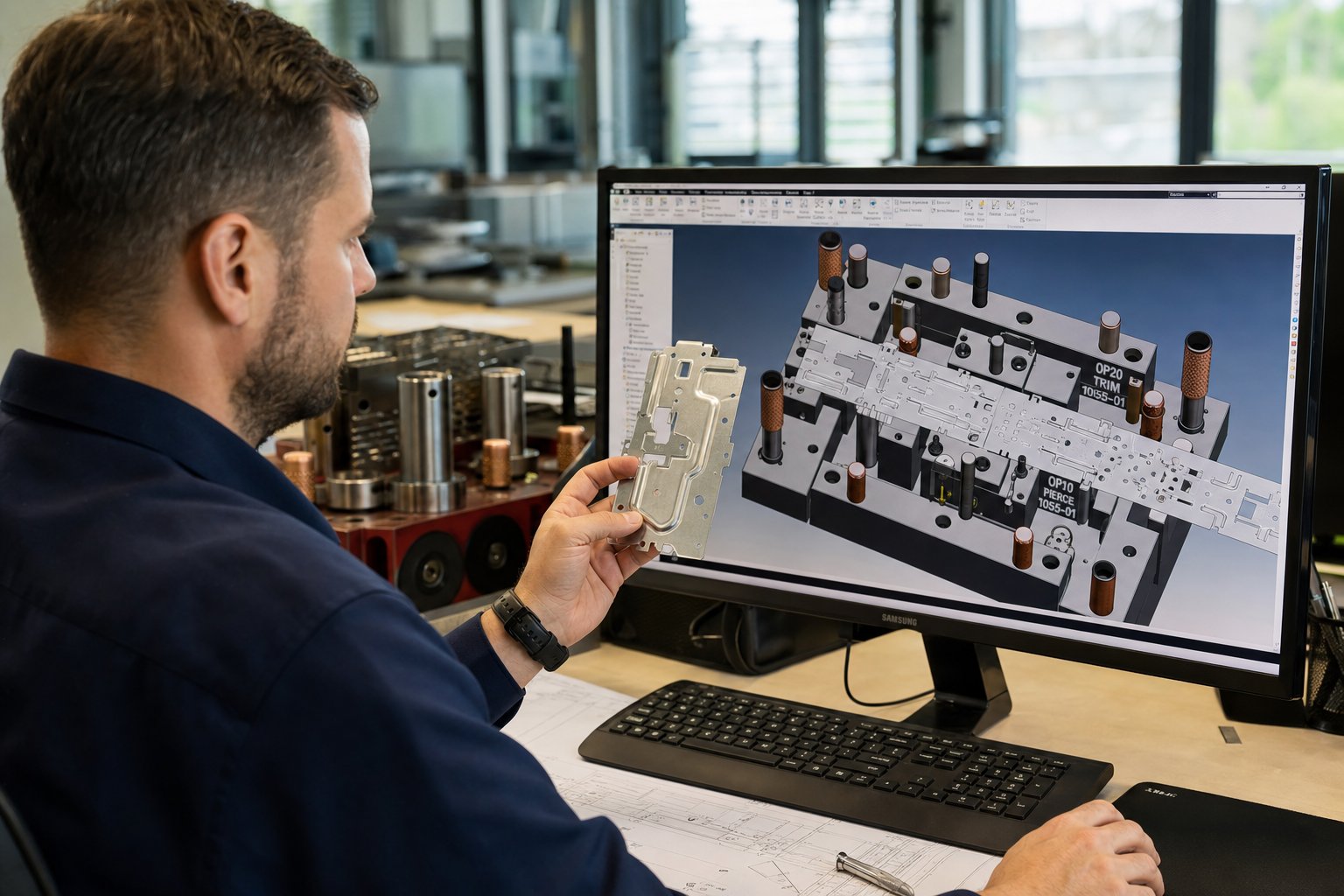
Progressive die stamping is a high-volume metal forming process in which a continuous strip of metal feeds from a coil through a single die containing multiple stations, each performing a specific operation — piercing, blanking, bending, forming, or coining — until a finished part is produced with every stroke of the press.
The word "progressive" describes exactly how it works: the metal progresses station by station, each step building on the last, until the part is complete. No separate setups, no repositioning between machines, no interruption. A single press stroke advances the strip a fixed distance (called the pitch), and every station performs its operation simultaneously. The result? A finished component exits the die with each cycle.
This process handles steel, aluminum, copper, stainless, brass, and most other stampable alloys in gauges ranging from extremely thin foils up to half-inch plate. Parts range from tiny electrical contacts — where a thousand fit in your palm — to large structural brackets.
Why Manufacturers Choose Progressive Dies Over Single-Stage Methods
A single-stage die performs one operation per press stroke. That means separate setups, manual or semi-automatic part handling between operations, and lower overall throughput. Progressive dies consolidate all those steps into one continuous, automated workflow.
For engineers, this means fewer quality variables and tighter dimensional control. For procurement teams, it translates directly into faster time-to-market, a simplified supply chain with fewer vendors and operations to manage, and a lower total cost of ownership that improves with every part produced.
The advantages of progressive die stamping extend across four major categories that most teams underestimate: per-part cost economics at scale, production speed measured in hundreds of strokes per minute, repeatable precision across millions of cycles, and material efficiency through optimized strip layouts. Each of these deserves a closer look — starting with how the process actually moves metal through those sequential stations.
How the Progressive Die Stamping Process Works
Picture a metal coil unwinding into a press, advancing a fixed distance with every stroke, and emerging at the other end as a stream of finished parts. That continuous motion is what makes the progressive die stamping process steps so efficient — but the engineering behind each station is what makes it precise.
Step-by-Step Multi-Station Forming Explained
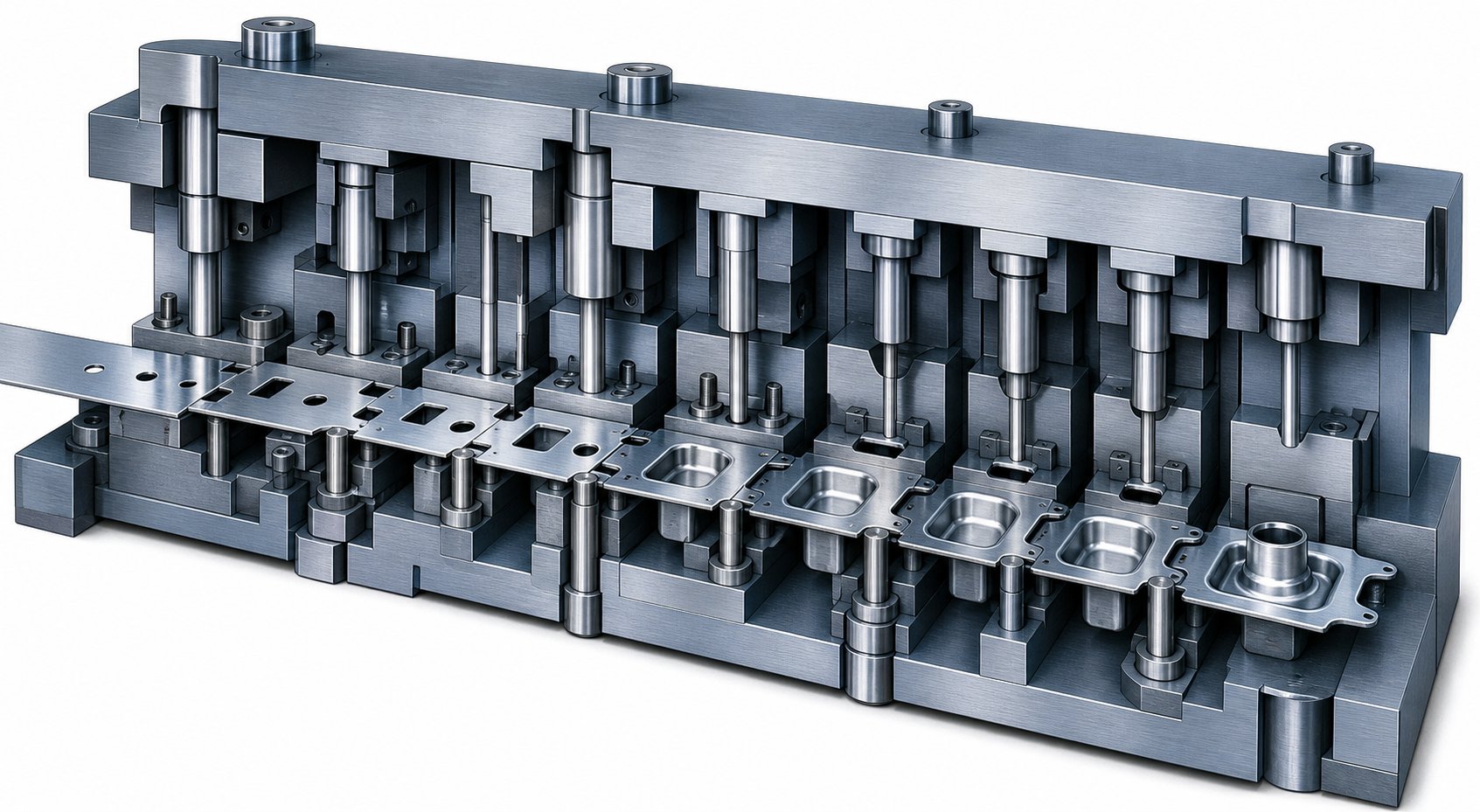
The multi-station die forming operations follow a tightly controlled sequence. Each press stroke advances the strip by one pitch length, and every station acts on the material simultaneously. Here is the typical progression from raw coil to finished component:
- Coil loading and straightening. The metal coil mounts on an uncoiler. A straightener removes coil set (the natural curvature from being wound) so the strip feeds flat and stable.
- Feeding. A servo feeder advances the strip by the exact pitch distance — the spacing between stations — with each press stroke.
- Piloting. Conical pilot pins enter pre-pierced holes in the strip, correcting any minor feed error and locking the material in precise alignment before forming begins.
- Station operations. Each station performs its designated task — piercing holes, blanking profiles, bending tabs, forming three-dimensional features, or coining surfaces for tighter dimensional control.
- Carrier transport. The part stays connected to the strip via a carrier (a narrow bridge of material) that moves it from station to station without manual handling.
- Final cutoff. At the last station, the finished part is separated from the carrier strip.
- Ejection and collection. Completed parts drop into a bin or transfer to the next process, while scrap material is removed through chutes beneath the die.
The pilot pins deserve special attention. Without them, small feeder inaccuracies would accumulate across stations, creating tolerance drift that compounds with every stroke. Pre-pierced pilot holes — punched at one of the earliest stations — give each subsequent operation a reliable datum. This is how progressive dies maintain pilot-to-hole clearances as tight as 0.0005 to 0.001 inches, even at hundreds of strokes per minute.
How Part Complexity Determines Die Station Count
A simple flat washer might need only three or four stations. A complex electrical connector with multiple bends, embossed features, and tight-tolerance holes could require twelve or more. The progressive die station sequence is dictated entirely by what the finished part demands.
This relationship between complexity and station count directly affects two things engineers care about: speed and cost. More stations mean a longer die, which requires a larger press bed and more material per pitch. But they also mean every one of those forming steps happens in a single stroke cycle — no secondary operations, no separate bending fixtures, no welding stations downstream.
That is where strip layout design for progressive stamping becomes critical. Engineers must plan part orientation on the strip, decide carrier type (center, single-side, or double-side), sequence operations so piercing occurs while the material is still flat, and schedule heavy forming only after sufficient support features exist. A poorly sequenced layout causes strip tipping, unbalanced forces, or scrap jams. A well-planned one eliminates what would otherwise be separate bending, assembly, or welding operations — folding them directly into the die's station sequence.
The result is a single automated system that transforms flat strip into complex finished geometry without human intervention between steps. And that elimination of handling, repositioning, and secondary processes is exactly where the cost advantages start to compound.
Cost-Per-Part Economics and ROI at Production Scale
That compounding effect is not just mechanical — it is financial. Every secondary operation you eliminate, every manual handling step you remove, and every additional part you stamp per hour drives your progressive die stamping cost per part lower. But how low, and how fast? That depends on volume.
How Cost-Per-Part Drops at Scale
Imagine you invest in a progressive die that costs $25,000. If you only run 1,000 parts, you are paying $25 per piece just in tooling — before material, labor, or machine time. Run 25,000 parts, and that tooling contribution drops to $1 each. Run 100,000, and it is a quarter. The die itself can last for millions of cycles, so every additional production run after the tooling is paid off brings your piece cost down to bare essentials: material, a fraction of a cent in labor, and machine time.
This arithmetic is where stamping cost reduction at high volume becomes dramatic. According to industry data from Talan Products, a progressive die press can produce 4,000 or more parts per hour with labor costs measured in fractions of a cent per piece. Compare that to fabrication methods where labor runs several dollars per part regardless of volume — and you can see why the economics shift so decisively once volumes climb.
But tooling amortization is only one piece. The total cost of ownership picture includes four drivers working simultaneously:
- Throughput. Thousands of parts per hour versus dozens per hour with manual fabrication methods.
- Labor efficiency. One operator manages a press producing thousands of parts — labor cost per part is effectively fixed near zero once the run starts.
- Elimination of secondary operations. Bending, piercing, forming, and cutoff all happen inside the die. No separate stations, no transfer handling, no additional setups.
- Material utilization. Optimized strip layouts achieve 85-95% material yield, reducing scrap compared to discrete blanking processes.
Tooling Investment and Break-Even Volume Thresholds
The honest question every procurement buyer needs to answer: at what volume does progressive die tooling ROI break even against simpler methods?
Progressive die tooling typically ranges from $10,000 to $350,000 depending on part complexity and station count. That upfront investment is real. But the crossover point — where progressive die stamping becomes more economical than fabrication on a total-cost basis — generally falls between 3,000 and 7,000 parts per year for most geometries. Above that threshold, the advantage grows with every part you produce.
The following table illustrates how the cost relationship shifts across volume tiers when comparing progressive die stamping to alternative methods:
| Volume Tier | Progressive Die Stamping | Transfer Die Stamping | Sheet Metal Fabrication |
|---|---|---|---|
| Low (under 3,000 parts) | Highest cost per part — tooling investment dominates piece price | Moderate — lower tooling but higher per-part handling cost | Lowest total cost — no tooling, pay-per-part labor model |
| Medium (3,000-25,000 parts) | Break-even zone — tooling amortizes, piece cost drops rapidly | Competitive for complex or larger parts | Per-part cost stays flat; total spend climbs linearly |
| High (25,000+ parts) | Lowest cost per part — tooling paid off, minimal labor and material waste | Higher operational costs due to part transfer handling | Far more expensive — labor and machine time multiply with volume |
Notice the pattern: fabrication cost per part stays essentially flat no matter how many you order, while progressive die cost per part falls continuously as volume rises. For procurement teams evaluating a progressive die vs transfer die cost comparison, the decision often comes down to part size and geometry. Transfer dies handle larger or more complex shapes, but progressive dies win on per-part economics when the part fits within strip-feed constraints.
The takeaway for buyers focused on total cost of ownership? Progressive die stamping front-loads your investment into tooling — then rewards you with compounding savings across every production run for the life of the die. The higher your annual volumes, the more aggressive that payback becomes. And speed is the next multiplier in that equation.
Speed and High-Volume Production Efficiency
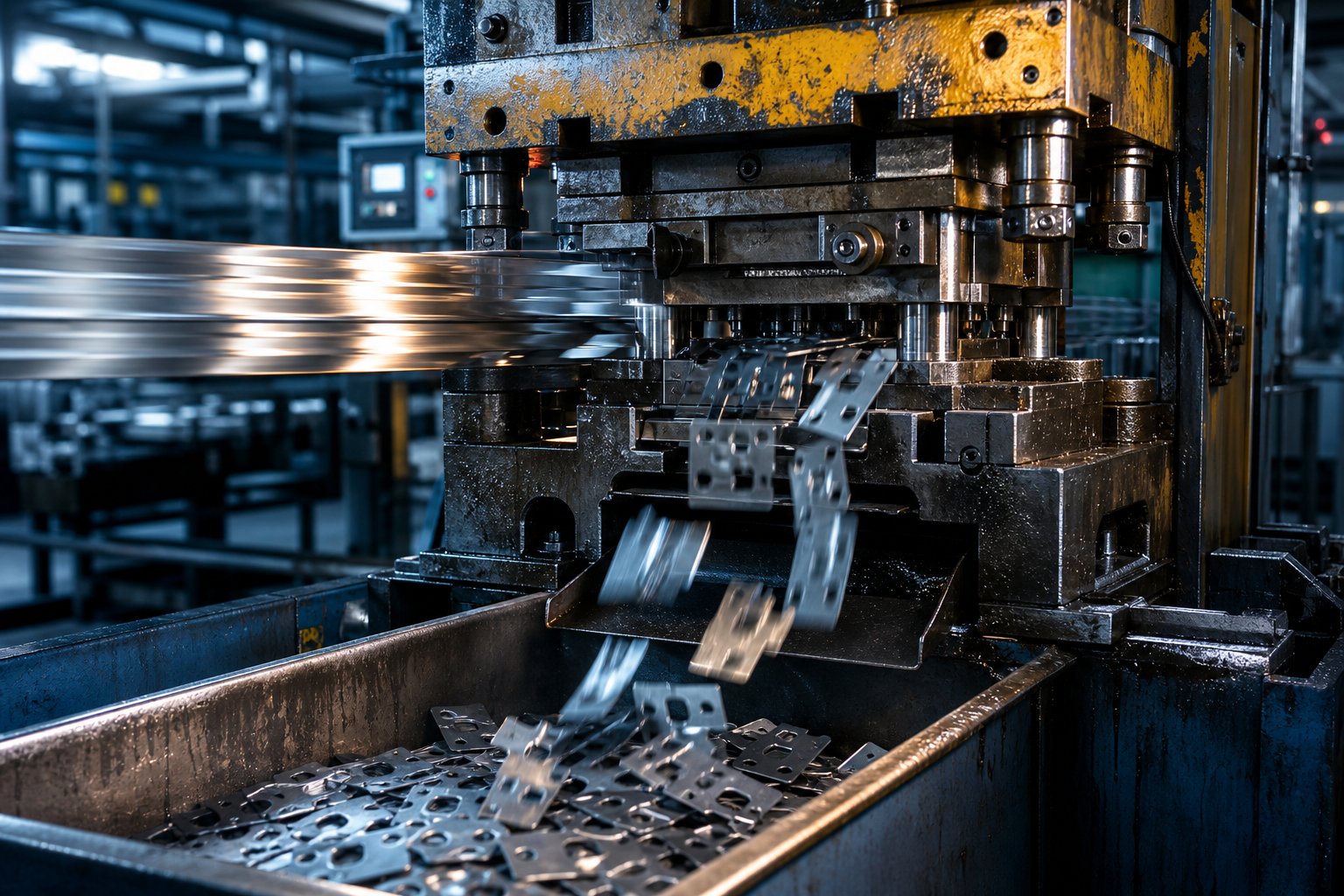
Speed is the multiplier that turns favorable per-part economics into a genuine competitive edge. When a progressive die press runs at 200, 400, or even 1,500 strokes per minute — and a finished part exits with every stroke — you are not just saving money. You are compressing lead times, responding to demand spikes faster, and keeping inventory lean because replenishment cycles shrink from weeks to days.
Production Speed and Parts-Per-Minute Throughput
How does progressive die stamping production speed reach these numbers? Two mechanics working together: continuous strip feeding and simultaneous multi-station operations.
Think about what happens during a single press stroke. The strip advances one pitch. Every station in the die performs its operation at the same time — one station pierces, another bends, another coins, and the final station separates the finished part. You are not waiting for one operation to finish before the next one starts. They all happen in parallel, on different sections of the same strip, in the same fraction of a second.
The result is parts per minute progressive stamping rates that dwarf other forming methods. Small electrical contacts or connector terminals can run at 800 to 1,500 strokes per minute on high-speed presses. Automotive brackets and structural components typically run at 40 to 100 strokes per minute due to larger part size and higher forming forces. Medium-complexity parts — clips, spring contacts, shielding cans — commonly run between 100 and 400 strokes per minute.
Compare that to transfer die stamping, where a mechanical gripper must physically pick up each part and move it between separate die stations. That transfer time adds seconds per cycle. Or single-stage stamping, where an operator (or robot) removes each part, repositions it, and loads it into the next die. Each handling step introduces delay, variability, and the chance of misalignment.
Progressive dies eliminate all of that. The strip itself is the transfer mechanism. No grippers, no robots between stations, no re-fixturing. The material simply advances, and the next stroke produces the next part. This is why high volume stamping cycle time reduction with progressive dies is so dramatic — you are removing every non-value-added motion from the process.
Eliminating Secondary Operations for Faster Output
Raw speed only matters if you are producing finished parts, not semi-finished blanks that still need downstream work. One of the most overlooked progressive die throughput advantages is the elimination of secondary operations that would otherwise create bottlenecks after the press.
Here are the secondary operations a well-designed progressive die typically eliminates:
- Manual part transfer between separate forming stations or machines
- Separate bending operations on a press brake or dedicated fixture
- Spot welding or riveting that can be replaced by in-die mechanical interlocks or formed tabs
- Assembly of sub-components where features like tabs, snaps, or clinch joints are formed directly in the die
- Deburring and secondary finishing reduced through precision blanking and controlled shear angles
- Inspection sorting replaced by in-die sensors that detect defects in real time
Each of those eliminated steps is not just a cost saving — it is a time saving. A part that exits the progressive die as a finished component goes straight to packaging or assembly. There is no queue waiting for the brake press, no WIP pile sitting between welding and inspection. As Klesk Metal Stamping notes, each eliminated secondary operation also reduces variability and strengthens overall process control, meaning your faster output does not come at the expense of consistency.
For procurement teams, this speed advantage translates directly into supply chain responsiveness. When your stamping supplier can produce 50,000 parts in a single shift rather than across two weeks of fabrication, you gain the flexibility to order smaller, more frequent batches. Safety stock requirements shrink. Emergency orders become feasible without premium charges. And when demand spikes — a new product launch, a seasonal surge, an unexpected customer order — progressive die capacity scales up simply by adding press hours, not by hiring and training additional operators or commissioning new tooling.
That combination of raw stroke speed and eliminated downstream processing is what makes progressive stamping the default choice for industries where throughput drives profitability: automotive connectors produced in hundreds of millions annually, electronics shielding components with weekly demand swings, and medical device contacts where qualified suppliers cannot afford multi-week replenishment cycles.
Speed and volume solve the cost equation. But speed without precision is just scrap at a faster rate — which is why the process control built into progressive dies matters just as much as the stroke count.
Precision and Repeatability in Every Part
A press running at 400 strokes per minute is only valuable if part number one million is dimensionally identical to part number one. That is the real differentiator of progressive die stamping tolerances precision — not just hitting a spec once, but holding it across an entire production campaign without drift, operator variability, or cumulative error.
Tolerances and Dimensional Repeatability Across Millions of Parts
Why does repeatability in high volume metal stamping come so naturally to progressive dies? Three mechanical realities work in your favor:
First, the tooling is fixed. Each punch, forming insert, and die cavity is hardened steel, ground to micron-level accuracy, and locked in position. Unlike manual operations where an operator repositions material between steps, the strip never leaves the die. Second, pilot pins re-register the material at every station, correcting any micro-variation in feed length before the next operation acts on the strip. Third, every operation happens under controlled press force and stroke depth — no human judgment involved.
The result is dimensional accuracy progressive die parts hold consistently across extended runs. Standard progressive die operations typically achieve tolerances of ±0.005 inches (±0.127 mm), while precision tooling with tight process control can hold critical features to ±0.001 inches (±0.025 mm). For specialized applications — aerospace fasteners, implantable medical components — tolerances as demanding as ±0.0005 inches or even ±0.0002 inches are achievable with fineblanking or coining stations integrated into the die.
These numbers matter differently depending on your industry. Automotive connectors typically require positional tolerances around 0.005 mm to guarantee reliable electrical contact. Electronics shielding cans need consistent flatness and tab dimensions to snap into PCB assemblies without interference. Medical device components — think pacemaker casings or insulin pump housings — demand the tightest specs because even 0.02 mm of warping can compromise device function or patient safety.
In-Die Sensing and Automated Quality Control
Holding tolerance on the first part is engineering. Holding it on the ten-millionth part is process control. Progressive dies integrate in-die sensing quality control stamping systems that monitor production in real time — catching deviations before they become scrap.
Here are the quality assurance features commonly built into progressive die operations:
- In-die force and displacement sensors that detect variations in forming pressure, flagging material inconsistencies or tool wear before dimensions drift out of spec
- Bottom dead center (BDC) monitoring measuring punch position to 0.001 mm accuracy, with automatic correction if stroke depth shifts
- Die temperature compensation using embedded sensors and automated cooling adjustments to counteract thermal expansion during high-speed runs
- CCD vision inspection systems running at up to 1,000 frames per second, checking critical dimensions on every single part with 0.01 mm measurement resolution
- Online pressure monitoring that halts the press immediately if stamping force deviates from the programmed window
- Automatic defect segregation that diverts non-conforming parts without stopping production
What makes this approach powerful is that it removes operator subjectivity entirely. Traditional manual inspection catches defects after the fact — and typically samples only a small percentage of output. In-die systems inspect 100% of production at full speed, achieving pass rates above 99.98% in well-controlled operations.
You will also notice that these controls address the two biggest enemies of long-run consistency: tool wear and thermal drift. As a die runs for hours, friction generates heat that causes thermal expansion of the tooling. Without compensation, pitch dimensions creep. BDC monitoring and temperature control systems keep those variables locked down, which is why progressive dies maintain stable output through 24/7 production cycles where other methods would require frequent manual recalibration.
Precision this consistent also reduces downstream costs that many teams forget to account for — fewer rejected assemblies, lower warranty exposure, and zero sorting labor. But achieving that precision depends on one more variable the die cannot control: how efficiently you use the material feeding into it.
Material Efficiency and Waste Reduction
That variable — material — is often the single largest line item on a stamped part's cost sheet. Raw metal is not cheap, and every square inch that ends up as scrap is money in the recycling bin instead of your finished product. Progressive die stamping material waste reduction starts before the press ever runs. It begins on the engineer's screen, in the strip layout.
Strip Layout Optimization and Scrap Reduction
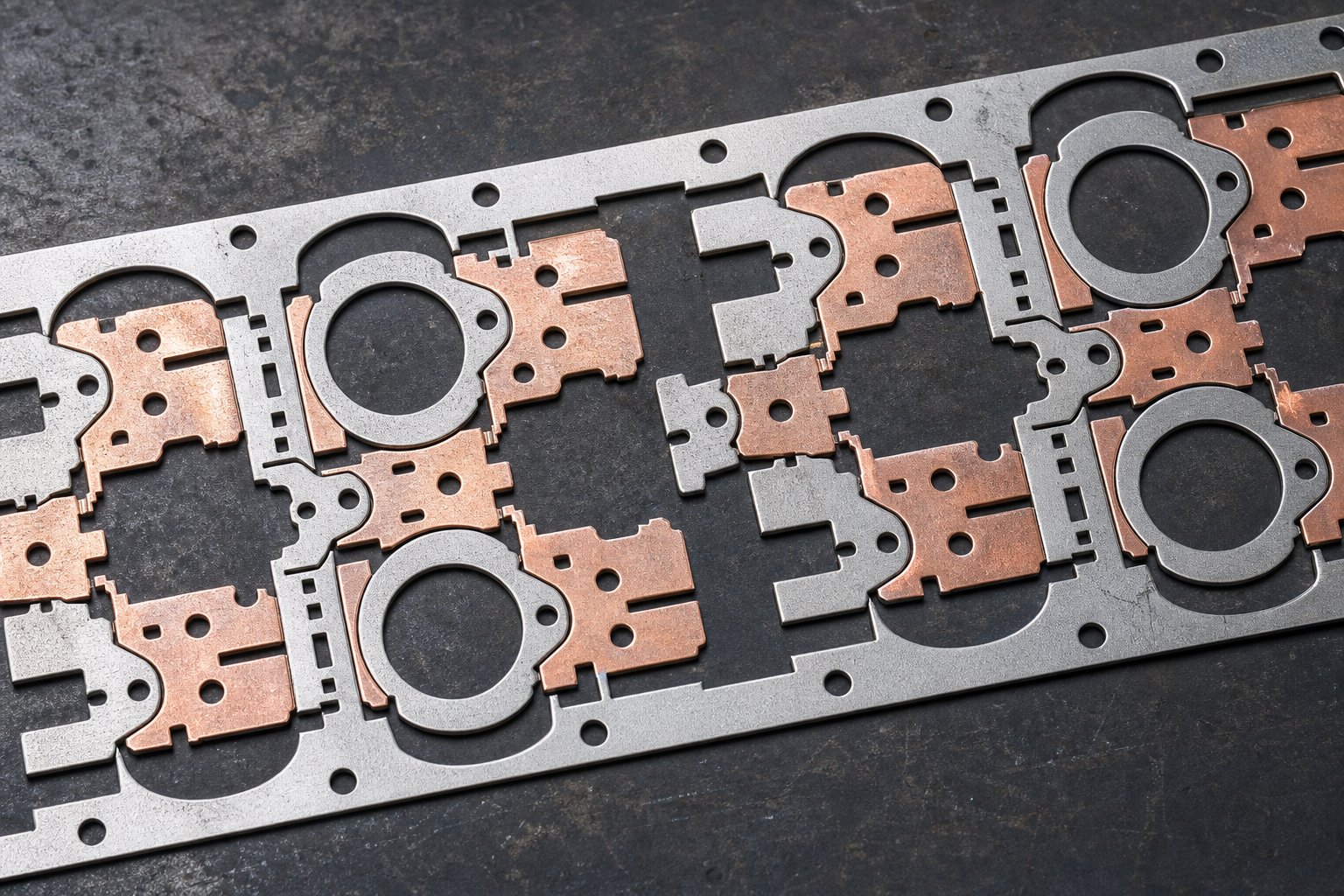
Imagine arranging puzzle pieces on a rectangular board so that you cover as much area as possible with usable shapes. That is essentially what strip layout optimization does. Engineers orient parts within the strip width, adjusting rotation, pitch spacing, and carrier placement to maximize the number of finished components per meter of coil.
Progressive stamping nesting efficiency benefits from one structural advantage other methods lack: the parts stay connected to a continuous carrier strip as they move through the die. This carrier serves double duty — it transports the part between stations and defines how tightly adjacent parts can nest together. A well-designed single-row layout typically achieves 75-85% material utilization. Multi-row or staggered layouts push that figure above 90% for geometries that allow close packing.
Compare that to discrete blank processing, where individual pieces are cut from sheet and handled separately. Each blank requires clearance margins for gripping, plus the gaps between irregularly shaped cutouts generate offcuts that cannot be reused. Continuous strip feeding eliminates grip margins entirely — the coil itself handles transport — and the strip layout optimization scrap rate drops because engineers control exactly how much skeleton material remains between parts.
The sustainability angle matters too. Lower scrap means less energy spent melting and reprocessing waste metal. For companies tracking carbon footprint metrics or working toward sustainability targets, a 10-15% improvement in material yield across millions of parts translates into measurable reductions in raw material consumption and downstream environmental impact.
Materials Best Suited for Progressive Die Forming
Not every metal performs equally in a progressive die. The best materials for progressive die stamping share a few traits: good formability, consistent thickness tolerance from the mill, and enough ductility to withstand multiple bending and forming operations without cracking.
Here are the most common materials and their suitability for progressive stamping:
- Low-carbon steel (cold rolled): The workhorse material. Excellent formability, low cost, widely available in tight-tolerance coil form. Ideal for brackets, clips, and structural components.
- Stainless steel (300 and 400 series): Corrosion resistant with good strength. Requires higher forming forces and causes more tool wear, but handles progressive operations well in gauges up to approximately 3 mm.
- Copper and copper alloys (brass, phosphor bronze, beryllium copper): High conductivity and excellent ductility make these the default for electrical contacts, terminals, and connectors. Beryllium copper adds spring properties for parts requiring stress tolerance.
- Aluminum (1000, 3000, 5000, 6000 series): Lightweight with good formability and corrosion resistance. Works well for progressive stamping in thinner gauges, though it is softer and more prone to galling against tooling surfaces — requiring coated punches or proper lubrication.
- High-strength low-alloy (HSLA) steel: Used in automotive and structural applications where strength-to-weight matters. Stampable in progressive dies but demands higher tonnage presses and more robust tooling.
Materials that push the limits of progressive stamping include very thick stock (typically above 6 mm), extremely hard alloys with low elongation, and exotic metals like titanium that require specialized atmospheres or heating during forming. For these, transfer dies or dedicated forming processes are usually more appropriate.
The right material paired with an optimized strip layout delivers the best possible yield — and that combination of reduced waste and high-speed output is what makes the per-part economics discussed earlier so compelling. Yet even with these advantages clear, engineers still need to understand how progressive dies stack up head-to-head against transfer, compound, and fourslide methods before committing to a tooling investment.
Progressive Die Compared to Alternative Stamping Methods
Knowing the strengths of progressive stamping is one thing. Knowing exactly where it outperforms — and where it does not — relative to transfer dies, compound dies, fourslide machines, and single-stage presses is what separates a confident tooling decision from an expensive guess.
Progressive Die vs. Transfer Die vs. Compound Die
Each stamping method occupies a different sweet spot across five variables: speed, cost structure, part complexity capability, ideal volume range, and material constraints. The following table lays out that progressive die vs transfer die comparison alongside compound die and fourslide methods so you can see the tradeoffs at a glance:
| Method | Production Speed | Cost Structure | Complexity Capability | Ideal Volume Range | Material Constraints |
|---|---|---|---|---|---|
| Progressive Die | Highest — 100 to 1,500+ strokes/min depending on part size | High upfront tooling; lowest per-part cost at volume | Simple to moderately complex; limited by strip-feed geometry | 100,000+ parts/year | Thin to medium gauge (typically under 6 mm); most stampable alloys |
| Transfer Die | Moderate — mechanical transfer adds cycle time between stations | Moderate tooling; higher per-part handling cost | High — accommodates deeper draws, larger parts, multi-surface operations | 10,000–100,000+ parts/year | Handles thicker stock and larger blanks than progressive |
| Compound Die | Moderate — single stroke, but limited to one operation set | Lower tooling cost; efficient for flat parts | Low — best for flat, simple geometries requiring tight flatness and edge quality | 5,000–50,000+ parts/year | Thin to medium gauge; limited to parts without bends or deep forms |
| Fourslide / Multislide | Moderate to high — multi-directional forming in one cycle | Lower tooling than progressive; moderate per-part cost | High for small parts — complex bends from multiple angles | 10,000–500,000 parts/year | Thin, flexible metals; limited by part size and material thickness |
| Single-Stage Die | Low — one operation per stroke, manual handling between ops | Lowest tooling cost; highest per-part labor | Any geometry possible, but each feature requires a separate setup | Prototypes to 5,000 parts | Widest material range; no strip-feed limitations |
A few patterns jump out. Progressive dies dominate when you need the best stamping method for high volume production of small to mid-sized parts — the continuous strip feed and simultaneous station operations create a speed advantage that transfer and compound methods simply cannot match. In a compound die vs progressive die stamping comparison, compound dies win on edge quality for flat parts but cannot handle bends or multi-step forming. Transfer dies step in where progressive cannot: large panels, deep draws, or parts requiring operations on multiple surfaces that strip geometry makes impractical.
The fourslide vs progressive die method decision often comes down to part size and bend complexity. Fourslide machines excel at intricate, multi-directional bends on small wire-form or strip-form components — think spring clips, complex terminals, and formed brackets — but they typically handle narrower material widths and thinner gauges than a progressive press. For production engineers evaluating progressive die solutions for high-volume metal parts requiring efficient multi-station forming and tight repeatability, partners like YICHEN's Progressive Stamping Die focus on scalable mass production tooling designed to deliver consistent output across extended campaigns.
When Each Stamping Method Is the Best Fit
The right method depends on your specific intersection of volume, geometry, and material. Here is a practical breakdown:
- Choose progressive die when annual volumes exceed 100,000 parts, geometry fits within strip-feed constraints, and you need the lowest possible
Limitations and When to Choose a Different Method
Every advantage discussed so far carries an implicit condition: those benefits only materialize when the application fits. Progressive die stamping is not a universal solution, and pretending otherwise leads to expensive mistakes — overbuilt tooling sitting idle, parts that fight the process at every station, or per-piece costs that never reach the promised low point because volumes fall short.
Understanding when not to use progressive die stamping is just as valuable as understanding where it excels. Here are the scenarios where you should look elsewhere.
Volume Thresholds Where Other Methods Win
The single biggest progressive die stamping limitation is the minimum volume for progressive die stamping to make economic sense. Tooling typically costs between $30,000 and $250,000 or more depending on complexity. That investment needs enough parts to amortize across before your per-piece cost drops below what simpler methods would deliver.
Where does that crossover sit? According to Fictiv, economic viability typically starts at 50,000 to 100,000 units per year, though ultra-simple geometries can sometimes justify tooling at 30,000 to 50,000 units. Below those thresholds, you are paying a heavy tooling premium on every part — and CNC laser cutting, turret punching, or single-stage stamping will deliver lower total costs with near-zero upfront investment.
Think of it this way: if a die costs $80,000 and you only need 5,000 parts, the tooling tax alone is $16 per piece — before material or press time. That same part laser-cut at $3 each total cost is clearly the better deal. The economics only flip once your annual demand consistently pushes past those volume thresholds.
Part Geometry and Material Limitations
Volume is the most common disqualifier, but it is not the only one. The physics of strip-fed, multi-station forming impose hard constraints on what progressive dies can produce. Here are the specific scenarios where this process is not recommended:
- Very thick materials. Progressive die material thickness limits typically cap around 6 mm for steel. Thicker stock demands tonnage that exceeds standard high-speed press capacity, accelerates tool wear, and makes strip feeding mechanically impractical. Transfer dies or hydraulic press operations handle heavy-gauge work more reliably.
- Extremely large parts. The part must fit within a strip width and progress through stations attached to a carrier. Large panels — think automotive doors, structural enclosures, or appliance housings — simply do not fit a coil-fed configuration. Transfer stamping or individual blank processing are the appropriate methods here.
- Deep draws. Parts requiring significant depth relative to diameter will tear the carrier strip or exceed the forming limits of a single press stroke. Deep-drawn shells, cups, and cylindrical housings need dedicated draw dies with blank holders and controlled material flow that a progressive setup cannot provide.
- Complex 3D geometries that cannot form progressively. If the finished shape requires forming operations from multiple angles that interfere with strip advancement — or if forming at one station distorts features created at a previous station — the part geometry simply does not suit sequential strip-based processing.
- Low-volume or frequently changing designs. Progressive dies are custom-built for a specific part. As Ruixin Mould notes, even slight modifications to part shape typically require replacing the entire die rather than adjusting a program. If your design is still iterating or production runs change frequently, CNC-based methods offer far more flexibility.
- Parts requiring operations on surfaces inaccessible within the die. Operations that need access to interior features or require the part to be flipped mid-process cannot happen while the part remains attached to a carrier strip moving in one direction through the press.
There is also the practical matter of lead time. A progressive die takes 12 to 20 weeks to design, machine, heat treat, and commission. If you need parts in four weeks, the tooling timeline alone rules this method out for your first production batch — regardless of eventual volume.
None of these limitations diminish the process where it does fit. They simply define the boundaries. Recognizing those boundaries early — before you commit capital to tooling — is what separates a smart manufacturing decision from a costly one. And that recognition leads directly to the question most engineers and buyers actually need answered: given my specific part, volume, and timeline, which path is right?
Making the Right Stamping Decision for Your Application
Answering that question requires more than gut instinct or a single quote comparison. It demands a structured evaluation of your progressive die stamping decision criteria — volume, geometry, material, tolerances, timeline, and budget — weighed against the lifecycle costs and capabilities you have seen throughout this guide.
Decision Criteria for Your Production Scenario
Whether you are an engineer assessing design-for-manufacturability fit or a procurement buyer calculating total cost of ownership, the following checklist helps you determine if progressive die stamping for my application makes sense:
- Annual volume exceeds 50,000-100,000 parts. Below this threshold, tooling amortization likely makes simpler methods more economical. Above it, per-part cost drops rapidly and the ROI strengthens with every production run.
- Part geometry fits strip-feed constraints. The finished shape can be formed progressively — no deep draws exceeding strip capability, no multi-surface operations requiring part flipping, and overall dimensions compatible with coil width and press bed size.
- Material is a stampable alloy in appropriate gauge. Steel, stainless, copper alloys, or aluminum in thicknesses typically under 6 mm. If your material is exotic or exceptionally thick, evaluate transfer or hydraulic press alternatives.
- Tolerances require mechanical consistency. If your critical dimensions demand ±0.1 mm or tighter across millions of parts, the fixed-tooling repeatability of progressive dies is difficult to match with manual methods.
- Design is stable. Frequent geometry changes are expensive with progressive tooling. Confirm your part design is validated and unlikely to change significantly before committing to die build.
- Lead time accommodates tooling development. Budget 8 to 20 weeks for design, machining, and trial runs. If you need production parts faster than that initial window, plan accordingly or start with bridge tooling.
- Budget supports upfront investment for long-term savings. Tooling costs are real — but total cost of ownership over 3-5 years of production is where progressive dies deliver their strongest payback.
For engineers, the progressive die tooling design validation process matters as much as the decision itself. This lifecycle includes DFM review with the die builder, CAE simulation to predict material flow and springback, T1-T3 trial sampling to verify dimensional conformance, and PPAP-level qualification before full production ramp. Each stage catches problems while they are still inexpensive to fix — long before a million parts are on the line.
From the procurement side, consider die maintenance and longevity. A well-maintained progressive die lasts millions of cycles, but it requires preventive maintenance schedules — regrinding cutting edges, replacing worn springs and pilots, and monitoring dimensional drift over time. Your supplier's maintenance capability directly affects long-term part consistency and your total cost picture.
Partnering with a Progressive Die Supplier
When the checklist points toward progressive stamping, the next step is finding a partner who can execute. Knowing how to choose a progressive die stamping supplier comes down to evaluating technical depth, production scale, and communication transparency.
Look for suppliers who offer full DFM support during the quoting stage — not just pricing, but feedback on strip layout, station sequencing, and tolerance achievability. Ask about their simulation capabilities, trial process, and how they handle die revisions. Confirm they have the press tonnage and bed size for your part, and that their quality systems (ISO 9001, IATF 16949 for automotive) match your industry requirements.
For teams sourcing progressive dies for high-volume metal parts requiring efficient multi-station forming and scalable mass production, YICHEN's Progressive Stamping Die serves as a resource worth evaluating — particularly for production engineers and procurement teams who need a partner capable of supporting both initial tooling development and long-term volume production with tight repeatability.
The advantages of progressive die stamping are substantial, but they are not automatic. They emerge from the intersection of the right part, the right volume, and the right manufacturing partner. Invest the time in this decision framework upfront, and the compounding returns — in cost, speed, precision, and material efficiency — will follow across every production run for years to come.
Frequently Asked Questions About Progressive Die Stamping Advantages
1. What are the main advantages of progressive die stamping over other methods?
Progressive die stamping offers four core advantages for high-volume manufacturing: dramatically lower cost per part as volumes increase (tooling amortizes across millions of cycles), production speeds reaching 100 to 1,500+ strokes per minute, dimensional repeatability within ±0.001 inches across entire production campaigns, and material utilization rates of 85-95% through optimized strip layouts. These benefits compound because the process eliminates secondary operations like separate bending, welding, and manual part transfer — reducing both labor costs and cycle time simultaneously.
2. What is the minimum volume needed to justify progressive die stamping?
Economic viability for progressive die stamping typically begins at 50,000 to 100,000 units per year, though simpler part geometries may justify tooling investment at 30,000 to 50,000 units. The break-even point depends on tooling cost (ranging from $10,000 to $350,000), part complexity, and the per-piece cost of alternative methods. Below these thresholds, CNC laser cutting, turret punching, or single-stage stamping usually deliver lower total costs because the tooling amortization burden per part remains too high.
3. How does progressive die stamping achieve tight tolerances at high speed?
Three mechanical factors enable consistent precision: fixed hardened-steel tooling ground to micron-level accuracy, conical pilot pins that re-register material position at every station (correcting feed variations to within 0.0005-0.001 inches), and controlled press force with exact stroke depth on every cycle. Modern progressive dies also integrate in-die sensing systems — force monitors, BDC position sensors, CCD vision inspection, and temperature compensation — that detect deviations in real time and maintain pass rates above 99.98% without operator intervention.
4. What materials work best for progressive die stamping?
The best-suited materials include cold-rolled low-carbon steel (the most common choice for brackets and clips), stainless steel in gauges up to 3 mm, copper alloys like brass and phosphor bronze for electrical contacts, and aluminum in thinner gauges for lightweight applications. These materials share good formability, consistent mill thickness tolerances, and sufficient ductility for multi-station forming. Materials that challenge the process include stock thicker than 6 mm, very hard alloys with low elongation, and exotic metals like titanium that require specialized forming conditions. Suppliers like YICHEN (https://www.yichen-group.com/stamping-die/progressive-stamping-die/) can advise on material-specific die design for scalable production.
5. How do I decide between progressive die stamping and transfer die stamping?
The decision hinges on part size, geometry, and volume. Choose progressive dies when parts are small to mid-sized, fit within strip-feed constraints, and annual volumes exceed 100,000 units — progressive dies deliver the fastest cycle times and lowest per-part costs in this range. Choose transfer dies when parts are too large for coil feeding, require deep draws, or need forming operations on multiple surfaces that strip geometry cannot accommodate. Transfer dies handle thicker stock and larger blanks but add cycle time due to mechanical part transfer between stations, resulting in higher per-part handling costs at equivalent volumes.