 Small batches, high standards. Our rapid prototyping service makes validation faster and easier —
  EN
EN


What Metals Are Magnetic? Why Stainless Steel Tricks You
What Metals Are Magnetic
What Metals Are Magnetic at a Glance
If you want the fast answer, the metals most commonly magnetic in everyday use are iron, nickel, cobalt, and many iron-based alloys such as plain carbon steel and cast iron. Quick overviews from Fractory and IMS both point to those materials as the practical answer to what metals are magnetic. If you are wondering what metals are magnets attracted to, iron-rich metals are the safest place to start.
In plain workshop language, what are magnetic metals? Usually the ones that give a clear pull from a handheld magnet, not just a faint scientific effect. If you need a simple what metals are magnetic list, begin with iron, nickel, cobalt, and many steels, then keep an eye on alloy-based exceptions.
Quick Reference Table for Common Metals and Alloys
| Material | Everyday magnetic response | Why it behaves that way | Familiar examples |
|---|---|---|---|
| Iron | Magnetic | Classic ferromagnetic metal | Iron filings, basic ferrous parts |
| Nickel | Magnetic | Ferromagnetic elemental metal | Plating, coin alloys |
| Cobalt | Magnetic | Ferromagnetic elemental metal | Magnet alloys, specialty components |
| Plain carbon steel | Magnetic | Mostly iron, so it inherits iron's pull | Nails, brackets, tools |
| Cast iron | Magnetic | Iron-based alloy | Pans, machine bases |
| Stainless steel families | Depends | Composition and structure vary by family | Sinks, appliances, fasteners |
| Aluminum | Weakly magnetic | Very weak response in normal conditions | Cans, trim, sheet |
| Copper | Non-magnetic | Does not strongly attract a household magnet | Wire, pipe |
| Brass | Non-magnetic | Common copper-based alloy without strong magnetic pull | Keys, fittings |
| Bronze | Non-magnetic | Usually behaves like other copper-based alloys | Bearings, marine hardware |
| Titanium | Non-magnetic | Not strongly attracted in everyday use | Medical and bike parts |
| Silver | Non-magnetic | Not ferromagnetic | Jewelry, coins |
| Gold | Non-magnetic | Not ferromagnetic | Jewelry, electronics plating |
A magnet is useful for screening a metal, but it cannot confirm an exact alloy, grade, or purity.
Why the Short Answer Has Important Exceptions
The catch is that alloy type changes the result. Stainless steel may attract a magnet strongly, weakly, or barely at all. Aluminum can show only a slight response, while copper, brass, silver, and gold usually seem non-magnetic in normal handling. So when people ask what metals are magnets attracted to, the simple answer works well for iron-based materials, but it gets less reliable as chemistry and internal structure change. That difference between strong pull, weak pull, and no noticeable pull is where the science behind magnetism becomes useful.
What Types of Metal Are Magnetic and Why
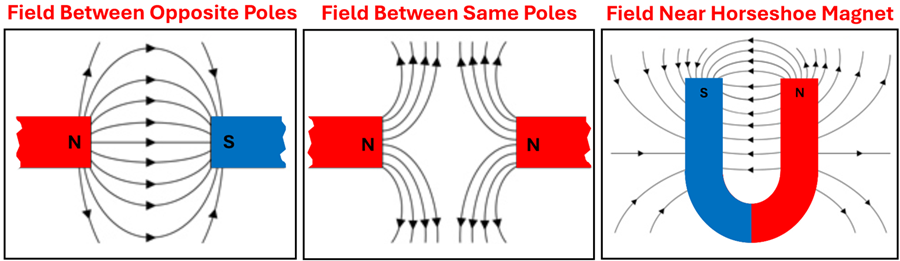
That quick table hides three very different behaviors. Educational explainers from NDE-Ed and the National MagLab group metals and other materials into three everyday categories: ferromagnetic, paramagnetic, and diamagnetic. A simple way to picture them is to imagine countless tiny arrows inside the material. In some metals, those arrows line up easily. In others, they barely react. In still others, they lean slightly against the field, so the metal seems non-magnetic in normal use.
At the atomic level, paired electrons tend to cancel each other out, while unpaired electrons create a net magnetic effect. That is the basic reason different metals respond so differently to the same magnet.
Ferromagnetic Metals and Strong Attraction
- Ferromagnetic metals are the ones most people mean when they ask what types of metal are magnetic. They are strongly attracted because groups of atoms form magnetic domains, and those domains can align in the same direction.
- This domain effect creates the obvious pull you feel with classic magnetic metals. NDE-Ed lists iron, nickel, and cobalt as examples, and MagLab explains how aligned domains let a material become magnetized.
- In practical terms, what are the magnetic metals? Usually the ferromagnetic ones, because their response is easy to notice with a handheld magnet.
Paramagnetic Metals and Weak Magnetic Response
- Paramagnetic metals are weakly attracted to a magnetic field. They have some unpaired electrons, but the pull is small and usually disappears once the magnet is removed.
- NDE-Ed includes magnesium, molybdenum, lithium, and tantalum in this group. In a lab, they respond. In a garage, that response is often too faint to be useful.
- That is why searches for what transition metals are magnetic usually focus on the strongly magnetic examples, not every metal with a tiny measurable effect.
Diamagnetic Metals in Everyday Life
- Diamagnetic metals weakly oppose an external magnetic field. NDE-Ed notes that they are slightly repelled and do not retain magnetism after the field is removed.
- Most readers experience them as non-magnetic because the effect is so weak. Copper, silver, and gold are common examples.
- So what type of metals are magnetic in ordinary workshop language? Not diamagnetic ones. A fridge magnet will usually seem to ignore them.
In household or shop language, non-magnetic usually means not strongly attracted to a handheld magnet, not that the material has zero magnetic behavior under all conditions.
The pattern is simple but important. Strong attraction usually points to ferromagnetism. Weak or invisible response may still be real, just too small to matter in everyday testing. That distinction becomes much more useful when the conversation shifts from textbook element names to the iron-based metals and alloys people actually handle.
What Are the Three Magnetic Metals?
Iron Cobalt and Nickel as the Best-Known Magnetic Metals
If you searched what are the three magnetic metals, the textbook answer is simple: iron, cobalt, and nickel. Mead Metals identifies these as the three elemental metals that are naturally ferromagnetic. In plain English, they are strongly attracted to magnets and can themselves become magnetized. So when readers ask what are the three metals that are magnetic, these are usually the names they want first. If your question is what metals are naturally magnetic, this is the clearest elemental answer.
That short list is accurate, but it is also a little too tidy for real life. Most people do not handle pure cobalt bars or pure nickel plates in the garage. They handle nails, brackets, machine parts, cookware, and tools. Those are usually alloys, and many of them act magnetic because iron is still the main ingredient.
Why Many Steels and Cast Irons Are Magnetic
Steel is the everyday extension of that three-metal answer. Okon Recycling notes that carbon steel is typically strongly magnetic because it is mostly iron, with relatively few alloying additions to disrupt magnetic domain alignment. Cast iron is also iron-based, so it usually gives a strong pull with a handheld magnet. Many iron-based tool steels behave the same way in practice. That is why plain steel is such a useful rule of thumb: if it is an ordinary iron-rich steel part, a magnet will usually grab it decisively.
| Material | Type | Everyday magnetic response | Why it behaves that way |
|---|---|---|---|
| Pure iron | Element | Strongly magnetic | Classic ferromagnetic metal |
| Cobalt | Element | Strongly magnetic | Elemental ferromagnet |
| Nickel | Element | Strongly magnetic | Elemental ferromagnet |
| Carbon steel | Iron-carbon alloy | Strongly magnetic | High iron content lets magnetic domains align easily |
| Cast iron | Iron-based alloy | Strongly magnetic | Iron-rich composition gives a clear ferrous response |
| Many tool steels | Iron-based alloy | Usually magnetic | They are still primarily steel, so iron drives the response |
| Ferritic or martensitic stainless | Iron-based stainless alloy | Usually magnetic | Its structure can support magnetic alignment |
Why Iron-Based Alloys Do Not All Behave the Same
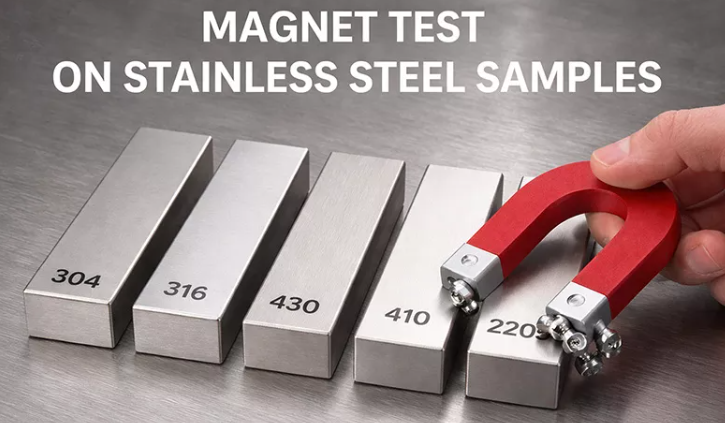
Here is the key distinction: elemental metals and commercial alloys are not the same category. Iron is one element. Steel is a whole family of iron-based alloys. Some remain strongly magnetic, while others change as chromium, nickel, heat treatment, and crystal structure alter the internal arrangement. Online Metals highlights that split clearly by noting that ferritic and martensitic stainless steels are magnetic, while austenitic grades such as 304 and 316 are often mostly non-magnetic.
So if you came here asking what 3 metals are magnetic, iron, cobalt, and nickel are the clean starting point. That also answers the common wording what are the 3 magnetic metals. Real parts are messier. The moment you move beyond pure elements, magnetism becomes less of a memorized list and more of a material clue, especially when non-ferrous metals and look-alike alloys enter the picture.
What Metals Are Not Magnetic in Everyday Use
A strong pull usually points to iron-rich metal. The confusing cases are the metals a pocket magnet seems to ignore. If you are asking what metals are not magnetic, the everyday shortlist usually includes aluminum, copper, brass, lead, silver, gold, titanium, and platinum. Guides from FIRST4MAGNETS and MPCO both place those materials in the non-magnetic camp for normal handling. In shop talk, that is also what most people mean by what metals are non magnetic.
Common Metals That Usually Do Not Stick to Magnets
- Aluminum - usually shows no noticeable pull from a handheld magnet.
- Copper - commonly treated as non-magnetic in wire, pipe, and fittings.
- Brass - this copper alloy usually behaves the same way in practical magnet checks.
- Lead - generally does not attract a household magnet.
- Silver and gold - usually do not stick to magnets in normal testing.
- Titanium and platinum - often chosen where a non-magnetic response is useful.
If you want a quick what metals are not magnetic list, that group covers most of the materials people ask about first. Questions about bronze, tin, and zinc come up often too, but a magnet is still better at separating likely ferrous from likely non-ferrous metal than naming an exact match.
Why Aluminum Copper Brass and Bronze Behave Differently
This is why searches for what types of metal are not magnetic and what metals are not attracted to magnets can feel broad. Many common non-ferrous metals simply do not give the sharp snap that steel does. If you are specifically asking what metals are not attracted to a magnet, aluminum, copper, brass, lead, silver, and gold are practical starting points.
Gold adds an important nuance. American Hartford Gold notes that pure gold is diamagnetic, which means it is very slightly repelled by strong fields. In everyday use, though, it still appears non-magnetic.
Precious Metals Jewelry and False Positives
People searching what jewelry metals are not magnetic usually mean gold and silver. A magnet can help screen them, but it cannot prove purity. American Hartford Gold highlights why: clasps, springs, pins, solder, screws, plated layers, or hidden steel cores can make one small area jump to a magnet while the main body does not. The same false positive shows up in household items with mixed-metal hardware.
No pull usually means probably non-ferrous, not confirmed pure gold, silver, or any exact alloy.
One metal family turns that simple rule upside down more than any other, and it is sitting in kitchens, tools, fasteners, and appliances everywhere: stainless steel.
What Types of Stainless Steel Are Magnetic
If you are trying to sort out what metals are magnetic and which are not, stainless steel is where the easy rule starts to wobble. A sink, screw, trim piece, or knife can all be called stainless and still react very differently to the same magnet. Guidance from ASSDA, Carpenter Technology, and BSSA lines up on the big point: the family name alone does not predict the magnetic response. Internal structure matters just as much as chemistry.
| Stainless family | Usual magnetic behavior | Why it behaves that way | Important fabrication and processing caveats |
|---|---|---|---|
| Austenitic, such as 304 and 316 | Often non-magnetic or only slightly magnetic | In the fully austenitic, annealed condition, magnetic permeability stays very low | Cold working can form martensite and create local pull. Some castings may be weakly magnetic because they can contain a few percent ferrite. |
| Ferritic, such as 409 or 430 | Usually magnetic | Ferritic structure is ferromagnetic, so magnets pull clearly even when annealed | Cold work and strong external fields can leave parts more noticeably magnetized. |
| Martensitic, such as 420 | Usually magnetic | Martensitic structure is ferromagnetic | Hardening makes these grades harder to demagnetize once magnetized. |
| Duplex and super duplex | Noticeably magnetic | They contain a large ferritic portion in the microstructure | Magnetic response is normal for this family and should not be mistaken for a fake or low-grade stainless. |
Austenitic Stainless Steel and Why It Often Seems Non-Magnetic
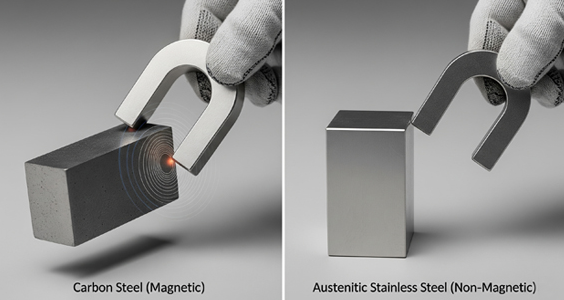
This is the stainless family that causes most of the confusion. Wrought austenitic grades such as 304 and 316 are generally regarded as non-magnetic in the annealed condition. In plain English, a handheld magnet usually will not grab them strongly. That is why many sinks, food equipment panels, and decorative sheets seem to fail the magnet test even though they are still iron-based stainless alloys.
The trick is that austenitic stainless is not permanently locked into that behavior. BSSA explains that cold working can partially transform austenite into martensite, which is ferromagnetic. So bent corners, drawn wire, sheared edges, and machined areas may show more pull than a flat, lightly worked section. That is one reason lists of what kinds of metals are magnetic can be misleading when they treat all stainless as one category.
Ferritic and Martensitic Stainless Steel That Usually Attract Magnets
Ferritic and martensitic stainless steels are much more straightforward. ASSDA notes that ferritic grades such as 409 and martensitic grades such as 420 are strongly attracted to a magnet even in the annealed state. In everyday terms, these are the stainless parts that often feel obviously magnetic, including many fasteners, appliance components, and knife blades.
Carpenter Technology also points out an important difference in behavior after processing. Annealed ferritic stainless can behave like a soft magnetic material, while cold work can make it act more like a weak permanent magnet. Martensitic stainless, especially in the hardened condition, can hold magnetism more stubbornly. So two stainless parts with similar corrosion resistance goals may behave quite differently once they have been formed and heat treated.
Duplex Stainless Steel and Mixed Magnetic Behavior
Duplex stainless steels sit in the middle by design. They combine austenite and ferrite, and ASSDA says duplex and super duplex grades are strongly attracted because they contain about 50 percent ferrite in their microstructure. A magnet sticking to duplex does not mean the material is poor quality or not really stainless. It simply means this family was built around a different phase balance.
How Cold Working and Fabrication Can Change the Result
For real parts, process history matters almost as much as grade family. Forming, rolling, straightening, drawing, or machining can increase magnetic response in austenitic stainless by creating deformation-induced martensite. BSSA specifically flags sharp corners, sheared edges, and machined surfaces as common places where that local pull shows up.
Welding can add another wrinkle. ASSDA notes that high heat input welding or poor heat treatment in some austenitic stainless steels can increase magnetic response locally, while small amounts of ferrite in austenitic welds are usually only a minor effect because the weld is a small part of the whole assembly. Cold-worked austenitic stainless can be returned toward its low-magnetism state by full solution annealing, although that is not always practical for finished parts.
Stainless steel is named for corrosion resistance, not for one single magnetic behavior.
That is why stainless keeps confusing magnet tests. If you are asking what types of metals are magnetic, stainless steel is really several family answers plus a fabrication story. A magnet is still useful, but here it works best as a clue, not a verdict. That becomes even more important when you are standing over an unknown part and trying to identify what it is from the response alone.
How to Test an Unknown Metal With a Magnet
A magnet becomes much more useful once you stop asking it to do too much. Stainless steel can fool it, plated parts can fool it, and mixed assemblies can fool it. Even so, it is still the fastest first filter for an unknown part. The basic test order shown by Mead Metals and PrimeWeld starts with magnetism, then narrows the possibilities with appearance, weight, markings, and other shop tests. If you are wondering what metals are attracted to magnets, this is the practical way to narrow the field without pretending you can name an exact alloy in one try.
Step One Test With a Magnet the Right Way
- Touch the magnet to the metal and note the response as strong, weak, or absent.
- Test more than one spot if the part has bends, welds, fasteners, coatings, or attached hardware. One small steel piece can distort the whole result.
- Treat a strong pull as a sign of likely ferrous, iron-rich material such as carbon steel or cast iron.
- Treat a weak pull as a clue, not a conclusion. Some stainless steels can show little to no pull, while others attract more clearly.
- If there is no noticeable pull, the part may be non-ferrous, but it could also be an austenitic stainless grade or a mixed assembly.
When people ask what metals are attracted to a magnet, they usually mean the strong-pull group. In workshop terms, that usually points you toward iron-based materials first.
Step Two Use Visual and Physical Clues
The magnet result gets more useful when you pair it with what you can see and feel. PrimeWeld notes that color, luster, density, and markings are some of the simplest follow-up clues, while Mead Metals recommends checking oxidation, surface appearance, and any identification codes on the material.
- Color and finish - shiny silver may suggest stainless or aluminum, reddish-brown may suggest copper, and a golden tone may suggest brass.
- Weight for size - aluminum usually feels light for its volume, while steel and stainless feel heavier.
- Corrosion behavior - obvious rust often points away from stainless and toward ordinary steel or cast iron.
- Markings and paperwork - stenciled grades, heat numbers, tags, or supplier documents beat guesswork every time.
- Spark testing - use only if appropriate, safe, and familiar. Metal Supermarkets describes it as a quick, inexpensive way to sort many ferrous metals, while copper, brass, and aluminum generally do not spark easily in the same way.
If you use grinding or chemical checks, PrimeWeld also stresses basic PPE such as safety glasses, gloves, and proper ventilation.
Step Three Interpret the Result Without Overconfidence
| Magnet result | Likely meaning | Best next checks | Common trap |
|---|---|---|---|
| Strong attraction | Often a ferrous metal such as carbon steel, cast iron, or some stainless grades | Look for rust, surface finish, grade marks, and use a spark test only if safe | Plating, hidden steel cores, or attached fasteners can mislead you |
| Weak attraction | Could be certain stainless steels, a worked area, or a mixed-metal part | Check several spots, compare weight, inspect welds and edges, review documentation | Local changes from forming, welding, or contamination may exaggerate one area |
| No noticeable attraction | Often a non-ferrous metal, but sometimes an austenitic stainless alloy | Use color, density, corrosion clues, markings, and if needed advanced ID methods | Assuming non-magnetic means pure aluminum, copper, silver, or gold |
A magnet can separate likely ferrous from likely non-ferrous metals. It cannot confirm grade, purity, or exact composition.
That is the safest answer to both what are the metals that are attracted to magnets and what metals are attracted by magnets: the test is excellent for screening, not final identification. It also explains why searches for what types of metals are attracted to magnets so often run into exceptions. Composition, structure, temperature, and processing can all change the pull more than most people expect.
What Metals Are Magnets Made Of?
A magnet test gets tricky because magnetic behavior is not fixed forever. Guidance from SAM points to composition, crystal structure, temperature, and microstructure as major reasons a metal or alloy may pull strongly, weakly, or not much at all. That is why two parts with a similar look can give very different results.
How Composition and Structure Change Magnetic Behavior
Chemistry matters, but atomic arrangement matters too. Eclipse Magnetics uses iron as a helpful example: alpha iron with a body-centered cubic structure is ferromagnetic, while other forms of iron respond differently. In plain English, the same base metal can change its magnetic response when its internal structure changes.
- Alloy composition - adding elements can strengthen, weaken, or redirect magnetic behavior.
- Crystal structure - the way atoms are packed can matter as much as the ingredient list.
- Impurities and microstructure - small defects can change coercivity, remanence, and overall response.
- Phase balance - mixed structures inside one alloy can create a mixed magnetic result instead of a simple yes or no.
- Material type - strongly magnetic metals, easily magnetized alloys, and permanent magnet materials are related ideas, but they are not identical.
Used in magnets is not the same as strongly magnetic in pure everyday form.
Why Temperature and Processing Matter
Heat can disturb magnetic order. SAM notes that rising temperature increases atomic vibration and weakens alignment, and every magnetic material has a Curie temperature where that ordered state is lost. Processing changes matter too. Cold work, heat treatment, welding, and phase changes can all alter structure, which changes how easily magnetic domains line up. That helps explain why one area of a formed or heat-affected part may react differently from the rest.
What Metals Are Used to Make Permanent Magnets
If your search was what metal are magnets made of, the honest answer is usually not one pure metal. Commercial permanent magnets often use alloys or compounds. Eclipse Magnetics lists several common families:
- Alnico - an alloy of aluminum, nickel, and cobalt.
- NdFeB - neodymium, iron, and boron.
- Samarium-cobalt - rare-earth magnet alloys used in specialist applications.
- Ferrite - iron oxide with strontium or barium, which is a ceramic magnet material rather than a simple metal alloy.
So, what metals are in magnets? Depending on the magnet type, the answer may include iron, nickel, cobalt, neodymium, or samarium. People asking what rare earth metals are used in magnets are usually looking for neodymium and samarium in those common permanent magnet systems. That also shows why what metals are magnets made of and what metals are used to make magnets are different questions from asking which pure metals stick to a fridge magnet.
Those fine-print differences are not just academic. They shape how magnet checks are used in scrap sorting, incoming inspections, and real-world material selection.
Using Magnetic Behavior in Real Material Selection
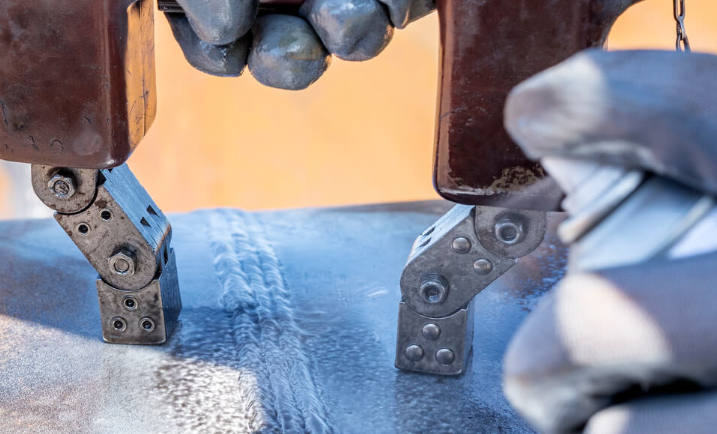
On a recycling pad, receiving dock, or stamping line, magnetic response stops being trivia and starts saving time. Okon Recycling describes magnets as a first sorting tool for separating ferrous metals such as iron and steel from non-ferrous metals like copper, aluminum, and brass before visual inspection, contamination checks, density clues, and XRF analysis. In other words, asking what metals are attracted by a magnet is useful for fast screening, but not for final material identification.
Where Magnet Testing Helps in Real Material Selection
- Recycling - A magnet gives a quick ferrous or non-ferrous split, which directly affects sorting and downstream processing.
- Incoming material checks - It helps flag obvious steel, cast iron, or magnetic stainless in mixed loads.
- Mislabel detection - If magnetism, color, and weight do not agree, the part needs more than a guess.
- Practical decision-making - On the floor, the question "magnets are attracted to what metals" usually means "is this likely iron-based or not?"
- Common shop shorthand - For first-pass sorting, what common metals are magnetic usually points to iron and steel, while what common metals are not magnetic usually points to aluminum, copper, and brass in normal handling.
Why Certified Manufacturing Processes Matter for Metal Parts
Once a part is headed into production, a magnet cannot replace records. The IATF 16949 traceability framework highlighted by QMII centers on record-keeping, process identification, supplier traceability, change management, and audit trails. Those controls help manufacturers trace defects, support recalls, and demonstrate compliance.
- Use the magnet test as triage, not grade release.
- Check part identifiers, supplier documentation, and process records when the exact material matters.
- Escalate uncertain cases to XRF or other lab verification when appearance and magnet response conflict.
- Select material for the whole job, including corrosion resistance, strength, formability, and process control, not magnetism alone.
A magnet is excellent for quick sorting. Traceability is what protects real production.
Choosing a Reliable Production Partner for Auto Stamping
Stamped automotive parts make that distinction clear. A magnet can separate obvious ferrous stock, but it cannot confirm the exact sheet, history, or readiness for forming. That is why suppliers with controlled traceability matter. One relevant example is Shaoyi, which presents its IATF 16949 certified auto stamping process, from rapid prototyping to automated mass production, for parts such as control arms and subframes. In projects like these, the smarter question is not only what metals are attracted by a magnet, but whether the supplier can verify the material and reproduce the process every time. That is where magnet testing becomes most valuable: as a fast first clue inside a much stronger quality system.
FAQs About What Metals Are Magnetic
1. What are the three metals that are magnetic?
The classic elemental answer is iron, nickel, and cobalt. In everyday use, though, most people run into magnetic iron-based materials rather than pure elements, so carbon steel, cast iron, and many tool steels are often the metals they notice first.
2. Is steel always magnetic?
No. Plain carbon steel and most cast irons usually attract magnets strongly because they are rich in iron, but some stainless steels can respond weakly or seem non-magnetic. Steel is a useful rule of thumb, not a universal yes.
3. Why is some stainless steel magnetic and some not?
Stainless steel is a broad family of alloys with different internal structures. Ferritic and martensitic stainless are usually magnetic, austenitic grades are often weakly magnetic or effectively non-magnetic, and duplex grades commonly show a noticeable pull. Processing matters too, because cold working, cutting, and welding can change the response.
4. What metals are not attracted to a magnet?
In normal home or shop testing, aluminum, copper, brass, bronze, lead, tin, zinc, silver, gold, titanium, and platinum usually do not stick to a handheld magnet. Some can show very weak magnetic effects in scientific settings, but that is rarely obvious in practical use. Hidden steel parts, plated layers, or mixed-metal hardware can still fool the test.
5. Can a magnet identify an exact alloy in recycling or manufacturing?
A magnet is best used for first-pass screening, not final identification. It can quickly separate likely ferrous from likely non-ferrous material, but exact alloy decisions still need markings, paperwork, or instrument-based checks. In controlled production environments such as automotive stamping, traceable systems and documented verification, including IATF 16949 processes like those presented by Shaoyi, are far more reliable than magnet response alone.