 Small batches, high standards. Our rapid prototyping service makes validation faster and easier —
 EN


Stamping Die Cost: How Much Do Automotive Stamping Dies Cost?
Stamping Die Cost: How Much Do Automotive Stamping Dies Cost?
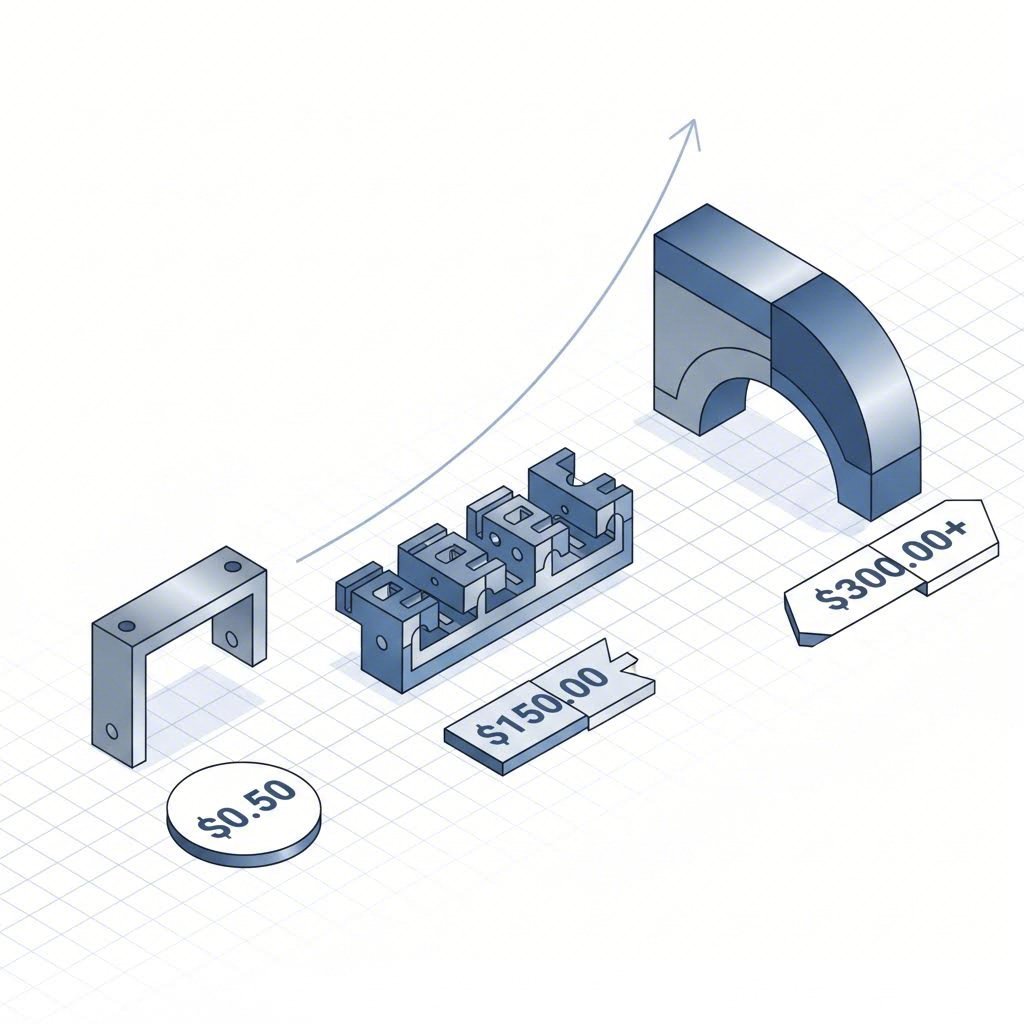
A stamping die for an automotive part typically costs between $1,000 and $150,000, depending on the type of die and the part it makes. Based on our own tool-room pricing, a simple blanking or piercing die costs $1,000–5,000, a progressive die $5,000–80,000 depending on complexity, a deep-drawing die $10,000–50,000 or more, and a transfer die $30,000–150,000 or more.
For the brackets, retainers, mounting plates and chassis parts that make up most automotive stamping work, progressive dies usually fall between $10,000 and $50,000. The tables below show where a specific die is likely to land, and the rest of the article explains why.
Stamping Die Prices by Die Type
Reference ranges from our tool room. Every die is quoted on its own drawing, but these ranges show where most automotive projects land.
|
Die type |
Typical parts |
Stations |
Reference price (USD) |
Typical annual volume |
|
Simple blanking die |
Washers, flat plates, simple brackets |
1 |
$1,000–5,000 |
Under 50,000 |
|
Simple piercing die |
Perforated plates, mounting tabs, small brackets |
1 |
$1,000–5,000 |
Under 100,000 |
|
Single-operation forming die |
Bent, flanged and simple formed parts |
1 |
$2,000–8,000 |
10,000–100,000 |
|
Compound die |
Precision blanks, washers, flanges |
1 (compound) |
$4,000–12,000 |
50,000–300,000 |
|
Small progressive die |
Small precision automotive stampings |
5–10 |
$5,000–15,000 |
100,000–1M |
|
Medium progressive die |
Retainers, brackets, mounting plates |
10–20 |
$10,000–30,000 |
100,000–1M+ |
|
Complex progressive die |
Chassis brackets, suspension parts |
15–30 |
$20,000–50,000+ |
300,000–2M |
|
High-complexity progressive die |
Multi-operation automotive structural parts |
25–40+ |
$35,000–80,000+ |
500,000–2M+ |
|
Deep-drawing die |
Spring seats, cups, housings |
3–8+ |
$10,000–50,000+ |
50,000–1M+ |
|
Progressive deep-drawing die |
Continuously drawn automotive parts |
10–25+ |
$20,000–60,000+ |
300,000–2M |
|
Transfer die |
Large chassis and structural parts |
5–15 |
$30,000–100,000+ |
100,000–1M+ |
|
Large automotive transfer die |
Large automotive structural parts |
8–20 |
$50,000–150,000+ |
100,000–500,000+ |
|
Fine blanking die |
High-precision toothed plates, functional parts |
1–3 |
$15,000–60,000+ |
50,000–500,000 |
Dies for Class-A exterior body panels such as doors and fenders are a separate category, built as multi-die press lines, and sit outside these ranges.
Progressive Die Cost by Complexity Level
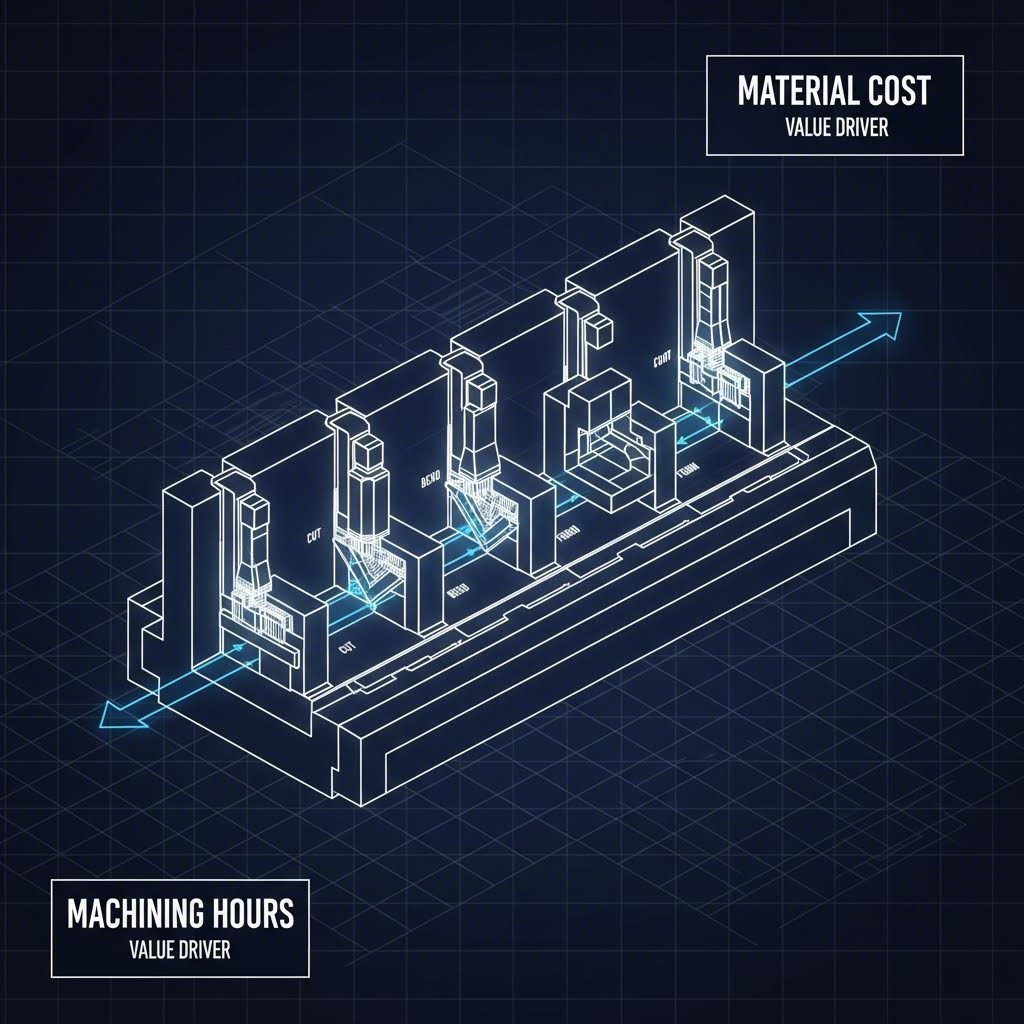
Progressive dies cover the widest price range, so it helps to break them down further. The main difference between levels is the number of stations, which follows directly from how many operations the part needs.
|
Level |
Stations |
Typical parts |
Material / thickness |
Die length |
Reference price |
|
Entry level |
5–8 |
Small brackets |
DC01/DC04, 0.6–1.2 mm |
400–800 mm |
$5k–10k |
|
Standard |
8–15 |
Retainers, brackets |
DC04/S355MC, 0.8–2.0 mm |
600–1,200 mm |
$8k–20k |
|
Medium complexity |
12–20 |
Automotive mounting parts |
DC04/S355MC, 1.0–2.5 mm |
800–1,500 mm |
$15k–30k |
|
Complex |
15–30 |
Chassis and suspension parts |
S420MC/S460MC, 1.5–3.0 mm |
1,000–2,000 mm |
$20k–50k+ |
|
High complexity |
25–40+ |
Complex automotive parts |
AHSS/DP600, 1.5–3.0 mm |
1,200–2,500+ mm |
$35k–80k+ |
What You Are Paying For in a Die
A die price is built from a handful of cost blocks. Knowing them makes it easier to read a quote and to see where savings are possible.
Design and forming analysis. Strip layout, station sequence, and CAE forming simulation to find cracking, thinning and springback risks before any steel is cut.
Die steel. Working inserts are typically Cr12MoV, DC53 or SKD11, with carbide inserts where wear is highest. Longer required tool life means better steel and more of it.
Machining and heat treatment. CNC machining, wire EDM, grinding and heat treatment of every punch, insert and plate. This grows directly with the number of stations.
Assembly and tryout. Fitting the die, running it in a press, and adjusting it until it produces parts to drawing. Large and complex dies need more tryout rounds.
Checking fixture. Most automotive programmes also need a checking fixture built to the same datum scheme as the die. It is often quoted separately, so ask whether it is included.
What Drives Die Cost Up
Two dies for similar-looking parts can differ in price by a factor of two or three. These are the factors that make the difference, starting with the ones that move the price most.
Part geometry and number of stations
Every hole, bend, flange and form needs a station, and every station adds punches, inserts, machining and assembly time. A bracket that needs 8 stations and one that needs 20 are simply different dies.
Required tool life
A die expected to run for several hundred thousand parts a year over many years needs harder steels, better heat treatment and replaceable inserts at the wear points. Always state the lifetime volume in the RFQ, or suppliers will each assume their own.
Cam mechanisms
Features that cannot be formed or pierced in the press direction need side-acting cams. Each cam is a mechanism in its own right, with its own machining and adjustment.
Part size and material strength
Larger parts need larger die sets, more steel and bigger machines. High-strength materials need stronger die structures and more wear-resistant inserts, and they make springback control harder.
Tolerances, automation and customer standards
Tighter tolerances need more precise machining and inspection. Automatic feeding, transfer and in-die sensors add system complexity. And OEM or Tier-1 die standards, such as those used by VW or Mercedes, add design and validation requirements that a standard die does not have.
For a side-by-side view of how these factors affect the total cost of a part, including piece price, see how much automotive stampings cost.

How Material Affects Die Cost
|
Material |
Common grades |
Typical thickness |
Forming difficulty |
Effect on the die |
Price impact |
|
Low-carbon steel |
DC01, DC04 |
0.6–3.0 mm |
Low |
Standard die steel and clearance design |
Baseline |
|
HSLA steel |
S355MC, S420MC |
1.0–4.0 mm |
Medium |
Higher press force, springback control |
Higher |
|
High-strength steel |
S460MC, S500MC |
1.5–4.0 mm |
Medium–high |
Stronger, more wear-resistant die design |
Much higher |
|
AHSS |
DP600, DP800 |
1.0–3.0 mm |
High |
More sensitive to forming, springback and wear |
Much higher |
|
Stainless steel |
SUS304, SUS430 |
0.6–2.5 mm |
Medium–high |
Friction, galling and wear |
Much higher |
|
Aluminium |
5xxx / 6xxx series |
0.8–3.0 mm |
Medium |
Springback, surface protection, forming control |
Higher |
Budgeting Beyond the Die Price
Maintenance. Punches need regrinding and worn inserts need replacing. We typically budget 5% of the die value per year, depending on material and volume.
Engineering changes. A design change after the die is built means die modification. The cost depends on how far the change reaches into the station sequence, and it is far lower when the tool room is in the same building as the press shop.
Soft tooling for validation. For prototypes and validation batches, single-operation dies in the $1,000–8,000 range let a programme finish design and process validation before committing to a full progressive die.
Where the die lives. When the same supplier builds the die and runs production, the die normally stays in that supplier's plant. That is how most of our projects work: dies are designed and built in our tool room in Ninghai and run on our own presses, so there is no tooling freight and no second supplier involved when an adjustment is needed. The customer owns the tooling they pay for; we store and maintain it.
How to Get an Accurate Die Quote
Send the 2D drawing and 3D model with revision level, material grade and thickness, annual and lifetime volume, the tool life you expect, critical-to-quality features, and any customer die standard. Tell us whether you need a checking fixture as well.
If the die will run in your own plant rather than ours, add your press tonnage, bed size, shut height and feed system, so the die is designed for the press it will actually run in.
We design and build automotive stamping dies in-house, and we also run them for custom automotive stamping parts. Send us your drawing for a technical analysis within 12 hours and a formal quotation within 24 hours. We sign an NDA before any file is shared.
FAQ
How much does a stamping die cost?
From about $1,000 for a simple blanking or piercing die to $150,000 or more for a large automotive transfer die. Most progressive dies for automotive brackets and chassis parts fall between $10,000 and $50,000.
How much does a progressive die cost?
From $5,000–10,000 for an entry-level die with 5–8 stations, to $35,000–80,000 or more for a high-complexity die with 25–40 stations for AHSS parts. The number of stations is the main driver.
Why does high-strength steel make a die more expensive?
Grades such as S460MC, S500MC and DP600 need stronger die structures, more wear-resistant inserts and more careful springback compensation. All of that adds steel, machining and tryout time.
Can you build a die that runs in our own press?
Yes. Send your press tonnage, bed size, shut height and feed system with the RFQ, and we design the die for that press and validate it before shipment.
How much should I budget for die maintenance?
We typically budget 5% of the die value per year, depending on material, thickness and production volume.
Written by: Xungui Xu
Reviewed by: Nansen, International Business Manager
Last updated: 2026.09.15