 Small batches, high standards. Our rapid prototyping service makes validation faster and easier —
  EN
EN


Inside The Forge: Custom Forged Wheel Manufacturing Steps Revealed
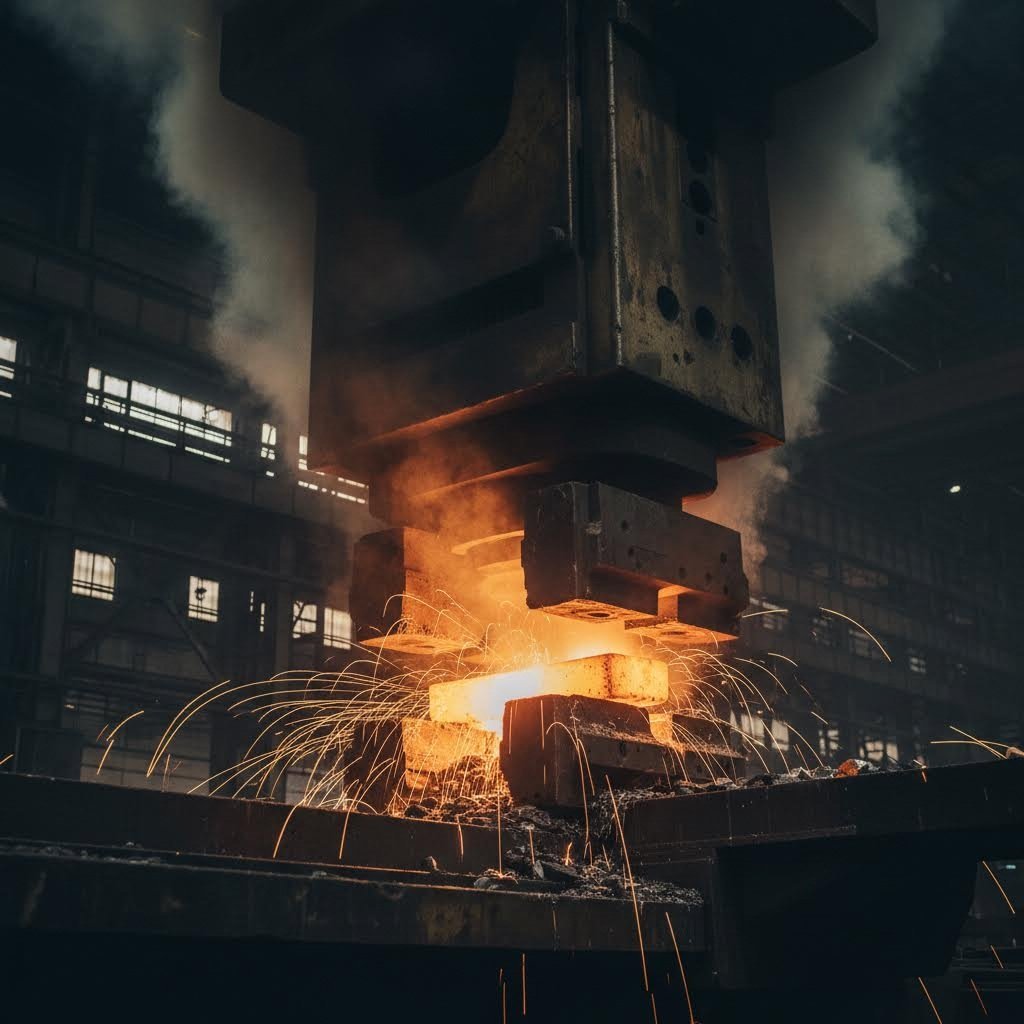
Understanding Custom Forged Wheel Manufacturing Excellence
What separates a high-performance forged wheel from an ordinary one? The answer lies deep within the manufacturing process itself. Custom forged wheels represent the pinnacle of automotive wheel engineering, where every decision made during production directly shapes how your vehicle accelerates, handles, and endures the demands of the road or track.
So, what are forged wheels exactly? By forged wheels definition, these components are crafted from a single block of high-grade aluminum that undergoes intense heat and pressure to create a wheel with exceptional strength-to-weight characteristics. Unlike cast alternatives, one piece forged wheels feature a dense, uniform grain structure that eliminates internal weaknesses, resulting in superior durability and performance.
The forging process compresses the metal, creating a tight grain structure that allows wheels to shed weight without sacrificing strength. This manufacturing decision alone determines whether your wheels can withstand high-stress driving conditions or succumb to metal fatigue over time.
Why Manufacturing Knowledge Matters for Wheel Buyers
Whether you're an automotive enthusiast seeking peak performance, a procurement professional evaluating suppliers, or a performance-focused buyer investing in quality components, understanding the forged wheels meaning goes beyond surface-level specifications. The manufacturing journey from raw aluminum billet to finished wheel involves critical stages that determine tensile strength, fatigue resistance, and overall longevity.
This technical reference bridges the gap between superficial overviews and inaccessible industry documentation. You'll discover exactly how each production phase impacts the wheel's ability to handle extreme forces, from aggressive cornering to rough terrain navigation.
The Engineering Precision Behind Every Custom Forged Wheel
Throughout this guide, you'll follow the complete manufacturing journey, including raw material selection, the forging process itself, heat treatment protocols, precision CNC machining, surface finishing, and rigorous quality control testing. Each step reveals why forged wheels command premium pricing and deliver unmatched performance characteristics that serious drivers demand.
Raw Material Selection and Aluminum Billet Preparation
Ever wonder what makes a forged wheel capable of handling extreme forces while remaining remarkably lightweight? The answer begins long before any metal touches a forging press. It starts with selecting the right aluminum alloy, and that decision shapes everything that follows in the manufacturing process.
So, what is an alloy wheel made of? The foundation of premium forged wheels is aerospace-grade aluminum, specifically alloys engineered to deliver exceptional strength without unnecessary weight. When asking what is a wheel made of at the highest performance levels, the answer almost always points to the 6xxx series aluminum alloys, with 6061-T6 standing as the industry benchmark.
Aerospace-Grade Aluminum Selection Criteria
Are forged wheels aluminum? Yes, but not just any aluminum. The 6061-T6 alloy represents a carefully engineered composition where magnesium and silicon serve as the principal alloying elements. According to industry specifications, a typical 6061-T6 composition delivers an optimal balance of properties that manufacturers cannot achieve with pure aluminum or lesser alloy grades.
Why does 6061-T6 dominate custom forged wheel production? The technical reasoning centers on three critical factors:
- Tensile strength optimization: With an ultimate tensile strength of approximately 290-310 MPa and yield strength around 250-260 MPa, 6061-T6 provides the structural integrity needed to withstand cornering forces, road impacts, and brake heat without permanent deformation.
- Heat treatability: The T6 temper designation indicates the alloy has undergone solution heat treatment followed by artificial aging, producing fine Mg₂Si precipitates that maximize hardness and strength throughout the material.
- Forgeability in the warm-to-hot range: At temperatures between 350-500°C, 6061 recrystallizes easily, allowing manufacturers to achieve a fine, equiaxed grain structure that improves fatigue life by 10-15% compared to extruded or cast alternatives.
The density of 2.70 g/cm³ combined with these strength characteristics creates what engineers call a high specific strength ratio. This means forged wheels can shed significant weight while maintaining, or even exceeding, the load-bearing capacity of heavier alternatives.
Material Properties That Define Wheel Performance
Understanding what are wheels made of at the metallurgical level reveals why material selection cannot be compromised. The 6061-T6 alloy delivers a comprehensive property profile that directly translates to on-road performance:
- Corrosion resistance: The magnesium-silicon matrix provides inherent protection against oxidation and typical environmental exposure, reducing the need for extensive post-processing treatments while extending wheel service life.
- Thermal conductivity: At approximately 167 W/m·K, the alloy rapidly dissipates heat generated during braking, protecting both the wheel structure and adjacent components from thermal damage.
- Moderate work-hardening: Unlike alloys that harden excessively under strain, 6061-T6 maintains predictable behavior during forging, allowing consistent quality across production runs.
- Weldability: For multi-piece wheel designs requiring welded joints, the alloy accepts TIG, MIG, and friction stir welding methods when properly prepared and post-treated.
However, manufacturers must also account for limitations. The alloy begins losing peak-aged hardness above 150°C during extended exposure, and its fatigue limit of approximately 95-105 MPa requires careful design consideration for highly cyclic, high-load applications.
Before any billet enters production, quality-focused manufacturers implement rigorous incoming material verification. This typically includes chemical composition analysis to confirm alloy specifications, dimensional inspection of billet stock, and documentation review tracing the material back to certified mills. Some facilities perform ultrasonic testing to detect internal voids or inclusions that could compromise the finished wheel's structural integrity.
The billet quality you start with directly determines the wheel quality you finish with. Substandard raw materials cannot be corrected through superior processing—they can only be rejected before wasting valuable production resources. This explains why leading manufacturers maintain strict supplier qualification programs and refuse to compromise on material sourcing, even when cost pressures mount.
With properly verified aerospace-grade aluminum billets secured, the manufacturing journey advances to the transformative forging stage, where intense pressure and heat reshape raw material into a wheel blank with extraordinary structural characteristics.
The Forging Process From Billet to Wheel Blank
Imagine taking a solid cylinder of aerospace-grade aluminum and transforming it into the recognizable shape of a wheel in mere seconds. That's exactly what happens inside a forging press, where extreme pressure and carefully controlled heat work together to create something far stronger than the raw material alone. Understanding how are forged wheels made requires diving into the precise parameters that separate exceptional wheels from mediocre ones.
The aluminum wheel forging process begins when a preheated billet, typically raised to temperatures between 350-500°C, enters the forging press. At this temperature range, the aluminum becomes malleable enough to flow under pressure while retaining the metallurgical properties that make it ideal for high-performance applications. Too cold, and the material resists shaping and develops cracks. Too hot, and you risk grain growth that weakens the final product.
According to industry documentation on forged wheel production, the forging rims process involves multiple pressing stages rather than a single operation. The initial pressings bring the wheel face into shape as the press applies several thousand tons of force. This incremental approach refines the grain structure progressively, creating a stronger end product than a single massive press stroke would achieve.
Open Die vs Closed Die Forging Techniques
When manufacturers discuss forging methods, two primary approaches dominate the conversation. Each technique serves specific purposes depending on the wheel design requirements, production volume, and precision needs.
Open die forging places the aluminum between flat or simple-shaped dies without fully enclosing the material. Think of it as controlled shaping where the metal can flow in multiple directions. This method excels at creating the initial wheel preform or producing large, relatively simple wheel blanks. The flexibility of open die forging makes it cost-effective for small-batch custom work where creating complex dies would be prohibitively expensive.
Closed die forging, also called impression die forging, takes a fundamentally different approach. The aluminum billet is placed within a die cavity that matches the exact shape of the desired wheel profile. When the press applies force, the metal is compelled to fill every contour of the cavity, producing intricate spoke patterns and precise dimensions in a single operation.
| Method | Applications | Advantages | Limitations |
|---|---|---|---|
| Open Die Forging | Initial preforms, large simple shapes, custom low-volume wheels, ring blanks | Lower tooling costs, flexibility for design changes, suitable for large parts, good grain development | Lower dimensional precision, rougher surface finish, slower production rate, requires skilled operators |
| Closed Die Forging | Complex spoke patterns, high-volume production, precision wheel faces, final wheel shapes | Tight tolerances, excellent surface finish, faster production, better material utilization, repeatable quality | High die costs, size limitations, less flexibility for design modifications, longer lead time for tooling |
Many premium wheel manufacturers employ both methods sequentially. They might use open die forging to create a preform with optimized grain flow, then finish the wheel face in closed dies for precision spoke geometry. This hybrid approach captures the benefits of both techniques.
Forging Press Operations and Tonnage Requirements
Here's where the scale of forging operations becomes impressive. While a typical home shop hydraulic press might generate 10-20 tons of force, the presses used for aluminum wheel forging operate in an entirely different realm. According to Rays wheel manufacturing documentation, their production presses are capable of producing 10,000 tons of pressure.
Why does press tonnage matter for wheel quality? Higher capacity presses deliver several critical advantages:
- Complete die filling: Sufficient force ensures the aluminum flows into every corner of complex die cavities, preventing voids or incomplete features in spoke designs.
- Grain refinement: Greater pressure compacts the aluminum more thoroughly, breaking down coarse grain structures and creating the fine-grained microstructure that enhances fatigue resistance.
- Faster cycle times: High-tonnage presses complete the forming operation in seconds rather than requiring multiple lighter strokes, improving production efficiency and consistency.
- Reduced residual stress: Uniform pressure distribution minimizes internal stresses that could cause warping during subsequent heat treatment or machining.
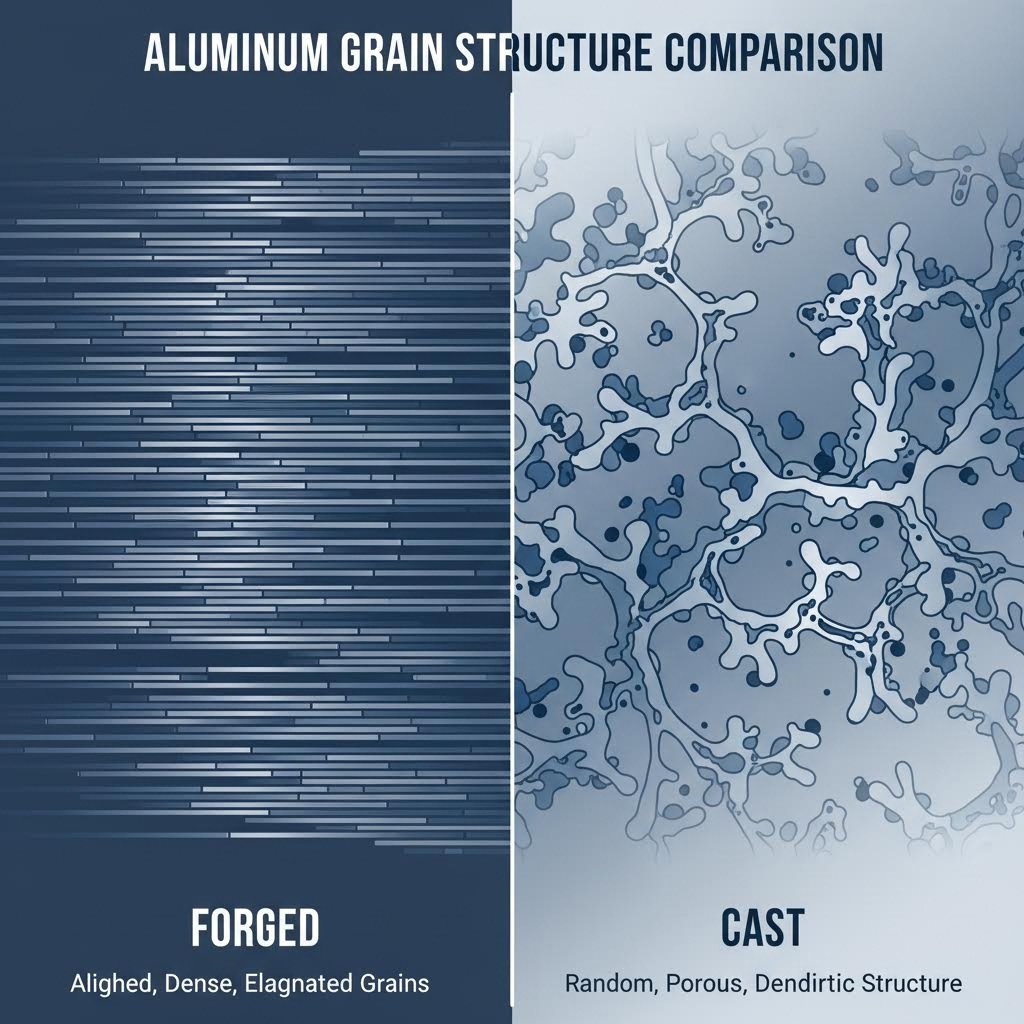
The grain structure alignment that occurs during forging represents the fundamental reason why forged wheels outperform cast alternatives. When molten aluminum solidifies in a casting mold, the grain structure forms randomly with porosity and weak points scattered throughout. Forging compresses and realigns these grains along the stress paths the wheel will experience in service.
This aligned grain flow eliminates the internal voids and porosity that plague cast components. The result? Forged wheels can achieve approximately 32% weight reduction compared to cast wheels of equivalent strength. The metallurgical reasoning is straightforward: without internal defects requiring extra material to compensate, engineers can design thinner cross-sections that maintain structural integrity.
The rotary forged technique represents a specialized variation where rollers progressively thin and strengthen the wheel barrel after the initial face forging. This process work-hardens the rim section while maintaining the forged face's structural advantages, offering a balance between full forging benefits and production efficiency.
After only a few seconds under thousands of tons of pressure, the classic wheel shape emerges from what was a simple aluminum cylinder. The edges are then rounded to prevent stress risers—those small fractures or bends that could propagate into cracks under repeated loading. What looks like a rough wheel blank at this stage already possesses the internal grain structure that will define its performance characteristics for years of service.
With the forging complete and the wheel blank's grain structure optimized, the next critical phase begins: heat treatment processes that unlock the full strength potential locked within the aluminum's molecular structure.
Heat Treatment and Tempering for Maximum Strength
What does forged wheels mean in terms of actual strength? The forging process creates the foundation, but heat treatment unlocks the aluminum's true potential. Without proper thermal processing, even the finest forged wheel blank would lack the mechanical properties needed for demanding performance applications. This critical phase transforms the molecular structure of the aluminum, creating a wheel capable of withstanding years of punishing road conditions.
Understanding what are forged rims at the metallurgical level means recognizing that the forged rims meaning extends beyond just the shaping process. The T6 temper designation you see on premium forged wheels indicates a precise two-stage thermal treatment that dramatically enhances strength, hardness, and fatigue resistance.
Heat Treatment Cycles for Optimal Strength
The T6 heat treatment process transforms ordinary aluminum into high-strength components through carefully controlled heating and cooling sequences. According to technical documentation on aluminum heat treatment, this process can double or triple the strength of aluminum without adding weight, making it essential for aerospace, automotive, and structural applications where both strength and weight matter.
The complete heat treatment cycle follows a precise sequence:
- Solution heat treatment: The forged wheel blank is heated to approximately 530°C (for 6061 alloy) for several hours. At this temperature, the alloying elements—primarily magnesium and silicon—dissolve completely into the aluminum matrix, creating a supersaturated solid solution. This step ensures uniform distribution of strengthening elements throughout the metal structure.
- Quenching: Immediately after solution treatment, the wheel undergoes rapid cooling, typically in water or polymer solutions. This step must occur within 10 seconds of removing the part from the furnace to preserve the supersaturated structure. The goal is trapping those dissolved elements before they can precipitate out in an uncontrolled manner.
- Artificial aging: The quenched wheel is then held at a lower temperature—around 175°C for 6061 aluminum—for approximately 8 hours. During this controlled aging period, fine Mg₂Si precipitates form throughout the metal structure. These microscopic particles block the movement of defects within the metal, dramatically increasing hardness and strength.
The timing and temperatures must be precise for each alloy. Even small variations can affect the final properties of the metal. For A356 aluminum commonly used in wheel applications, research published in the International Journal of Fatigue confirms that alloys in T6 condition show the best fatigue behavior, particularly in low-cycle fatigue scenarios that simulate real-world driving stresses.
Tempering Processes That Maximize Durability
What happens if manufacturers skip or improperly execute heat treatment steps? The consequences directly impact wheel safety and longevity:
- Incomplete solution treatment: If alloying elements don't fully dissolve, the subsequent aging process cannot produce uniform strengthening. The wheel may have inconsistent hardness zones, creating potential failure points under stress.
- Quench delay: Waiting too long between solution treatment and quenching allows uncontrolled precipitation to begin. Properties suffer significantly, and the wheel cannot achieve specified strength levels regardless of subsequent aging.
- Overaging: Leaving parts at aging temperature too long actually reduces strength. The precipitates grow beyond optimal size, losing their effectiveness at blocking defect movement. Manufacturers must monitor aging time carefully and test sample parts regularly.
- Warping and distortion: Improper quenching technique or inadequate fixturing can cause dimensional changes that render the wheel unusable or require excessive machining to correct.
Climate and operating environment considerations influence heat treatment protocols as well. Wheels destined for harsh environments may undergo slight overaging to improve stress corrosion cracking resistance, trading a small amount of peak strength for enhanced long-term durability. This T7-adjacent approach creates a more stable microstructure that maintains properties better under challenging conditions.
Quality-focused manufacturers implement rigorous process controls to prevent heat treatment defects. Temperature recorders document the complete thermal history of each production batch. Hardness testing—expecting 95-105 HB (Brinell hardness) for properly treated 6061-T6—provides quick verification of successful treatment. Conductivity testing offers a non-destructive method to identify improperly treated parts before they proceed to machining.
The transformation is remarkable: after heat treatment, 6061 aluminum achieves yield strength improvements of approximately 30% compared to untreated material. Fatigue resistance improves significantly, allowing T6 treated parts to withstand many more load cycles before failing. This makes them suitable for the dynamic, high-stress applications that performance wheels face daily.
With the aluminum's mechanical properties now optimized through precise thermal processing, the wheel blank is ready for the precision machining operations that will transform it from a rough forging into a finished wheel with exact specifications for bolt patterns, offsets, and spoke profiles.
Precision CNC Machining and Profile Creation
Picture a heat-treated wheel blank emerging from the tempering process—strong, thermally optimized, but still rough and undefined. How does this crude forging transform into the precisely engineered wheel construction you'll mount on your vehicle? The answer lies in Computer Numerical Control machining, where multi-axis cutting tools sculpt aluminum with accuracy measured in microns rather than millimeters.
The construction of wheel profiles demands machinery capable of maintaining extraordinary precision while removing substantial material. Unlike simple turning operations, modern forged wheel machining involves complex three-dimensional geometries: intricate spoke patterns, precise bolt patterns, and hub bores that must mate perfectly with vehicle hubs. This is where the investment in advanced equipment separates premium manufacturers from the rest.
Multi-Axis CNC Machining Operations
The specific machinery used at each manufacturing stage determines both the achievable precision and the range of customization options available. Modern forged wheel production relies on several specialized machines working in sequence.
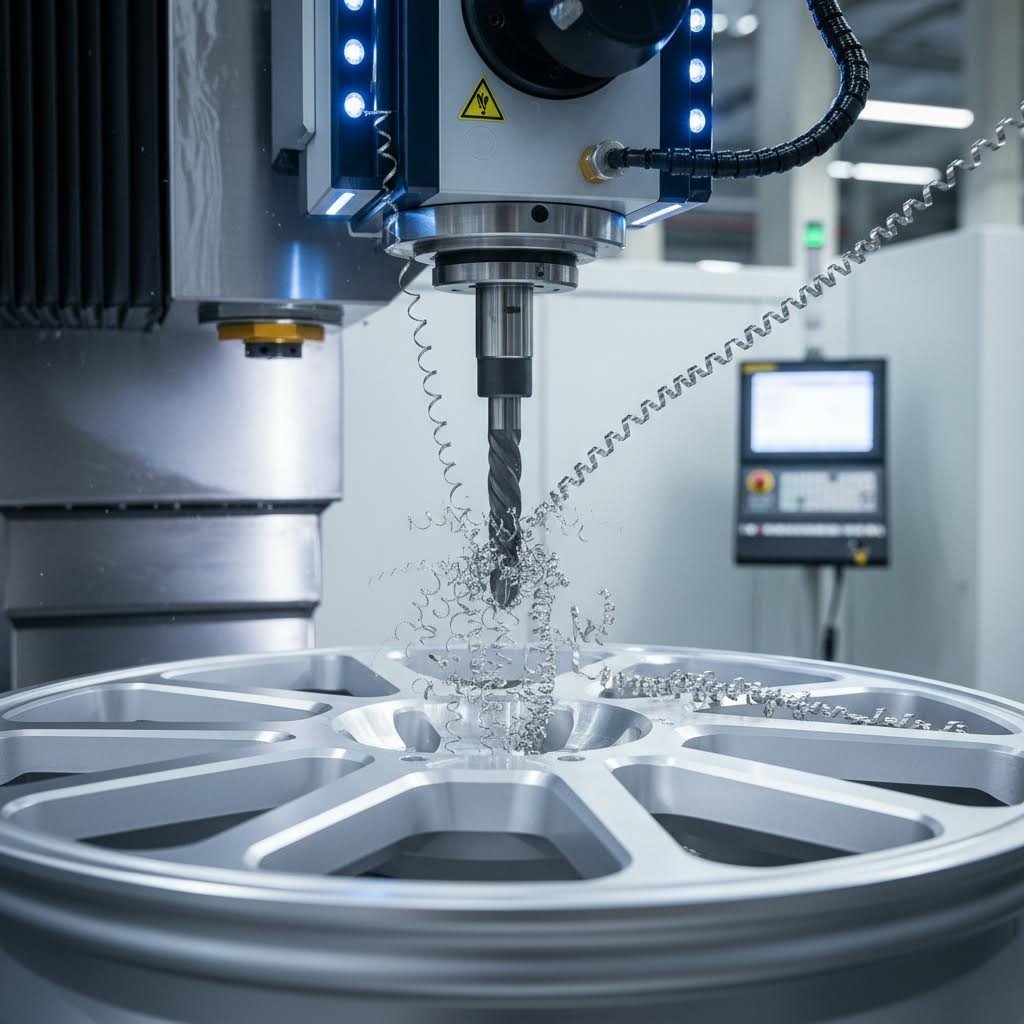
CNC vertical turning lathes handle the initial rough machining of the wheel blank. These massive machines grip the forged blank and rotate it while cutting tools remove excess material from the barrel, rim flanges, and center section. The lathe establishes the basic wheel profile, including the drop center that allows tire mounting and the rim widths that determine tire fitment.
Multi-axis CNC machining centers perform the detailed work that gives each wheel its distinctive appearance. According to precision machining specifications, advanced CNC equipment routinely holds tolerances from ±0.002" down to ±0.0004" (±0.050 mm to ±0.010 mm). Five-axis machining centers prove particularly valuable for wheel production because they can approach the workpiece from virtually any angle, cutting complex spoke designs in single setups rather than requiring multiple repositionings that introduce potential errors.
For multi piece wheel designs and two piece wheel configurations, additional specialized operations come into play. The barrel sections and center discs must be machined with matching profiles that bolt or weld together seamlessly. This demands even tighter tolerances on mating surfaces to prevent vibration or air leaks after assembly.
Achieving Micron-Level Precision in Wheel Profiles
The sequential machining operations follow a carefully orchestrated progression from rough cutting to final profiling:
- Rough turning: CNC lathes remove the bulk of excess material from the forged blank, establishing the approximate wheel profile while leaving 1-2mm of stock for finishing passes. This aggressive material removal shapes the barrel, rim sections, and center disc quickly while maintaining acceptable surface quality.
- Semi-finish turning: A second lathe operation refines the wheel geometry, removing most remaining stock while achieving dimensional accuracy within 0.1mm. Surface finish improves significantly, preparing the wheel for final operations.
- Bolt pattern drilling: Precision drilling operations create the lug holes that attach the wheel to the vehicle hub. Bolt circle diameter accuracy is critical—even 0.1mm errors can cause uneven lug torque and potential loosening. Most manufacturers use dedicated drilling fixtures or five-axis machining centers with probing capabilities to verify each hole position.
- Hub bore machining: The center bore that fits over the vehicle hub receives careful attention. Hub-centric wheels require bore diameters matched to specific vehicle specifications within 0.02mm to ensure proper centering and eliminate vibration.
- Spoke profile machining: Five-axis CNC centers sculpt the spoke patterns that define each wheel's aesthetic character. Complex undercuts, chamfers, and contoured surfaces emerge as cutting tools navigate programmed toolpaths. This stage often represents the longest machining cycle due to the intricate geometry involved.
- Finish turning: Final passes on the rim surfaces achieve the dimensional precision required for tire bead seating and proper sealing. Surface roughness specifications typically require Ra values below 3.2 microns on sealing surfaces.
- Valve stem hole drilling: A precisely angled hole accommodates the tire valve, positioned to clear brake components and allow easy access for tire inflation.
The relationship between machining precision and wheel balance deserves particular attention. Every gram of material asymmetry creates imbalance that manifests as vibration at speed. When CNC operations maintain consistent wall thicknesses and symmetrical spoke profiles, the wheel requires minimal balance weights after mounting—sometimes just 10-15 grams compared to 50+ grams for less precisely machined alternatives.
Customization options like offset and width specifications are implemented directly through CNC programming adjustments. The offset—the distance between the wheel mounting surface and the rim centerline—is established during the initial turning operations by varying the depth of the center section relative to the barrel. According to manufacturing documentation from premium wheel producers, customers can choose custom size, offset, and finish, with these parameters programmed during CNC machining to match each vehicle's specific requirements.
Width adjustments similarly require reprogramming the lathe operations to position the rim flanges at different distances apart. The beauty of CNC manufacturing is that these changes require only software modifications rather than physical tooling changes, enabling true customization without the traditional cost penalties of bespoke manufacturing.
Quality verification occurs throughout the machining sequence. Coordinate measuring machines (CMMs) check critical dimensions against specifications, while dynamic balance testing identifies any asymmetries that slipped through dimensional checks. Wheels failing these inspections either return to machining for correction or are scrapped entirely—there's no compromise on precision when safety depends on proper wheel construction.
With the wheel now machined to exact specifications, the next phase focuses on surface finishing and protective coatings that will determine both the aesthetic appeal and long-term durability of the finished product.
Surface Finishing and Protective Coating Applications
You've got a precisely machined forged wheel with perfect dimensions and optimized grain structure. But what happens next determines whether that wheel turns heads for years or succumbs to corrosion within months. Surface finishing is where engineering meets artistry—and where the difference between forged wheels vs alloy wheels becomes visually apparent.
When buyers ask what is better alloy or forged wheels, part of the answer lies in finishing capabilities. Premium forged wheels accept a wider range of high-quality finishes because their dense, void-free surfaces provide superior substrates for coatings. Understanding what is forged rims at the finishing stage reveals why these wheels maintain their appearance far longer than alternatives.
Surface Finishing Options and Techniques
The finishing stage offers remarkable customization opportunities where your preferences directly influence the final product. According to premium wheel manufacturers, building tailor-made forged wheels means choosing the exact finish you want—far beyond the generic color options seen on off-the-shelf cast alternatives.
Available finish types include:
- Solidtone color finish: Single-stage finishes achieved by applying a layer of color powder coat, combined with gloss or satin clear coat for different sheen levels. This durable, easy-to-maintain option serves as the standard for most wheels.
- Polished finish: A mirror-like fine polished surface in raw aluminum color, achieved through combined machine and hand polishing. A clear top coat seals the aluminum, eliminating the need for ongoing polishing to preserve shine. The result resembles chrome but with the weight advantages of forged aluminum.
- Transparent/Translucent (Candy) finish: A multi-stage process where wheels are first polished to a reflective substrate, then receive a colored transparent top coat after thorough cleaning and rinsing. The result is a stunning candy finish that can be further enhanced with glossy or satin clear coats.
- Brushed finish: The most labor-intensive option, requiring artisan hand brushing for each spoke and wheel surface—up to 8 hours per wheel depending on design complexity. The brushed texture beneath a transparent color top coat creates unique visuals that reflect light differently from every angle. This premium upgrade cannot be replicated on off-the-shelf wheels.
Each finish type affects more than just appearance. Polished surfaces require sealed clear coats to prevent oxidation. Powder coated finishes provide excellent chip resistance for daily-driven vehicles. Brushed finishes with transparent top coats offer the best of both worlds—distinctive aesthetics with substantial protection.
Protective Coatings for Long-Term Durability
Beyond aesthetics, protective coatings serve a critical function: shielding the aluminum substrate from environmental damage. Professional coating specialists confirm that high-quality protective layers prevent water, road salts, and chemicals from reacting with metal surfaces over time.
Ceramic coatings represent the pinnacle of wheel protection. These advanced coatings form a hydrophobic layer that repels water, brake dust, and road contaminants while reducing scratch susceptibility. The heat-resistant properties of ceramic coatings minimize oxidation and color fading caused by brake heat and UV exposure. Professional ceramic wheel protection, when properly applied, lasts between 2 to 5 years depending on driving conditions.
Quality control checkpoints throughout finishing ensure consistent results:
- Pre-treatment inspection: Surfaces are examined for machining marks, porosity, or contamination that could compromise coating adhesion.
- Cleaning verification: Multi-stage cleaning removes oils, metalworking fluids, and particulates before any coating application.
- Coating thickness measurement: Specialized gauges verify powder coat or paint thickness meets specifications—typically 60-80 microns for standard applications.
- Adhesion testing: Cross-hatch or pull-off tests confirm coatings bond properly to the substrate, preventing future peeling or flaking.
- Visual inspection: Trained inspectors examine every wheel for orange peel texture, runs, sags, or color inconsistencies under controlled lighting conditions.
Industry certification standards govern the entire finishing process. SAE (Society of Automotive Engineers) and JWL (Japan Light Alloy Wheel) standards specify minimum requirements for coating durability, corrosion resistance, and appearance consistency. Manufacturers achieve compliance through documented procedures, calibrated equipment, and regular third-party audits that verify process controls remain effective.
The inspection criteria for surface quality extend beyond visual checks. Salt spray testing subjects finished wheels to accelerated corrosion conditions, verifying protective coatings perform as specified. UV exposure testing confirms color stability over simulated years of sunlight exposure. These rigorous protocols ensure your custom forged wheels maintain their finish through seasons of road salt, summer heat, and daily driving abuse.
With surface finishing complete and protective coatings applied, the manufacturing journey enters its final critical phase: comprehensive quality control testing that validates every aspect of the wheel's construction before it reaches your vehicle.
Quality Control Testing and Certification Standards
What is a forged wheel if it cannot survive the punishing conditions of real-world driving? All the precision forging, heat treatment, and machining mean nothing if quality control fails to catch defects before wheels reach your vehicle. This critical phase separates manufacturers who deliver consistent excellence from those gambling with your safety.
Unlike generic overviews that gloss over testing procedures, understanding detailed QC checkpoint information reveals exactly how premium manufacturers verify every wheel meets exacting standards. Whether you're evaluating the best 3 piece wheel brands or single-piece forged options, the depth of quality control processes tells you more about wheel reliability than marketing claims ever could.
Critical Quality Control Checkpoints
Quality verification isn't a single step at the end of production—it's woven throughout the entire manufacturing journey. According to industry quality control documentation, effective forging quality control encompasses pre-forging material verification, in-process monitoring, and comprehensive post-forging inspection. Each checkpoint catches specific defect types before they propagate into finished products.
The contrast with wheel casting processes is significant. Cast wheels require extensive inspection for porosity and shrinkage defects inherent to the casting process. Forged wheels eliminate these concerns but introduce different inspection priorities focused on grain flow, dimensional accuracy, and heat treatment verification.
| Manufacturing Stage | Test Type | Acceptance Criteria | Failure Consequences |
|---|---|---|---|
| Incoming Material | Chemical composition analysis, ultrasonic inspection | Alloy composition within specification, no internal voids or inclusions | Material rejected, supplier notified, batch quarantined |
| Post-Forging | Visual inspection, dimensional check, grain flow verification | No surface cracks, laps, or folds; dimensions within 1mm tolerance | Rework if minor, scrap if structural defects present |
| Post-Heat Treatment | Hardness testing, conductivity testing | 95-105 HB hardness for 6061-T6, conductivity within specified range | Re-treatment if recoverable, scrap if overaged or damaged |
| Post-Machining | CMM dimensional inspection, surface roughness measurement | Critical dimensions within 0.05mm, Ra below 3.2 microns on sealing surfaces | Rework machining if stock allows, scrap if undersized |
| Post-Finishing | Coating thickness, adhesion testing, visual inspection | 60-80 micron coating, cross-hatch adhesion pass, no visual defects | Strip and recoat, or scrap if substrate damaged |
| Final Inspection | Dynamic balance, radial/lateral runout, leak testing | Balance within 30g, runout below 0.5mm, no air leakage | Rebalance or remachine if possible, otherwise scrap |
Common manufacturing defects and their prevention require understanding root causes. Surface defects like cracks, laps, and folds typically originate from improper forging temperatures or die wear. Internal defects stem from raw material quality issues or inadequate forging pressure. Dimensional defects result from die design problems, uncontrolled cooling, or machining errors. Quality control experts emphasize that prevention through precise parameter control always outperforms detection-and-rejection approaches.
Testing Protocols That Ensure Structural Integrity
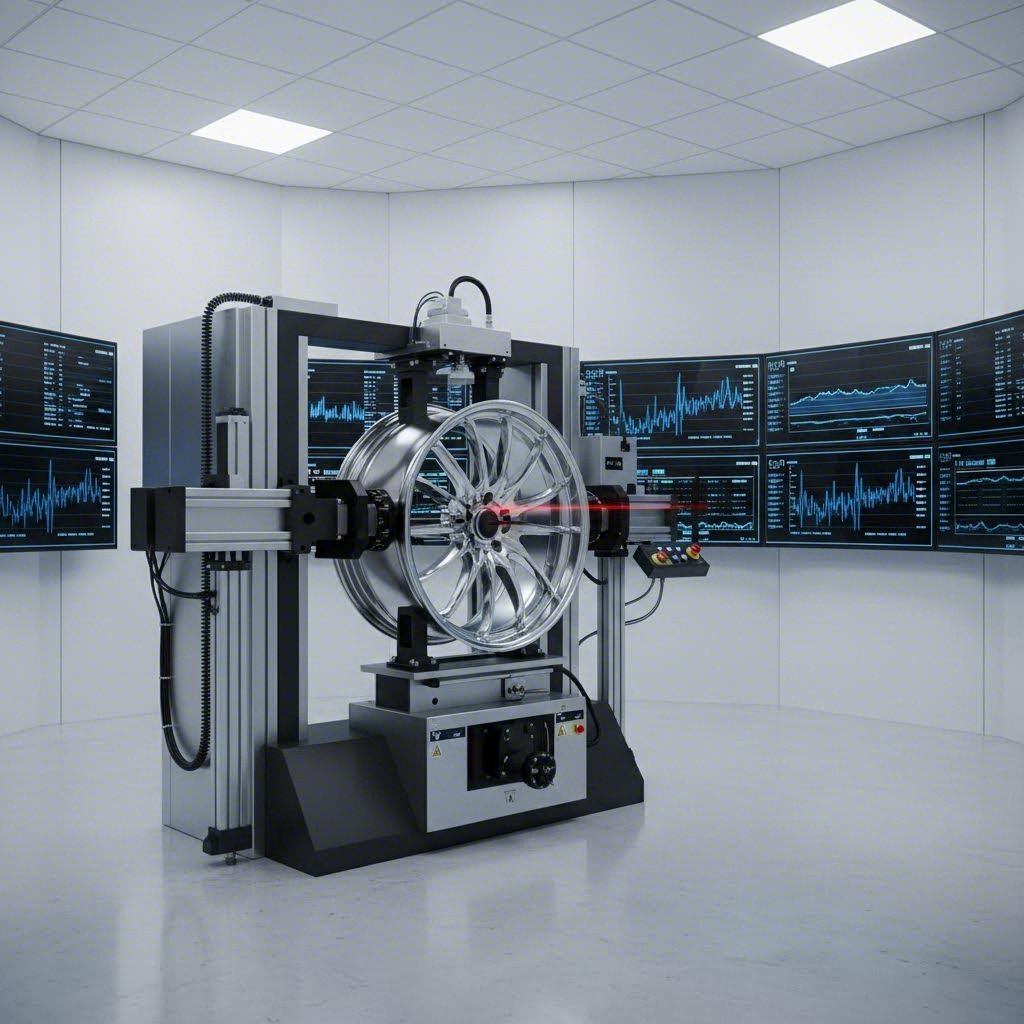
Beyond dimensional verification, structural integrity testing subjects wheels to conditions far exceeding normal service loads. According to JWL certification requirements, wheels must pass three primary fatigue tests to earn certification marks.
Dynamic cornering fatigue testing simulates the bending stresses experienced during aggressive cornering. The test wheel mounts to a rotating table while a moment arm applies constant force at the wheel's outer mounting pad. As published research on wheel fatigue testing explains, this test reproduces stress patterns very similar to actual cornering conditions. The wheel must complete specified rotation cycles—often hundreds of thousands—without developing cracks visible under dye penetrant inspection.
Dynamic radial fatigue testing positions the tire-wheel assembly against a rotating drum while applying constant radial load. This simulates the continuous loading experienced during straight-line driving. According to JWL standards, wheels must withstand a minimum of 400,000 test cycles without failure. Test parameters include specific tire pressures and loads calculated from maximum vehicle weight with safety margins applied.
Impact testing evaluates resistance to sudden shock loads, simulating pothole strikes or curb impacts. JWL standards specify a 13-degree impact test for passenger car wheels, with precise air pressure and striker weight requirements. According to JWL testing documentation, wheels pass if they sustain no air leaks or cracks, though bending without cracking is acceptable under JWL standards. The stricter JWL-T standard for truck wheels fails any wheel showing noticeable deformation.
SAE (Society of Automotive Engineers) certification follows similar testing philosophies with North American-specific requirements. Both SAE and JWL standards mandate that finished, production-representative wheels undergo testing—not pre-production samples or unfinished blanks. As JWL documentation specifically states, plated wheels must be tested after plating, not before, ensuring the complete manufacturing process is validated.
How do you evaluate manufacturer quality based on their process descriptions? Look for these indicators:
- Documented inspection frequencies: Quality manufacturers specify how often each test occurs—every piece, statistical sampling, or batch testing.
- Calibration programs: References to equipment calibration schedules indicate measurement accuracy is maintained over time.
- Traceability systems: The ability to trace any wheel back to its raw material batch, heat treatment lot, and inspection records demonstrates serious quality commitment.
- Third-party certifications: ISO 9001, IATF 16949, or NADCAP certifications require external audits verifying quality systems actually function as documented.
- Failure response protocols: Descriptions of how failed parts are handled, root causes investigated, and corrective actions implemented reveal whether quality is reactive or proactive.
The surveillance testing requirements within JWL certification add another verification layer. Even after initial registration, VIA (Vehicle Inspection Association) protocols specify ongoing surveillance tests. If any product fails surveillance testing, all products registered under that category must undergo complete retesting. This ongoing accountability ensures manufacturers maintain quality standards long after initial certification.
With quality verification complete and certification requirements satisfied, the manufacturing timeline and cost factors come into focus—understanding what drives pricing helps you evaluate whether quoted costs reflect genuine quality investments or simply inflated margins.
Manufacturing Timelines and Cost Considerations
You've followed the complete journey from raw aluminum billet through forging, heat treatment, precision machining, finishing, and quality testing. Now comes the question every buyer eventually asks: how long does this actually take, and why do custom forged wheels cost what they do? These practical considerations often remain the most opaque aspects of the manufacturing process, yet they directly impact your procurement decisions.
Whether you're sourcing forged wheels for trucks, evaluating various aftermarket wheel suppliers, or exploring premium options from specialized producers like martini works wheels, understanding timeline and cost drivers helps you distinguish genuine value from inflated pricing.
Manufacturing Timeline From Order to Delivery
The complete production cycle for custom forged wheels spans multiple weeks, with each manufacturing stage requiring dedicated time that cannot be compressed without sacrificing quality. Unlike off-the-shelf products sitting in warehouses, true custom manufacturing means your wheels don't exist until your order initiates production.
| Manufacturing Stage | Typical Duration | Key Activities |
|---|---|---|
| Design and Engineering | 3-7 days | CAD modeling, FEA simulation, fitment verification, customer approval |
| Material Procurement | 5-10 days | Billet ordering, incoming inspection, material certification verification |
| Forging Operations | 2-4 days | Billet preheating, forging press operations, blank inspection |
| Heat Treatment | 3-5 days | Solution treatment, quenching, artificial aging, hardness verification |
| CNC Machining | 5-8 days | Rough turning, finish machining, spoke profiling, bolt pattern drilling |
| Surface Finishing | 4-7 days | Surface preparation, coating application, curing, quality inspection |
| Quality Control and Testing | 2-3 days | Dimensional inspection, balance testing, certification verification |
| Packaging and Shipping | 2-5 days | Protective packaging, documentation, freight coordination |
The total timeline typically ranges from 6 to 12 weeks for standard custom orders. However, several factors influence where your project falls within this range:
- Design complexity: Intricate spoke patterns requiring extensive five-axis machining add days to the CNC stage. Simple designs with standard profiles process faster.
- Finish selection: Hand-brushed finishes requiring 8+ hours per wheel extend finishing timelines significantly compared to standard powder coat options.
- Order quantity: Larger production runs amortize setup times across more units, but the sheer volume of machining and finishing operations extends total lead time.
- Certification requirements: Orders requiring specific JWL or SAE testing add time for third-party laboratory scheduling and test completion.
Rapid prototyping capabilities can dramatically accelerate development cycles when time-to-market pressure intensifies. Manufacturers with in-house engineering capabilities and vertically integrated production can compress initial prototype delivery to remarkably short timeframes. For example, Shaoyi (Ningbo) Metal Technology offers rapid prototyping in as little as 10 days, leveraging their IATF 16949 certification to ensure quality remains uncompromised throughout accelerated timelines. This capability proves invaluable when evaluating fitment, aesthetics, or structural performance before committing to full production runs.
Cost Factors That Impact Custom Wheel Pricing
Why do custom forged wheels command premium pricing? According to industry analysis on forged wheel value, the forged wheel price reflects not only the material and manufacturing process, but also the combination of superior performance, safety, and customization capabilities that simply cannot be replicated at lower price points.
The cost structure breaks down across several major categories:
- Raw material costs (15-20% of total): Aerospace-grade 6061-T6 aluminum billets cost significantly more than casting alloys. The premium pays for certified material with guaranteed composition and traceability.
- Forging operations (20-25% of total): High-tonnage forging presses represent multi-million dollar capital investments. Operating costs include die maintenance, energy consumption, and skilled operator labor. According to Apex wheel manufacturing documentation, specialized motorsports dies designed by in-house engineers allow superior brake clearance and spoke designs—but these custom dies add tooling costs that generic blanks avoid.
- Heat treatment (5-10% of total): Precision furnace operations with strict temperature control and documentation add costs beyond simple batch processing.
- CNC machining (25-35% of total): This stage often represents the largest cost component. Complex spoke designs can require 6 or more hours of machining per wheel on five-axis CNC centers. Machine time rates for precision equipment easily exceed $150-200 per hour in developed markets.
- Finishing operations (10-15% of total): Multi-stage coating processes, hand-applied finishes, and quality inspections accumulate significant labor costs. Premium finishes like hand-brushed treatments command substantial upcharges reflecting their labor intensity.
- Quality control and certification (5-10% of total): Third-party testing, documentation systems, and the occasional scrapped wheel that fails inspection all factor into final pricing.
What manufacturing decisions most impact final wheel pricing? Several factors create substantial cost differences between seemingly similar products:
- Blank sourcing: Manufacturers utilizing generic off-the-shelf forging blanks save on die development costs but sacrifice design flexibility and optimized performance characteristics.
- Machining depth: Extensive side-milling to create I-beam spoke profiles removes weight without compromising strength, but adds hours of machine time per wheel.
- Testing rigor: As premium manufacturers emphasize, the wheel industry in the US is completely unregulated—brands can sell wheels without satisfying any safety regulations or make performance claims without proof. Manufacturers who invest in actual third-party testing incur costs that corner-cutting competitors avoid.
- Production location: Labor rates, facility costs, and regulatory compliance requirements vary dramatically by region. Manufacturers near major shipping ports—like facilities strategically located near Ningbo Port—can offer logistics advantages for global delivery.
The value proposition becomes clearer when you consider what forged wheels deliver: approximately 32% weight reduction compared to equivalent cast wheels, superior impact resistance, extended fatigue life, and customization options that mass-produced alternatives cannot match. For performance applications, racing environments, or heavy-duty truck use, these advantages often justify the premium investment.
Understanding these timeline and cost factors positions you to evaluate manufacturer quotes intelligently. Suspiciously low prices typically indicate compromises somewhere—whether in material quality, testing rigor, or machining precision. Conversely, inflated quotes without corresponding quality investments simply extract margin without delivering proportional value.
With manufacturing timelines and cost structures now demystified, the final consideration becomes selecting the right manufacturing partner—one whose capabilities, certifications, and quality systems align with your specific requirements.
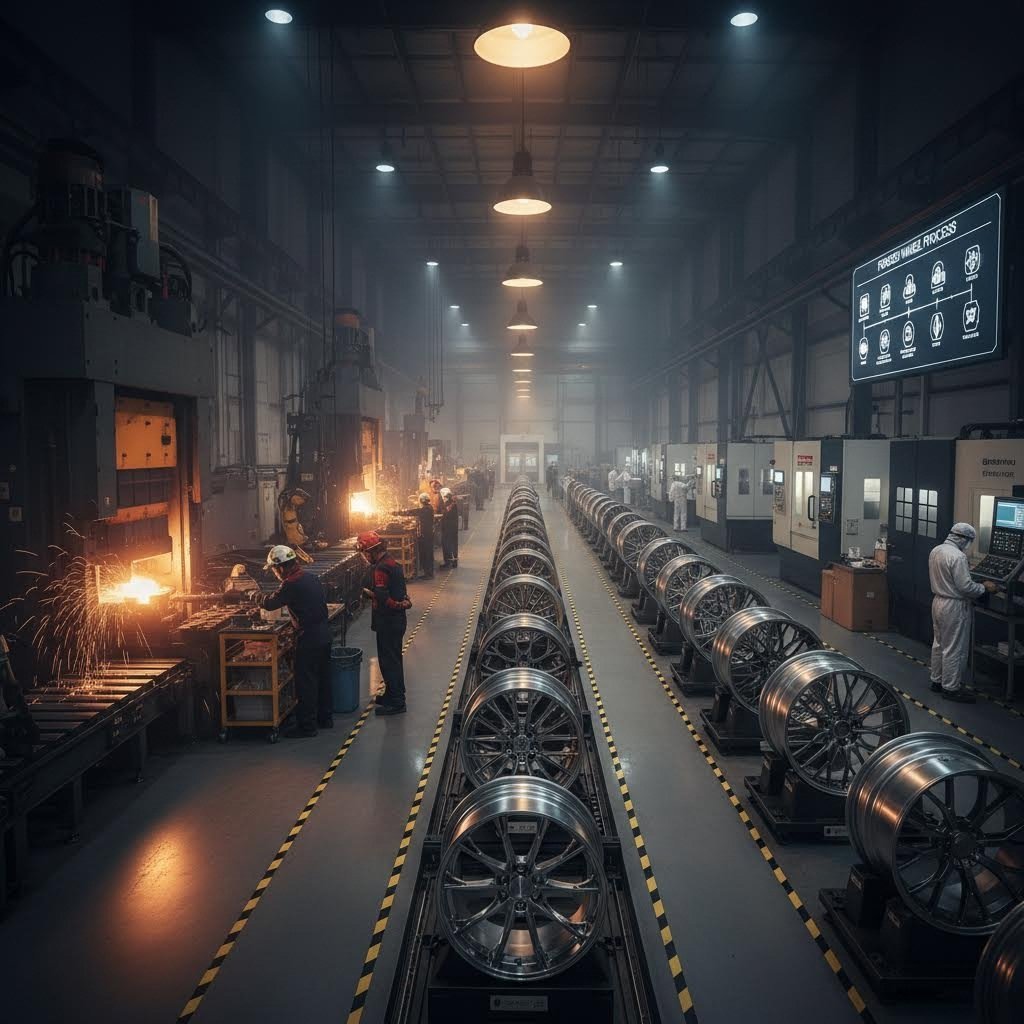
Selecting the Right Custom Forged Wheel Manufacturer
You now understand the complete journey from aluminum billet to finished forged wheel—the forging pressures, heat treatment cycles, precision machining tolerances, and rigorous testing protocols that separate exceptional wheels from mediocre ones. But here's the challenge: how do you translate this manufacturing knowledge into selecting a partner who actually delivers on these quality expectations?
The custom forged wheel market includes manufacturers spanning the full quality spectrum. Some invest heavily in equipment, certifications, and testing. Others cut corners wherever margins allow. Your ability to distinguish between them determines whether you receive wheels that perform flawlessly for years or components that fail when you need them most.
Key Questions to Ask Your Wheel Manufacturer
Armed with manufacturing process knowledge, you can now ask questions that reveal whether a supplier genuinely controls quality or simply claims to. Consider these critical inquiries during your evaluation:
- What aluminum alloy grade do you use, and can you provide material certifications? Quality manufacturers readily provide documentation tracing billets to certified mills. Vague answers about "aerospace-grade aluminum" without supporting paperwork suggest inadequate material controls.
- What forging press tonnage do you utilize? As you learned, press capacity directly affects grain refinement and structural integrity. Manufacturers should specify their equipment capabilities—presses in the 8,000 to 10,000+ ton range indicate serious investment in forging infrastructure.
- Can you describe your heat treatment process and verification methods? Look for specific answers about solution treatment temperatures, quench timing, and aging parameters. Hardness testing documentation demonstrates actual verification rather than assumed compliance.
- What CNC equipment do you use for machining? Multi-axis machining centers from recognized manufacturers (DMG Mori, Mazak, Haas) capable of holding tight tolerances indicate precision capabilities. Ask about measurement systems verifying dimensional accuracy.
- What certifications does your facility hold? According to industry certification standards, reputable manufacturers should hold multiple relevant certifications demonstrating commitment to quality, safety, and industry norms.
- What testing do finished wheels undergo? Specific references to JWL dynamic cornering tests, radial fatigue testing, and impact testing with quantified parameters indicate thorough validation. Generic claims about "rigorous testing" without details warrant skepticism.
- Can you provide traceability for any wheel back to its raw material batch? Complete traceability systems demonstrate mature quality management. This capability proves essential if warranty issues ever arise.
The depth and specificity of answers tell you as much as the answers themselves. Manufacturers confident in their processes welcome detailed inquiries. Those deflecting technical questions likely have something to hide.
Evaluating Manufacturing Excellence in Potential Partners
Beyond individual questions, systematic evaluation criteria help you compare potential suppliers objectively. Consider these factors when assessing manufacturer capabilities:
- Certification portfolio: According to certification requirements for reliable manufacturers, key certifications include ISO 9001 for quality management systems, IATF 16949:2016 for automotive industry suppliers, JWL/JWL-T for wheel safety standards, VIA for independent third-party testing verification, and TÜV for European market acceptance. IATF 16949 certification proves particularly valuable because it covers the entire production process, ensuring high-quality standards at every stage with focus on continuous improvement and defect prevention.
- Equipment capabilities: Vertical integration—owning forging presses, heat treatment furnaces, CNC machining centers, and finishing lines—indicates control over the complete manufacturing chain. Outsourcing critical stages introduces quality variability.
- Quality control infrastructure: Dedicated inspection equipment including coordinate measuring machines, hardness testers, dynamic balancing equipment, and surface analysis tools demonstrates investment in verification rather than assumption.
- Engineering expertise: In-house engineering teams capable of FEA analysis, custom die design, and application-specific optimization differentiate serious manufacturers from simple job shops machining generic blanks.
- Testing documentation: As industry experts emphasize, reputable manufacturers conduct rigorous testing including load simulation, concentricity tests, and dimensional checks using Finite Element Method analysis. They should willingly provide certifications from JWL VIA, TUV, DOT, SAE, and other relevant bodies.
- Production capacity and lead times: Manufacturers with sufficient capacity to meet your timeline requirements without rushed production that compromises quality. Rapid prototyping capabilities—some facilities offer prototypes in as little as 10 days—demonstrate engineering agility.
- Geographic considerations: Proximity to major shipping ports facilitates efficient global delivery. Strategic locations near logistics hubs like Ningbo Port reduce transit times and shipping costs for international orders.
For organizations seeking a manufacturing partner demonstrating these capabilities, Shaoyi (Ningbo) Metal Technology exemplifies the qualification criteria discussed throughout this guide. Their IATF 16949 certification ensures automotive-grade quality systems govern every production stage. Their precision hot forging solutions extend beyond wheels to demanding components like suspension arms and drive shafts—applications requiring the same metallurgical excellence and dimensional precision that premium forged wheels demand. The strategic location near Ningbo Port enables streamlined global delivery, while in-house engineering supports rapid prototyping when accelerated timelines are essential.
Environmental and Sustainability Considerations
Modern manufacturing responsibility extends beyond product quality to environmental stewardship. When evaluating forged wheel manufacturers, consider their sustainability practices:
- Material efficiency: Forging inherently generates less waste than casting, but leading manufacturers optimize billet sizing and recycle machining chips through certified aluminum recyclers.
- Energy consumption: Modern forging presses with regenerative systems recover energy during the return stroke. Heat treatment furnaces with efficient insulation and heat recovery reduce energy intensity per wheel produced.
- Coating systems: Powder coating generates near-zero volatile organic compounds compared to traditional liquid paints. Water-based cleaning and pretreatment systems minimize chemical waste streams.
- Facility certifications: ISO 14001 environmental management certification indicates systematic approaches to minimizing environmental impact throughout operations.
These considerations increasingly influence procurement decisions as organizations face sustainability reporting requirements and customer expectations for responsible sourcing.
Bringing It All Together
The custom forged wheel manufacturing journey you've explored—from aerospace-grade aluminum selection through 10,000-ton forging operations, precise T6 heat treatment, micron-level CNC machining, protective finishing, and comprehensive quality testing—represents an extraordinary convergence of metallurgical science and manufacturing precision.
Each stage builds upon the previous, and compromises anywhere in the chain diminish the final product. This is why manufacturer selection matters profoundly. A supplier who sources questionable billets, skips heat treatment verification, or avoids third-party testing cannot deliver wheels worthy of your vehicle or your trust—regardless of how impressive their marketing appears.
You now possess the knowledge to evaluate manufacturers on substance rather than claims. Ask the detailed questions. Request the documentation. Verify the certifications. The manufacturers who welcome this scrutiny are precisely the partners who deliver wheels that perform as promised, year after year, mile after mile.
Whether you're building a track-focused performance machine, upgrading a luxury vehicle, or specifying wheels for demanding commercial applications, the manufacturing excellence behind custom forged wheels justifies the investment. Choose your manufacturing partner with the same precision they should apply to creating your wheels.
Frequently Asked Questions About Custom Forged Wheel Manufacturing
1. How are forged wheels made?
Forged wheels are made through a multi-stage process starting with aerospace-grade 6061-T6 aluminum billets heated to 350-500°C. The heated billet enters a forging press capable of producing up to 10,000 tons of pressure, which compresses and shapes the metal while aligning its grain structure. After forging, the wheel blank undergoes T6 heat treatment including solution treatment at 530°C, rapid quenching, and artificial aging at 175°C for approximately 8 hours. Precision CNC machining then creates the final wheel profile, spoke patterns, bolt patterns, and hub bores. Surface finishing with powder coating or polishing provides protection and aesthetics, followed by rigorous quality testing including dynamic fatigue and impact tests.
2. What is the difference between cast and forged wheels?
Cast wheels are made by pouring molten aluminum into molds where it cools and solidifies, often resulting in random grain structures with internal porosity and weak points. Forged wheels start as solid aluminum billets subjected to extreme heat and pressure, creating a dense, uniform grain structure aligned along stress paths. This fundamental manufacturing difference gives forged wheels approximately 32% weight reduction compared to cast wheels of equivalent strength, superior impact resistance, and significantly better fatigue life. While cast wheels are more affordable, forged wheels deliver unmatched performance for demanding applications like racing and high-performance driving.
3. Why are forged wheels more expensive than other wheel types?
Forged wheel pricing reflects substantial investments across every manufacturing stage. Raw aerospace-grade 6061-T6 aluminum costs significantly more than casting alloys. Forging operations require multi-million dollar high-tonnage presses and specialized dies. CNC machining often represents 25-35% of total cost, with complex spoke designs requiring 6+ hours of machine time per wheel on five-axis centers charging $150-200 per hour. Premium finishes like hand-brushed treatments add labor-intensive processes. Quality control including third-party JWL and SAE certification testing adds verification costs that budget manufacturers avoid. The result is wheels with superior strength-to-weight ratios, customization options, and long-term durability that mass-produced alternatives cannot match.
4. What certifications should a forged wheel manufacturer have?
Reputable forged wheel manufacturers should hold multiple certifications demonstrating quality commitment. IATF 16949:2016 certification is particularly valuable for automotive applications, covering the entire production process with focus on continuous improvement and defect prevention. ISO 9001 establishes quality management system foundations. JWL and JWL-T certifications verify wheels pass dynamic cornering fatigue, radial fatigue, and impact tests per Japanese standards. VIA certification confirms independent third-party testing verification. TÜV certification enables European market acceptance. Manufacturers like Shaoyi (Ningbo) Metal Technology hold IATF 16949 certification, ensuring automotive-grade quality systems govern every production stage from rapid prototyping through mass production.
5. How long does it take to manufacture custom forged wheels?
Complete custom forged wheel manufacturing typically spans 6 to 12 weeks depending on complexity and specifications. The timeline includes design and engineering (3-7 days), material procurement (5-10 days), forging operations (2-4 days), heat treatment (3-5 days), CNC machining (5-8 days), surface finishing (4-7 days), quality control testing (2-3 days), and packaging with shipping (2-5 days). Factors extending timelines include intricate spoke patterns, hand-brushed finishes requiring 8+ hours per wheel, larger order quantities, and specific certification requirements. Some manufacturers offer rapid prototyping capabilities in as little as 10 days for initial samples before committing to full production runs.