 Small batches, high standards. Our rapid prototyping service makes validation faster and easier —
  EN
EN


Automechanika Frankfurt 2026: Five Questions Buyers Asked in Hall 4.2
Automechanika Frankfurt 2026: Five Questions Buyers Asked in Hall 4.2
Automechanika Frankfurt ran from 8 to 12 September 2026, and Shaoyi spent those five days in Hall 4.2, Stand M31. This is not a photo diary. We brought twelve stamped samples to the stand and let them start the conversation, and by the end of the week the same five questions had come up again and again. They are worth writing down, because what buyers ask at a stand says more about the state of component sourcing than most market reports do.
Why a Component Manufacturer Books a Stand in Frankfurt
Automechanika Frankfurt runs every two years at Messe Frankfurt and remains the largest meeting point in the automotive aftermarket and supply chain. The 2026 edition brought more than 4,400 exhibitors from over 80 countries, around five percent more than the previous edition, in a year that has not been easy for the industry. The 2024 show drew over 107,000 visitors from 172 countries.
For a parts manufacturer, the value of the show is compression. A supplier evaluation that normally takes three months of emails, sample shipments and video calls happens in twenty minutes, because the part is in the buyer's hand and the people who made it are standing next to it. No PDF replaces a quality engineer turning a stamped bracket over and looking at the edge condition and the burr side.
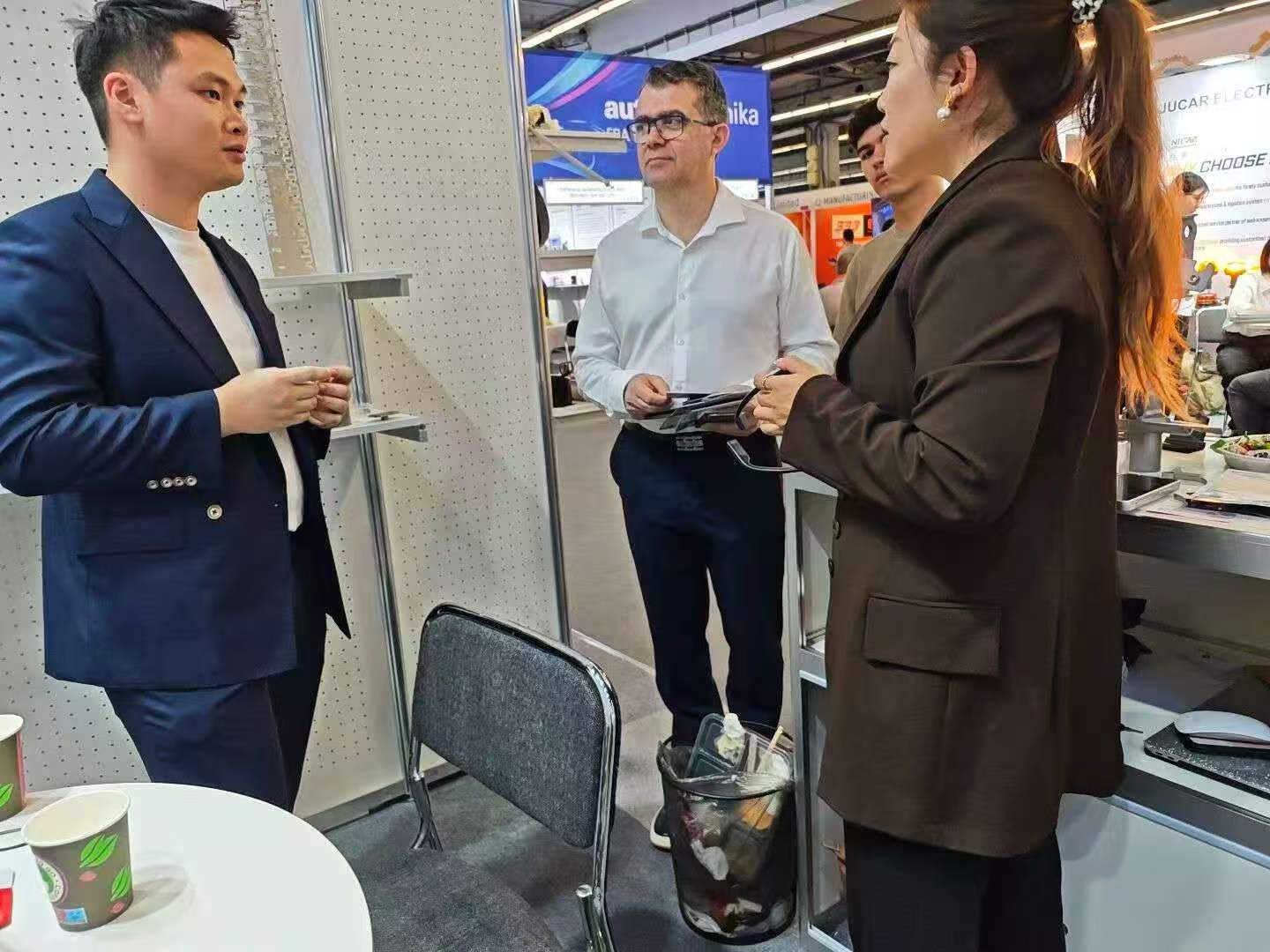
Stand M31, Hall 4.2, Automechanika Frankfurt 2026.
Hall 4.2: Where the Conversation Starts at Material Grade
The fairground is organised by subject, and Halls 1, 3 and 4 hold Parts & Components, traditionally around half of the total exhibition space. This is the chassis, suspension, braking and driveline neighbourhood, which is exactly where our parts belong.
It changes who walks up to the stand. Visitors in this hall are buyers, quality engineers and product engineers. Nobody asked what stamping is. They asked about material grade, thickness, hole position after forming, die ownership and PPAP. Very few conversations stayed at the marketing level for more than a minute.
What We Put on the Table
Twelve samples travelled to Frankfurt with us, chosen to cover the range rather than to look impressive: from 0.8 mm precision parts to 3.5 mm control arm stampings, from deep-drawn spring seats to welded and machined assemblies.
|
Sample |
Typical application |
Material grade |
Thickness |
Key operations |
|
Shock absorber spring seat |
Shock absorber |
DC04 / DD13 |
1.8 mm |
Deep drawing, forming, flanging, restrike |
|
Shock absorber mounting plate |
Shock absorber assembly |
DC04 / S355MC |
2.6 mm |
Piercing, forming, flanging |
|
Shock absorber bracket |
Shock absorber / suspension |
S420MC / S460MC |
2.5 mm |
Piercing, bending, forming |
|
Chassis bracket |
Chassis structure |
S420MC / S460MC |
2.6 mm |
Multi-station stamping, bending, stiffening ribs |
|
Control arm stamping |
Suspension |
S420MC / S460MC |
3.5 mm |
Forming, piercing, flanging |
|
Small precision stamping |
Precision automotive part |
DC01 / DC04 |
0.8 mm |
High-speed piercing, precision forming |
|
High-strength steel bracket |
Chassis / body |
DP600 / S500MC |
1.6 mm |
High-strength steel forming, piercing |
|
Heat shield |
Exhaust / underbody |
SUS430 / DC04 |
0.85 mm |
Deep drawing, forming, flanging |
|
Retainer plate |
Shock absorber / chassis |
DC04 / C45 |
1.5 mm |
Piercing, forming, bending |
|
Small mounting bracket |
Automotive mounting |
DC01 / S355MC |
1.85 mm |
Piercing, bending, flanging |
|
Welded stamping assembly |
Chassis / shock absorber |
S355MC / S420MC |
2.3 mm |
Stamping and welding |
|
Stamping and CNC assembly |
Chassis / suspension |
S420MC / C45 |
2.0 mm |
Stamping, CNC machining, welding |
Six of them — the spring seat, chassis bracket, precision part, high-strength bracket, small mounting bracket and welded assembly — came with the progressive strip laid out beside the finished part.
That choice was deliberate. A finished part shows what a supplier can deliver; a strip shows how it thinks. The strip tells an engineer where the piercing stations sit relative to the forming stations, how the carrier is arranged, how much material goes into the part and how much goes into scrap. Several visitors spent longer on the strips than on the parts, which is usually the sign of a serious buyer.
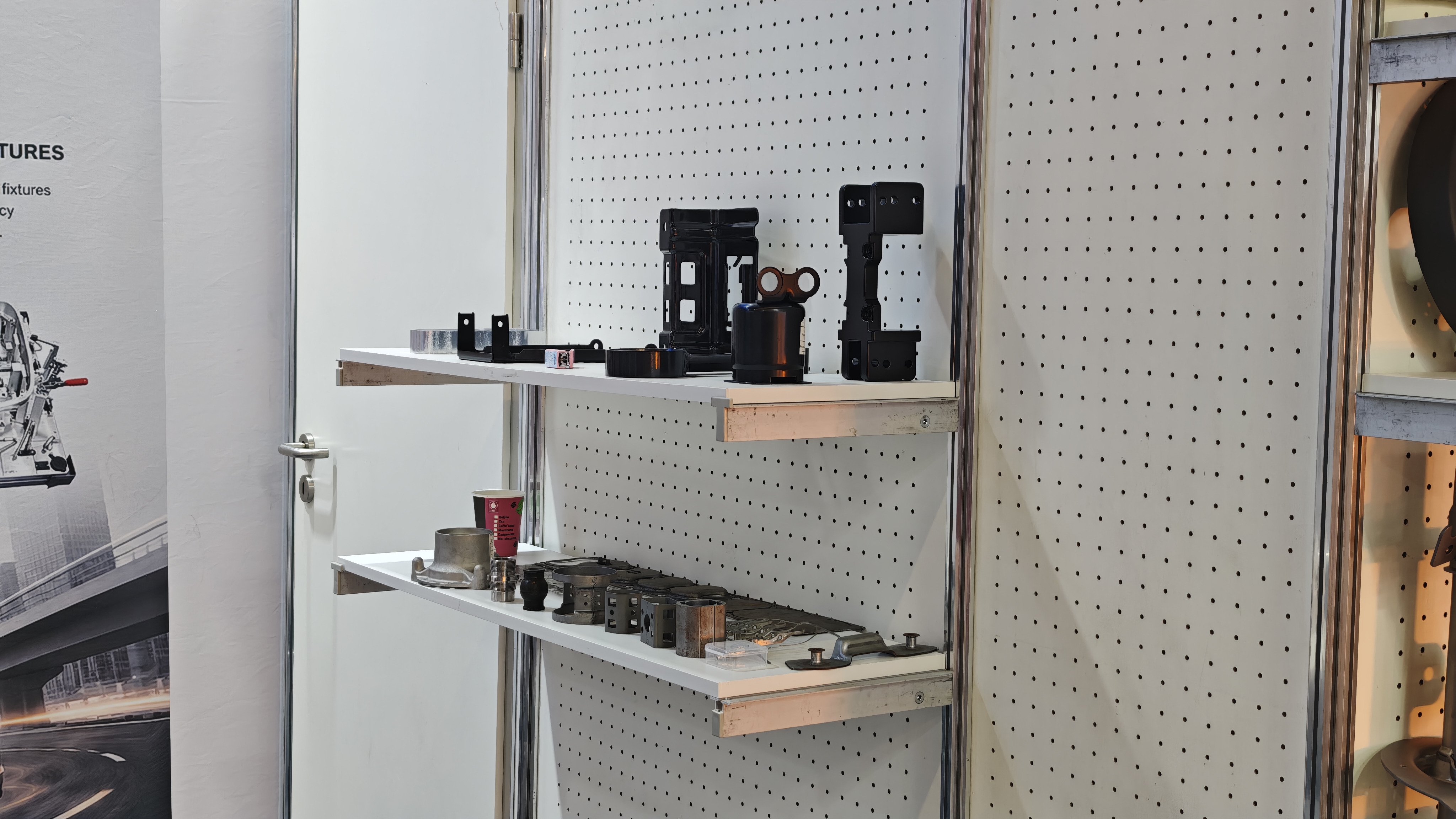 Progressive strip beside the finished part: station sequence, carrier design and material utilisation, visible at a glance.
The Five Questions
1. What kind of parts do you manufacture?
Automotive metal parts, and specifically stamped parts for chassis, suspension and shock absorber applications. We also design and build the progressive dies in-house, so a programme can run with one supplier from tooling development through to mass production.
The samples on the table were the short answer to this question. They map to the three areas we actually live in, rather than to a catalogue of everything a press can theoretically make.
2. Do you make the dies in-house?
Yes. Progressive dies are designed and built by our own tooling team, and we control tryout, modification and final validation ourselves.
The reason this matters is not lead time, although that improves too. It is that the die and the stamping process can be optimised together instead of being treated as two separate projects. When tooling comes from an outside tool room, a forming problem found at tryout becomes a negotiation between two companies. When the die was designed in the same building that runs the press, it becomes a correction.
3. What materials and thicknesses can you stamp?
A range of automotive sheet materials: low-carbon steel, high-strength steel, and selected stainless and aluminium grades. For typical automotive stamping our thickness range runs from roughly 0.6 to 4.0 mm, depending on grade, part geometry and forming process. For a specific RFQ, material and thickness are confirmed during the tooling feasibility analysis.
The samples we brought show what that range means in practice: 0.8 mm DC01 precision parts at one end, 3.5 mm S460MC control arm stampings at the other, and a 0.85 mm SUS430 heat shield in between.
4. What is your MOQ?
There is no fixed MOQ. We support prototype, small-batch and mass-production work.
The more useful question is which process suits the volume. At low volumes, tooling amortisation dominates the piece price, so a simpler die makes more sense. At higher volumes, progressive tooling and automated feeding bring the piece cost down far enough to justify the tooling investment. That trade-off belongs in the feasibility analysis, not in an afterthought.
5. How do you control quality?
We operate under an IATF 16949 quality management system. New projects follow APQP and PPAP, with FMEA, control plans and process monitoring according to the project requirements. Dimensional inspection uses CMM and other equipment depending on the part. Before mass production we validate both the tooling and the production process, so the process is stable from the first production lot.
A Case We Walked Through Several Times at the Stand
Every stand at Automechanika claims precision and reliability. What a buyer can actually use is a specific problem and how it was solved. When visitors asked whether we had built a shock absorber upper mounting plate before, this is the story we told.
The part was made from high-strength steel, and the local forming area carried relatively high deformation. During the first tooling tryout, cracking appeared around a formed radius.
The quick answer would have been to change to a more formable grade. We analysed the forming process first and found that material flow around the raised section was not balanced. So instead of changing the material, we optimised the forming radius and adjusted the material-flow control and blank-holder force. The cracking was solved.
That revealed the next issue: springback on the mounting surface, which affected the dimensional stability of the part. We added a final restrike and calibration operation to control the critical mounting area and stabilise the dimensions.
The point of telling this story at a trade stand is not the fix itself. It is the sequence. For this kind of part, our approach is not to modify the die after a problem appears. It is to identify the forming risks during die design, using forming analysis and stamping experience, and to optimise the forming sequence before mass production. Tryout will always find something; the aim is that it only finds small things.
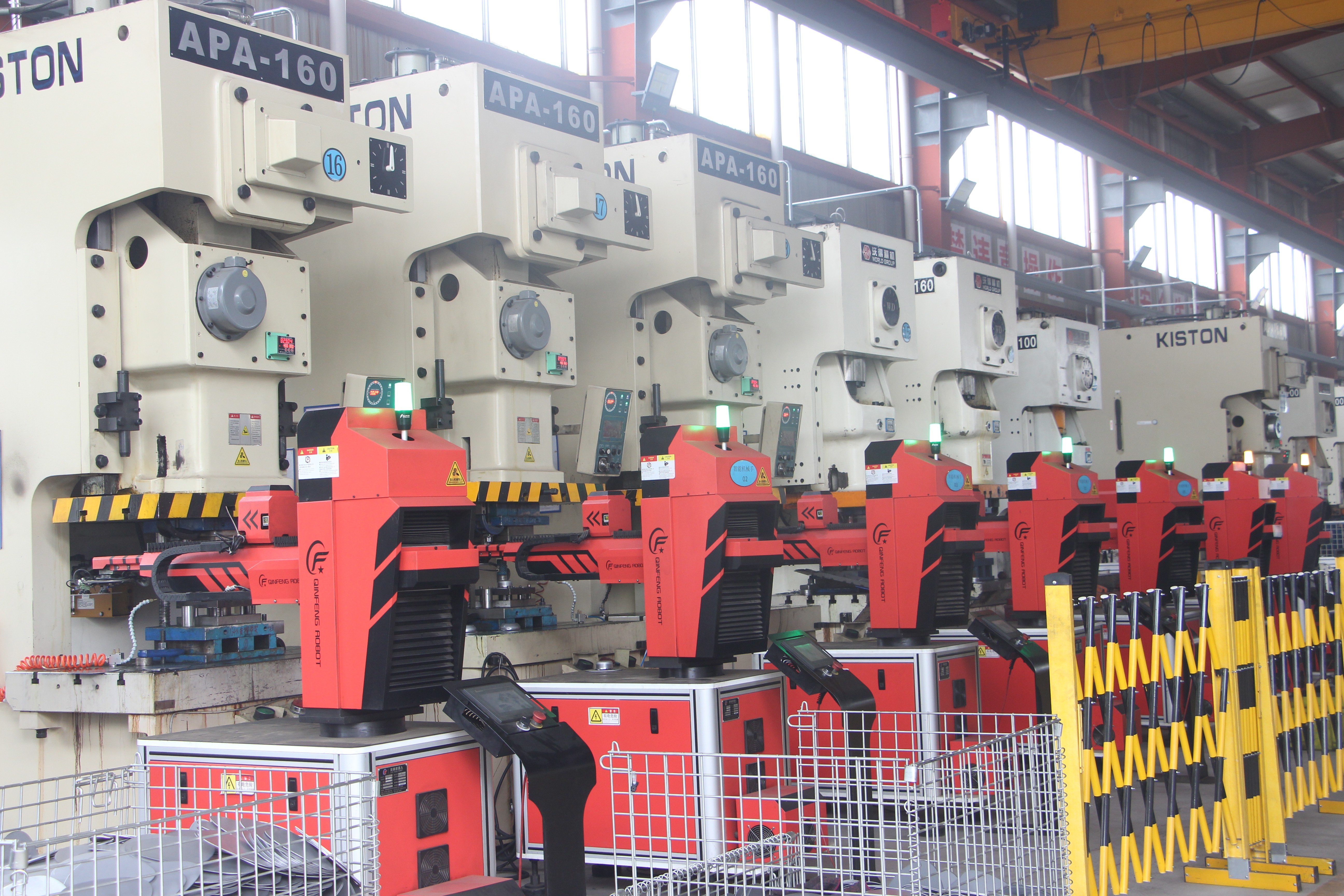
Forming risks are identified at die design; tryout confirms them rather than discovering them.
What Those Five Questions Have in Common
Only one of the five was about capacity. The other four were about risk.
Tooling has become the risk buyers worry about first. The die question came up before price in most conversations. A tool that arrives late, or that needs three rounds of correction through a third party, delays a programme in a way that no piece-price difference recovers.
High-strength steel is now the default rather than the exception. Half the samples we brought are S420MC, S460MC, S500MC or DP600. Buyers asked about cracking, springback and die wear as routine questions, not special cases, which is what happens when lightweighting targets and load requirements land on the same bracket.
Volume flexibility is expected upfront. Buyers wanted to know that prototype and validation batches would be accepted, and that the process route could change as volume grows. Nobody wanted to commit to hard tooling before design and process validation were behind them.
If We Did Not Get to Talk in Frankfurt
If you design or buy stamped metal parts for chassis, suspension, shock absorber or body applications — for passenger cars, commercial vehicles or EV platforms — send your 2D/3D drawing to [email protected] or use the quote form on our website. You will get a tooling feasibility analysis and a quotation back, and we sign an NDA before any file is shared.
If a factory visit is not realistic this year, we can arrange a live video walkthrough of the press lines, tool room and inspection area instead.
The next Automechanika Frankfurt takes place from 5 to 9 September 2028. We expect to be there. We would rather talk before then.
Written by: Nansen
Reviewed by: Nansen, Business Manager
Last updated: 21/9/2026